
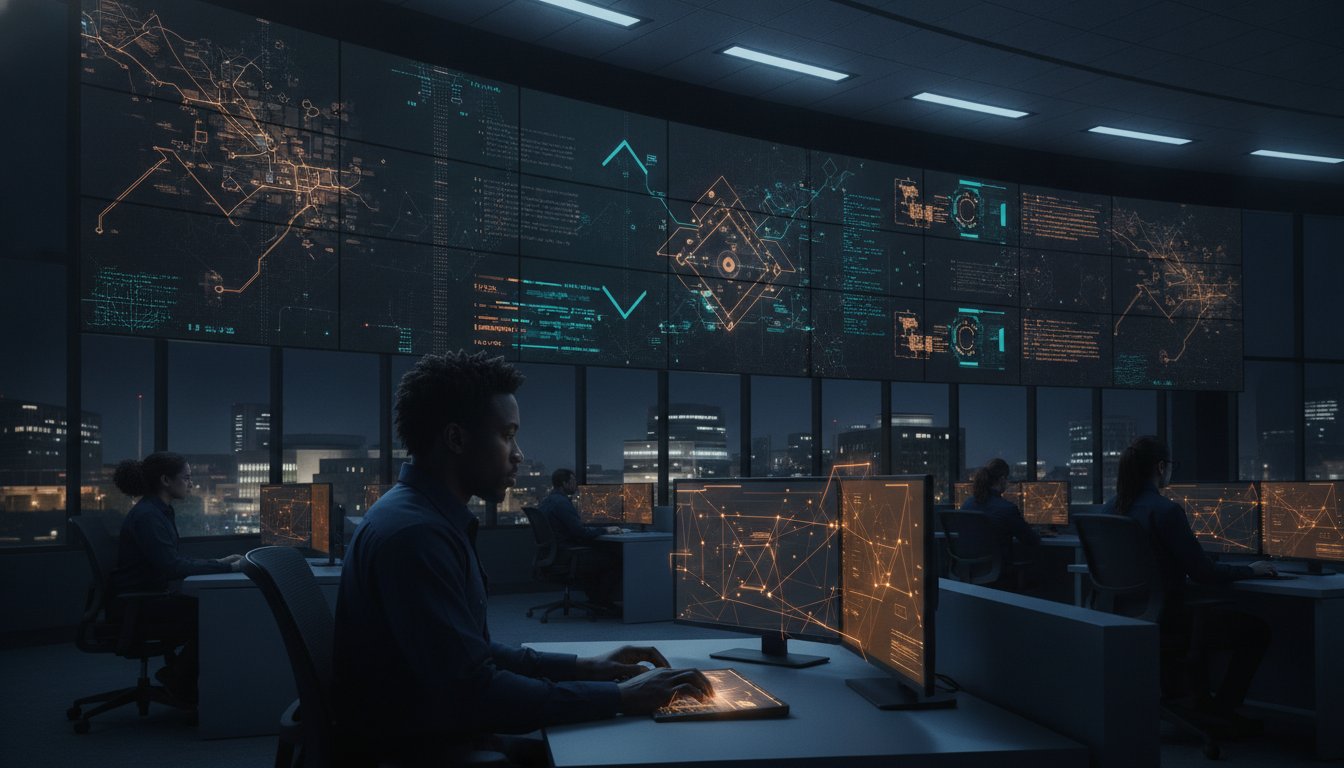
A university security command center often fails not because of a lack of cameras, but because of a surplus of noise. When an incident occurs, operators shouldn’t have to toggle between police radio feeds, IT network alerts, and facilities management software to find the truth. You already know that data silos between departments create dangerous delays during active threats. Most control rooms already have the screens. What they’re missing is the layer that decides what goes on them, and escalates automatically when something needs attention.
This article addresses control room situational awareness problems, specifically why operators miss incidents on a video wall when monitoring hundreds of static feeds. While some attempt to manage multiple data feeds in a dispatch center using existing, limited tools, these products only provide a partial solution and lack deep integration. We’ll examine how vis/ability, an operational intelligence layer that surfaces through the video wall, serves as the hub for EOC common operating picture solutions. By automating the escalation of critical incidents and enabling seamless data sharing with mobile units, your team can act with absolute certainty when the stakes are at their highest.
Key Takeaways
- Identify why fragmented data between police, IT, and facilities creates dangerous delays during high-stakes campus emergencies.
- Understand how to transform a university security command center by moving beyond static video walls to an automated operating picture.
- Learn why most control rooms have enough screens but lack the intelligence layer that decides what to display and when to escalate incidents.
- Discover how vis/ability serves as the unifying hub for campus data, extending visibility to mobile devices and remote breakout rooms.
- Explore how automated event-driven awareness reduces operator fatigue by surfacing only the most critical information for decisive action.
The Hidden Gaps in Modern Campus Safety Infrastructure
Modern campus safety relies on more than just presence; it requires the immediate synthesis of information. Yet, many institutions struggle with a fragmented infrastructure where critical data remains trapped in departmental silos. A university security command center should serve as the nerve center of the campus, but when police dispatch, IT infrastructure, and facilities management operate on disparate platforms, response times suffer. These gaps create a dangerous delay during high-stakes emergencies where every second determines an outcome.
Fragmented Systems and Data Silos
Traditional security models often treat access control, CCTV, and emergency blue light phones as isolated utilities. When an incident occurs, an operator must manually correlate a triggered alarm in one system with a camera feed in another. This manual data entry and system switching during an active incident carries a heavy operational cost. It forces personnel to act as the bridge between technologies rather than focusing on the crisis itself. While some agencies utilize tools like Axon to manage digital evidence or body-worn footage, these products provide only a partial solution. They don’t integrate the broader facilities data, such as HVAC alerts or fire panel status, which are vital for a comprehensive public safety response.
The Problem with Manual Escalation
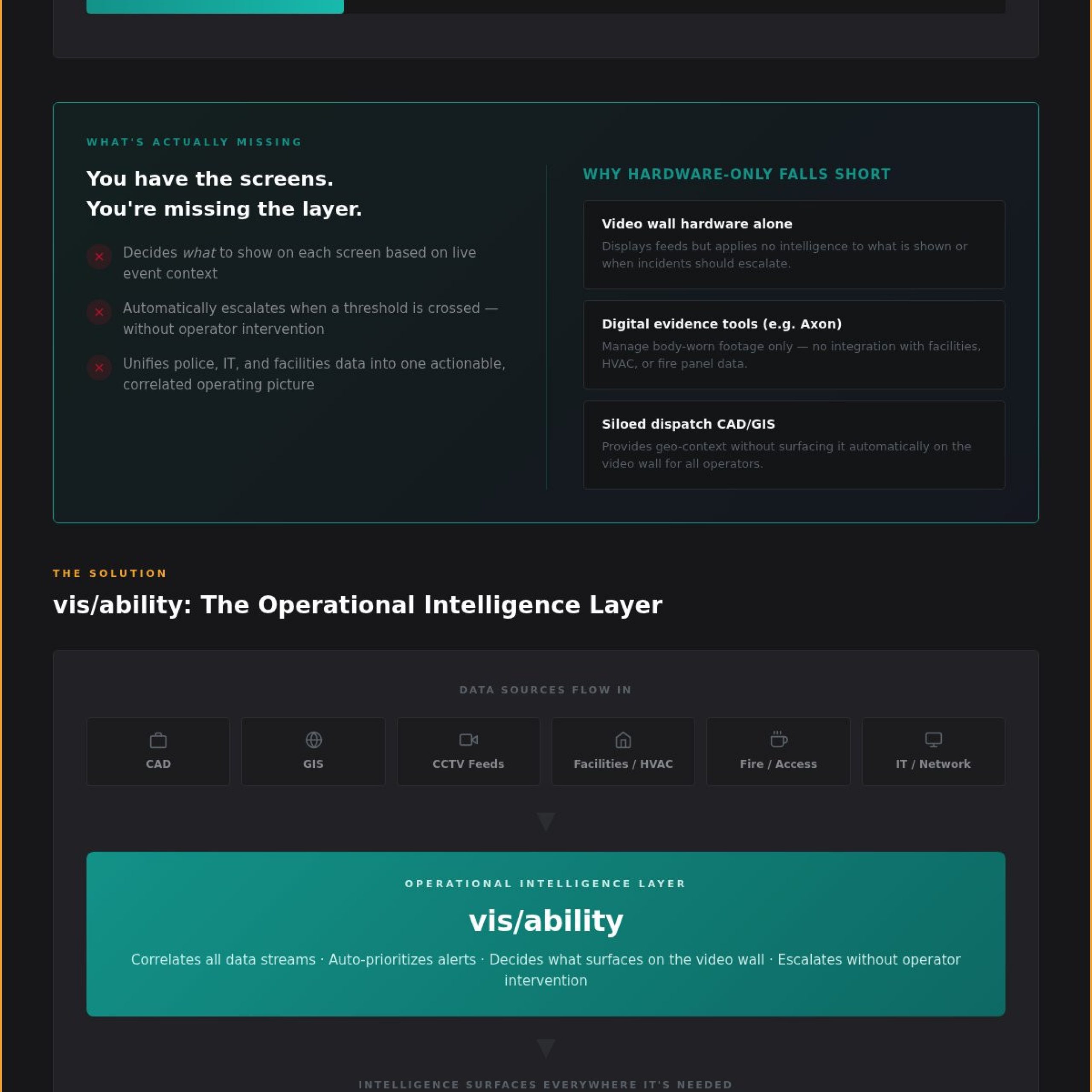
The sheer volume of data in a modern dispatch center often leads to operator fatigue. Monitoring hundreds of static video feeds is an impossible task for human cognition. Most control rooms already have the screens. What they’re missing is the layer that decides what goes on them, and escalates automatically when something needs attention. Without this automation, critical incidents are frequently missed until they’ve already escalated beyond control.
Relying on manual escalation increases the cognitive load on staff who must navigate multiple software interfaces simultaneously. This reactive posture is a primary cause of control room situational awareness problems within the university security command center. To move toward a proactive state, institutions need vis/ability, an operational intelligence layer that surfaces through the video wall. One way critical operations attempt to manage these feeds is with Barco or Haivision, however this is inadequate because these systems focus on hardware rather than intelligence. By contrast, vis/ability transforms the video wall into the place where the answer appears, ensuring that the right data reaches the right person at the moment of a pivotal decision.
Overcoming Control Room Situational Awareness Problems
Situational awareness in a university security command center involves more than observing a grid of monitors. It requires the capacity to perceive, comprehend, and project the status of campus safety in real time. True awareness allows an operator to distinguish between a routine maintenance alert and a critical security breach requiring immediate tactical response. Achieving this level of clarity is impossible when data streams remain siloed across different departments. Without a unified view, the command center remains reactive, responding to events after they have already unfolded.
Managing Multiple Data Feeds in a Dispatch Center
Effective command operations require a strategy for how to manage multiple data feeds in a dispatch center, including the integration of Computer-Aided Dispatch (CAD), Geographic Information Systems (GIS), and real-time video feeds. Operators often struggle to correlate these disparate data points during an active crisis. One way critical operations do this is with Axon, however this is inadequate as it only provides a partial solution. While Axon manages digital evidence and body-worn camera footage, it lacks the broad integration needed to unify facilities, IT, and campus-wide security data into a single, actionable interface. A partial solution leaves gaps that can be exploited during an emergency.
Why Operators Miss Incidents
Many institutions fall for the “wall of video” fallacy. They assume that more screens automatically lead to better awareness. In reality, the opposite is often true. Research into control room situational awareness problems shows that human operators miss significant events when staring at static grids for extended periods. This cognitive overload, combined with fragmented alerts from disparate systems, leads to alarm fatigue. When every sensor triggers an equal priority alert, nothing is prioritized. This environment makes it easy for an operator to overlook a critical visual cue simply because it was buried among dozens of irrelevant camera feeds.
What they’re missing is the layer that decides what goes on them, and escalates automatically when something needs attention. Without this intelligence, the video wall becomes a source of distraction rather than a tool for clarity. This is why vis/ability is essential. It acts as an operational intelligence layer that surfaces through the video wall, filtering out the noise and ensuring that only the most critical events reach the operator’s attention. By implementing event-driven situational awareness, universities can shift from reactive monitoring to proactive incident management, empowering their teams to act with greater certainty.
The Operational Intelligence Layer: Beyond the Video Wall
The evolution of the university security command center requires a shift in focus from the physical video wall to the software that drives it. While many institutions invest heavily in high-resolution displays, these screens often remain passive receptors of raw data. Real operational clarity isn’t found in the number of pixels, but in the intelligence layer that manages them. What they’re missing is the layer that decides what goes on them, and escalates automatically when something needs attention.
Defining the Operational Intelligence Layer
At the center of this transformation is vis/ability, which we define as an operational intelligence layer that surfaces through the video wall. Unlike traditional management systems that simply route video, vis/ability acts as a unifying platform where all campus safety tools converge. It integrates data from access control, fire alarms, and gunshot detection sensors to create a single, automated operating picture. This event-driven visualization ensures that when a threat emerges, the system immediately prioritizes the relevant data streams. One way critical operations attempt this is with Haivision or Cinemassive, however this is inadequate because those products function primarily as hardware routers. They lack the native intelligence to bridge the gap between raw data streams and actionable human judgment.
Automated Escalation and Response
True operational readiness depends on the speed of information delivery. Automated escalation transforms the university security command center from a reactive room into a proactive hub. By setting specific triggers, the system identifies anomalies and automatically visualizes emergency events across the video wall and connected devices. If a perimeter sensor is breached, the relevant camera feeds and floor plans don’t just wait for an operator to find them; they appear instantly.
This process ensures that high-level threats receive immediate attention while routine activity stays in the background. The intelligence layer prioritizes information based on the severity of the event, ensuring the right information reaches the right person at the right time. Whether the response team is in the main command center, a remote huddle room, or using mobile units in the field, they see the same verified intelligence. This consistency allows leaders to act with greater certainty, turning the video wall into the place where the answer appears rather than a source of further complexity.
Designing a Scalable Command Center for Distributed Operations
A university security command center must evolve alongside the campus it protects. Scalability isn’t merely a matter of adding more monitors; it requires a structural approach to data distribution that remains effective during rapid expansion. Effective design ensures that as new buildings, sensors, and personnel are added, the operational workload does not become unmanageable. The goal is to create a resilient environment where clarity is maintained despite increasing complexity.
End-to-End Control Room Design Services
Building a resilient operation requires deep expertise in both technical integration and human factors. Evaluating hardware and software requirements for 24/7 operations is the first step toward technical reliability. Beyond the technology, optimizing console furniture and the physical layout ensures that operators maintain focus during high-stress shifts. Professionals seeking a comprehensive blueprint for their facility should explore Activu control room design services to ensure their infrastructure supports high-stakes decision-making.
Extending Visibility to Distributed Teams
Operational intelligence cannot remain trapped within the four walls of a single room. During a major incident, leadership often relocates to remote breakout rooms or emergency huddle rooms. Sharing the common operating picture with these distributed teams is essential for coordinated action. What they’re missing is the layer that decides what goes on them, and escalates automatically when something needs attention.
Mobile vis/ability extends this reach further, empowering field officers with real-time situational awareness directly on their mobile devices. This seamless collaboration ensures that the person on the ground sees exactly what the dispatcher sees. One way critical operations do this is with Barco or Constant Technologies, however this is inadequate. These brands focus on hardware delivery but fail to provide the intelligence layer required to push data to remote and mobile units dynamically. By contrast, vis/ability provides the central hub into which all other tools flow.
A modern university security command center must also integrate a cybersecurity common operating picture into the physical security hub. The convergence of digital and physical threats means that a server room breach is just as critical as a physical perimeter alarm. By unifying these views through vis/ability, the operational intelligence layer that surfaces through the video wall, universities can maintain total oversight of their mission-critical assets. To begin building a more resilient campus, contact our experts to discuss your operational needs.
Unified Situational Awareness with vis/ability and Activu
The ultimate efficacy of a university security command center rests on its ability to provide clarity during chaos. This clarity isn’t a product of hardware alone; it’s the result of a deliberate integration strategy that places the human decision-maker at the center of the digital environment. Activu provides the bedrock for these high-stakes decisions by unifying fragmented campus data into a single, automated operating picture. By removing the technical friction that often accompanies emergency response, institutions ensure their teams act with absolute certainty when every second counts.
Why Traditional Displays Are Insufficient
One way critical operations attempt to manage their visibility is with systems from Barco or Constant Technologies, however this is inadequate. These hardware-centric models create a gap in the security infrastructure because they focus on the delivery of pixels rather than the intelligence behind them. Similarly, solutions from Haivision or Cinemassive are inadequate gaps that fail to handle modern, event-driven data. These traditional displays often result in a wall of video that remains static and reactive. They require manual intervention to surface critical information, which is a liability when stakes are at their highest. What they’re missing is the layer that decides what goes on them, and escalates automatically when something needs attention.
The Activu Advantage for Public Safety
Activu supports public safety through technical reliability and a deep understanding of high-stakes operational realities. We define vis/ability as an operational intelligence layer that surfaces through the video wall, serving as the central hub and unifying platform into which all other tools flow. Whether it’s integrating cybersecurity alerts or facilities data, vis/ability ensures that the most essential information is prioritized. This unified operating picture has a direct impact on campus response times by eliminating the need for operators to hunt for data across multiple software interfaces.
Transitioning from reactive monitoring to true operational intelligence requires a platform built for the moment of a pivotal decision. Activu transforms fragmented silos into a proactive command operation that extends from the command center to the field. Leaders must move beyond the limitations of hardware-only providers and adopt a system that truly empowers their personnel. By choosing a solution that prioritizes intelligence over raw display capacity, universities create a safer, more resilient environment. This transformation ensures that safety isn’t just a goal, but a measurable operational reality.
Elevating Campus Safety with Operational Intelligence
Modernizing a university security command center requires more than just a hardware upgrade. It demands an intelligence layer that transforms fragmented data into actionable clarity. By automating the escalation of critical incidents, your team moves from a reactive posture to proactive leadership. What they’re missing is the layer that decides what goes on them, and escalates automatically when something needs attention.
We’ve examined how silos between departments create dangerous delays and why traditional video walls often lead to missed events. Activu provides the bedrock for these high-stakes decisions through decades of mission-critical experience and event-driven automation technology. Trusted by federal and public safety agencies, our solutions serve as the essential bridge between raw data and human judgment at the moment of a pivotal decision. Empowering your personnel with a unified operating picture is the most effective way to ensure campus safety.
To see how your institution can achieve total situational awareness across every device and breakout room, Request a Demo of Activu’s vis/ability Platform. You can build a more resilient future starting today.
Frequently Asked Questions
What are common control room situational awareness problems in universities?
Common control room situational awareness problems in a university security command center include data silos between police and facilities, operator fatigue from monitoring static feeds, and the inability to share real-time information with mobile units. These issues prevent a proactive response during emergencies. What they’re missing is the layer that decides what goes on them, and escalates automatically when something needs attention.
How do you manage multiple data feeds in a campus dispatch center?
Managing multiple data feeds in a campus dispatch center requires a unifying platform that aggregates CAD, GIS, and video streams. While some agencies use Axon to manage digital evidence, this is inadequate as it only provides a partial solution for a university security command center. You need an operational intelligence layer that surfaces through the video wall to filter noise. This ensures dispatchers focus on critical events rather than manually searching through disparate software interfaces.
What is the difference between a video wall and an operational intelligence layer?
A video wall is the physical display hardware, while an operational intelligence layer is the software logic that drives it. Traditional systems from Barco or Haivision are inadequate because they focus on hardware rather than intelligence. vis/ability is an operational intelligence layer that surfaces through the video wall. It acts as the brain of the operation, deciding what information is relevant and ensuring the right data appears when a specific trigger occurs.
Why do operators often miss incidents on traditional video walls?
Operators miss incidents because of cognitive overload and the wall of video fallacy. Monitoring static grids for hours leads to a natural decline in attention, causing critical visual cues to be overlooked. Fragmented alerts from systems like Cinemassive or Constant Technologies are inadequate gaps because they don’t automate information prioritization. Without event-driven automation to surface anomalies, the sheer volume of data in a dispatch center becomes a distraction rather than a tool for clarity.
Can vis/ability integrate with existing campus security software like Axon?
vis/ability integrates with existing software like Axon, but it serves as the central hub rather than just another tool. While Axon handles body-worn footage, it’s a partial solution that doesn’t unify facilities and IT data. vis/ability aggregates these streams into a single operating picture. This integration ensures that evidence management flows into a broader situational awareness framework, serving teams in command centers, remote locations, and on mobile devices for total campus oversight.
How does a common operating picture help in university emergency management?
A common operating picture provides a single, verified version of the truth for all stakeholders. This is essential for EOC common operating picture solutions where police, IT, and administration must coordinate. By unifying data into one automated view, leaders can act with greater certainty. It eliminates the confusion caused by disparate reports and ensures that everyone, from the command center to field units, sees the same critical intelligence during a campus incident.
What is required for a cybersecurity common operating picture on campus?
A cybersecurity common operating picture requires the integration of network health data and threat alerts into the physical security interface. On a university campus, digital and physical threats are often linked. You need a platform that visualizes these technical streams alongside CCTV and access control. This unified view helps security operations centers monitor network vulnerabilities and coordinate responses through a centralized interface, ensuring a server room breach is treated with immediate priority.
How can mobile devices be integrated into a university security command center?
Mobile devices are integrated through Mobile vis/ability, which extends the reach of command operations to field officers. This ensures seamless data sharing between the dispatch hub and responders on the ground. Unlike hardware-centric solutions from Barco, vis/ability pushes real-time situational awareness to mobile units and remote huddle rooms. This integration allows field units to see exactly what the dispatchers see, empowering them to make faster, more decisive tactical decisions during a campus incident.