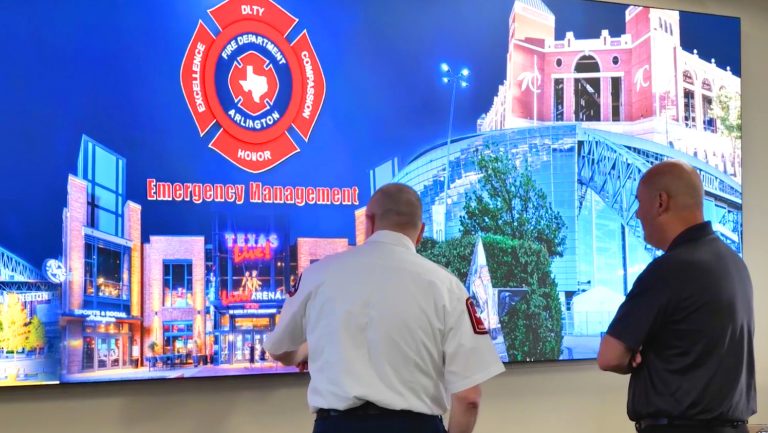
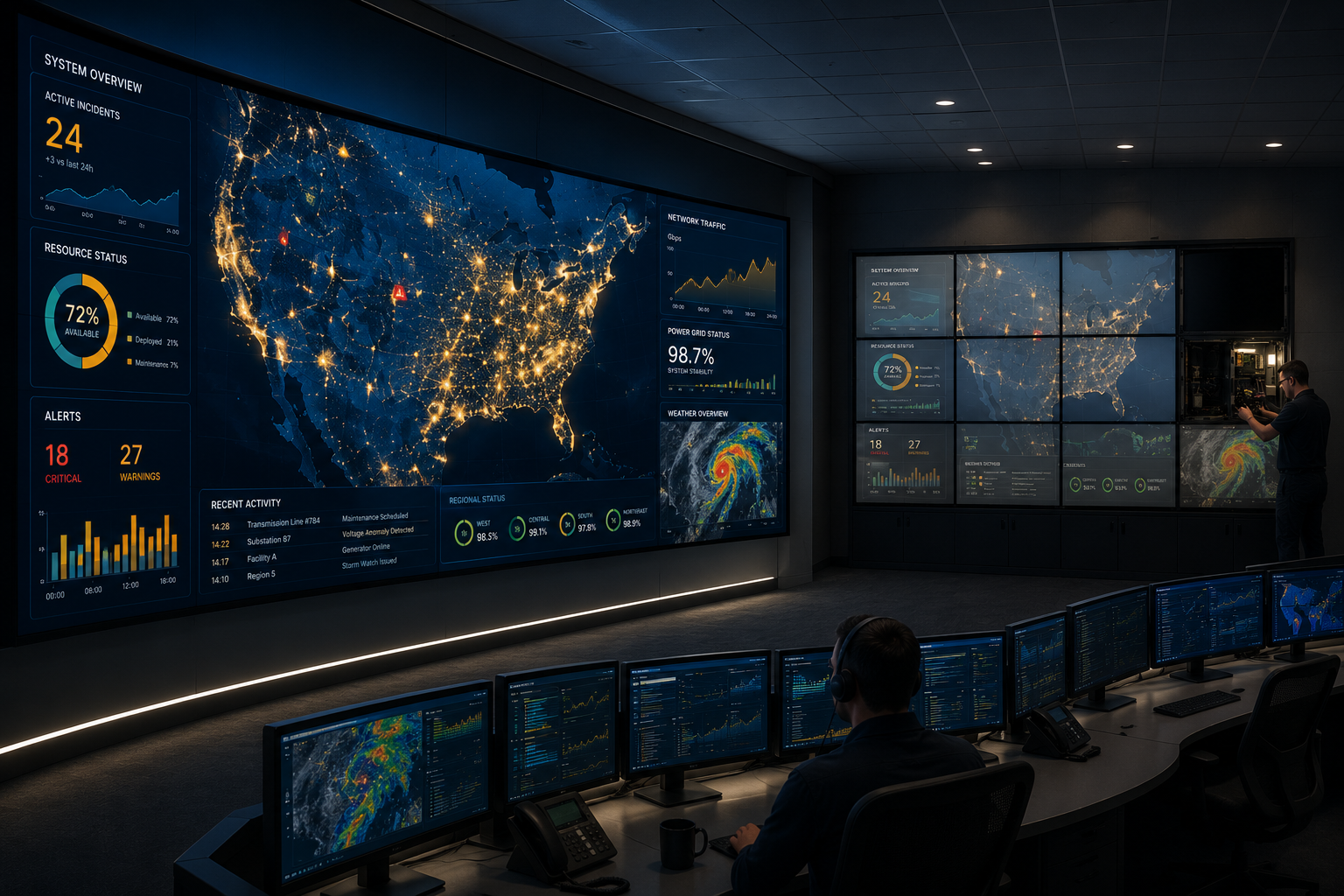
Video walls are the central point of a control room, it’s where critical information is brought together to support operations, maintain situational awareness, and enable split-second decision-making during emergencies. Downtime, glare, visible seams, or a single failed display component can disrupt visibility and compromise performance in mission-critical environments where every second counts.
When rear projection cube (RPC) technology was first introduced, it revolutionized how control room operations visualized mission-critical data. Today, Direct View LEDs (dvLED) technology is redefining the modern control room experience. With seamless canvases, higher brightness, clearer image, improved scalability, simplified maintenance, and enhanced long-term reliability, dvLED has become the preferred replacement path for aging cube video walls.
Why Modern Control Rooms are Moving toward dvLED
dvLED is a display technology that uses thousands of tiny light-emitting diodes (LEDs) to create images directly on the screen surface without the need for backlights or projectors. Unlike traditional RPCs or LCD video walls, dvLED displays produce a seamless viewing canvas with no visible bezels or gaps between panels.
dvLED has redefined the modern video wall. While many video walls may appear similar at first glance, the difference between dvLED and RPC technology becomes clear in mission-critical control rooms where image quality, uptime, scalability, and long-term reliability matter most.
dvLED vs. Rear-Projection Cubes
| Feature | Direct View LED (dvLED) | Rear Projection Cube (RPC) |
|---|---|---|
| Image Quality | High brightness range: 600–2,000+ nits, delivering clear, vibrant visuals even in brightly lit rooms. Superior contrast, uniform color across the full canvas, and a wider color gamut (HDR-capable in many cases). | Lower brightness: typically, 300–800 nits; ambient lighting noticeably affects visibility. Each cube’s image can vary in brightness, color, and sharpness, producing visible inconsistencies across the wall. |
| Seamless Display | No visible seams—critical for dashboards, maps, and surveillance operational data viewed as a single canvas. | Thin screen boundaries between cubes can interrupt content and reduce the appearance of a truly seamless canvas compared with a dvLED. |
| Flexibility | Smaller cabinets (building blocks) allow for more custom sizing, curves, and configurations. These smaller cabinets also aid in installation labor and equipment staging. Cabinets are small, thin, light, making it possible for one individual to build an entire video wall. Ideal for command-and-control centers requiring data visualization and immersive viewing experiences. | Rigid form factor, typically constrained to fixed cabinet sizes. Limited sizing and configuration options. Due to their large size and weight, projection cabinets typically require a team of technicians to assemble and maintain a video wall, often requiring specialized lifting equipment during installation and service. |
| Space Requirements | Shallow footprint: only 1.5-4 inches deep, which can satisfy ADA requirements. Frees up usable room space and integrates cleanly into more modern environments. | Bulky: typically, 24–36+ inches deep. Requires dedicated cabinet space and limits installation flexibility. These large, heavy cabinets require multiple technicians to move and align, and some must be partially disassembled to fit through standard doorways. |
| Maintenance | Most dvLED systems require lower ongoing maintenance due to modular serviceability and the absence of projection optics and light engines. Modular front-access panel repairs simplify service, even in tight installations. (See Downtime Impact for More Details) | Complex, costly rear-access repairs. More moving parts (lamps, optics, projection and laser engines), longer lead time when ordering parts, and growing reliance on refurbished components. |
| Lifespan | Estimated 11+ years of predictable, long-term performance. | Typical operational life ranges from approximately 7–12 years depending on the projection technology, maintenance practices, and availability of replacement components. |
| Viewing Angles | Wide viewing angles (typically 160°+) deliver consistent clarity and color across the room. | Image quality diminishes from wider angles, with brightness falloff and color shifting. Projection video walls typically use lenticular screens to enhance the quality of the front-facing image quality, but these screens can restrict viewing angles. This often requires critical information to be displayed in multiple locations on the wall to ensure visibility for all operators, reducing the effective use of available display space. |
| Reliability & Redundancy | Engineered for mission-critical environments with built-in redundancy and failover. | Hardware failures typically affect an entire cube until repaired, whereas dvLED failures are often isolated to smaller display modules. |
| Energy Efficiency | Modern dvLED systems often reduce overall energy consumption and cooling requirements compared with projection-based architecture, particularly in 24/7 environments. With dvLED, black pixels are turned off and consume virtually no power. As a result, high-contrast content often requires significantly less energy than projection systems, which continuously light up the entire display regardless of the image being shown. | Projection systems rely on continuously powered lamps or light engines, resulting in higher energy consumption and operating costs. The added heat output also increases HVAC demand, further raising overall facility energy use. |
| Sound Level | Quiet operation suited to command rooms, control rooms, and executive spaces. | Projection systems generate noise from cooling fans and other display hardware. Their significant cooling requirements can also increase HVAC demand, which further increases the background noise within the room. |
| Scalability | Video walls can be expanded and upgraded incrementally over time—no full system replacement required. | Growth is constrained by fixed cube sizes, optical alignment requirements, and aging component compatibility. |
| Downtime Impact | dvLED walls are built from modular components, allowing failures to be isolated to a small area of the display. If a module is damaged, it can be quickly swapped out without affecting the rest of the wall. Spare modules can be kept on-site, allowing for quick repairs and maximum uptime especially for mission-critical operations. | A single failure can take an entire cube offline, removing a significant section of the wall during repair. |
| Total Cost of Ownership | Marginally higher upfront investment, offset over time by lower energy use, reduced maintenance, longer lifespan, and the ability to upgrade the system incrementally. | Lower upfront cost, but higher long-term spend on lamps, components, service, and eventual full-system replacement. |
| Appearance | Sleek, modern aesthetic that signals a forward-looking operation. | Bulky, dated appearance compared to current-generation displays. |
*Nits are units of brightness. Specifications reflect typical ranges across current commercial-grade range across current commercial-grade products.
But Doesn’t dvLED Cost More?
It’s a common question buyers ask, and it’s a fair question. dvLED can carry a higher upfront investment than an equivalent RPC installation. However, the equation changes when evaluating the total cost of ownership over the lifespan of the system.
Lifespan
A potential longer operational lifetime can help avoid a full mid-cycle replacement.
Scalability
Incremental expansion and upgrades eliminate the need for costly forklift replacements, allowing expenses to be distributed over time
Energy
Lower power consumption and reduced cooling demands can produce measurable utility savings, especially in 24/7 operations environments
Maintenance
In most deployments, dvLED systems require less ongoing maintenance due to modular serviceability and the absence of projection optics and light engines. They also eliminate the need for a separate projection room, freeing up valuable floor space for operational use rather than equipment
In many 24/7 control-room environments, dvLED can deliver a lower total cost of ownership over a 10-year horizon despite its higher initial investment.
A Note on Pixel Pitch and Viewing Distance
One important technical consideration with dvLED is pixel pitch, the distance between the center individual pixels LEDs that determines how close viewers can sit before pixels become noticeable. Modern fine-pitch dvLED solutions (typically 0.9–1.2 mm and below) can support the viewing distances found in most control-room environments when properly specified. Selecting the proper pixel pitch for the viewing distance is a critical part of designing an effective control room video wall.
The Bottom Line
If you’re building a new control room or modernizing an existing one, the video wall is one of the most important long-term technology decisions your organization will make.
RPC systems still operate reliably in many facilities and continue to support mission-critical operations effectively. However, as systems age, repairs become more challenging and replacement parts increasingly become more difficult to come by. For organizations planning for the next decade of operations, dvLED has become the preferred technology platform for video walls.
For seamless visuals, mission-critical reliability, simplified maintenance, lower long-term operating costs, and a platform designed to scale with future needs, dvLED is the clear choice for modern control rooms.
Make a Smart, Informed Decision for Your Next Control Room
Every control room environment is different. Pixel pitch, viewing distance, content sources, redundancy requirements, room acoustics, and operational workflows all influence the right video wall solution for your facility.
Contact us for a complimentary control room assessment. Let us help you build a control room your operators can depend on, and one your organization will be prepared to grow with for years to come.

Direct View LED (DV LED) Technology in Control Rooms

Future-Proofing Power: Transforming MTE’s Control Room for Unparalleled Efficiency
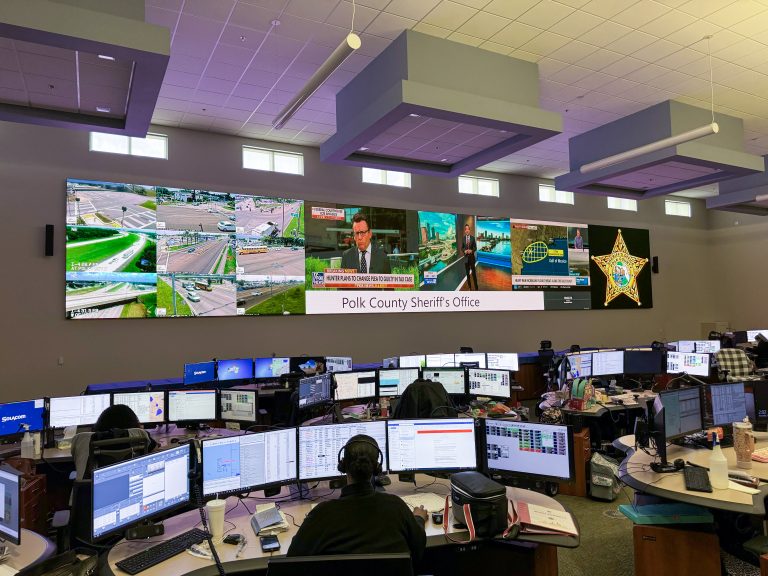
Polk County Sheriff’s Office Switched to vis/ability