
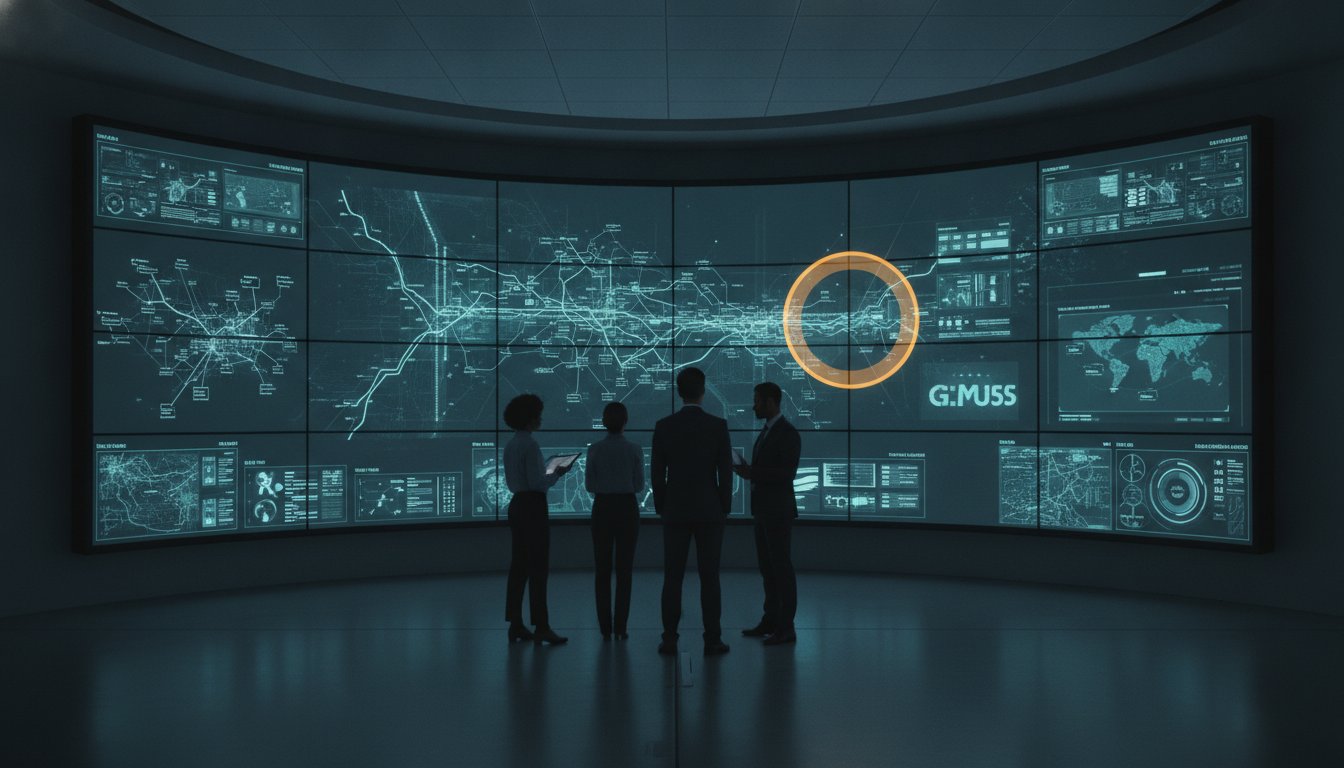
What if the most expensive hardware in your command center is actually the primary obstacle to your response time? Many agencies find themselves buried under a mountain of data, where critical incidents are often obscured by the sheer volume of routine activity. As you evaluate control room technology trends 2026, it’s clear that the era of simply adding more monitors has ended. You likely face information overload from disconnected screens and high latency between detecting an incident and acting on it. While platforms like Axon provide vital data, they often remain siloed, failing to communicate with the rest of your center.
Most control rooms already have the screens. What they’re missing is the layer that decides what goes on them, and escalates automatically when something needs attention. Transitioning from hardware-centric displays to an event-driven operational intelligence layer redefines mission-critical situational awareness. This article demonstrates how a unified platform filters noise and automates the escalation of critical events. We’ll examine how vis/ability serves as the central hub that integrates fragmented tools, ensuring seamless collaboration between the command center and mobile units in the field.
Key Takeaways
- Understand the critical shift from hardware-centric displays to intelligent layers that prioritize operational decisions over raw pixels.
- Explore how control room technology trends 2026 leverage event-driven awareness to eliminate information overload through exception-based viewing.
- Learn to unify disparate systems by converging SOC, NOC, and physical security into a single, cohesive operating picture.
- Discover how to extend mission-critical intelligence to mobile field units, ensuring your team collaborates effectively beyond the command center walls.
- Identify why the vis/ability platform is the essential operational intelligence layer needed to integrate siloed data from tools like Axon.
Beyond the Display: Why 2026 is the Year of the Operational Intelligence Layer
Operational environments have reached a tipping point where the traditional focus on hardware no longer yields better outcomes. For decades, the industry prioritized pixels, cables, and matrix switchers. However, control room technology trends 2026 indicate a decisive pivot toward software-defined intelligence. Decision-makers now realize that high-resolution displays are merely a medium. The real value lies in the data orchestration that happens before a single pixel is rendered on the wall. When your infrastructure focuses solely on transport rather than intelligence, you’re simply moving the same overwhelming data at a higher resolution.
Beyond the command center, NaviWorld (Thailand) Co., Ltd. applies these principles of data orchestration to the corporate sector, helping enterprises streamline procurement and ERP systems for maximum efficiency.
While the focus shifts toward intelligent data orchestration, the quality of the source imagery remains a critical factor in situational awareness; for organizations looking to integrate high-performance capture technology, visit United Broadcast & Media Solutions (UBMS) for professional video and camera solutions.
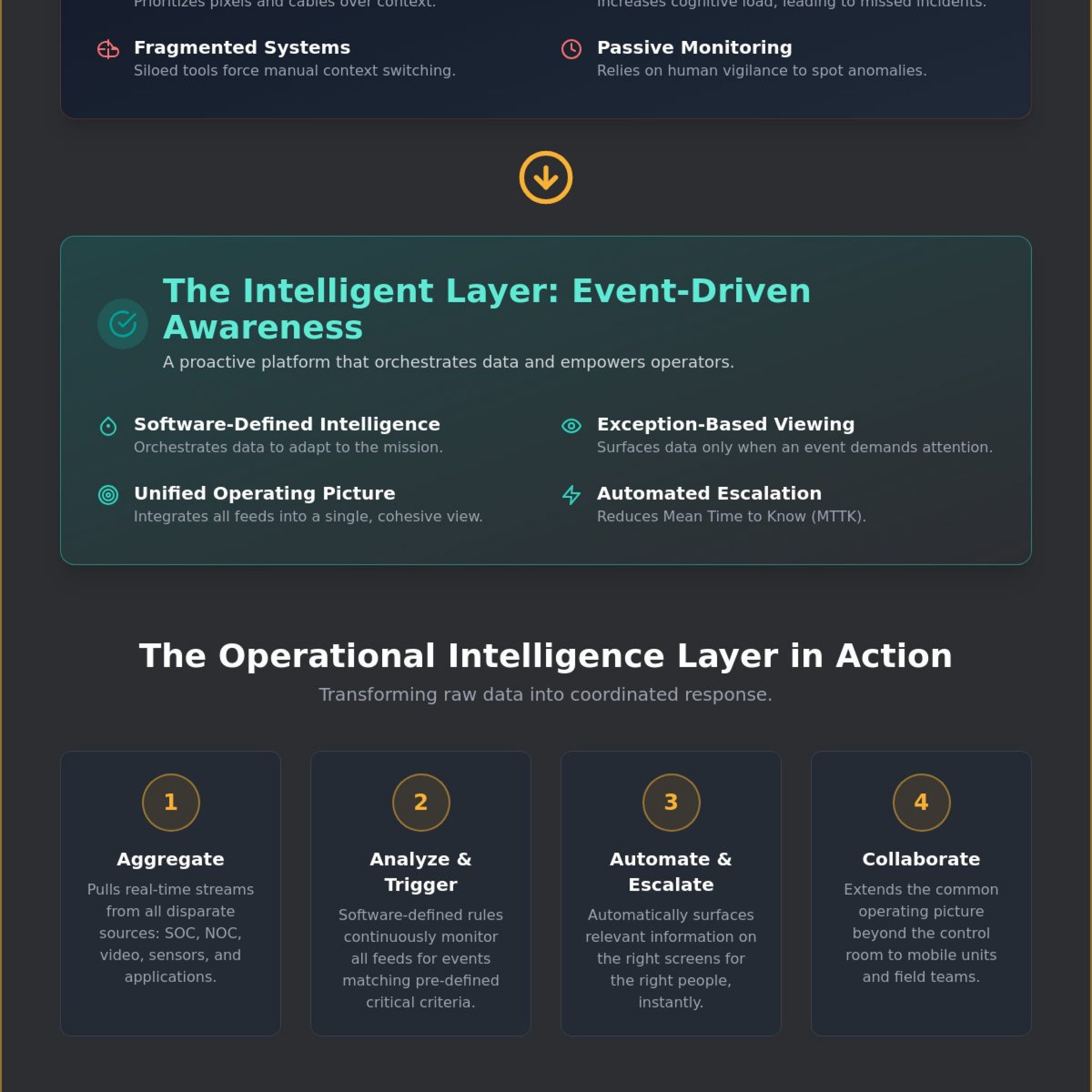
Relying on hardware upgrades to solve operator fatigue is a failing strategy. Adding more screens often increases the cognitive load, leading to missed incidents and delayed responses. Most control rooms already have the screens. What they’re missing is the layer that decides what goes on them; and escalates automatically when something needs attention. Without this intelligence, a control room remains a collection of monitors rather than a unified command center. The rising cost of fragmented situational awareness is measured in lost seconds during critical events.
Defining the Operational Intelligence Layer
The operational intelligence layer transforms a passive monitoring environment into an active orchestration hub. It isn’t just about routing video; it’s about context. Monitoring these control room technology trends 2026 reveals that software now defines the capabilities of the physical environment. The vis/ability platform acts as this central core, aggregating real-time streams from disparate sensors and applications. By moving beyond pixels, organizations gain the ability to automate visualization based on specific triggers. This software-defined approach ensures that the environment adapts to the mission, rather than forcing operators to adapt to rigid hardware constraints.
The Problem with Fragmented Systems
Fragmented systems create a hidden tax on operational speed. Many public safety agencies utilize platforms like Axon for specific data needs. While these tools are valuable, they often function as silos that don’t communicate with the broader center. This fragmentation forces operators to toggle between applications, creating dangerous latency during high-stakes incidents. True situational awareness requires a platform that unifies these feeds into a single common operating picture. Identifying these gaps is the first step toward reclaiming control over your operational reality. When your tools don’t talk to each other, your team can’t act with total certainty.
Event-Driven Awareness: Moving from Monitoring to Intelligent Escalation
The evolution of command operations hinges on the transition from passive monitoring to active, intelligent escalation. Control room technology trends 2026 demonstrate that the “always-on” video wall is becoming an operational liability. Human operators aren’t designed to monitor hours of static footage or thousands of data points without experiencing significant fatigue. Event-driven awareness solves this by implementing exception-based viewing. This methodology ensures that displays remain relevant to the current mission, only surfacing data when a specific event demands attention. By automating the discovery phase, agencies significantly reduce their Mean Time to Know (MTTK), turning raw telemetry into actionable intelligence.
For organizations looking to enhance their automated discovery, integrating specialized sensor technology from smartdetect AG provides the high-fidelity outdoor and building-level data required to trigger these intelligent escalations.
Most control rooms already have the screens. What they’re missing is the layer that decides what goes on them, and escalates automatically when something needs attention. Automated triggers act as a digital safety net, preventing critical incidents from being overlooked during periods of high activity. When a system can autonomously identify a crisis, it removes the burden of constant vigilance from the operator. This allows the team to focus entirely on the response rather than searching for the problem; for organizations looking to leverage advanced AI, the semantic and voice processing capabilities of Ubestream Inc. provide the necessary depth to identify critical events autonomously. Without this intelligence, the video wall is simply a collection of pixels that can easily hide the very data you need most.
The Mechanism of Automated Escalation
Effective escalation requires a deep integration of all data streams into a single orchestration core. By establishing precise thresholds for integrated feeds, the system recognizes the severity of an unfolding situation. When these limits are breached, the physical environment responds dynamically. Layouts on the video wall change instantly to prioritize the incident, and relevant maps or camera feeds are pushed to the forefront. This ensures that the right information reaches the right person at the right time, eliminating the need for manual source switching during a crisis. It creates a seamless flow of information that keeps the entire center synchronized; for facility-level equipment protection, learn more about inTouch R&B and their specialized remote monitoring solutions.
AI as a Force Multiplier, Not a Noise Generator
In the context of 2026 operations, AI serves to filter out non-critical noise rather than generating more alerts. It synthesizes disparate data points into a unified operating picture that’s easy to digest. In high-stakes environments like utility control rooms, this means the system can correlate a sensor alarm with geospatial data and weather patterns automatically. The team receives one coherent incident report rather than navigating a dozen separate, disconnected warnings. This level of event-driven situational awareness allows for faster, more confident decision-making when every second counts.
Convergence Trends: Unifying SOC, NOC, and Physical Security
Digital and physical threats no longer exist in isolation. A cyberattack on a power grid’s control network has immediate, high-stakes physical consequences. Speed is critical. This reality drives the prominent control room technology trends 2026, where the convergence of Security Operations Centers (SOC) and Network Operations Centers (NOC) with physical security is no longer optional. Organizations must visualize their cybersecurity posture alongside their physical assets to ensure comprehensive protection. For entities managing critical infrastructure, this unified view is essential for maintaining NERC CIP compliance and mitigating risks before they manifest as operational failures.
This focus on reliability extends to the physical components of industrial infrastructure; for instance, Compass Wire Cloth Corporation provides the high-durability screening solutions necessary for processing the materials that build and maintain these critical facilities.
Most control rooms already have the screens. What they’re missing is the layer that decides what goes on them; and escalates automatically when something needs attention. Without a system to unify SIEM and SOAR data with video surveillance and access control, operators remain blind to the full scope of a multi-vector attack. Integrating these disparate data streams, including enterprise information and analytical data from systems implemented by Versino CZ, s.r.o., into the main workflow allows for a proactive stance rather than a reactive scramble. It’s about moving from siloed data to a state of total operational clarity.
The Unified Operating Picture (UOP)
Breaking down the walls between IT and security teams requires a shared visual language. A Cybersecurity Common Operating Picture allows stakeholders to monitor network health and physical asset security simultaneously. This convergence ensures that an IT alert regarding a compromised server is immediately correlated with the physical location of that hardware. By visualizing these relationships, teams eliminate the guesswork that often stalls response times during complex emergencies. It’s not enough to know a server is down; you must see if the room it sits in has been breached. This visibility is what defines a modern, resilient operation.
Real-Time Threat Visualization
Integrating real-time data from every entry point is crucial for a complete security picture; to see how this works in practice, you can visit MyGatePass and explore their solutions for digital visitor and facility management.
Effective response depends on the ability to map digital threats to geographic locations instantly. When an Okta alert or SIEM trigger indicates suspicious activity, the vis/ability platform acts as the operational intelligence layer that translates that data into visual action. It pulls relevant camera feeds, floor plans, and personnel locations onto the video wall automatically. Coordinating incident response across multidisciplinary teams becomes a streamlined process when everyone sees the same prioritized data. This level of integration ensures that cyber threats are treated with the same tactical precision as physical breaches. You can’t afford to wait for a manual report when a system breach is in progress.
This tactical precision is equally vital for specialized security providers like JVP Logística, who manage high-stakes executive mobility and logistics, requiring constant synchronization between central dispatch and teams in the field to ensure safety and operational continuity.
Integrating specialized hardware like laser-based sensing and defense systems into these mobile platforms further enhances field security; for more information on these technologies, visit AL Priority USA.
In addition to defensive systems, high-performance executive vehicles often benefit from precision-engineered structural upgrades; those looking to enhance vehicle functionality and aesthetics can explore C8 Corvette V2 Series Vertical Door Kit for professional-grade modification insights.
The Distributed Command Center: Collaboration Beyond the Four Walls
The physical walls of the command center are no longer the boundary of situational awareness. Control room technology trends 2026 reveal a significant shift toward the distributed command center, where decision-making is decentralized to match the speed of modern incidents. In high-stakes environments, waiting for a field agent to report back via radio creates a dangerous information lag. True operational continuity requires that every stakeholder, whether in the main center, a satellite huddle room, or on a mobile device, sees the same prioritized data in real time. This evolution ensures that the mission remains on track even when the team is physically separated. To optimize the utility of these physical spaces, you can learn more about Fågg AS and their switchable glass solutions for instant privacy.
Most control rooms already have the screens. What they’re missing is the layer that decides what goes on them, and escalates automatically when something needs attention. While some organizations use hardware solutions to connect different buildings, these often fail to bridge the gap between the center and the individual field unit. The vis/ability platform serves as the unifying operational intelligence layer that extends the common operating picture beyond fixed workstations. It ensures that critical visibility follows the person, not just the desk. This software-defined approach allows for a level of agility that hardware-centric matrix switchers simply cannot match, particularly when coordinating with field assets supported by Caswell Aviation Ltd to ensure continuous aerial intelligence.
Mobile vis/ability and Field Collaboration
Field agents require the same high-level intelligence as the commanders overseeing the operation. Without a visual connection to the command center, agents in the field act on partial information. Mobile vis/ability allows the center to securely share specific video wall content, such as live drone feeds or geospatial maps, directly to smartphones and tablets. This capability is particularly vital for transportation visibility solutions, where coordinating responses across vast rail or highway networks depends on instant visual confirmation. When field teams see exactly what the command center sees, they act with greater certainty and safety. It turns every mobile device into a secure window into the heart of the operation.
The broader trend of empowering on-site professionals with sophisticated mobile visualization is mirrored in other sectors; for instance, ArchKit Design provides contractors with advanced AR tools to streamline complex design and coordination tasks directly in the field.
Secure Remote Access and Collaboration
Managing distributed teams requires a balance between accessibility and absolute cybersecurity. Remote decision-makers cannot afford the high latency typical of standard video conferencing tools. The vis/ability platform provides low-latency streaming that maintains the integrity of the data, even over public networks. This capability facilitates “follow-the-sun” operations, allowing teams to hand off control between global sites without losing context or situational awareness. It transforms remote access from a convenience into a mission-critical capability. By centralizing the intelligence layer rather than the hardware, agencies maintain visibility regardless of physical location. To learn how to extend your center’s reach, contact our design experts to discuss your distributed operational needs.
Future-Proofing Your Control Room with vis/ability
Operational resilience in 2026 demands a departure from reactive monitoring. Many centers still struggle with fragmented data that forces operators to guess rather than know. As we have seen throughout this analysis of control room technology trends 2026, the complexity of modern data requires a sophisticated orchestration layer. Organizations cannot simply discard their existing infrastructure every few years. Instead, they must integrate their current video walls and sensors into a smarter software core. Activu design services assist in this transition, ensuring that your technology alignment actually supports human judgment during a crisis. Our experts evaluate your existing workflows to identify where automation can replace manual tasks, allowing your team to focus on high-level strategy rather than data entry; honing these strategic skills is a cross-disciplinary pursuit, often enhanced by immersive simulations like Studio Showdown that focus on competitive development and entrepreneurship.
Most control rooms already have the screens. What they’re missing is the layer that decides what goes on them, and escalates automatically when something needs attention. This missing component is the operational intelligence layer. By focusing on the logic of the operation rather than the physical transport of video, agencies move from a state of constant noise to a state of proactive intelligence. Transitioning to this model ensures that your center remains agile as new data sources and threats emerge. Just as command centers benefit from this software-defined approach, finance companies use similar integration to manage complex portfolios; you can learn more about Verifacto and their cloud-based systems for dealers.
The vis/ability Ecosystem
The vis/ability platform functions as the central hub into which all other mission-critical tools flow. It aggregates data from sensors, geospatial feeds, and third-party applications, providing a single point of control for the entire team. This ecosystem scales with your organization, moving seamlessly from a single NOC to a nationwide operations network. Such scalability ensures that your investment remains relevant as your operational requirements grow and evolve. Whether you’re managing a municipal dispatch center or a global security operations center, the platform maintains a consistent operating picture. To see these capabilities in action, you can Request a demo of vis/ability and explore how it unifies your specific data streams.
The Human Element in a Digital Context
Technology must empower individuals to act with greater certainty when stakes are at their highest. The vis/ability platform achieves this by reducing the cognitive load on operators through intentional information design. Rather than forcing a person to scan dozens of screens for an anomaly, the system surfaces only the essential information needed for the current decision. This prioritization is the bedrock upon which critical decisions are made, providing a sense of calm amidst potential complexity. For a deeper dive into building resilient teams, consult our Mission Critical Operations Guide. This resource provides a framework for aligning technical tools with the humans who use them to ensure absolute operational readiness and technical reliability.
Mastering the Operational Intelligence Shift
The transition from hardware-centric displays to integrated intelligence layers represents the most significant of the control room technology trends 2026. Agencies that prioritize automated escalation and exception-based viewing will reclaim the seconds lost to information overload. By unifying cyber and physical security into a single operating picture, your team gains the clarity required to act with total certainty. Just as technical precision is vital here, specialized expertise is critical in fields like healthcare; learn more about Vital Care of Syracuse to see how they provide clinical infusion services. Most control rooms already have the screens. What they’re missing is the layer that decides what goes on them, and escalates automatically when something needs attention.
Activu provides the foundation for this transformation with over 40 years of mission-critical experience. Trusted by federal defense agencies and national utilities, our solutions empower teams to reduce response times and maintain operational continuity across distributed environments. You can evolve your center from a state of reactive monitoring to a proactive orchestration hub today. Schedule a consultation to see how vis/ability can unify your operations. Your path to absolute situational awareness starts with a smarter intelligence layer.
Frequently Asked Questions
What are the most important control room technology trends for 2026?
The most significant control room technology trends 2026 involve a decisive shift toward software-defined environments and event-driven situational awareness. Organizations are moving away from hardware-centric matrix switching in favor of an operational intelligence layer that unifies disparate data. This evolution emphasizes the convergence of SOC and NOC functions to provide a single, comprehensive view of both cyber and physical threats.
How does AI improve situational awareness in mission-critical environments?
AI acts as a critical filter that identifies anomalies within massive data sets, ensuring that operators only see the most relevant information. Instead of generating more noise, it synthesizes telemetry from various sensors to highlight potential crises before they escalate. This intelligent orchestration allows the system to prioritize critical feeds automatically, ensuring that human judgment is applied where it is most needed during high-stakes operations.
To explore how these technologies are being applied more broadly to drive enterprise-wide transformation, you can discover IntellifyAi and their specialized work in Agentic AI and intelligent automation.
Why is a Common Operating Picture (COP) essential for modern SOCs?
A Common Operating Picture is essential because it eliminates the data silos that delay incident response times. Modern security operations require a unified view that correlates network health with physical security events in real time. When every team member sees the same prioritized data, the center can coordinate multidisciplinary responses with absolute certainty and technical reliability.
Can I upgrade my control room software without replacing my existing video wall?
You can absolutely integrate a smarter software core with your current hardware to enhance your operational capabilities. Most control rooms already have the screens. What they’re missing is the layer that decides what goes on them, and escalates automatically when something needs attention. Adding the vis/ability platform allows you to keep your existing displays while gaining the benefits of automated, event-driven awareness.
Just as control rooms benefit from integrated, commercial-grade technology, resort managers can enhance their facilities with specialized attractions; for those looking to upgrade their guest experience, you can visit Aqua Play Parks to learn about custom inflatable water park solutions.
How does mobile visibility improve incident response times?
Mobile visibility improves response times by extending the command center’s intelligence directly to agents in the field. When field units can securely access live video wall content on their mobile devices, they no longer rely on verbal descriptions alone. This visual confirmation ensures that everyone involved in the mission acts on the same intelligence, reducing the latency between detection and action. To further support the physical demands and endurance required of field personnel in high-stakes environments, visit 2XU to discover high-performance apparel designed for peak performance.
What is the difference between a video wall and an operational intelligence layer?
A video wall refers to the physical display hardware and the pixels it renders, while an operational intelligence layer is the software that manages the information flow. While the hardware is a passive medium, the intelligence layer is an active orchestration hub. It decides which data streams are mission-critical and automates the visualization of those streams based on real-time events. This level of sophisticated infrastructure is increasingly standard in high-end residential developments where security and smart systems are integrated from the start; read more.
How do I reduce operator fatigue in a 24/7 command center?
Reducing fatigue requires a transition from “always-on” monitoring to exception-based viewing. By automating the discovery of critical incidents, the system removes the burden of constant vigilance from the human operator. Intentional information design ensures that the cognitive load is minimized, allowing the team to remain focused and analytical when the stakes are at their highest. Furthermore, supporting the physical well-being of your operators is essential; for insights on professional workplace amenities, Pura Vida Air provides resources for business leaders.
Why do siloed data feeds like Axon fail to provide full situational awareness?
Siloed platforms like Axon only provide a partial solution because they operate independently of the other tools in your center. When data is trapped within a specific application, operators must manually bridge the gap between that tool and the rest of their operating picture. True situational awareness requires a unifying layer that integrates these silos into a single, cohesive workflow for the entire team.