

In a high-stakes emergency, the human brain can process only seven pieces of information at once, yet a typical operator in 2024 manages over 40 distinct data streams simultaneously. You likely recognize that the sheer volume of telemetry, video feeds, and sensor data has outpaced the human capacity to filter what’s actually relevant. This information overload leads to critical lag times and operator fatigue when seconds matter most. Implementing advanced control room solutions is no longer about adding more screens; it’s about engineering a system that filters the noise so your team can focus on the mission.
We’ll show you how to integrate event-driven situational awareness and high-performance visualization to transform your command center into a proactive decision-making hub. By the end of this article, you’ll understand how to create a unified operating picture that slashes incident response times and scales seamlessly as your data needs grow. This guide explores the technical framework required to move from reactive monitoring to predictive, mission-critical intelligence that empowers every operator to act with absolute certainty.
Key Takeaways
- Transition from passive monitoring to proactive situational awareness by implementing an integrated ecosystem of hardware and event-driven software.
- Optimize your command center’s physical layer by selecting display technologies and ergonomic designs tailored to the specific rigors of mission-critical environments.
- Deploy modern control room solutions that filter operational noise, ensuring decision-makers see only the most relevant information during high-stakes events.
- Apply sector-specific visualization strategies to meet the unique security and reliability requirements of utility, transport, and defense operations.
- Establish a scalable foundation for future growth by choosing a strategic partner focused on long-term system intelligence rather than one-off equipment sales.
Beyond the Video Wall: Defining Modern Control Room Solutions
Modern control room solutions represent a unified ecosystem where hardware, software, and specialized design services converge to protect vital infrastructure. By 2026, the industry has moved decisively past the era of static video walls and passive monitoring. These systems now prioritize software-defined visualization to manage the massive influx of telemetry from IoT sensors and distributed networks. The primary objective is to eliminate the lag between data ingestion and human action. In high-stakes environments, every second lost to data fragmentation increases risk. Leaders now deploy integrated control room solutions to ensure that critical information reaches the right person at the exact moment it’s needed.
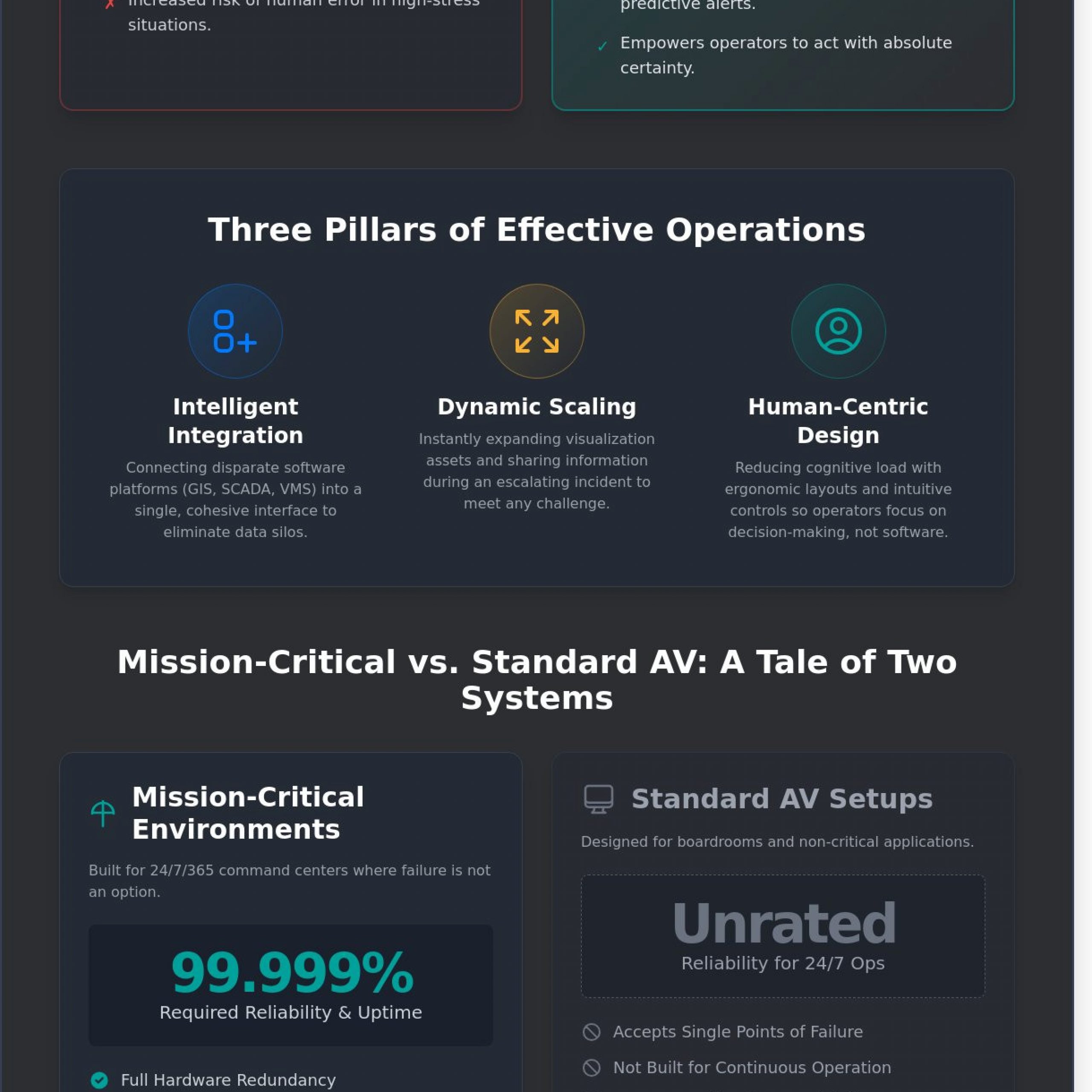
Effective operations rely on three core pillars:
- Intelligent Integration: Connecting disparate software platforms into a single interface.
- Dynamic Scaling: The ability to expand visualization assets instantly during an escalating incident.
- Human-Centric Design: Reducing cognitive load so operators remain focused on decision-making rather than navigating complex menus.
The Evolution of Situational Awareness
Situational awareness has shifted from simple observation to predictive analysis. Operators no longer just watch feeds; they interact with a Common Operating Picture (COP) that unifies data streams into a single, coherent view. Real-time visualization is a non-negotiable requirement for 2026 operations. It ensures that stakeholders see the same truth simultaneously. This clarity prevents fragmented responses and provides the visibility into what matters most when a crisis unfolds. It’s the difference between reacting to history and managing the present.
Mission-Critical vs. Standard AV
Standard AV setups designed for boardrooms don’t meet the rigors of a command center. Mission-critical environments demand 99.999% reliability and full hardware redundancy to ensure 24/7 uptime. High-availability architectures are the standard for emergency operations, where a single point of failure is unacceptable. These systems utilize specialized processing to handle uncompressed video and complex geospatial data without latency. Standard office equipment simply can’t handle these high-bandwidth, high-consequence workloads where absolute technical reliability is the only acceptable baseline.
The Intelligence Layer: Software Integration and Event-Driven Awareness
Software acts as the cognitive engine of the modern command center. It transforms static pixels into a dynamic tool for decision-making. High-performance control room solutions in 2026 rely on this intelligence layer to manage video wall content with surgical precision. Instead of overwhelming operators with every available metric, event-driven visualization filters out the 90% of data that doesn’t require immediate action. The vis/ability platform serves as this central coordination point, ensuring that only the most relevant intelligence reaches the screen when stakes are highest. By integrating platform-agnostic applications, agencies can bridge the gap between siloed software and unified action.
Aggregating Real-Time Data Streams
Effective operations depend on the seamless fusion of disparate systems. Modern platforms pull live feeds from GIS mapping, SCADA industrial controls, VMS security cameras, and cybersecurity monitoring tools into a single pane of glass. When a sensor detects a breach or a mechanical failure, automation triggers specific layouts to highlight the affected area instantly. Event-driven situational awareness is the automated prioritization of critical data during an incident. This logic removes the burden of manual searching; it allows teams to respond to sub-second alerts with total clarity. This automated filtering prevents the cognitive overload that often leads to errors in high-stress environments.
Extending Visibility to Distributed Teams
Operational success rarely happens within the four walls of a command center alone. Information parity ensures that field units and remote stakeholders see exactly what the lead dispatcher sees. Mobile visibility tools provide this Common Operational Picture (COP) on any smartphone or tablet, maintaining a unified front during complex emergencies. Sharing the same view across different locations eliminates the ambiguity that often plagues distributed operations. It empowers stakeholders to act with certainty because they’re working from a single source of truth. Organizations looking to harden their infrastructure can connect with our team to learn more about deploying these collaborative tools across their network.
- GIS and Mapping: Provides spatial context for assets and incidents.
- SCADA Integration: Monitors industrial processes and infrastructure health in real time.
- VMS Feeds: Delivers visual confirmation of sensor-based alerts.
- Cybersecurity Tools: Protects the integrity of the control room solutions themselves.
The result is a streamlined workflow where data moves faster than the crisis it describes. This intelligence layer doesn’t just display information; it interprets the environment to provide a decisive advantage.
Engineering for Reliability: Hardware and Ergonomic Design
Reliability in a mission-critical environment starts at the physical layer. High-performance control room solutions require hardware engineered to run 8,760 hours a year without interruption. This involves selecting display technologies that match the specific visual requirements of the facility. While LCD panels offer 4K clarity for close-up monitoring, direct-view LED has become the 2026 standard for large-scale visualization due to its lack of bezels and 100,000-hour half-life. However, implementing 4K resolution in the control room requires more than just high-density displays—it demands an operational intelligence layer that prevents information overload and ensures critical data reaches operators when it matters most. Video wall processors act as the central nervous system, managing ultra-high-resolution data streams with sub-16ms latency to ensure operators see events exactly as they happen. Professional design services integrate these components into a cohesive floor plan, optimizing traffic flow and technical access for maintenance teams.
High-Performance Video Wall Systems
Direct-view LED provides a seamless canvas that eliminates the visual interruptions of traditional tiled displays. This continuity is vital for tracking moving assets across a geospatial map or monitoring complex utility grid schematics. For 24/7 operations, hardware must feature redundant power supplies and hot-swappable components to prevent total system downtime. Modern control room solutions rely on high-bandwidth IP networks that deliver uncompressed video signals across the facility. The foundation of this network architecture depends on selecting the right IPTV encoder for mission-critical stream distribution to ensure minimal latency and maximum reliability. This technical foundation ensures that critical intelligence remains visible even during peak data loads or sudden hardware stress.
Human Factors and Fatigue Mitigation
An operator’s cognitive capacity is a finite resource. Effective design prioritizes ergonomics to extend this capacity during 12-hour shifts. Sightline analysis, based on ISO 11064 standards, ensures every screen is visible without neck strain or postural fatigue. Lighting systems now use automated color temperature shifts to mimic circadian rhythms, reducing eye strain during night operations. Acoustic treatments with a Noise Reduction Coefficient of 0.85 or higher minimize ambient distractions that lead to errors. These physical optimizations prevent the burnout that leads to human error, keeping the focus on the mission at hand. Well-designed interfaces and console layouts don’t just look professional; they serve as a safeguard against the chaos of a developing crisis.
Industry-Specific Applications for Command and Control
Modern control room solutions serve as the central nervous system for critical infrastructure. While the underlying technology remains consistent, the application of these tools changes based on the specific operational demands of the sector. Whether managing a national power grid or a metropolitan transit network, the objective is the same: convert massive data streams into actionable intelligence. Activu’s platform adapts to these unique environments, ensuring that the right information reaches the right person at the exact moment a decision is required.
Energy, Utilities, and NERC CIP Compliance
Utility operators now manage a grid that is 20% more complex than it was in 2020 due to the rapid integration of renewable energy sources. This shift requires a sophisticated visualization of grid health that accounts for intermittent power loads and decentralized generation. To maintain stability, Utilities & Energy providers rely on mission-critical displays to monitor SCADA systems and weather patterns simultaneously. Situational awareness in this sector isn’t just about efficiency; it’s a regulatory necessity. Meeting NERC CIP compliance standards requires strict data handling and secure visualization protocols that prevent unauthorized access to sensitive control systems. Our solutions provide the audit trails and secure environments necessary to manage outages and maintenance cycles without compromising national security.
Transportation and Public Safety Hubs
Urban density has increased the data load on Transportation management centers by nearly 35% over the last three years. These hubs must integrate thousands of traffic sensors, tolling data, and live camera feeds into a single pane of glass. When an incident occurs, the platform allows for immediate coordination between transit officials and emergency responders. This unified approach is the foundation of the modern Real-Time Crime Center (RTCC). By aggregating gunshot detection alerts, license plate readers, and CAD data, public safety agencies reduce response times by an average of 15%. This level of coordination ensures that every stakeholder sees the same operational picture, removing the silos that often delay life-saving actions.
- Grid Reliability: Real-time monitoring of transmission lines and substation health.
- Regulatory Alignment: Built-in protocols for NERC CIP and NIST cybersecurity frameworks.
- Interagency Coordination: Seamless data sharing between police, fire, and EMS during large-scale events.
- Asset Management: Visualizing the location and status of rolling stock and maintenance crews.
The versatility of these control room solutions allows organizations to scale their operations as their data footprint grows. By prioritizing clarity over volume, we help operators focus on the events that actually impact safety and service delivery. Precision in visualization leads to certainty in action.
Ready to enhance your operational visibility? Contact our engineering team to design a solution tailored to your mission.
Selecting a Strategic Partner for Mission-Critical Operations
Selecting a partner for control room solutions requires looking beyond the hardware specifications on a data sheet. A vendor that operates as a mere “box-seller” cannot provide the depth of expertise needed when lives or national infrastructure are on the line. You need a partner who views your operational success as their primary metric. In 2026, the complexity of global utility grids and transit networks means a single minute of system downtime can result in costs exceeding $9,000. Reliability isn’t a feature; it’s a requirement that must be engineered into every layer of the environment.
A strategic partner understands that technology should never be a barrier between an operator and a decision. They prioritize systems that are intuitive under stress and scalable for future growth. You’re not just buying screens and processors; you’re investing in a long-term architecture that must evolve as your data sources multiply. This relationship demands 24/7/365 technical availability and a deep understanding of the high-stakes nature of your specific industry.
The Cybersecurity Common Operating Picture
Cyber threats no longer live strictly in the digital space. They frequently target physical infrastructure, making it vital to visualize network threats alongside physical operations. Modern SOCs use advanced visualization to merge SIEM and SOAR data into a unified view. This integration allows teams to identify a server breach and a physical perimeter alarm on the same interface. Studies from 2025 indicate that this unified perspective can reduce incident response times by 25% during complex, multi-vector attacks. Visibility into the network is now as critical as visibility into the field.
From Design to Long-Term Lifecycle Support
The engineering process begins with a rigorous analysis of your workflow and ends with a system that grows with you. A true partner manages the entire lifecycle, from the initial CAD drawings to post-install maintenance. Software updates and hardware refreshes, typically scheduled every 5 to 7 years, are essential to prevent legacy vulnerabilities. This proactive approach ensures your control room solutions remain a sharp tool for your operators rather than a source of technical debt. A resilient operations center provides the steady clarity your team needs to act with absolute certainty. To begin building your resilient command center, contact Activu for a professional consultation.
Architecting Operational Resilience for 2026 and Beyond
Success in mission-critical environments depends on the seamless transition from data overload to actionable intelligence. Modern control room solutions must serve as more than a visual centerpiece; they function as the nervous system of an entire operation. By leveraging the Vis/ability platform, organizations can integrate any application or data source into a single, cohesive view. This ensures that technical experts and decision-makers see exactly what matters when every second counts.
Activu brings over 40 years of specialized experience to this high-stakes field. Our systems currently support the U.S. Federal Government and Fortune 500 companies, providing the technical bedrock required for infrastructure-critical decisions. We’ve engineered these tools to prioritize reliability and human-centric design, ensuring your team remains focused during complex events. Your operation deserves a partner that understands the gravity of your mission and provides the clarity needed to lead with confidence.
Request a Consultation with an Activu Control Room Expert
The path to a more efficient and secure command center starts with a commitment to superior engineering. You’ve built a team of experts; give them the visibility they need to succeed.
Frequently Asked Questions
What are the essential components of a control room solution?
High-performance video walls, secure KVM systems, ergonomic consoles, and unified visualization software form the core of a modern command center. These systems must handle 24/7 duty cycles with 99.999% uptime to remain reliable. Modern control room solutions integrate disparate data streams into a single interface, allowing operators to transition from monitoring to action without switching hardware or losing focus during critical events.
How does event-driven situational awareness improve response times?
Event-driven situational awareness automates the delivery of critical data when specific thresholds or alarms are met. Instead of scanning 50 monitors for an anomaly, the system pushes the relevant video feed or sensor data to the front of the display. This reduces the cognitive load on operators and can shave 30 to 60 seconds off initial response times during a high-stakes crisis.
Can modern control room software integrate with my existing legacy applications?
Modern control room solutions integrate with legacy applications through APIs and screen-scraping protocols that ingest data from SCADA or mainframe systems dating back to the 1990s. This ensures that older, stable infrastructure remains visible alongside modern cloud-based analytics. By unifying these sources, organizations extend the lifecycle of their existing hardware while gaining the benefits of modern, real-time visualization.
What is the difference between a NOC and a SOC in terms of visualization?
A Network Operations Center (NOC) focuses on uptime and throughput metrics, while a Security Operations Center (SOC) prioritizes threat detection and incident response. NOC displays typically feature network maps and bandwidth charts. Conversely, SOC visualization requires high-resolution forensic video and logs from SIEM platforms to track 100% of network intrusions or physical breaches as they occur.
How do ergonomics in control room design affect operator performance?
Ergonomic design reduces physical fatigue and mental burnout, which directly impacts decision-making accuracy. Standards like ISO 11064 dictate console heights and viewing angles to prevent neck strain and long-term injury. Research shows that optimized lighting and adjustable sit-stand desks can increase operator alertness by 15% during 12-hour night shifts, preventing costly errors during mission-critical tasks.
Is it possible to share control room data with mobile or remote users securely?
Secure remote sharing is achieved through encrypted browser-based portals and VPN-less protocols that maintain data sovereignty. Field technicians can view the exact same Common Operating Picture as the command center on a tablet or smartphone. This synchronization ensures that 100% of the team works from the same facts, regardless of whether they’re in the center or on-site.
What display technology is best for a 24/7 mission-critical video wall?
Direct-view LED (dvLED) and professional-grade LCD panels with ultra-narrow bezels are the industry standards for 2026. LED technology offers 100,000 hours of service life and eliminates gaps between screens for a seamless image. For mission-critical environments, these displays must include redundant power supplies to ensure zero downtime even if a specific hardware component fails.
How does a Common Operating Picture (COP) benefit large-scale organizations?
A Common Operating Picture provides a single, verified version of reality across multiple departments or agencies. In a large utility or transit system, it breaks down silos by showing the same real-time map to every stakeholder. This alignment eliminates conflicting reports and allows leadership to deploy resources with 100% confidence in the underlying data they’re seeing.