
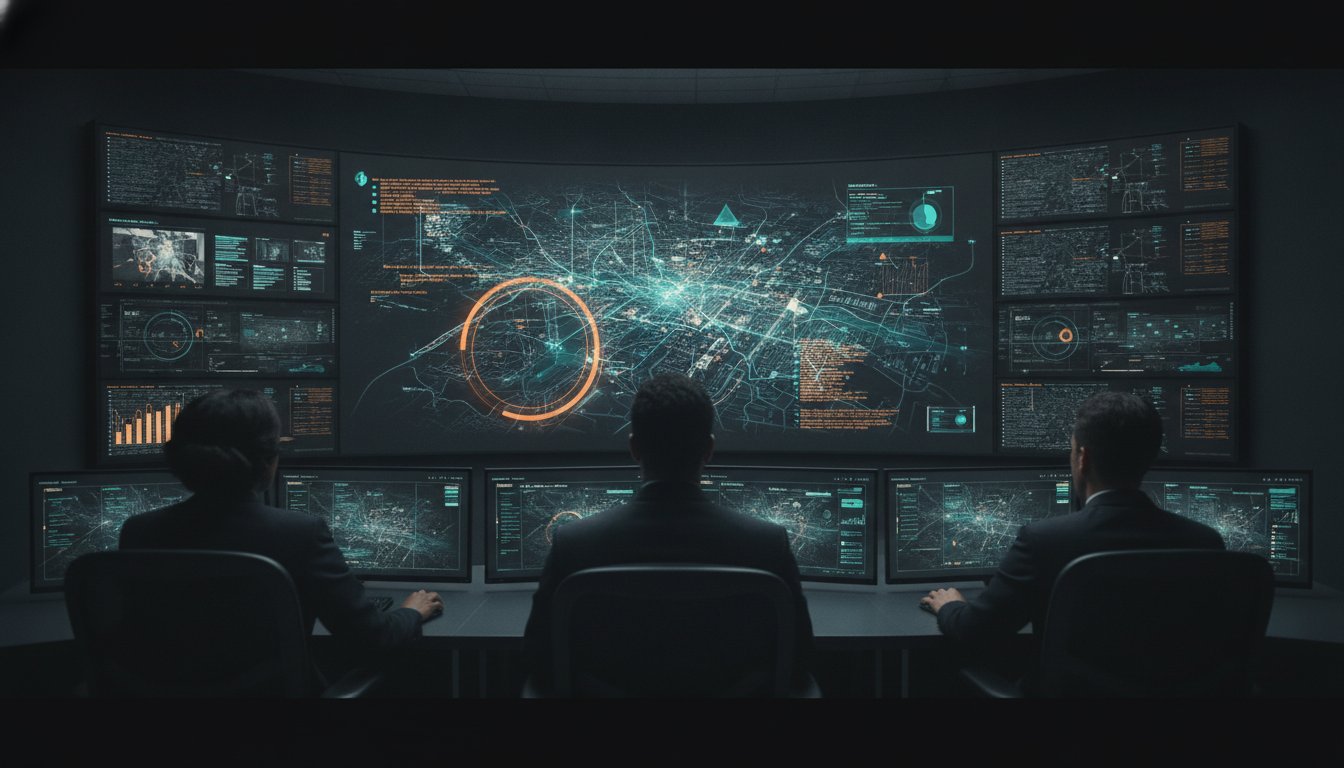
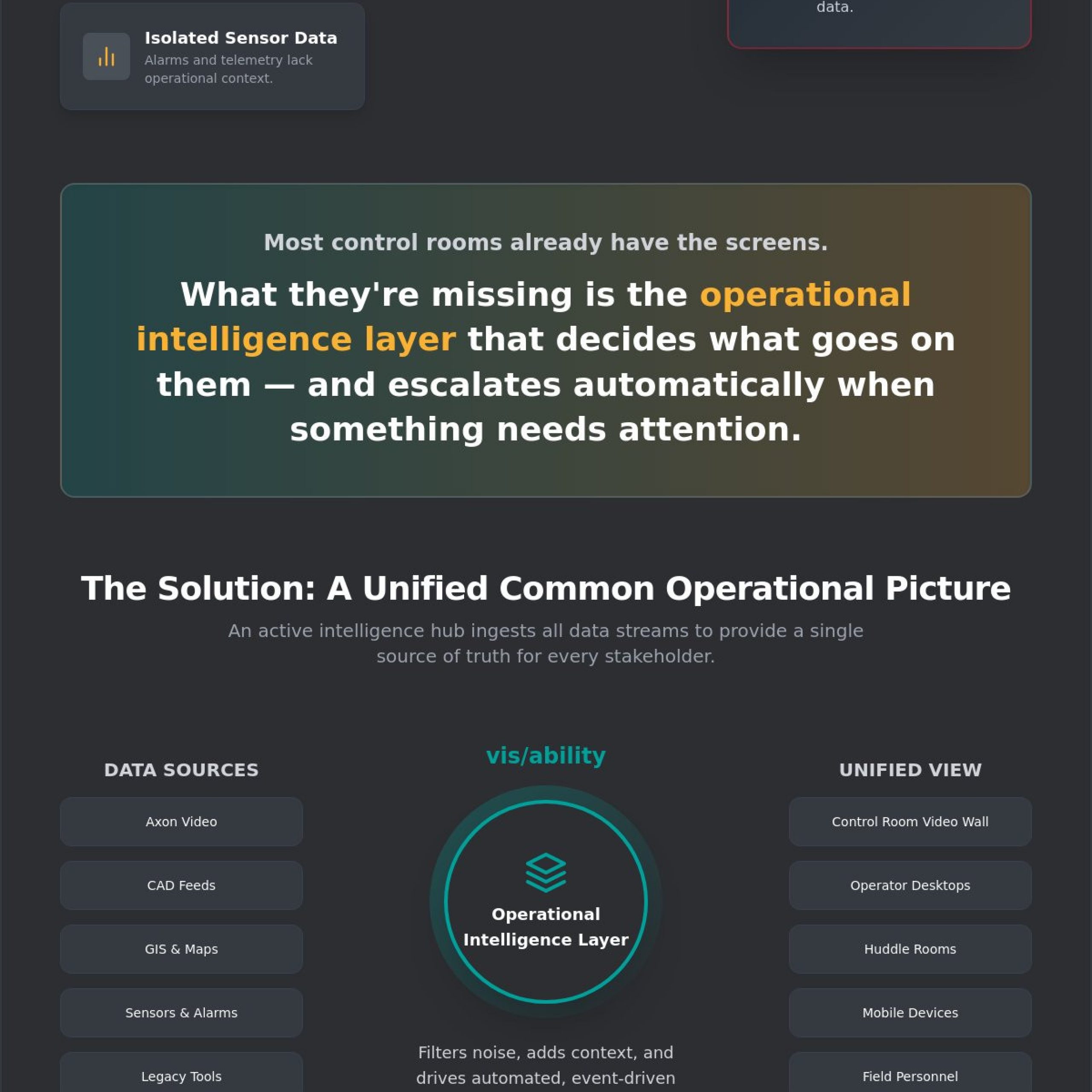
A digital display filled with video feeds and maps is often mistaken for situational awareness, but for most command centers, it is actually the source of the problem. When operators are forced to toggle between siloed systems like Axon or disparate CAD feeds, the resulting cognitive load leads to fatigue and missed incidents. Establishing a true common operational picture for distributed teams requires more than just shared access to a screen. It demands a system that filters the noise and surfaces only the data that impacts the mission. Most control rooms already have the screens. What they’re missing is the layer that decides what goes on them; and escalates automatically when something needs attention.
You likely recognize the frustration of communication lags between the control room and field personnel. This article demonstrates how to bridge that gap by building a unified, actionable intelligence layer that empowers your team to act with certainty. We will examine the transition from passive monitoring to automated, event-driven visualization that ensures every stakeholder sees exactly what they need, exactly when they need it.
Key Takeaways
- Fragmented data silos in mission-critical environments create a high noise-to-signal ratio that causes operators to miss pivotal incidents.
- Learn how a common operational picture for distributed teams transforms passive monitoring into active intelligence by providing a single source of truth.
- Most control rooms already have the screens; what they’re missing is the layer that decides what goes on them and escalates automatically when something needs attention.
- Effective COP architecture requires auditing existing data streams and integrating legacy tools into a unified, scalable software layer.
- Discover how vis/ability serves as the central hub that makes existing systems more useful for teams in the command center, huddle rooms, or on mobile devices.
The Fragmentation Crisis in Distributed Mission-Critical Operations
Control rooms are drowning in data but starving for intelligence. High-stakes environments like utilities and public safety agencies often operate under the illusion of total visibility. They invest in massive video walls and dozens of monitors, yet critical incidents still slip through the cracks. The primary culprit is a skewed noise-to-signal ratio. When every feed is treated with equal importance, nothing is prioritized. This fragmentation is the greatest threat to maintaining a Common Operational Picture (COP) across a modern organization.
Why Operators Miss Incidents in Modern Control Rooms
Modern control rooms suffer from chronic cognitive overload. Analysts monitor dozens of disparate feeds, from Axon video streams to real-time CAD data. While tools like Axon provide essential footage, they only offer a partial solution. They lack the unifying context required for a full common operational picture for distributed teams. This creates a “swivel-chair” effect where operators must manually jump between incompatible software, losing focus and critical time. Distributed teams lose precious seconds during these manual data handoffs. A technician in the field sees one reality while the dispatcher sees another. Without a central hub, these discrepancies lead to hesitation when action is needed most. Most control rooms already have the screens. What they’re missing is the layer that decides what goes on them, and escalates automatically when something needs attention.
The Hidden Cost of Information Silos
Information silos do more than just frustrate staff; they jeopardize lives and infrastructure. In utility operations or emergency response, fragmented visibility leads to delayed resource deployment. If the field team isn’t seeing the same live telemetry as the command center, coordination collapses. This directly impacts Operational Continuity. When remote teams are out of sync, the risk of conflicting SITREPs increases. One team reports a cleared site while another identifies a persistent threat. These contradictions aren’t just technical errors. They’re operational failures that stem from a lack of a unified intelligence layer. Traditional dashboards fail because they provide data without context. A chart showing a spike in sensor activity is useless if the operator doesn’t know it relates to a specific fire alarm or security breach. To bridge this gap, organizations need an operational intelligence layer that synthesizes raw data into actionable certainty.
Defining the Common Operational Picture for Distributed Teams
A common operational picture for distributed teams is more than a shared map or a collection of charts. It is a live, unified view of an entire operation that remains accessible to every stakeholder, regardless of their location. While some organizations rely on tools like Axon for video evidence, these systems only provide a partial solution. They lack the overarching context needed to drive real-time decisions across a complex enterprise. A true COP acts as a dynamic intelligence hub where data doesn’t just sit; it flows and informs.
The distinction between a simple shared screen and a dynamic hub is found in the intelligence of the delivery. A shared screen is passive. It displays what a human operator manually selects. An intelligence hub is active. It understands the relationship between different data streams and surfaces the most relevant information based on the current mission. This transition requires a bi-directional flow of data. Field personnel shouldn’t just receive orders. They must feed live intelligence back into the hub, serving as remote sensors that enhance the collective understanding of the event. This creates a loop of event-driven awareness that keeps every team member aligned.
The Three Pillars of an Effective COP
- Visibility: Ensuring identical, high-resolution data reaches video walls, desktops, and mobile devices simultaneously without latency.
- Context: Merging GIS data, environmental sensors, and live video into a single spatial understanding so users know exactly where an incident is occurring in relation to critical assets.
- Collaboration: Empowering experts across different time zones to annotate live feeds and share insights instantly, turning a tactical view into a collaborative workspace.
Most control rooms already have the screens. What they’re missing is the layer that decides what goes on them, and escalates automatically when something needs attention. Without this layer, operators are left to guess which screen holds the most critical information during a crisis.
From Centralized Hubs to Distributed Intelligence
Operations are no longer confined to a single physical room. The COP must extend to huddle rooms and mobile devices to be truly effective for modern agencies. Static SOPs often fail during rapid escalations because they cannot adapt to live data. By contrast, a dynamic operational picture evolves as the situation changes, providing a proactive rather than reactive stance. The vis/ability platform serves as this essential operational intelligence layer. It acts as the central hub into which all other mission-critical tools flow, making disparate systems like VMS or SIEM more useful for the whole team.
The decentralization of critical workflows is a trend mirrored in other sectors; for example, TecniTiva offers virtual education programs that allow students to complete their primary and secondary schooling entirely online.
When information is distributed, certainty is the ultimate goal. You can connect with our design experts to learn how to unify your organization’s data streams into a single source of truth. By moving away from static displays and toward active intelligence, teams gain the clarity required to act when stakes are at their highest.
Overcoming the “Dashboard Trap” with Automated Escalation
The “dashboard trap” is a common failure point in modern mission-critical environments. It occurs when the volume of incoming data exceeds the human capacity to process it. Many agencies assume that adding more monitors will improve awareness. In reality, more screens often lead to more noise. Operators end up managing the technology rather than the mission. This transition from data-rich to insight-poor happens quickly when systems are fragmented.
Most control rooms already have the screens. What they’re missing is the layer that decides what goes on them, and escalates automatically when something needs attention.
Passive monitoring is the default state for many organizations. They rely on operators to manually scan dozens of feeds. This method is prone to human error and fatigue. Active intelligence, however, uses software to filter and prioritize. While some organizations use standalone tools like Axon for video or Juvare for incident management, these applications only solve part of the puzzle. They provide data within their own silos but don’t communicate with the rest of the ecosystem. To be effective, these tools must flow into a unifying operational intelligence layer. This ensures that a common operational picture for distributed teams is built on integrated insights rather than isolated data points.
The Problem with Passive Visualization
Static displays eventually become invisible to the people watching them. When a Video Wall doesn’t change in response to real-world events, it becomes visual wallpaper. This phenomenon is a primary reason why operators miss incidents. The information is present, but it isn’t prioritized. A common operational picture for distributed teams must be dynamic to be useful. It should act as a responsive asset that shifts its focus based on the severity of incoming alerts. Without this responsiveness, the “more data” approach actually results in less awareness.
The Power of Event-Driven Escalation
Event-driven escalation removes the manual burden from the operator. Automated triggers can be set to identify specific anomalies, such as a perimeter breach or a power surge. When a trigger is hit, the relevant data is instantly pushed to the foreground of the COP. This capability is vital for Public Safety and Utilities, where response times are measured in seconds. By automating the discovery phase of an incident, teams can move straight to the decision phase. This technology doesn’t replace human judgment; it protects it. By filtering out irrelevant data, the system allows experts to focus their cognitive energy on complex problem-solving. It ensures that remote personnel and command center staff are always working from a single, high-priority source of truth.
Implementing a Scalable COP Architecture for Remote Teams
Building a robust common operational picture for distributed teams requires a shift from hardware-centric thinking to a software-defined architecture. It isn’t enough to simply stream video to a laptop. A scalable architecture must prioritize the delivery of high-value intelligence while maintaining security across diverse network conditions. Implementation begins with a rigorous audit of existing data silos to identify the “critical signal” sources, those specific data points that, if missed, result in operational failure. This process identifies what truly matters before technical integration begins.
Integrating Fragmented Systems
The foundation of a modern COP relies on the strategic use of Commercial Off-the-Shelf (COTS) solutions. These tools allow organizations to avoid the limitations of “walled garden” platforms that restrict data flow. A successful implementation brings disparate systems like SCADA, VMS, and GIS into a single, cohesive interface. While some agencies use specialized tools like Axon or Juvare, these are often partial solutions. They lack the native ability to unify with other mission-critical infrastructure. A true operational intelligence layer serves as the central hub where these tools become more useful to the entire team. Most control rooms already have the screens. What they’re missing is the layer that decides what goes on them, and escalates automatically when something needs attention.
Ensuring Security and Reliability in the Field
Distributing a COP to remote endpoints introduces significant cybersecurity and bandwidth challenges. The architecture must be designed for low-latency distribution, ensuring that a field technician sees the same data as the command center analyst without delay. Low-bandwidth optimization is essential for teams operating on cellular or satellite links. This ensures a single source of truth is maintained even when network conditions are poor. Cybersecurity protocols must be embedded at every layer, protecting sensitive operational data as it moves between the hub and mobile devices.
To implement this architecture effectively, follow these five essential steps:
- Step 1: Audit existing data silos to isolate critical signal sources from background noise.
- Step 2: Deploy a unifying software layer, like vis/ability, to integrate COTS and legacy systems.
- Step 3: Establish secure, low-latency distribution channels to all mobile and remote endpoints.
- Step 4: Configure automated alerting based on specific operational thresholds to trigger visual escalations.
- Step 5: Train distributed teams on collaborative interaction, ensuring everyone knows how to annotate and share insights within the shared view.
Transitioning from fragmented data to a unified operational picture is a mission-critical upgrade. To begin your transition, you can request a consultation with our design services team to evaluate your current infrastructure and identify gaps in your situational awareness.
The vis/ability Advantage: Beyond Static Visualization
The vis/ability platform represents the final evolution of operational situational awareness. It is the operational intelligence layer that unifies fragmented data streams into a single, actionable source of truth. While individual tools like a VMS or a SIEM provide valuable data, they often remain isolated within their own interfaces. vis/ability changes this by serving as the central hub into which all other mission-critical tools flow. It doesn’t replace your existing stack; it makes it more useful for the entire team. By aggregating these feeds, the platform ensures that a common operational picture for distributed teams is always accurate and up to date.
Most control rooms already have the screens. What they’re missing is the layer that decides what goes on them, and escalates automatically when something needs attention.
This automated orchestration is what separates proactive intelligence from reactive monitoring. When an incident occurs, vis/ability doesn’t just show you the data. It prioritizes the most relevant feeds across every connected device. This ensures that stakeholders in the command center, huddle rooms, and in the field are looking at the same critical information simultaneously. This level of coordination is impossible when relying on partial solutions like Axon, which lack the native ability to bridge the gap between disparate data sets and human decision-makers.
Empowering the Distributed Expert
Operational success often depends on experts who aren’t physically present in the control room. Through the link tool, remote specialists can contribute directly to the COP from any location. This “anywhere visibility” is a game changer for sectors like Transportation and Manufacturing. In these environments, a delay in sharing a critical view can lead to significant downtime or safety risks. With one click, an engineer in a different city can see exactly what the on-site team sees, allowing for immediate collaborative troubleshooting. This level of mobile vis/ability ensures that decision-making isn’t tethered to a physical desk, allowing expertise to be deployed exactly where and when it is needed.
Building the Future of Mission Control
The shift toward event-driven situational awareness is no longer a luxury. It’s a requirement for modern operations. Organizations must move beyond static visualization to survive the increasing complexity of today’s data landscape. By implementing a common operational picture for distributed teams through vis/ability, you protect your most valuable asset: human judgment. The system handles the detection and delivery of information, freeing your people to focus on the response. This proactive stance reduces response times and ensures that no critical event is ignored due to operator fatigue or information overload.
The path to operational certainty begins with a clear understanding of your current gaps. You can contact Activu today for a tailored control room assessment. Our experts will help you transform your fragmented data into a unified intelligence layer that empowers your team to act with absolute certainty when stakes are at their highest.
Achieve Absolute Clarity in High-Stakes Operations
Establishing a resilient common operational picture for distributed teams requires moving beyond the dashboard trap of static monitoring. By unifying disparate data streams into a single intelligence layer, your organization can eliminate the cognitive load that causes operators to miss critical incidents. This transition ensures that every team member, whether in the command center or the field, acts from the same source of truth. Most control rooms already have the screens. What they’re missing is the layer that decides what goes on them, and escalates automatically when something needs attention.
The vis/ability platform provides this essential orchestration, offering seamless integration with Axon, Juvare, and your existing legacy systems. Trusted by Federal Government and Defense agencies, it reduces response times by automating the escalation of high-priority events. You can Request a Demo of vis/ability: The Operational Intelligence Layer for Distributed Teams to see how we bridge the gap between raw data and human judgment. Empower your personnel with the certainty they need to lead when stakes are at their highest.
Frequently Asked Questions
What is the difference between a dashboard and a common operating picture?
A dashboard is a passive collection of static charts and historical data, whereas a common operating picture for distributed teams is a live, unified intelligence layer. Dashboards often trap operators in a cycle of passive monitoring, leading to fatigue. A COP prioritizes active information, ensuring that every stakeholder sees the same mission-critical data simultaneously. This transition is essential for moving from simply viewing data to making high-stakes decisions with absolute certainty.
How does a COP improve response times for distributed teams?
A COP reduces response times by eliminating the need for manual data handoffs between the command center and the field. When an anomaly is detected, the system pushes the relevant feeds to the front of the display instantly. This automation allows operators to bypass the discovery phase and move directly to the response phase. By removing communication lags, distributed teams can coordinate their actions in seconds rather than minutes.
Can a common operating picture integrate with my existing legacy software?
Yes, a robust COP must integrate with legacy systems, SCADA, and VMS feeds to be effective. Most control rooms already have the screens. What they’re missing is the layer that decides what goes on them, and escalates automatically when something needs attention. vis/ability acts as this unifying platform, making older tools more useful by bringing their data into a single, modern interface accessible to all team segments.
What are the hardware requirements for a distributed COP?
Modern COPs are software-defined, meaning they don’t require proprietary hardware for every endpoint. The system utilizes your existing video walls, huddle room displays, and mobile devices to distribute intelligence. Because the platform is built for low-latency distribution, it can run on standard COTS hardware. This flexibility ensures that your common operational picture for distributed teams remains scalable and cost-effective as your agency grows or your mission evolves.
How do you prevent information overload in a common operating picture?
Information overload is prevented through automated filtering and event-driven escalation. Instead of displaying every feed at once, the system only surfaces data that meets specific operational thresholds. This reduces operator fatigue by ensuring they only interact with information that requires a decision. By managing the noise-to-signal ratio, the platform protects the operator’s cognitive capacity, allowing them to remain focused during complex, high-pressure events.
Is a COP secure enough for government or defense operations?
Yes, the system is engineered to meet the stringent security requirements of Federal Government and Defense agencies. It incorporates advanced encryption and secure distribution protocols to protect sensitive mission data. By providing a Cybersecurity Common Operating Picture, the platform ensures that both operational and security data remain protected across all remote and mobile endpoints. This creates a secure bedrock upon which mission-critical decisions are made with technical reliability.
How do mobile teams access the common operating picture?
Mobile teams access the common operating picture through secure, low-bandwidth optimized applications on their handheld devices. This ensures that field personnel see the exact same live intelligence as the command center staff, even in areas with poor network conditions. By using tools like the link feature, remote experts can contribute to the shared view in real-time. This bi-directional flow of data keeps every distributed stakeholder aligned and ready to act.
What role does automation play in situational awareness?
Automation acts as the proactive engine behind situational awareness by identifying anomalies before a human operator notices them. It bridges the gap between raw data and human judgment by automatically escalating critical feeds to the foreground. While tools like Axon provide essential video, they are only partial solutions without this automated orchestration. Automation ensures that the most important information is never lost in the complexity of a massive, multi-feed operation.