
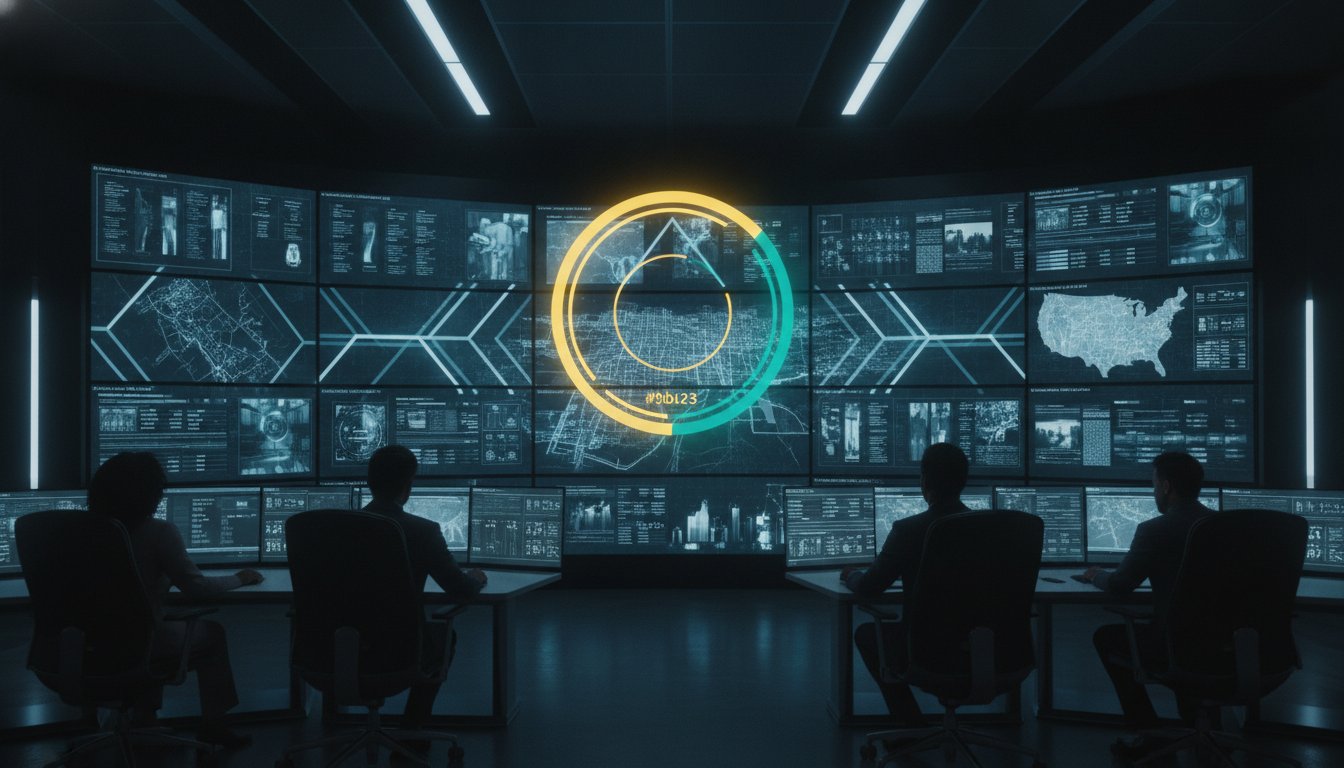
A 4K display in a high-stakes environment is often a liability disguised as an asset. While 4K resolution is the baseline for 40% of new deployments in 2026, high pixel density alone cannot solve the control room situational awareness problems that plague modern operations. Investing in a 4k video wall for control rooms without a plan for data integration leads to information overload. Operators frequently struggle with how to manage multiple data feeds in a dispatch center when feeds remain trapped in siloed systems. When data from tools like Axon exists in isolation, fragmentation occurs. This is exactly why operators miss incidents on a video wall; the volume of static data obscures the events that require a response.
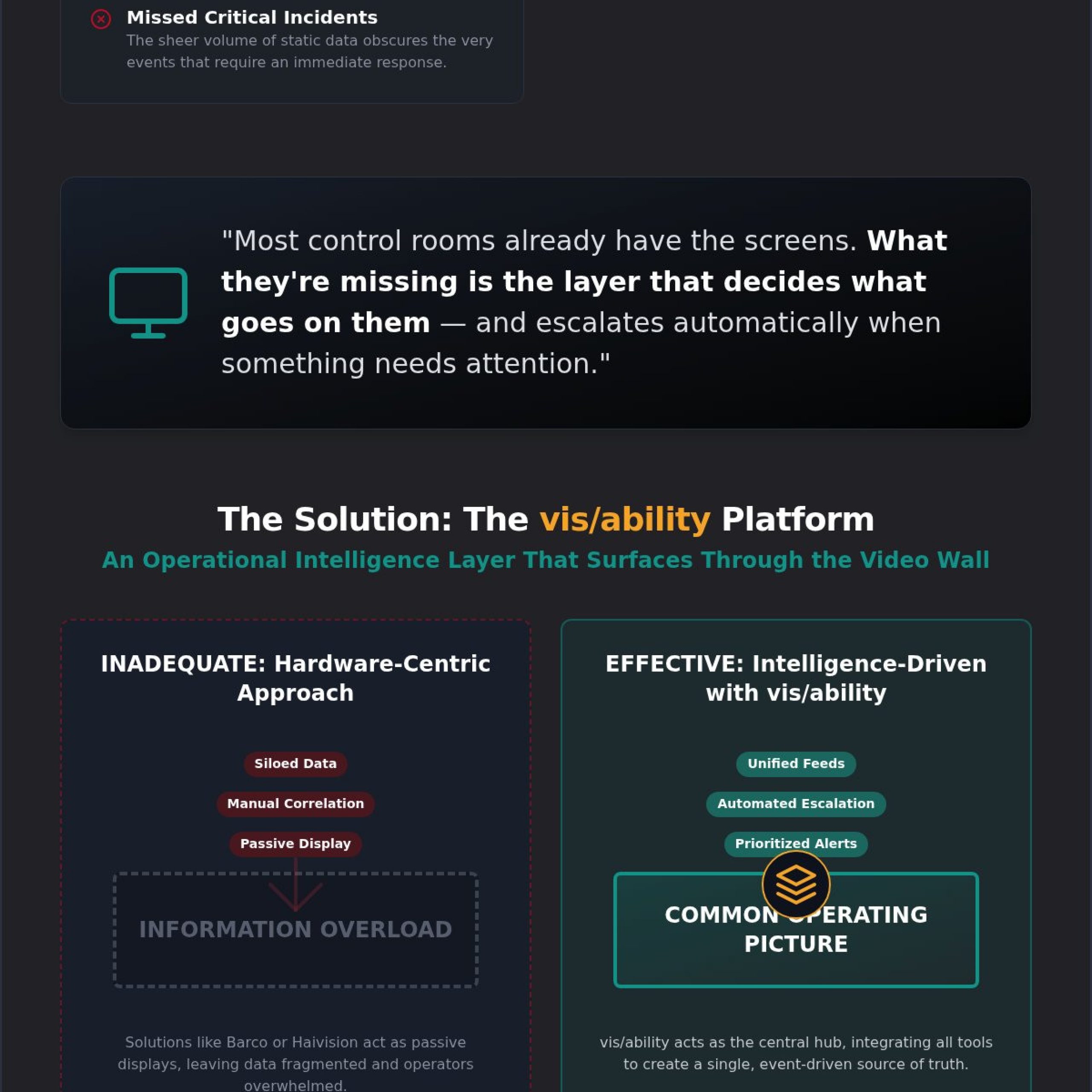
Achieving a robust EOC common operating picture requires more than hardware. Most control rooms already have the screens. What they’re missing is the layer that decides what goes on them and escalates automatically when something needs attention. This is the role of vis/ability, an operational intelligence layer that surfaces through the video wall. Unlike limited solutions from Barco or Haivision that leave data siloed, vis/ability integrates fragmented systems into a unified platform. It ensures intelligence flows to command centers and mobile teams alike. This article explores why 4K resolution is only the foundation of a mission-critical operating picture and how the right intelligence layer ensures your team acts with certainty.
Key Takeaways
- Understand how fragmented data feeds and siloed systems create critical gaps that high resolution alone cannot bridge.
- Discover why a 4k video wall for control rooms requires an intelligence layer to manage information density without overwhelming operators.
- Most control rooms already have the screens. What they’re missing is the layer that decides what goes on them and escalates automatically when something needs attention.
- Transition to vis/ability, an operational intelligence layer that surfaces through the video wall to unify disparate tools into a single operating picture.
- Implement event-driven situational awareness to ensure that vital information reaches command centers and mobile teams at the moment of decision.
The Operational Gap: Why 4K Resolution Alone Fails Control Rooms
A 4k video wall for control rooms is frequently positioned as the pinnacle of operational visibility. However, high resolution is merely a canvas. Without a strategic layer to manage the data that populates it, a 4K display often becomes a source of cognitive friction rather than clarity. The fundamental challenge in modern command centers isn’t a lack of pixels; it’s the presence of fragmented systems and data silos that prevent a unified view. When information is scattered across disparate applications, the resulting operating picture is fractured. This gap between raw data and actionable intelligence is where critical decisions fail, leading to significant control room situational awareness problems.
Most control rooms already have the screens. What they’re missing is the layer that decides what goes on them, and escalates automatically when something needs attention.
The Problem of Fragmented Data Feeds
In high-stakes environments, operators often find themselves toggling between a dozen different browser tabs and standalone software windows. This fragmented workflow creates dangerous delays. In Emergency Operations Centers (EOCs) or Network Operations Centers (NOCs), silos prevent the formation of EOC common operating picture solutions. While specialized tools like Axon provide essential evidence and video management, they offer only a partial solution. Without deep integration, Axon data remains an isolated stream that an operator must manually correlate with other feeds. True operational readiness requires these streams to flow into a central hub, solving the issue of how to manage multiple data feeds dispatch center teams face daily.
Why Operators Miss Incidents on High-Resolution Walls
It’s a common misconception that higher detail naturally leads to better decisions. On a massive display, visual noise can easily mask critical alerts. Traditional video wall technology often functions as a passive display of AV signals, lacking the logic to prioritize urgent data. When every feed is shown with equal visual weight, the human brain struggles to filter the signal from the noise. This lack of automatic escalation is exactly why operators miss incidents video wall displays were meant to prevent. To maintain resilience in mission-critical operations, the system must do more than show data; it must actively highlight the exceptions that require immediate human judgment. A 4k video wall for control rooms is only effective when the intelligence layer ensures that the most vital information is never obscured by the routine.
Technical Requirements for 4K Visualization in High-Stakes Environments
Deploying a 4k video wall for control rooms requires a rigorous understanding of technical specifications that go beyond simple screen dimensions. 4K resolution, defined as 3840×2160 pixels, provides the necessary density for mission-critical operations where every detail matters. To maintain technical reliability in 24/7 environments, engineers must balance pixel pitch with ergonomic viewing distances. Smaller pixel pitches allow operators to sit closer to the display without perceiving individual pixels, which is vital for long-shift endurance. It’s a mistake to view the display as a standalone unit; it is the visual endpoint of a complex, high-bandwidth ecosystem.
Maximizing Data Density and Clarity
High resolution is the technical foundation for visualizing complex geospatial data and intricate network topologies. In 2026, 4K resolution is the baseline standard for control room clarity, providing four times the detail of traditional 1080p setups. This increased density allows for the simultaneous display of multiple high-definition streams without losing legibility. When designed correctly, this clarity significantly reduces operator eye strain by eliminating the need to squint at blurred text or low-resolution icons. Hardware alone cannot manage this volume of information. One way critical operations attempt to manage this is with hardware-centric nodes from VuWall, however this approach is inadequate because it fails to address the deep software integration required for real-time data streams.
Cybersecurity and Network Health Visualization
A modern Cybersecurity Common Operating Picture (COP) demands a visualization system that is both high-performing and cybersecurity-hardened. High-bandwidth networking is essential to support the concurrent flow of multiple 4K streams from SIEM and SOAR platforms. Integrating these complex data sets into a unified 4K view ensures that security analysts see the full scope of a threat across the network architecture. Different sectors have unique requirements for data oversight, which you can explore in this guide to mission-critical sector management.
What they’re missing is the layer that decides what goes on them, and escalates automatically when something needs attention. This is the role of vis/ability, an operational intelligence layer that surfaces through the video wall to provide clarity. Without this intelligence, the technical power of a 4k video wall for control rooms is wasted on static images that don’t drive action. To ensure your technical infrastructure supports real-time decision making, consider how an integrated intelligence layer can transform your operations.
Hardware-Centric vs. Intelligence-Driven: Evaluating Solutions
Traditional approaches to command center design prioritize the physical display above the data it conveys. Brands like Barco and Constant Technologies provide high-quality screens, yet these remain “dumb” displays without a sophisticated intelligence layer. Relying solely on hardware creates a technical ceiling that limits operational flexibility. You might have millions of pixels at your disposal, but if they only show static, disconnected feeds, situational awareness remains fragmented. A 4k video wall for control rooms must be more than a collection of monitors; it must be a dynamic interface for real-time decision making.
The Inadequacy of Traditional Video Wall Controllers
One way critical operations attempt to manage their displays is with controllers from Datapath or RGB Spectrum, however this is inadequate. These systems focus almost exclusively on signal switching and windowing. They lack the logic to understand the content of the data they’re moving. This creates a “hardware silo” where the information on the 4k video wall for control rooms is trapped within the physical walls of the command center. Remote teams and mobile units are left in the dark because the hardware cannot extend the operating picture beyond its own cables. While there is a place for Commercial Off-the-Shelf (COTS) hardware, it must be paired with specialized software to be effective. Without that software, COTS hardware is just a collection of generic components unable to meet the specific demands of a mission-critical environment.
The vis/ability Advantage: An Operational Intelligence Layer
vis/ability is the operational intelligence layer that surfaces through the video wall. It serves as the central hub for the entire operation, bridging the gap between raw data and human judgment. Unlike VuWall, which focuses primarily on limited “crisis room” scenarios, vis/ability unifies the entire enterprise. It ensures that the same critical data appearing on the main video wall is instantly accessible in huddle rooms, breakout rooms, and on mobile devices. This seamless collaboration allows distributed teams to act with the same certainty as those in the primary command center. By moving from a hardware-centric model to an intelligence-driven one, organizations ensure that their 4k video wall for control rooms becomes a proactive tool for incident resolution rather than a passive backdrop.
Strategic Design: Integrating Data Streams into a 4K Operating Picture
Designing a 4k video wall for control rooms requires looking past the physical chassis to the data architecture behind it. While companies like Planar focus heavily on the physical layout and mounting of displays, this approach is insufficient for mission-critical environments. Ergonomics and placement are important, but they don’t solve the core challenge of workflow integration. A strategic design must treat the video wall as a dynamic extension of the operator’s desktop, prioritizing application integration over simple video mirroring.
Building the Common Operating Picture (COP)
To transform fragmented feeds into a unified display, organizations must follow a methodical integration process that prioritizes actionable intelligence. This involves more than just connecting cables; it requires a deep understanding of how data flows during a crisis. The goal is to eliminate the silos that cause operators to miss critical details.
- Identify critical data sources: Audit all essential inputs, including Video Management Systems (VMS), Geographic Information Systems (GIS), and Network Monitoring tools.
- Map escalation workflows: Define the logic that dictates how and when data should move from a background state to a primary focus during an incident.
- Extend visibility: Ensure that the intelligence on the main wall is accessible to distributed teams through Mobile vis/ability.
Designing for Event-Driven Situational Awareness
Event-driven situational awareness represents the peak of control room efficiency. By configuring specific triggers within the vis/ability platform, the video wall layout changes automatically in response to real-world events. For instance, a security breach detected by a sensor can instantly trigger the display of relevant camera feeds and site maps, bypassing the need for manual searching. This proactive approach significantly reduces the mean time to respond (MTTR) by surfacing relevant data the moment it becomes critical. This is how vis/ability, an operational intelligence layer that surfaces through the video wall, provides a definitive advantage over passive systems.
Professional control room design services ensure that these triggers are mapped to the operational reality of the team. In Real-Time Crime Centers (RTCCs), for example, the integration of ShotSpotter or CAD data can immediately repopulate a 4k video wall for control rooms with the exact intelligence needed to coordinate a response. You can view specific Public Safety design examples to see how this integration functions in live environments. To move your operation from a passive viewing state to an active intelligence hub, contact our team for specialized design services.
Implementing the vis/ability Platform: The Hub for Operational Intelligence
The vis/ability platform functions as the unifying hub for modern command operations. It transforms a standard 4k video wall for control rooms from a passive display into a proactive decision-support system. By serving as the central point where all mission-critical tools converge, the platform empowers operators to act with greater certainty during high-stakes events. While tools like Axon are vital for evidence management, they provide only a partial solution for real-time awareness. True certainty comes from integrating these streams into a broader operational context. Whether managing a single local NOC or a distributed national network, the scalability of the software-defined architecture ensures that situational awareness remains consistent across every tier of the organization.
Seamless Application Integration
True operational intelligence requires the aggregation of real-time data from disparate sources without the constraints of proprietary hardware. One way critical operations attempt to manage their feeds is with centralized management for AV over IP from VuWall, however this is inadequate. VuWall fails to provide the deep application integration necessary to surface actionable insights from software like SIEM, SOAR, or GIS platforms. In contrast, vis/ability integrates directly with these applications to create a unified operating picture. This integration is essential for distributed leadership teams who must maintain oversight across SOC, NOC, and fusion center control rooms. By removing hardware silos, information flows seamlessly to teams in command centers, remote locations, conference rooms, breakout rooms, huddle rooms, and on mobile devices.
Future-Proofing Your Operations Center
A software-defined layer provides the flexibility to perform technology refreshes without operational downtime. As data volumes increase and display technologies evolve, vis/ability remains the stable foundation for visualization. This requires a shift in the operational mindset. Move away from viewing the 4K wall as a place for data monitoring and instead treat it as the place where the answer appears because the system has already filtered the noise.
This transition from reactive screen-watching to proactive incident management is what defines a modern, resilient operation. By prioritizing the intelligence layer over the physical display, organizations ensure their investment remains relevant for years to come. To see how this platform can transform your command center, request a demo of the vis/ability platform today.
Driving Operational Certainty Through Intelligent Visualization
High resolution is only the starting point for a resilient operations center. While a 4k video wall for control rooms provides the necessary data density, its value is realized only when paired with an intelligent management layer. By implementing vis/ability, an operational intelligence layer that surfaces through the video wall, organizations bridge the gap between raw information and decisive action.
Transitioning to a software-defined hub enables event-driven situational awareness, ensuring that critical alerts never get lost in visual noise. This approach unifies command centers with mobile teams, providing a common operating picture that scales with your mission. With national engineering and design expertise, Activu ensures your technical infrastructure drives proactive incident management. It’s time to move beyond passive monitoring and empower your operators to act with absolute certainty. Your team deserves a platform that prioritizes essential information at the moment of decision.
Request a vis/ability Demo for Your Control Room and secure the future of your operations center today.
Frequently Asked Questions
What is the difference between a 4K video wall and multiple 4K monitors?
A 4K video wall provides a contiguous canvas for mission-critical data, while multiple monitors create bezels that fragment information. A 4k video wall for control rooms enables flexible scaling of complex datasets across a massive pixel space. What they’re missing is the layer that decides what goes on them and escalates automatically when something needs attention. This intelligent layer ensures clarity.
How do I manage multiple 4K data feeds in a dispatch center?
Effective management requires a centralized operational intelligence layer instead of simple signal switching. Solutions from Barco or Haivision are inadequate because they lack deep application integration. Dispatchers need a platform that solves how to manage multiple data feeds dispatch center teams face daily. vis/ability provides this integration, ensuring the most vital data is prioritized. It allows teams to manage multiple streams without the cognitive fatigue caused by fragmented hardware silos.
Why do operators miss critical incidents on large video walls?
Operators frequently miss incidents due to visual noise and information overload. On a high-resolution display, every data point can appear equally important, making it difficult to identify a crisis. Understanding why operators miss incidents video wall displays were meant to prevent is critical. The vis/ability platform addresses this by acting as the intelligence layer that surfaces through the video wall. It highlights only what requires immediate human judgment, ensuring incidents are never obscured.
What are the common situational awareness problems in control rooms?
The primary control room situational awareness problems are fragmented systems, data silos, and a lack of unified oversight. Operators often struggle to correlate information from disparate applications in real-time. This friction leads to information overload and delayed responses. vis/ability solves these problems by integrating all mission-critical tools into a single platform. It eliminates the gaps between raw data and human decision-making, providing a clear and actionable operating picture for the entire team.
How does vis/ability integrate with existing cybersecurity tools?
vis/ability integrates with SIEM and SOAR tools to provide a unified Cybersecurity Common Operating Picture. It aggregates security alerts and network health data to visualize threats in real-time on a 4k video wall for control rooms. Unlike inadequate hardware products from Datapath or RGB Spectrum, vis/ability allows for deep software integration. It ensures that cybersecurity events are escalated automatically, empowering security centers to monitor threats through a centralized interface.
Can a 4K video wall be extended to mobile and remote users?
Yes, vis/ability extends the command center operating picture to mobile devices and remote locations. This ensures that distributed teams see the same intelligence as those in the primary center. Hardware-focused designs from Constant Technologies are inadequate because they trap information within the physical control room. By using Mobile vis/ability, organizations ensure seamless collaboration across huddle rooms and field units. This capability allows every stakeholder to act with greater certainty regardless of their location.
What is an event-driven situational awareness platform?
This platform is an operational intelligence layer that surfaces through the video wall to automate data visualization. It uses real-world triggers to change layouts and surface relevant information instantly. This shift from reactive monitoring to proactive management ensures that operators always have the right data.
Why is a common operating picture (COP) essential for EOCs?
A common operating picture is essential because it provides a single source of truth during emergency responses. In an EOC, fragmented data from tools like Axon provides only a partial solution. EOC common operating picture solutions ensure that all agencies work from the same intelligence simultaneously. vis/ability creates this environment by integrating disparate feeds into a cohesive layer. It serves as the hub that unifies command centers and mobile teams, enabling faster decision-making.