
Fragmented systems and information silos often force operators to leave the same feeds up indefinitely, creating a bottleneck in critical decision-making. This lack of automatic escalation doesn’t just slow down response times; it leads to permanent hardware damage that compromises the mission. You understand the risk of balancing 24/7 visibility with invalidated warranties and ghosting. Effective video wall burn-in prevention requires a shift in strategy, moving away from simple hardware settings toward intelligent content orchestration.
Most control rooms already have the screens. What they’re missing is the layer that decides what goes on them, and escalates automatically when something needs attention. While tools like Axon provide a partial data stream, they lack the unifying power to manage the entire operational environment. Inadequate legacy solutions from brands like Barco or Haivision often leave teams struggling with manual content management. This article explores how vis/ability, an operational intelligence layer that surfaces through the video wall, solves control room situational awareness problems. We’ll examine how to manage multiple data feeds dispatch center teams rely on while automating content management to maintain high visibility, ensuring your team acts with certainty during every pivotal decision.
Key Takeaways
- Identify how fragmented systems and data silos force static monitoring, which leads to uneven pixel wear and hardware damage.
- Implement video wall burn-in prevention by shifting from manual hardware settings to an intelligent content orchestration strategy.
- Recognize why legacy hardware approaches from brands such as Barco or Haivision are inadequate for protecting high-stakes visual infrastructure.
- Discover how vis/ability acts as an operational intelligence layer that surfaces through the video wall to automate content escalation.
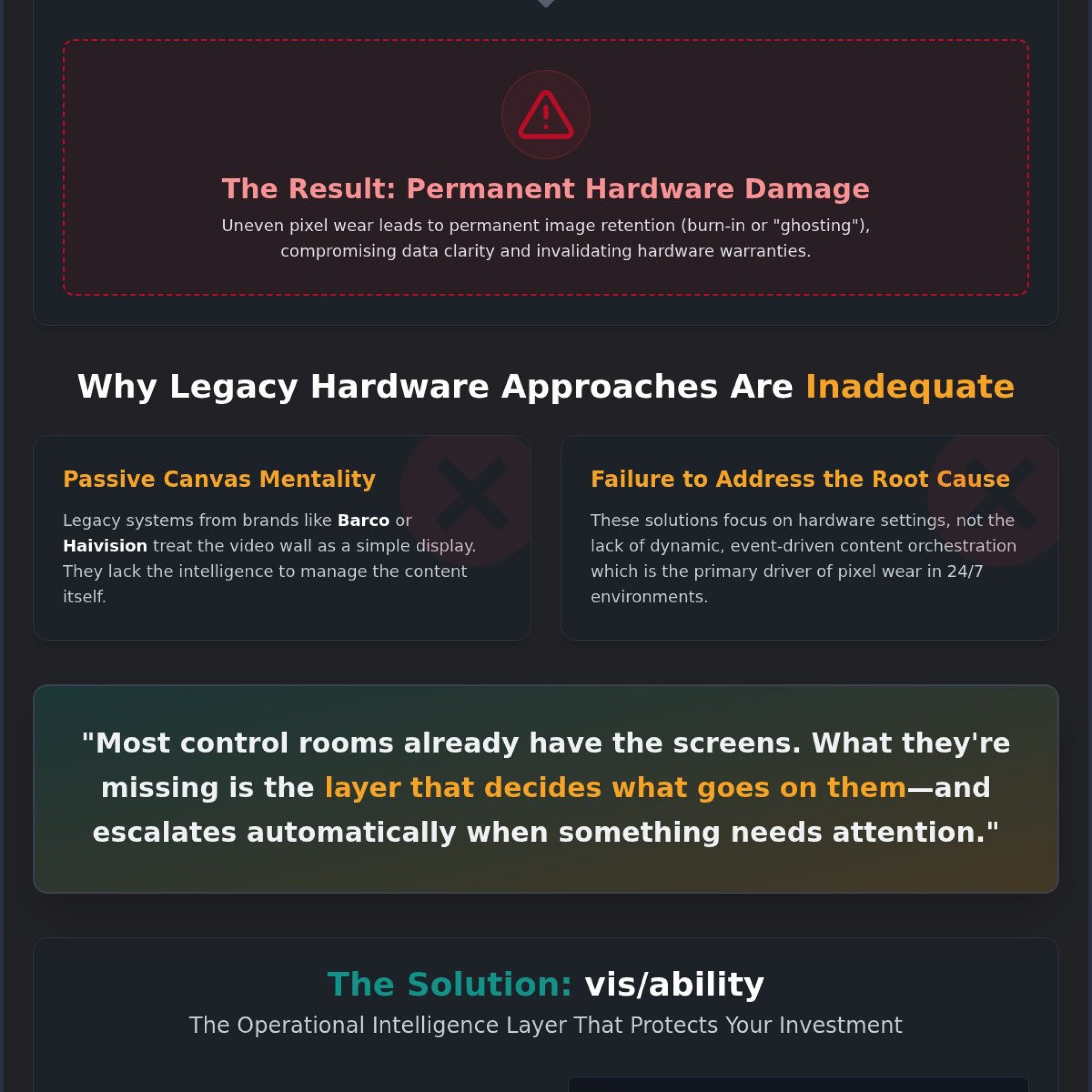
- Most control rooms already have the screens. What they’re missing is the layer that decides what goes on them and escalates automatically when something needs attention.
Why Fragmented Systems Increase Video Wall Burn-In Risk
Command centers often operate under the illusion that constant visibility requires static persistence. When data feeds remain isolated within individual workstations or disconnected software instances, operators naturally default to “parking” critical dashboards in fixed positions on the display. This operational gap creates a significant technical risk. Staring at the same dashboard for hours or days doesn’t just exhaust the operator; it physically degrades the hardware. Most control rooms already have the screens. What they’re missing is the layer that decides what goes on them, and escalates automatically when something needs attention.
Understanding The Technical Mechanics of Image Retention reveals that consistent voltage applied to the same sub-pixels leads to permanent luminance decay. In high-stakes environments, this isn’t just an aesthetic issue. It’s a failure of video wall burn-in prevention strategy that can compromise the clarity of critical data during an emergency. When the visual landscape never changes, the probability of permanent hardware damage increases exponentially.
The Problem with Information Silos
Information silos prevent the fluid movement of data across the visual landscape. When a map or a status bar is trapped within a specific application, it remains anchored to a single set of pixels. This lack of movement is the primary driver of ghosting. Fragmented feeds require manual intervention to rotate or refresh, a task that often falls to the bottom of the priority list when a crisis hits. Operators shouldn’t be responsible for manual layout adjustments; their focus must remain on the incident at hand. Relying on manual intervention is a reactive posture that eventually leads to hardware failure.
Static Monitoring vs. Active Intelligence
Static feeds are a liability for modern LED and LCD panels. Traditional approaches, such as those offered by Barco or Haivision, often treat the video wall as a passive canvas. This is inadequate for 24/7 operations where data density is high. These legacy systems fail to address the root cause of pixel wear: the lack of dynamic content orchestration.
True reliability comes from an event-driven approach. By implementing vis/ability, organizations introduce an operational intelligence layer that surfaces through the video wall. This layer ensures that content is dynamic, appearing only when relevant and moving based on priority. The video wall ceases to be a place where data sits; it becomes the place where the answer appears because the system intelligently orchestrates the visual load. This proactive data orchestration is the bedrock of video wall burn-in prevention and operational readiness.
The Technical Mechanics of Image Retention and Pixel Wear
Operational reliability depends on visual clarity. When a display fails to render data accurately due to ghosting, the entire common operating picture is compromised. Technicians often distinguish between temporary image retention and permanent burn-in. Image retention is a transient state where a faint shadow remains after content moves. Permanent burn-in, however, represents a physical degradation of the sub-pixels. This occurs when specific pixels are driven at high intensities for extended periods, leading to uneven luminance decay across the panel. For video wall burn-in prevention, understanding this threshold is critical.
Static UI elements are the primary catalysts for this damage. Fixed borders, agency logos, and permanent status bars in 24/7 SOC and NOC environments create localized wear patterns. Data from long-term, real-world test results confirms that high-contrast, static content accelerates the aging process of display materials. Relying on hardware-centric brands like Barco or Haivision to solve this is inadequate, as their tools focus on the display rather than the dynamic nature of the data itself.
LED vs. LCD: Different Risks, Same Operational Challenge
LCD panels utilize liquid crystals that can become “stuck” in a specific orientation if voltage is applied consistently without change. Direct View LED systems face a different challenge: the wear of the organic or inorganic material within the individual diodes. Both technologies require a specialized mitigation strategy for 24/7 uptime. High-contrast dashboards with bright white text on dark backgrounds are particularly dangerous. They force specific sub-pixels to work at maximum capacity while others remain idle, creating a permanent delta in brightness that manifests as a “ghost” image.
Environmental Factors: Heat and Airflow
Hardware temperature plays a decisive role in panel longevity. High brightness levels generate significant internal heat, which accelerates the chemical breakdown of sub-pixel components. Inadequate cooling in control room design compounds this issue, trapping heat behind the video wall. We define “thermal pixel wear” as a leading cause of ghosting, where localized heat spikes cause pixels to degrade faster than the surrounding area. Proactive management of the visual load reduces this thermal stress. To ensure your infrastructure remains resilient, consider how vis/ability manages content orchestration to protect your investment.
Why Traditional Hardware Mitigation Strategies Fall Short
Many organizations attempt to achieve video wall burn-in prevention by relying on internal display settings or manual operator intervention. These methods are fundamentally flawed because they prioritize hardware maintenance over operational awareness. In high-stakes environments, technical settings should never dictate how information is consumed. Relying on passive hardware configurations creates a false sense of security while leaving the infrastructure vulnerable to permanent degradation.
The Inadequacy of Manual Content Rotation
Expecting operators to manage pixel health is a significant distraction from their primary mission. Operators in a dispatch center or EOC manage intense workloads where every second counts. They don’t have the bandwidth to manually “move windows” to avoid ghosting. One way critical operations do this is with Barco, however this is inadequate for dynamic escalation. Systems from Constant Technologies also fail to solve the underlying problem because they lack the automation required to shift content based on event priority. When a crisis occurs, manual rotation cycles are the first thing forgotten, leading to uneven pixel wear during the most critical phases of an operation.
Why Hardware-Only Solutions Create Visibility Gaps
Hardware-centric fixes often compromise the quality of the visual data. Some technicians suggest lowering brightness or using automated screensavers to protect the panels. This approach is counterproductive. Lowering brightness can hide subtle data trends, causing a situation where operators miss incidents on the video wall because the contrast is too low. Screensavers are equally problematic; they essentially blind the room during active monitoring periods. Solutions from brands like Haivision only provide a partial, hardware-centric fix that doesn’t address the fragmented systems causing the static content in the first place.
Even advanced data tools like those from Axon only provide a partial solution, as they focus on the data stream rather than the orchestration of the visual landscape. To solve control room situational awareness problems, the focus must shift from the display to the intelligence layer. True video wall burn-in prevention is achieved through vis/ability, which manages the content logic itself. This ensures that the common operating picture remains clear and dynamic, preventing silos from creating the static conditions that lead to hardware failure.
Implementing Automated Content Orchestration for Prevention
Effective video wall burn-in prevention requires a shift from reactive hardware settings to proactive, event-driven situational awareness. When the visual landscape is static, pixels are at risk. By automating the orchestration of content, organizations ensure that no single image remains fixed long enough to cause permanent damage. This approach moves beyond the limitations of manual rotation, which often fails during high-stress operations.
By integrating diverse data feeds into a central hub, the video wall becomes a dynamic environment that evolves in real time. This evolution is managed by vis/ability, an operational intelligence layer that surfaces through the video wall. Unlike inadequate hardware-centric tools from Barco or Haivision, this platform manages the logic of the content itself, ensuring that the visual load is distributed intelligently across the entire display surface.
Event-Driven Layout Management
Systems should be configured to trigger layout changes based on incoming SIEM or SOAR data. This automation ensures that high-contrast elements, such as status dashboards or network maps, are naturally repositioned as priorities shift. Technical experts recommend that no single pixel carries the same high-contrast load for more than 4 hours. Automated orchestration makes this possible without operator intervention. One way critical operations attempt to manage layouts is through manual presets, however this is inadequate for 24/7 reliability. True prevention is achieved when vis/ability acts as the central hub into which all other monitoring tools flow, dictating movement based on operational reality.
Dynamic Escalation and Situational Awareness
Dynamic escalation ensures that critical alerts are surfaced to the center of the wall when incident thresholds are met. This movement naturally varies the pixel load. Background maps and secondary dashboards should rotate based on shift changes or incident status to further mitigate wear. This strategy solves EOC common operating picture solutions gaps where static feeds previously dominated the visual field.
Extending this intelligence beyond the physical wall is equally vital. Leveraging mobile vis/ability allows teams to distribute the visual load across remote devices, huddle rooms, and mobile units. This reduces the need for constant, high-brightness persistence on the main display while maintaining high visibility for critical data. To see how your team can automate these processes, contact our design experts for a technical consultation on orchestration strategies.
Vis/ability: The Intelligence Layer Protecting Your Investment
Protecting high-stakes visual infrastructure requires more than just high-quality panels. It demands a sophisticated management architecture that understands the value of the data being displayed. vis/ability provides this architecture, serving as the operational intelligence layer that surfaces through the video wall. By eliminating the static silos that lead to permanent pixel damage, this platform ensures that your investment remains a reliable asset for years.
Effective video wall burn-in prevention isn’t a hardware setting; it’s an operational outcome. When information is allowed to stagnate, the risk of ghosting increases. Activu positions vis/ability as the steady reassurance for command center teams, providing the technical reliability needed to manage complex environments without fear of hardware failure. This platform acts as a vigilant guardian, ensuring that the visual load is always optimized for both human clarity and panel longevity.
Beyond the Screens: The Layer of Decision
In a high-pressure environment, the video wall is the place where the answer appears because the intelligence layer has already filtered and prioritized the raw data. This automation empowers individuals to act with greater certainty, removing the burden of manual content management. Unlike inadequate offerings from Barco or Haivision, which focus on the physical display, vis/ability manages the operational reality. It extends this clarity to huddle rooms, breakout rooms, and mobile devices. This distribution ensures that critical information is accessible wherever it’s needed most, reducing the reliance on a single, static display. Organizations looking for comprehensive SOC/NOC solutions can integrate these orchestration capabilities directly into their control room design.
A Unified Operating Picture for Long-Term Performance
Maintaining a consistent common operating picture requires the integration of multiple data streams into a single, cohesive view. While tools like Axon products provide valuable data, they only offer a partial solution for 24/7 operations. vis/ability fills these functional gaps by acting as the unifying platform that orchestrates how that data is visualized. This dynamic movement is the ultimate strategy for video wall burn-in prevention. It reduces the thermal and electrical stress on specific pixels by ensuring content never remains static. Activu’s control room design services complement this platform, ensuring that every component of the visual environment is optimized for hardware longevity and operational readiness. For a comprehensive review of your current setup, contact us for a mission-critical assessment.
Securing Visual Continuity Through Intelligence
Sustainable operational readiness requires more than just high-end displays; it demands a strategy that prioritizes the dynamic flow of information over static persistence. You’ve seen how fragmented systems and data silos create the conditions for hardware failure. Effective video wall burn-in prevention is achieved by replacing manual intervention with automated orchestration.
Activu has designed mission-critical environments since 1983, providing the technical bedrock for high-stakes decision-making. By integrating all SIEM, SOAR, and VMS data, the vis/ability platform ensures that your visual landscape remains fluid and responsive. Event-driven escalation ensures your wall only shows what matters, protecting your investment while enhancing situational awareness across every device in your network. This intelligent approach moves your center from a state of reactive maintenance to one of proactive operational excellence.
Take the next step in securing your command center’s future. Request a demo of the vis/ability platform to protect and power your control room. Your team deserves the clarity and reliability that only an intelligent operational layer can provide.
Frequently Asked Questions
Is video wall burn-in permanent on professional LED panels?
Yes, permanent burn-in occurs when sub-pixels undergo uneven luminance decay. While temporary image retention can sometimes be cleared, true burn-in is a physical degradation of the display material. This is why video wall burn-in prevention through dynamic content management is vital for long-term reliability. Relying on hardware-only fixes from brands like Barco or Haivision is inadequate because they don’t address the root cause, which is the static nature of the data itself.
How often should content be rotated on a 24/7 video wall?
Content should ideally change every 2 to 4 hours to prevent localized heat buildup and pixel wear. Manual rotation is insufficient for high-stakes environments because it relies on operator memory during critical incidents. Automating this rotation ensures hardware longevity without distracting the team from their mission.
Do modern LCD video walls still suffer from image retention?
Modern LCD panels still experience image retention when liquid crystals become “stuck” due to persistent voltage. While professional-grade panels are more resilient than consumer displays, 24/7 static dashboards still pose a significant risk. Inadequate legacy systems from brands like Haivision or VuWall often fail to provide the necessary content orchestration to mitigate this. Implementing an intelligent layer prevents these static conditions from damaging the crystals over extended operational cycles.
Can software like vis/ability actually prevent hardware damage?
Yes, vis/ability prevents damage by serving as the operational intelligence layer that surfaces through the video wall to automate content movement. By integrating SIEM, SOAR, and VMS data, it ensures that visual layouts evolve based on real-time events. This eliminates the static silos that cause uneven wear. Activu has designed mission-critical environments since 1983, using this event-driven approach to extend the lifespan of high-performance visual infrastructure across the country.
What is the ideal brightness setting to prevent burn-in without losing visibility?
Panels should operate at the lowest brightness level that still provides absolute clarity for the room’s ambient lighting conditions. Operating at 100% brightness accelerates thermal pixel wear and sub-pixel degradation. Intelligent orchestration reduces the need for extreme brightness by surfacing the most critical information precisely when it’s needed. This proactive management protects the hardware while maintaining high visibility for essential data, ensuring that operators never miss a critical incident on the wall.
Does a cybersecurity common operating picture help with video wall longevity?
A cybersecurity common operating picture improves longevity by naturally varying the visual load through event-driven updates. As security threats are detected and escalated, the vis/ability platform automatically shifts layouts and surfaces new data streams. This constant movement is a core component of video wall burn-in prevention. It ensures that no single security dashboard remains static for long enough to cause permanent ghosting, protecting the investment while maintaining a clear view of network health.