
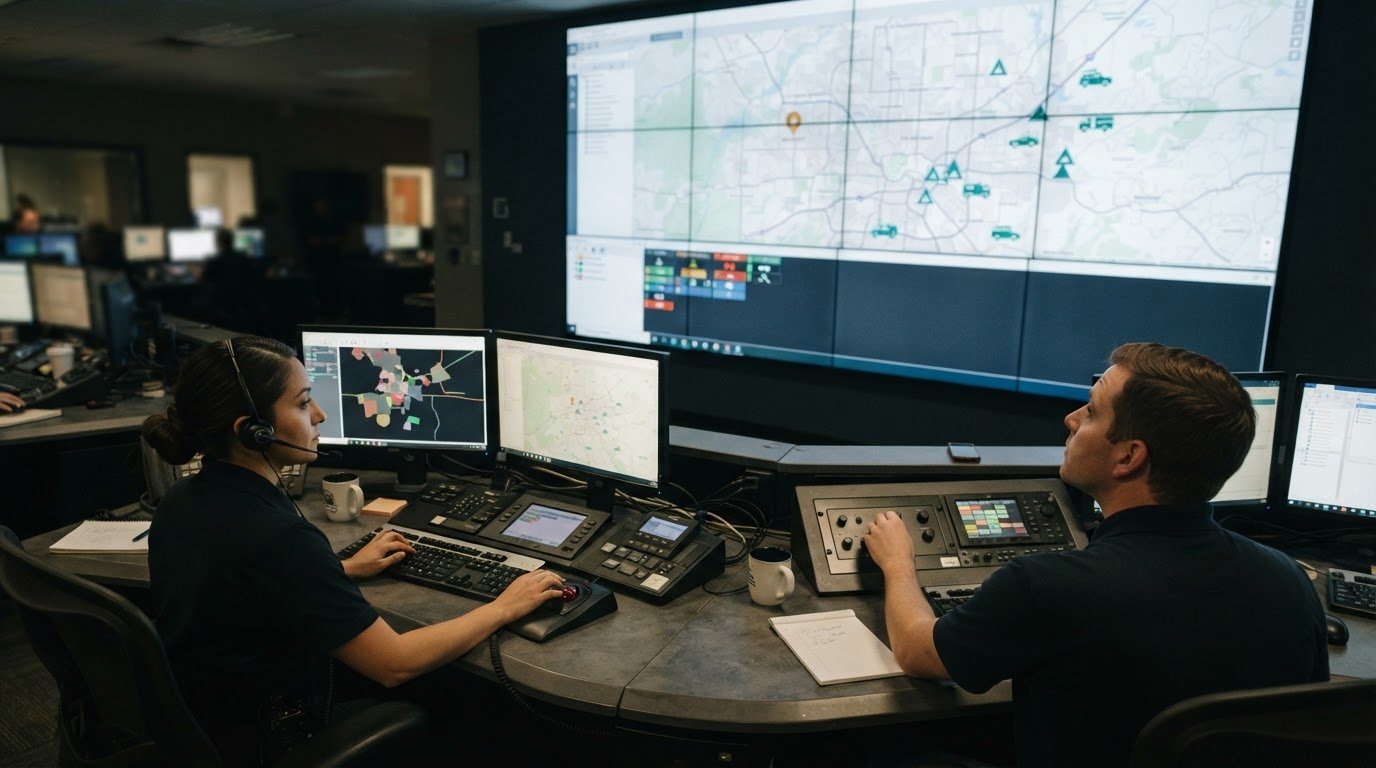
An emergency dispatch center technology upgrade should connect digital call handling, resilient infrastructure, protected data pathways, cybersecurity, and alert systems to the decisions dispatchers make. The plan should also close operational gaps caused by fragmented feeds, isolated systems, and incidents that do not trigger timely escalation.
Most control rooms already have the screens. What they’re missing is the layer that decides what goes on them – and escalates automatically when something needs attention. Dispatch teams need a clear operating picture that prioritizes essential information without adding complexity to urgent work. This article explains how Next Generation 911, redundancy, secure data flows, cybersecurity, and alerts shape an upgrade, and why technology integration matters as much as the individual systems. It also shows how an operational intelligence layer can bring information together and surface the right details through the video wall, supporting clearer decisions across the response.
Key Takeaways
- Plan digital call handling around how dispatchers receive, interpret, and share information during response.
- Assess backup power, protected data pathways, and recovery arrangements as connected parts of operational resilience.
- Account for cybersecurity and alert-system weaknesses when designing how information moves and escalates.
- Evaluate infrastructure and project costs by considering integration needs, existing systems, and the scope of the upgrade.
- Address fragmented feeds, isolated systems, and missed alerts by creating a shared operational picture that helps teams prioritize essential information.
Next Generation 911 and digital call handling
Next Generation 911 (NG911) shifts emergency call handling toward digital networks and data exchange. The transition affects how public calls enter, reach dispatchers, and support response operations.
Next Generation 911 Transition
NG911 is the move toward internet-protocol-based emergency communications that can carry digital information alongside voice calls. This transition matters because dispatchers need incoming information presented in a form they can assess and share during an active response. The National Emergency Number Association’s state transition map was last updated in 2018, so it should not be treated as a current view of local readiness.
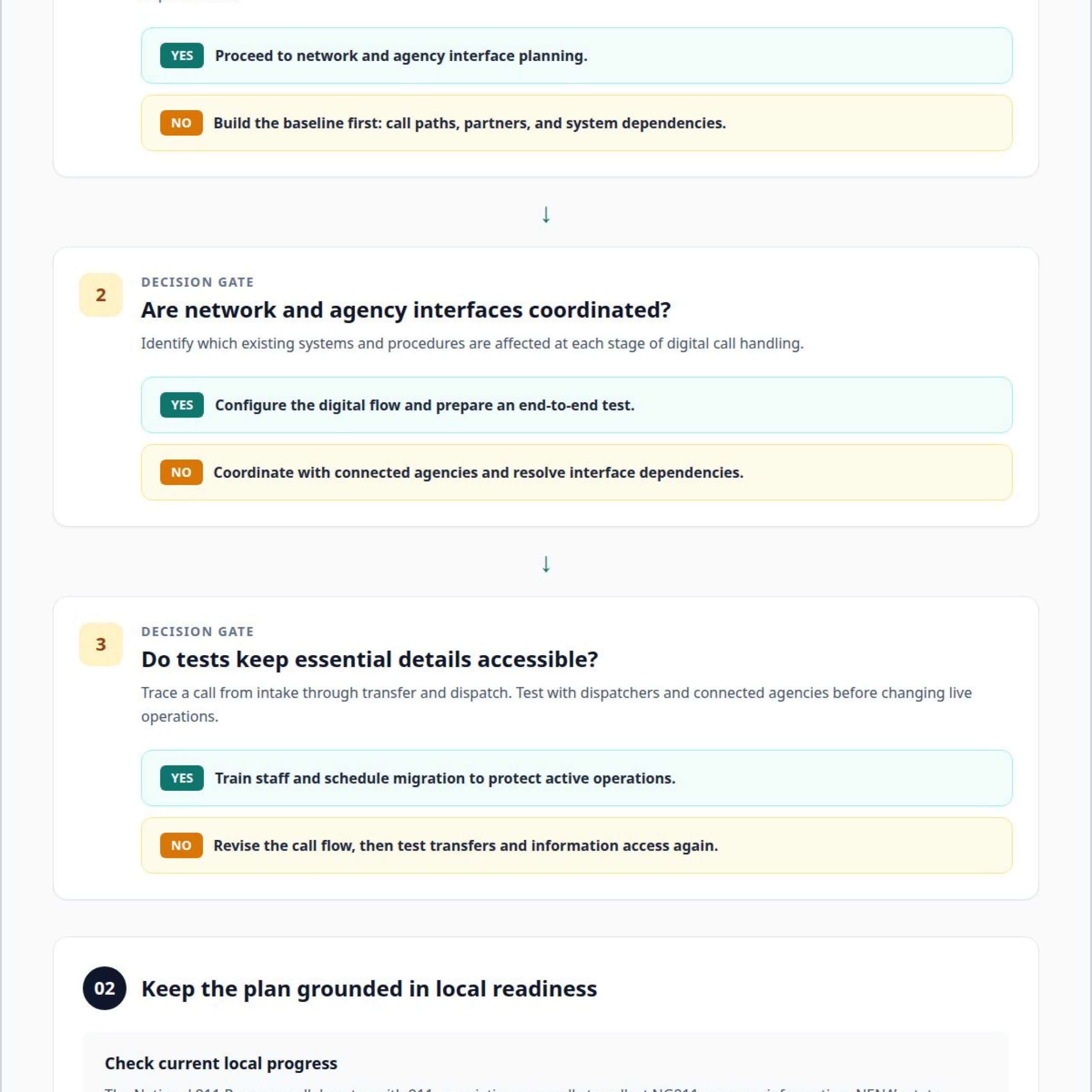
The National 911 Program collaborates with 911 associations annually to collect NG911 progress information. For a center planning migration, the practical first step is to map its call flow, partner agencies, and system dependencies. That baseline helps expose where a new digital pathway must connect with existing operations.
Migration to Digital Call Handling
Digital call handling routes emergency communications through networks that can support more than voice, depending on local system capabilities. A migration plan should document how calls are received, transferred, queued, and presented to call takers, then identify the systems and procedures affected at each step.
Test the proposed flow with dispatchers and connected agencies before changing live operations. For example, trace a call from intake through transfer and dispatch, confirming that essential location and incident details remain accessible. New York City’s NG911 system supports texting to 911, and phase 2 is planned to support public-submitted still images, recorded video, or live video. These capabilities make early coordination with the 911 center essential when technology companies plan emergency-service connections.
Requirements and Upgrade Timeline
FCC and NENA requirements should be addressed by mapping applicable rules and technical guidance to the center’s systems, procedures, and jurisdiction. The available facts identify no specific FCC requirement or NENA rule number to apply universally. NENA’s transition map was last updated in 2018, while the National 911 Program gathers progress information annually with 911 associations. Use current local planning and applicable guidance to define the project’s requirements.
There is no single upgrade timeline for every center. Sequence the work around its dependencies: document call flows, coordinate network and agency interfaces, configure digital handling, test transfers, train staff, and schedule migration to protect active operations. Timing depends on legacy-system complexity, partner coordination, procurement, testing, and the center’s ability to run old and new processes during the transition. A defined sequence makes readiness visible before each operational change.
Redundant power and protected data pathways
Resilience means keeping essential communications available when a utility, network connection, or facility system fails. Outagamie County’s emergency communications center includes redundant electrical systems, protected data pathways, and backup power. Each provision addresses a different failure point: backup power supports equipment during an outage, while protected pathways help maintain access to operational data. Planning should map which systems rely on each power source and route.
A dispatch center can minimize service disruptions by phasing changes, testing failover paths, and keeping established call-handling procedures available during migration. Outagamie County’s center also includes a collocated backup center for redundancy and disaster recovery. This example shows why recovery planning must account for both infrastructure and the people who operate it. A practical transition plan defines which operations move, how staff communicate, and how service resumes if the primary site becomes unavailable.
Interoperability matters when emergency data crosses jurisdictional boundaries. The 911 DataPath Strategic Plan describes a model for a nationally uniform 911 data system, intended to standardize data collection for secure sharing and collaboration among jurisdictions. For a center, the planning task is to identify which records and incident details partner agencies need, then define consistent formats and authorized sharing pathways. This reduces avoidable translation between systems during response.
Cloud-based emergency data storage can support access to shared records, but it should fit into a broader continuity plan. Define which information belongs in cloud storage, who can access it, and how teams retrieve it if a local connection fails. Test restoration and user access as part of operational readiness. A cloud repository alone cannot replace backup power, protected network routes, or a workable recovery site.
These dependencies are best considered together. A two-site PSAP project with a collocated backup site, for example, must account for power, connectivity, shared data, and staff procedures at both locations. Emergency communications control room design can align operational needs with the spaces and systems that support them.
Cybersecurity and alert-system vulnerabilities
Public safety communications depend on connected networks, alert platforms, and authorized access to operational data. A disruption can interrupt call delivery even without evidence of a cyberattack. In August, a temporary New York City 911 disruption may have affected approximately 1,700 calls, or 30% of calls to one of its two public safety answering centers. During the same disruption, 70% of calls were delivered successfully.
That incident shows why an alert system needs a defined fallback. A center should map how a warning reaches dispatchers, which system validates it, and what staff do if the primary channel fails. For example, document an alternate way to share an urgent notice if a network connection or notification service becomes unavailable. Exercise the scenario so staff understand the sequence and their responsibilities.
Cybersecurity planning should begin with the center’s actual data flows. Identify which users and systems can access call details, responder information, and alert controls. Limit access to operational needs, review permissions when roles change, and maintain records of system activity. A compromised account can expose data or disrupt communications, so access control and monitoring belong in the upgrade design.
Alerts can also create risk when ownership or context is unclear. Define the source, priority, recipient, and expected action for each alert type. Then test whether each message reaches the right role and remains understandable during a busy response. For example, distinguish a system-health warning from an incident alert, and specify who acknowledges each. This reduces confusion and helps keep important signals from blending into routine notifications.
Finally, connect cybersecurity monitoring to the operational picture decision-makers use. Separate security events from routine status updates, then establish escalation criteria for incidents that could affect call handling or responder communications. A Cybersecurity Common Operating Picture can help teams relate technical alerts to operational impact. It should support human judgment with prioritized information, clear ownership, and a known response path, rather than adding another uncoordinated stream of alerts.
Emergency communications center technology infrastructure
Infrastructure planning connects call-taking, communications, workstations, and recovery arrangements. A documented project scope helps align these systems with dispatch operations.
Dispatch Center Technology Infrastructure
An emergency communications center’s infrastructure includes the systems and work areas that support call handling and dispatch. One project required 10 workstation desks and integration across two PSAP sites plus a collocated backup site. Its consoles specified adjustable work surfaces from 22 to 48 inches. Fire consoles used five screens each, while police consoles used seven. These details show how staffing, roles, and workflows shape infrastructure requirements.
Technology should fit existing systems and procedures while supporting dispatcher workflows. For example, each role’s console layout should provide access to the applications needed for its communications tasks. Planning should also consider equipment placement, ventilation, and how staff access systems during a shift.
Vendor Comparisons
Emergency dispatch technology vendors may specialize in call handling, communications networks, consoles, or system integration. Compare proposals based on how well the components work together, support existing procedures, and accommodate recovery arrangements. A project connecting two PSAP sites and a backup site, for example, needs clear interface and failover planning across locations.
No single vendor comparison fits every center. Assess each proposal against operational scope, interoperability, training needs, and documented system dependencies. Ask how the design will handle a change to one component without disrupting connected workflows.
Local and State Requirements
Local and state requirements depend on the jurisdiction and the systems included in the project. The Wireless Communications and Public Safety Act of 1999 was designed to ensure immediate response to U.S. requests for fire, police, and emergency medical services, according to the U.S. Congress. Translate applicable jurisdictional requirements into system, procedure, and procurement criteria.
Dispatcher training should address changed call flows, console functions, escalation procedures, and fallback operations. Use realistic scenarios that reflect the new interfaces and the center’s response roles. For funding, the National Telecommunication Industry Administration and the National Highway Traffic Safety Administration initiated a grant program to facilitate the transition to NG911.
Upgrade Costs
Upgrade costs depend on project scope, integration work, site requirements, equipment configuration, and migration needs. Pricing depends on the project and is provided after a quote request. Cost factors include the number of locations, existing systems, infrastructure changes, and training requirements.
Compare budgets against defined deliverables, not a single equipment line. A two-site PSAP project with a backup location has different integration and continuity needs from a single-site console refresh. Identify these differences early to clarify what the project includes.
How much does a 911 dispatch center technology upgrade cost?
There is no single price for a 911 dispatch center technology upgrade. The total depends on project scope, existing systems, site conditions, integration work, and the migration plan. A focused replacement of one component differs from a broader project that connects call handling, communications, workstations, and backup operations. The estimate should reflect the complete operational scope.
Start by separating the project into cost categories. For example, list system equipment, software, integration, installation, testing, training, and ongoing support as distinct items. This structure shows whether a proposal covers the full transition or only selected components. It also lets decision-makers compare proposals on the same scope, rather than comparing headline totals based on different assumptions.
Legacy integration can significantly affect the estimate. A new call-handling system may need to interface with existing records, mapping, radio, or alert workflows. Each connection requires assessment, configuration, and testing. Documenting dependencies early helps reveal where specialized integration is needed or existing systems may need changes. Site work can add costs when construction, cabling, power, or room modifications are part of the plan.
Operational continuity also affects project cost. A phased installation may require temporary workflows, parallel testing, or extra coordination to keep dispatch running during cutover. Training costs depend on which systems change, which roles are affected, and what exercises staff need before adopting new procedures. Include recovery testing and acceptance criteria in the project scope, rather than treating them as optional tasks after installation.
Consider ongoing expenses separately. Software licensing, maintenance, support, replacement planning, and future integration needs can affect total cost of ownership. Ask each proposal to distinguish initial project expenses from recurring costs and identify its assumptions about existing infrastructure. Pricing depends on the project and is provided after a quote request. Key factors include system scope, site conditions, integrations, migration, training, and support.
A clear estimate ties every cost to an operational requirement. For instance, if the project includes a backup location, specify which functions it must support and how testing will demonstrate readiness. This helps budget owners evaluate trade-offs against continuity needs, not equipment counts alone. A defined scope also gives procurement teams a stronger basis for reviewing proposals.
Control Room Situational Awareness Problems: Fragmented Systems and Missed Alerts
Control room situational awareness problems often start with fragmented systems, information silos, and a lack of automatic escalation. Dispatchers may need to switch between call details, responder updates, maps, and camera feeds. Each system can provide useful information, but operators must connect the separate details while managing active incidents. That manual work can make changes harder to detect and prioritize.
Knowing how to manage multiple data feeds dispatch center teams rely on requires a shared view organized around operational relevance. Consider a road closure reported by a field unit while incoming calls describe nearby congestion. If those details remain in separate applications, dispatchers must recognize the connection themselves. A common operating picture can bring relevant incident, location, and resource information together for faster assessment.
Emergency operations centers face a similar challenge during incidents spanning agencies or jurisdictions. Effective EOC common operating picture solutions help authorized teams work from shared, current information. They should show which updates matter, where they apply, and whether action is needed. Without clear ownership and escalation paths, an important change can remain buried among routine updates.
Why operators miss incidents video wall displays cannot connect disconnected feeds or determine which information needs attention. An alert may appear alongside unrelated content, with no clear link to an incident or next action. Most control rooms already have the screens. What they’re missing is the layer that decides what goes on them – and escalates automatically when something needs attention.
Start by tracing how an incident signal moves from its source to a decision. Identify where teams manually switch applications, repeat information, or depend on someone noticing an update. Then define which events warrant escalation, who owns the response, and what context supports a decision. This process exposes workflow gaps, not just visibility gaps.
When information is fragmented across teams, a shared operational picture can help align the response. Explore situational awareness for control rooms to see how integrated information can support clearer incident decisions.
Activu Corporation
Activu Corporation helps emergency dispatch teams address fragmented systems, information silos, and alerts that lack automatic escalation. Its solutions connect operational information so teams can prioritize what matters and make decisions with greater clarity. An emergency dispatch center technology upgrade can benefit from this approach when new and existing systems need to work together around dispatcher workflows.
vis/ability is an operational intelligence layer that surfaces through the video wall. It serves as a central hub where integrated applications and data streams support a unified operating picture. Most control rooms already have the screens. What they’re missing is the layer that decides what goes on them – and escalates automatically when something needs attention. The wall becomes a place where the operational answer appears because vis/ability organizes and presents relevant information.
Application Integration brings relevant tools and data into the shared environment, while Event-Driven Situational Awareness helps teams focus on changing conditions that need attention. The goal is to connect information with human judgment, not add another isolated feed. This can help dispatchers see relationships between updates and give teams a clearer basis for coordinating their response.
The vis/ability Platform supports teams across command centers, remote locations, conference rooms, breakout rooms, and huddle rooms. Mobile vis/ability extends access to mobile devices. Video Wall Systems provide a shared display environment, while a Cybersecurity Common Operating Picture brings cybersecurity information into operational awareness. Together, these offerings help teams share context across locations and roles.
Activu Corporation is a natural next step when your center needs to connect applications, organize operational information, or improve how teams see and escalate changing conditions. Discuss your dispatch center’s workflows, system connections, and coordination needs with Activu Corporation. Contact Activu Corporation to discuss your control room requirements.
Set the Next Upgrade Around Operational Priorities
Use the next planning decision to define what dispatchers need to see, how teams coordinate, and which information should trigger action. Those priorities give an emergency dispatch center technology upgrade a clear operational purpose and keep implementation choices tied to real workflows. Build the plan around the decisions staff need to make, not a collection of disconnected systems.
Activu Corporation offers Video Wall Systems, the vis/ability Platform, and Event-Driven Situational Awareness to organize information for operational use. The right combination depends on how your center needs to integrate applications, prioritize incoming information, and support coordination across teams. Start a focused discussion with Activu to connect those needs to a practical control room approach.
Contact Activu Corporation to discuss your needs and explore how your operations can present essential information more clearly. With priorities defined and teams aligned, your next upgrade can support more confident decisions when the response matters.
Frequently Asked Questions
What technology upgrades are needed for a 911 emergency dispatch center?
Prioritize upgrades according to operational gaps, system dependencies, and the decisions dispatchers must make. A center handling changing call types may focus on digital call intake, while another may need stronger connections between incident records, mapping, and responder updates. Include dispatcher-facing interfaces and alert workflows in the assessment. The right scope ties each technology change to a specific task, such as locating an incident or coordinating a response.
How do NG911, CAD, radio, and dispatch systems integrate?
Systems integrate through defined data exchanges and workflows that connect call information to incident management and field communications. For example, a call taker records an incident, CAD manages its details, and dispatch shares relevant information with responders through radio systems. Integration planning should identify which system owns each data element, how updates reach connected tools, and how staff handle mismatched or delayed information during a live incident.
How do agencies compare cloud-based and on-premises dispatch systems?
Compare them by operational dependencies, data access, recovery responsibilities, integration needs, and the agency’s control requirements. A cloud-based system relies on network connectivity and an agreed service arrangement; an on-premises system depends more directly on local infrastructure and its maintenance. In either model, assess how staff access essential functions during a connection or facility disruption, and how each option fits existing workflows and recovery plans.
What cybersecurity and backup measures should a dispatch center upgrade include?
Include role-based access, account reviews, security-event monitoring, documented incident procedures, and tested data recovery. Define how the team will respond if an account is compromised or a system becomes unavailable. For example, a tabletop exercise can guide supervisors and technical staff through isolating an affected system, communicating status, and restoring essential services. Record responsibilities and decision points so response actions remain clear under pressure.
What grants and funding are available for 911 dispatch center upgrades in the United States?
The National Telecommunication Industry Administration and the National Highway Traffic Safety Administration initiated a grant program to facilitate the transition to NG911. The LIFT America Act and Build Back Better Act proposed NG911 funding, but the proposed Build Back Better amount was cut by over 95 percent in the House.