

A two-second delay in a live video feed isn’t just a technical glitch; in a command center, it’s a blind spot that can compromise an entire operation. When you’re managing a crisis, you can’t afford the stutter of packet loss or the security vulnerabilities of unencrypted streams. Most teams struggle with fragmented data and siloed video feeds that fail to provide a unified view. This is where the srt protocol becomes the technical bedrock of your mission-critical workflow, providing the stability required for high-stakes decision making.
Most control rooms already have the screens. What they’re missing is the layer that decides what goes on them, and escalates automatically when something needs attention. You likely already understand that public internet connections are notoriously unreliable for high-stakes video delivery. We’ll show you how to master the technical foundations of Secure Reliable Transport to ensure low-latency, encrypted delivery across your entire team. This article examines how srt integrates into an operational intelligence layer to provide a complete common operating picture, transforming raw data into actionable certainty.
Key Takeaways
- Identify the operational costs of video lag and packet loss when relying on standard internet protocols during high-stakes incidents.
- Master the technical foundations of the srt protocol, including its error-correction mechanisms that ensure stream reliability over the public internet.
- Compare the tactical advantages of low-latency transport against older streaming methods that lack the security required for command centers.
- Learn the hardware and configuration requirements for deploying secure encoders and decoders to maintain visibility across distributed teams.
- Discover how an operational intelligence layer unifies these feeds to provide a clear and automated common operating picture for your entire organization.
The Challenge of Real-Time Video in Mission-Critical Operations
Mission-critical environments like Emergency Operations Centers (EOCs) and Global Security Operations Centers (GSOCs) rely on visual intelligence to protect people and assets. When a crisis unfolds, every second counts. If the video feed on the wall is even slightly delayed, the command team is reacting to history rather than managing the present. This lag creates a dangerous gap in situational awareness that can lead to catastrophic failures in response. Organizations often face significant control room situational awareness problems when their video infrastructure can’t keep pace with the speed of an incident.
Why Latency is the Enemy of Decision-Making
In a tactical setting, the difference between success and failure often hinges on the speed of information. While a two-second delay is standard for streaming a football game, it’s unacceptable in a command room where lives are on the line. Operational latency is the gap between an event occurring and an operator seeing it. When this gap grows, operators lose the ability to coordinate field teams effectively. Decisions become hesitant because the data isn’t synchronized with reality. High-performance environments require a “glass-to-glass” speed that traditional streaming protocols simply cannot deliver over standard networks.
The Problem with Unpredictable Networks
Most distributed operations can’t rely on dedicated fiber for every feed. They use cellular backhaul, satellite links, or the public internet to pull video from remote sites or mobile units. These networks are inherently unstable and suffer from several common issues:
- Packet Loss: Missing data that causes video to stutter or drop entirely.
- Jitter: The variation in the time it takes for data packets to arrive, which causes decoders to struggle with reassembling the image.
- Bandwidth Fluctuations: Sudden drops in network capacity that lead to visual artifacts or “buffering” wheels.
When a feed breaks during a critical incident, the result is a total loss of visibility. This is why operators miss incidents on the video wall and why organizations are turning to srt as their primary transport method. It provides the technical foundation to recover lost data and maintain a smooth stream even when bandwidth is compromised.
Most control rooms already have the screens. What they’re missing is the layer that decides what goes on them, and escalates automatically when something needs attention. While various field data sources provide essential information, they often offer only a partial solution for the command center. Without an operational intelligence layer like vis/ability, even a high-quality srt stream remains a siloed data point. True situational awareness requires a system that unifies these feeds into a single common operating picture, ensuring that the right information reaches the right person at the right time.
What is SRT? Secure Reliable Transport Protocol Explained
Secure Reliable Transport, or srt, is an open-source video transport protocol designed to optimize streaming performance across unpredictable networks. Developed by Haivision and released to the public in 2017, the protocol has since gained widespread adoption through the SRT Alliance, which currently includes over 600 members. It addresses the primary shortcomings of traditional protocols by combining the speed of User Datagram Protocol (UDP) with an intelligent error-recovery mechanism. While standard video feeds often degrade when faced with network congestion, this protocol remains resilient, ensuring that critical visual data reaches its destination without the artifacts or stuttering that plague lesser systems.
The Mechanics of Packet Recovery
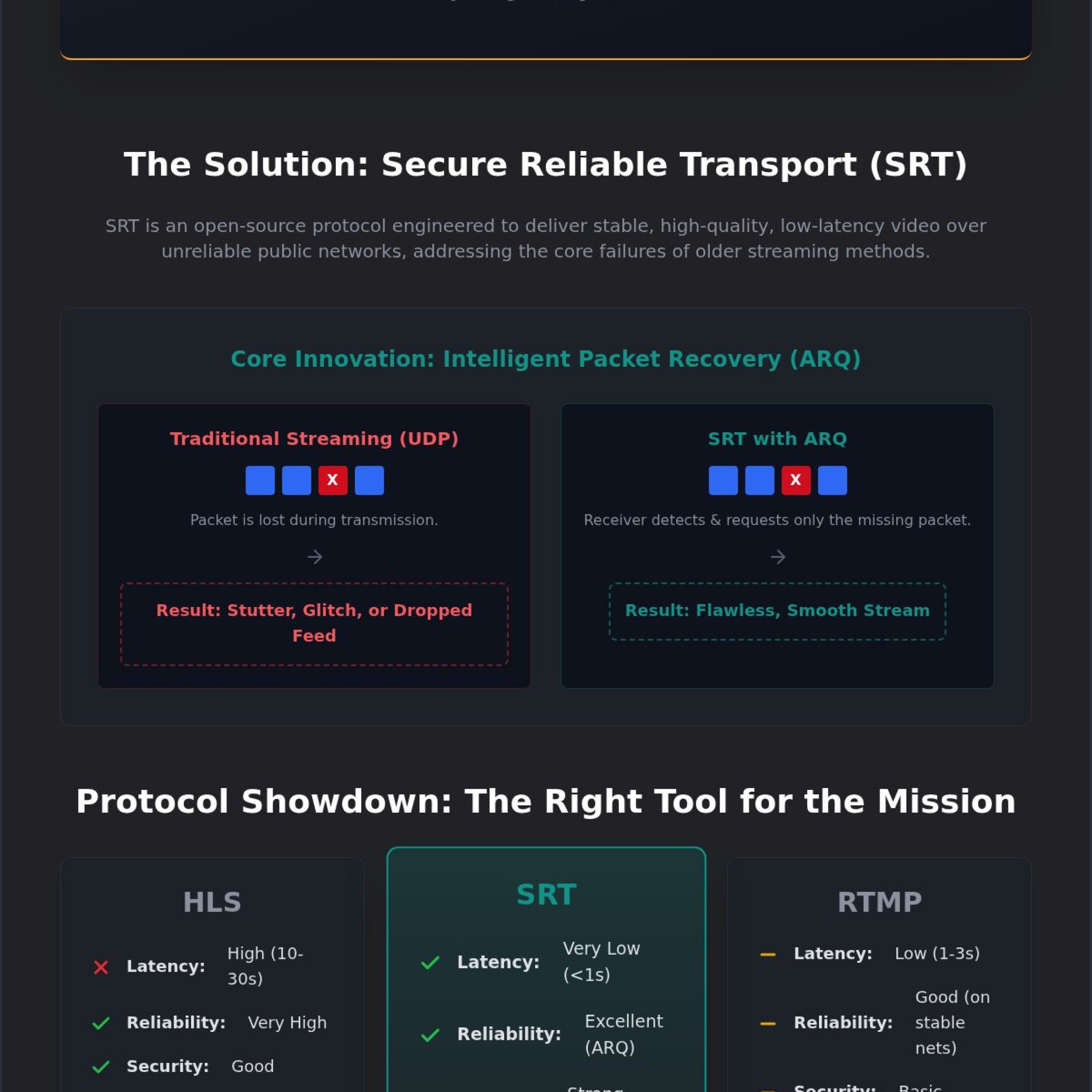
The core innovation within the protocol is its use of Automatic Repeat Request (ARQ). Unlike standard TCP/IP, which requires an acknowledgment for every data packet sent and creates significant overhead, this protocol uses selective retransmission. When the receiver detects a missing packet, it requests only that specific piece of data. This “handshake” process occurs in real-time, allowing the stream to recover from packet loss without the massive latency spikes associated with traditional retransmission methods. High-performance hardware, such as the Haivision Makito X4 which received critical software updates in December 2024, leverages these mechanics to ensure source clocks remain perfectly synchronized at the decoder. This precision is vital in environments where multiple feeds must be viewed simultaneously for accurate situational awareness.
Security and Encryption Standards
In mission-critical operations, the integrity of the video feed is as important as its speed. The protocol incorporates professional-grade security through end-to-end AES-128 and AES-256 encryption. This ensures that sensitive feeds from drones, traffic cameras, or tactical units remain protected from interception while in transit over the public internet. For federal agencies and public safety organizations, this level of security is non-negotiable. It forms a vital component of a Cybersecurity Common Operating Picture, where every data stream must be verified and secured against external threats. By providing a secure tunnel for video, it allows teams to leverage cost-effective internet connections without compromising their operational security posture.
Most control rooms already have the screens. What they’re missing is the layer that decides what goes on them, and escalates automatically when something needs attention. While the srt protocol provides the secure transport, it’s the operational intelligence layer that makes the data actionable. Integrating these secure feeds into the vis/ability platform allows your team to move beyond simply watching video to actively managing a unified operating environment where every feed is prioritized based on the current mission requirements.
SRT vs. RTMP and HLS: Selecting the Right Protocol for Command Centers
Choosing a transport protocol is a technical decision with immediate operational consequences. While some organizations continue to use legacy protocols like RTMP or HLS, these options often introduce unacceptable risks in high-stakes environments. RTMP, originally designed for Flash-based web players, lacks the encryption standards and packet-recovery intelligence required for modern tactical feeds. HLS, while reliable for massive public audiences, relies on segmenting video into chunks, which inherently creates multi-second delays. For a command center, these delays aren’t just inconvenient; they represent a failure in real-time oversight.
Most control rooms already have the screens. What they’re missing is the layer that decides what goes on them, and escalates automatically when something needs attention. Selecting srt provides the low-latency foundation that legacy protocols can’t match, ensuring that your video wall displays reality, not a delayed recording. This protocol’s ability to handle high-performance video over imperfect networks makes it the definitive choice for distributed teams.
When to Use SRT Over Legacy Protocols
The shift away from RTMP is accelerating as centers modernize their infrastructure. In a “first-mile” scenario, such as a remote drone feed transmitted over a cellular network, the srt protocol outperforms legacy options by adapting to bandwidth fluctuations in real-time. RTMP often drops the connection entirely when it encounters jitter, requiring a manual restart that costs valuable time. While HLS is effective for “last-mile” delivery to thousands of passive viewers where latency is secondary to scale, it fails in tactical coordination. In a mission-critical context, your choice must prioritize speed and security over broad consumer compatibility.
Performance Benchmarks in High-Stakes Environments
Performance in a command center is measured by sub-second latency and rapid recovery. While RTMP can achieve low latency, it does so at the expense of reliability on imperfect networks. HLS typically sees latencies of 10 to 30 seconds, which is unusable for active incident management. This protocol allows for sub-second delivery even when packet loss reaches 10% or higher. This level of resilience is essential for maintaining Operational Continuity during network disruptions. When a link drops, the protocol’s rapid handshake ensures the feed recovers in milliseconds, preventing the “black screen” failure that often plagues traditional IP video systems.
Implementing SRT for Global Situational Awareness
Effective deployment of the srt protocol begins with selecting hardware that can handle the computational load of real-time AES encryption and ARQ packet recovery. High-performance encoders must be configured to navigate enterprise firewalls without introducing security gaps. The protocol simplifies this through three handshake modes: Caller, Listener, and Rendezvous. In a typical Network Operations Center (NOC) setup, the receiver acts as the Listener on a specific port, allowing remote encoders to call in with their feeds. This structure maintains a tight security posture while enabling video to flow from distributed teams across the globe.
Managing these streams requires a disciplined approach to Stream ID management. Without a standardized naming convention for every incoming feed, a NOC can quickly become overwhelmed by fragmented data. A Stream ID acts as a unique identifier that tells the receiver exactly what the content is and where it belongs in the common operating picture. This metadata is the first step toward automating how video is handled within your infrastructure, ensuring that operators aren’t manually searching for feeds during an active incident.
Integrating SRT with Video Wall Systems
Deploying these feeds onto a large-scale display surface requires a strategic integration layer. Most control rooms already have the screens. What they’re missing is the layer that decides what goes on them, and escalates automatically when something needs attention. By utilizing IPTV encoders that support the srt protocol, you can ingest dozens of remote feeds and scale them across massive display surfaces without losing clarity. This eliminates the siloed video sources that often lead to operator fatigue and missed incidents on the video wall.
Maintaining Security in Remote Operations
Security remains the primary concern for federal and public safety agencies. When transporting video over the public internet, teams must implement rigorous AES key management. Rotating these keys and ensuring they are only accessible to authorized decoders prevents unauthorized access to sensitive feeds. This level of protection is essential for maintaining CJIS or NERC CIP compliance, especially when extending visibility to Mobile vis/ability users in the field. Field operators can receive the same secure, low-latency feeds as the command center, ensuring every member of the team acts with the same intelligence. To see how these protocols unify your operations, contact our team for a technical consultation.
Beyond the Protocol: vis/ability as Your Operational Intelligence Layer
Success in a mission-critical environment requires more than just a stable connection. While the srt protocol provides the necessary reliability for video transport, it’s merely the delivery mechanism. Raw video feeds, regardless of their quality or security, can become a source of noise if they aren’t contextualized. Operators often face information overload when forced to monitor dozens of high-definition streams simultaneously. To transform these feeds into actionable intelligence, organizations must move beyond simple viewing and implement a centralized hub that unifies all data and video streams into a coherent whole.
The Layer That Decides What Matters
Most control rooms already have the screens. What they’re missing is the layer that decides what goes on them, and escalates automatically when something needs attention. This is the primary function of the vis/ability platform. It acts as the operational intelligence layer for your srt feeds, filtering information based on real-time events rather than static monitoring. Standalone video players or basic wall management software only show what you tell them to show. In contrast, an intelligent layer automatically prioritizes critical feeds based on sensor data, emergency calls, or geospatial triggers, ensuring the most vital information is never obscured by routine operations.
Unifying Disparate Systems for Faster Response
Fragmented data is the greatest obstacle to rapid response. Many organizations utilize specialized tools like Axon for field data, but these platforms often provide only a partial solution that remains siloed from the rest of the command center. They lack the unifying layer needed to create a full common operating picture. vis/ability fills these visibility gaps by integrating with disparate systems and presenting a single, cohesive view to the entire team. Whether your operators are in a central command center, a huddle room, or using mobile devices, they receive a synchronized version of the truth. This eliminates the confusion of conflicting data and allows for a decisive response during the moments that matter most.
This transition from reactive viewing to proactive management is the final step in mastering your operational environment. By moving through the technical pain of latency and packet loss and exiting toward the clarity of vis/ability, you empower your team to act with greater certainty. High-performance transport is the foundation, but intelligence is the engine of a successful operation. Don’t let your secure video feeds remain isolated in a fragmented system. To see how these tools can be tailored to your specific mission requirements, contact us for an operational consultation and tailored demonstration.
Securing the Future of Mission-Critical Visibility
Maintaining visibility in a high-stakes environment requires a foundation of technical excellence and strategic foresight. You now understand that the srt protocol is the bedrock of secure, low-latency video delivery, overcoming the inherent instability of public networks. By prioritizing error correction and end-to-end encryption, your team can operate with the confidence that visual data is both accurate and protected. A stable stream is only useful if it reaches the right person at the critical moment of decision.
Most control rooms already have the screens. What they’re missing is the layer that decides what goes on them, and escalates automatically when something needs attention. This is why Federal and Defense agencies rely on our event-driven automation to reduce operator fatigue and ensure seamless integration with existing COTS hardware. Moving beyond raw data allows you to build a proactive common operating picture that empowers your entire organization to act with greater certainty.
See how vis/ability transforms SRT feeds into actionable intelligence. Your mission deserves the clarity that only a unified operational intelligence layer can provide.
Frequently Asked Questions
What does SRT stand for in video streaming?
SRT stands for Secure Reliable Transport. It is a protocol designed specifically for high-performance video delivery over unpredictable networks like the public internet. Since its open-source release in 2017, the protocol has gained support from over 600 members of the SRT Alliance. It provides a technical foundation that ensures video streams remain stable even when network conditions fluctuate, making it a preferred choice for professional broadcast and mission-critical operations.
Is SRT better than RTMP for mission-critical video?
SRT is superior to RTMP for mission-critical environments because it includes built-in error recovery and professional encryption. While some organizations still use RTMP, it often fails when faced with jitter or packet loss on the public internet. This protocol uses an intelligent retransmission mechanism that keeps feeds stable without the high latency associated with older standards. It provides the reliability required for high-stakes decisions where every frame of video is essential.
How does SRT handle packet loss over the internet?
The protocol handles packet loss through a mechanism called Automatic Repeat Request (ARQ). When the receiver detects that a data packet is missing, it sends a request to the sender to retransmit only that specific packet. This selective approach is far more efficient than standard TCP methods. It allows the stream to recover from loss in real-time, preventing the visual artifacts and stuttering that compromise situational awareness in a command center.
Does SRT provide encryption for secure video feeds?
Security is a core component of the protocol, offering end-to-end AES-128 and AES-256 encryption. This ensures that sensitive feeds from tactical units or remote sensors remain protected while in transit over public infrastructure. For federal agencies and public safety organizations, this encryption is vital for maintaining compliance and preventing unauthorized access. It allows teams to leverage cost-effective internet connections without sacrificing the integrity of their operational data.
What is the minimum bandwidth required for an SRT stream?
Bandwidth requirements depend on the video resolution and codec, but the srt protocol generally requires approximately 25% overhead above the video bitrate to handle retransmissions. For a high-definition 1080p stream using H.264, you might allocate 5 to 8 Mbps. The protocol’s efficiency allows it to adapt to bandwidth fluctuations, ensuring that the most critical visual data reaches the command center even when network capacity is limited or unstable.
Can SRT feeds be integrated into an existing NOC video wall?
Most control rooms already have the screens. What they’re missing is the layer that decides what goes on them, and escalates automatically when something needs attention. SRT feeds integrate seamlessly into existing NOC video wall systems through the vis/ability platform. It acts as the operational intelligence layer that unifies these feeds with other data sources. This integration eliminates siloed video streams and provides a comprehensive common operating picture for the entire team.
How does SRT protocol reduce latency in command centers?
The protocol reduces latency by utilizing a UDP-based transport layer combined with a low-overhead error recovery system. Unlike traditional protocols that rely on large buffers to smooth out network issues, this method recovers lost packets in milliseconds. This allows command centers to achieve sub-second glass-to-glass latency. Operators see events as they happen, which is critical for coordinating emergency responses and managing high-stakes incidents where timing is the most important factor.
Is SRT an open-source protocol?
SRT is a completely open-source protocol, which means its code is available on GitHub for any developer or organization to use. It’s not a commercial product with a price tag, but rather a collaborative industry effort managed by the SRT Alliance. This open nature has led to rapid adoption across diverse hardware and software platforms. It ensures that mission-critical organizations can implement a standardized, future-proof transport method without being locked into a single vendor’s proprietary technology.