
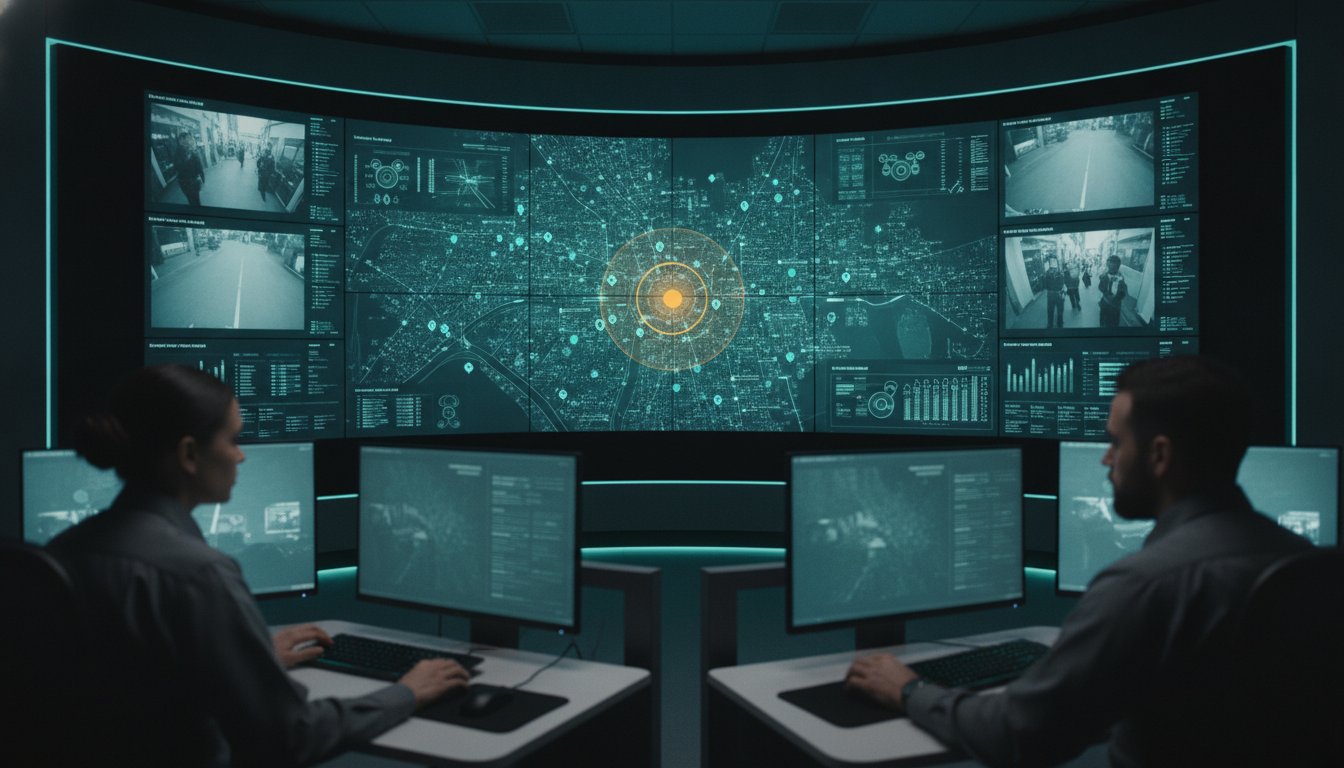
A critical incident alert triggers from a field unit, but your control room operators are currently focused on separate CAD and GIS screens. This often leaves crucial video feeds buried in sub-menus, turning vital seconds into lost minutes. This persistent reality of information overload plagues modern public safety. While various sources provide valuable sensor and body-worn camera data, traditional approaches to axon integration for control rooms often result in yet another siloed dashboard, failing to deliver a true common operating picture. You understand the frustration of having critical data but lacking the immediate, unified visibility needed to act with absolute certainty.
Most control rooms already have the screens. What they’re missing is the layer that decides what goes on them, and escalates automatically when something needs attention. This article demonstrates how Activu Corporation’s operational intelligence layer bridges the gap between fragmented feeds and a unified environment. We’ll examine how to transform your video wall from a passive display into a proactive hub that automates high-priority escalations. You’ll learn how to create a vendor-agnostic platform that connects dispatch, field units, and command staff through a single, reliable pane of glass.
Key Takeaways
- Identify the operational gaps created by fragmented data streams from drones, body cams, and IoT sensors.
- Learn why effective axon integration for control rooms requires vis/ability as a central operational intelligence layer to manage and filter high-volume feeds.
- Transition from reactive monitoring to proactive response by implementing event-driven visualization that triggers automated alerts based on sensor data.
- Establish a unified operating picture that connects your video wall, huddle rooms, and mobile devices for seamless collaboration.
- Empower command staff to act with greater certainty by focusing on essential information during the moments that matter most.
The Challenge of Fragmented Data in Modern Command Centers
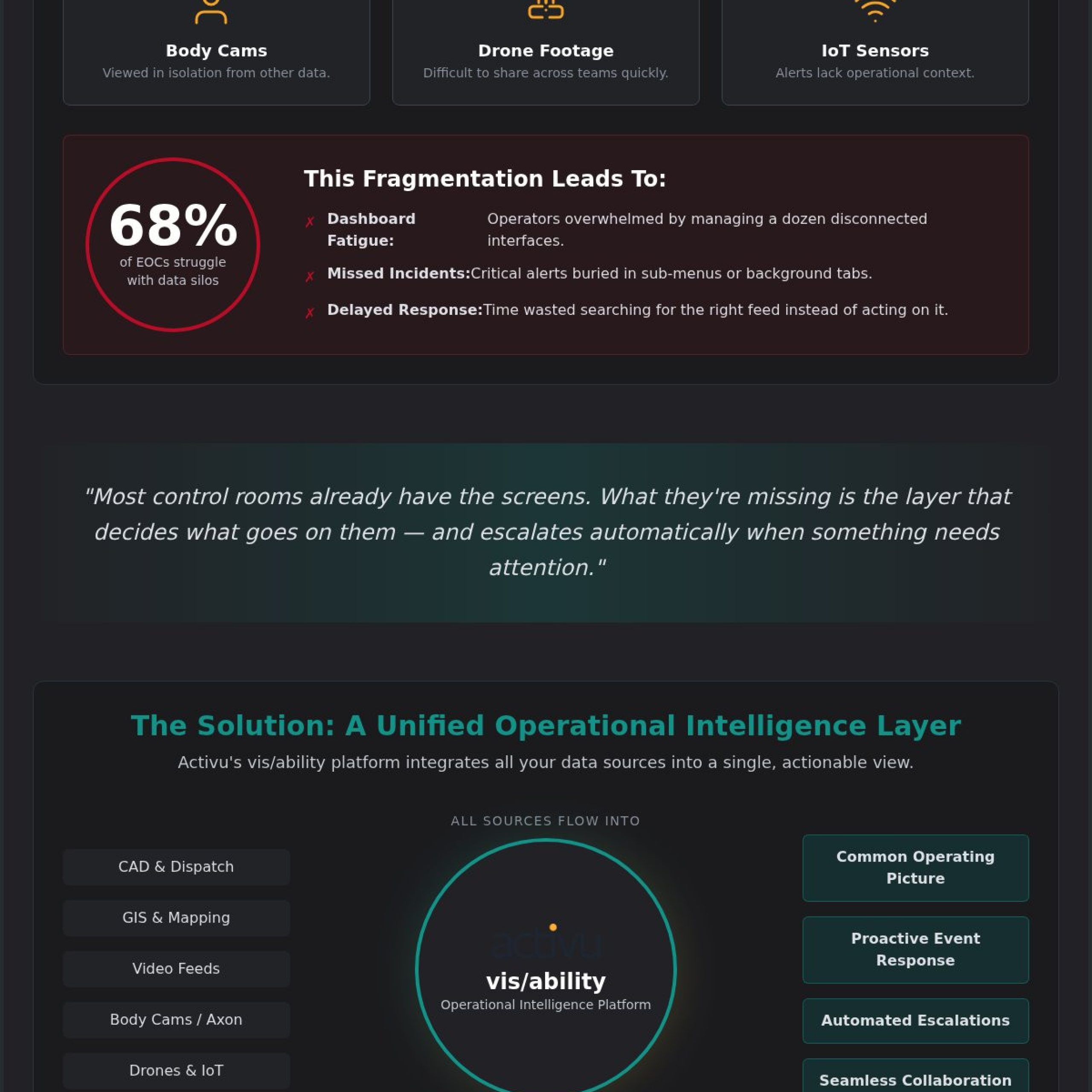
Modern command centers operate within a paradox of abundance. While the influx of real-time data from drones, body-worn cameras, and IoT sensors provides unprecedented field intelligence, it often creates a fog of information that obscures critical events. In high-stakes environments like a Real-Time Crime Center (RTCC), data volume has outpaced human processing capacity. This surge in sensor-rich inputs frequently results in dashboard fatigue. Operators find themselves managing a dozen disconnected interfaces, where a life-saving alert might be hidden behind a sub-menu or a background tab. When seconds determine the outcome of a life-safety event, searching for the right feed is not an option.
The gap between field intelligence and command visibility is a structural failure of fragmented systems. Most control rooms already have the screens. What they’re missing is the layer that decides what goes on them; and escalates automatically when something needs attention. Without this intelligence layer, axon integration for control rooms remains a collection of disparate feeds rather than a cohesive strategy. True situational awareness requires more than just access to data; it requires the immediate prioritization of that data to empower human judgment.
The Hidden Cost of Siloed Public Safety Tools
Fragmented systems introduce friction at the exact moment when speed is the only metric that matters. When dispatchers must toggle between proprietary interfaces to cross-reference a drone feed with a body cam stream, response times suffer. Industry reports suggest that 68 percent of emergency operations struggle with these data silos, which directly impacts the cognitive load on staff. Managing a crisis through a browser-tab approach is inherently unstable. It relies on an operator’s manual dexterity rather than automated protocol. This inefficiency doesn’t just slow down the room; it creates blind spots that can lead to missed incidents and compromised officer safety.
Common Situational Awareness Problems in RTCCs
Maintaining a common operational picture (COP) becomes nearly impossible when data remains trapped within single-vendor ecosystems. While Axon Evidence provides essential forensic and real-time video, viewing these files in isolation lacks the broader geospatial context of the incident. Distributed teams often struggle to share these live feeds across huddle rooms or mobile devices, leading to a breakdown in collaboration. This lack of visibility is why operators miss incidents on the video wall. The information exists, but it isn’t accessible to the right people at the right time. Effective axon integration for control rooms must solve for this fragmentation to ensure that every decision is backed by the full weight of available intelligence. For agencies focused on public safety, the goal is to transform these isolated streams into a unified, actionable intelligence hub.
Why Axon Alone is a Partial Solution for Situational Awareness
Axon provides a formidable ecosystem for public safety. Fusus aggregates video, Evidence.com manages digital assets, and TASER sensors track deployments. This suite offers high-quality data from the field. However, relying solely on a single-vendor environment creates a proprietary lock-in. This often limits your ability to integrate non-Axon systems like CAD, building management, or specialized IoT sensors. Effective axon integration for control rooms must account for these external data points to be truly useful during a crisis. When a system can’t talk to your broader infrastructure, it becomes another silo to manage.
Most control rooms already have the screens. What they’re missing is the layer that decides what goes on them, and escalates automatically when something needs attention. Without this operational intelligence layer, Axon feeds remain trapped in a desktop-centric view. Individual workstations aren’t designed to support the collaborative requirements of a large-scale video wall. Command staff need more than just another dashboard. They need a unified environment where every tool works in concert to provide total visibility.
The Scope of Axon Fusus in Real-Time Operations
Fusus excels at pulling together disparate camera feeds into a single interface. It provides a strong foundation for field data aggregation. The limitation arises when that data stays siloed on an operator’s monitor. Enterprise-wide visibility requires a platform that can take those Fusus streams and push them to any display in the center instantly. Citing the challenges of fragmented data, researchers emphasize that information must be integrated to aid decision-making for officers. Fusus is a powerful tool, but it requires a unifying layer to reach its full potential in a command center.
Bridging Digital Evidence with Real-Time Response
Evidence.com is often viewed as a post-incident tool. It stores the history of an event for forensic analysis. The challenge lies in bringing that historical context into a live incident flow. If an operator needs to compare a current suspect’s description with previous body cam footage, they shouldn’t have to leave their primary operating environment. You need to move beyond simple playback. By integrating these assets into a central hub, you turn static evidence into actionable intelligence. To see how this looks in practice, you can explore the vis/ability platform as a solution for these integration gaps. This approach ensures that your team isn’t just watching video, but managing an informed response.
vis/ability as the Operational Intelligence Layer
Most control rooms already have the screens. What they’re missing is the layer that decides what goes on them, and escalates automatically when something needs attention. This is the precise function of vis/ability. It serves as the operational intelligence layer that transforms a wall of monitors into a proactive decision support system. While individual tools like Axon provide critical field perspectives, they often remain isolated from the rest of your tech stack. By positioning the vis/ability platform as your central hub, you integrate these streams into a broader mission-critical framework.
A vendor-agnostic approach is essential for modern control room design. You shouldn’t be limited by a single ecosystem’s roadmap. True axon integration for control rooms means your video wall can simultaneously display Axon Fusus feeds alongside CAD data, GIS mapping, and real-time social media alerts. This integration ensures that your technology serves your workflow, rather than forcing your team to adapt to proprietary limitations. It creates a flexible foundation where new tools can be added without disrupting the existing operational flow.
Creating a Unified Common Operating Picture (COP)
Establishing a unified COP requires more than just showing every available feed. It requires aggregating real-time data into a single, intuitive interface where context is immediate. vis/ability ensures that every team member sees the same prioritized information, regardless of their location. This visibility extends from the primary command center to huddle rooms and mobile devices. When a field commander and a dispatch operator look at their respective screens, they’re viewing the same reality. This alignment is the bedrock of successful multi-agency coordination and rapid response.
Reducing Cognitive Overload for Operators
Information overload is a significant risk in high-stakes environments. vis/ability addresses this by filtering out environmental noise to focus on mission-critical alerts. The platform simplifies complex application integration, allowing operators to interact with data through a streamlined workflow. This technical clarity empowers human judgment. Instead of managing software, your team manages the incident. Through automated escalation, the platform ensures that high-priority feeds from axon integration for control rooms gain immediate prominence. This proactive management prevents critical details from being lost during peak operational stress, allowing your experts to act with greater certainty when it matters most.
Implementing Axon Integration for Large-Scale Visualization
Establishing a technical framework for axon integration for control rooms requires a shift from simple video monitoring to intelligent data management. Most control rooms already have the screens. What they’re missing is the layer that decides what goes on them, and escalates automatically when something needs attention. This integration must facilitate a seamless API-level handshake between the Axon cloud environment and your local visualization infrastructure. The goal is to ingest high-resolution streams without introducing latency that could compromise a real-time response during a critical incident.
Securing this data flow is a fundamental requirement for any common operating picture. Every stream and data point must be protected by robust cybersecurity protocols to maintain public trust and regulatory compliance. An event-driven architecture ensures that sensitive data is only displayed when operationally relevant, which reduces the digital attack surface and prevents information from being exposed to unauthorized personnel. This controlled visibility allows command staff to focus on the mission with absolute technical reliability.
Technical Requirements for Seamless Integration
Optimizing video performance for a large-scale video wall involves managing complex bitrates and coding standards. Utilizing HEVC (High Efficiency Video Coding) or SRT (Secure Reliable Transport) protocols ensures that body-cam and drone feeds remain stable even when network bandwidth is constrained. Integrating Evidence.com assets requires secure API gateways that allow for the instant retrieval of historical data without breaking the chain of custody. By leveraging COTS (Commercial Off-The-Shelf) hardware, agencies can build a flexible and scalable deployment that avoids the high costs and limitations of proprietary hardware. This technical agility ensures your command center stays current as sensor technology evolves.
Designing the Optimal RTCC Environment
Physical ergonomics must align with your digital workflow to ensure long-term operational readiness. A successful RTCC layout balances live video feeds with real-time data analytics, preventing the operator fatigue that leads to missed incidents. vis/ability manages this complexity by allowing command staff to instantly share content between the main video wall, huddle rooms, and mobile devices. This fluidity is essential for collaborative planning as events escalate in the field. When developing these high-stakes environments, many agencies utilize specialized Control Room Design Services to ensure their space supports the technology effectively.
Modernizing your command center requires a strategic approach to both software integration and physical design. To ensure your team has the visibility they need to act with certainty, schedule a consultation with our integration experts today.
Event-Driven Intelligence: Moving from Reactive to Proactive
Public safety operations demand a transition from passive observation to proactive response. Traditional monitoring relies on operators manually identifying an incident amidst a sea of static feeds, a process that inherently introduces delays. Event-driven intelligence shifts this burden from human eyes to automated protocols. By utilizing vis/ability as the central hub for axon integration for control rooms, your environment becomes sensitive to the data it receives. When an incident occurs, the system doesn’t just record it; it presents the most relevant information to the command staff instantly.
Most control rooms already have the screens. What they’re missing is the layer that decides what goes on them, and escalates automatically when something needs attention. This operational intelligence layer ensures that the video wall reflects the current mission priority without manual intervention. For instance, a 911 call reporting a specific incident can automatically trigger the display of the nearest Axon Fusus camera feeds and officer body cam streams. This level of automation ensures operational continuity, providing a feeling of calm and clarity even as a situation rapidly evolves.
Automating the Incident Management Workflow
Intelligent automation relies on specific triggers to activate pre-defined workflows. Within a vis/ability environment, you can set thresholds based on Axon sensor data, such as a body cam being activated or a TASER being drawn. These events can trigger immediate layout changes on the main video wall, ensuring that the most critical feeds are front and center. Gunshot detection alerts or CAD updates can also serve as catalysts for these automated escalations. By removing the need for manual searching and clicking, you significantly reduce response times. This proactive monitoring allows your team to focus on the human element of the crisis, empowered by technical clarity and immediate situational awareness.
Next Steps for Your Command Center
Modernizing your command center begins with a candid evaluation of your current visualization gaps. If your operators are still toggling between browser tabs to find Axon Evidence files during an active incident, your situational awareness is compromised. A pilot program for vis/ability and axon integration for control rooms provides a clear path toward a unified operating picture. This allows your agency to test event-driven triggers in a controlled environment before a full-scale deployment. To move toward a more proactive posture, reach out to our team to Contact Us for a custom assessment of your operational needs. We’ll help you build the bedrock upon which your most critical decisions are made.
Advancing Your Command Center’s Operational Readiness
Operational success in high-stakes environments depends on the transition from fragmented data feeds to a unified, event-driven architecture. While Axon provides critical sensors and field evidence, these tools reach their full potential only when integrated into a broader intelligence framework. Most control rooms already have the screens. What they’re missing is the layer that decides what goes on them, and escalates automatically when something needs attention. By implementing a vendor-agnostic platform, you ensure that your team remains focused on actionable intelligence rather than managing siloed dashboards.
Achieving seamless axon integration for control rooms requires a partner with proven expertise in RTCC design and mission-critical visualization. The vis/ability platform serves as the bedrock for your operations, providing the clarity and technical reliability needed to act with absolute certainty. You can bridge the gap between raw data and human judgment by automating high-priority escalations and unifying your team’s perspective across any device. Take the next step in securing your common operating picture today.
Request a vis/ability Demo to See Axon Integration in Action
We look forward to helping you build a more resilient and responsive command center environment.
Frequently Asked Questions
How does Axon Fusus integrate with existing video wall systems?
Axon Fusus integrates through the vis/ability platform, which serves as the operational intelligence layer. It ingests Fusus camera feeds via secure APIs and presents them on the main video wall. While Fusus aggregates data effectively, it requires a unifying layer to manage complex layouts and enterprise-wide distribution. This approach ensures that aggregated field data is instantly visible to all stakeholders within the command center environment.
Can I view Axon Evidence.com files directly on my common operating picture?
You can access and display Evidence.com assets directly within your common operating picture using the vis/ability platform. This integration allows operators to pull historical video or forensic data into a live incident flow without switching between separate dashboards. Integrating these assets ensures that past context is immediately available to inform current decision-making. It provides a more comprehensive view during high-stakes operations.
What are the security requirements for integrating Axon with third-party software?
Security requirements include secure API gateways, end-to-end encryption, and strict adherence to CJIS compliance standards. The vis/ability platform maintains the integrity of the data flow by ensuring that axon integration for control rooms does not compromise the chain of custody. By utilizing secure authentication and encrypted transport protocols, the system protects sensitive public safety data from unauthorized access or potential external threats.
Does vis/ability support mobile access for Axon data feeds?
vis/ability provides full mobile support, allowing field commanders to view the same prioritized Axon data feeds as the command center staff. This mobile vis/ability ensures that distributed teams remain aligned through a shared reality. Whether in a huddle room or on a mobile device, every team member has access to the same critical intelligence to facilitate seamless and effective collaboration.
How do automated alerts work in an integrated control room?
Automated alerts function by setting specific triggers based on Axon sensor data, such as a body cam being activated or a TASER deployment. When a trigger is met, the vis/ability platform automatically changes the video wall layout to highlight the relevant feeds. This event-driven approach ensures that mission-critical information is prioritized instantly. It removes the need for manual intervention from the operator during a crisis.
Can vis/ability integrate with non-Axon systems like Motorola or Milestone?
vis/ability is a vendor-agnostic platform that integrates with a wide range of non-Axon systems, including Motorola CAD and Milestone VMS. This flexibility prevents proprietary lock-in and allows agencies to build a truly unified operating picture. By serving as the central hub, vis/ability makes all your existing operational tools more useful for the entire team regardless of the specific hardware or software manufacturer.
What is the benefit of an event-driven situational awareness platform?
The primary benefit is the reduction of response times through automated escalation of high-priority information. Most control rooms already have the screens. What they’re missing is the layer that decides what goes on them, and escalates automatically when something needs attention. This proactive posture transforms the video wall from a passive monitor into a dynamic decision support tool. It focuses operator attention on essential intelligence when it matters most.
How does vis/ability help reduce operator fatigue in busy RTCCs?
vis/ability reduces fatigue by filtering out environmental noise and focusing solely on mission-critical alerts. By simplifying complex axon integration for control rooms and other data streams into one intuitive interface, it lowers the cognitive load on operators. This technical clarity allows staff to remain analytical and focused when stakes are at their highest. It prevents incidents from being missed due to the complexity of information overload.