

What if the difference between a successful emergency intervention and a catastrophic failure was just 500 milliseconds of video latency? In a mission-critical command center, you know that fragmented data streams and dropping feeds aren’t just technical nuisances; they’re operational blind spots that jeopardize safety. You’ve likely seen feeds fail to sync across distributed teams during a 2024 response event. This article helps you master the technical foundations of the srt protocol. You’ll discover how to leverage secure reliable transport to maintain a stable, low-latency feed that supports real-time decision-making in high-stakes environments.
Most control rooms already have the screens. What they’re missing is the layer that decides what goes on them, and escalates automatically when something needs attention. We define this as vis/ability, the operational intelligence layer that surfaces critical data through the video wall. While tools like Axon provide valuable data, they remain fragmented silos without a central hub to unify the stream. By utilizing srt within a vis/ability framework, you ensure that secure, synchronized video reaches the right eyes at the right time. We’ll show you how to move beyond simple viewing to a state of clear intelligence across all your EOC and remote setups.
Key Takeaways
- Understand why the srt protocol is essential for overcoming the latency and security gaps that plague fragmented feeds in high-stakes operational environments.
- Master the technical mechanics of the “handshake” process to ensure reliable video delivery through complex firewalls without sacrificing transmission speed.
- Evaluate the limitations of legacy streaming protocols to see why they often fall short of the sub-second response times required for mission-critical emergency management.
- Identify the hardware and software requirements for integrating low-latency feeds into a unified operating picture to enhance situational awareness across the organization.
- Discover how vis/ability functions as the operational intelligence layer that automatically surfaces critical information on your video wall the moment an incident demands attention.
What Does SRT Stand For? Defining Secure Reliable Transport
SRT stands for Secure Reliable Transport. This open-source video transport protocol delivers high-quality, low-latency video across unpredictable public networks. In mission-critical environments, the primary obstacle to success is not a lack of data, but the presence of fragmented feeds and inconsistent network performance. Legacy protocols frequently fail when they encounter packet loss or jitter; this creates a dangerous delay in situational awareness. Most control rooms already have the screens. What they’re missing is the layer that decides what goes on them, and escalates automatically when something needs attention.
Reliable video transmission acts as the foundation for operational intelligence. When an operator must determine how to manage multiple data feeds dispatch center environments often become overwhelmed by signal noise. The srt protocol addresses these vulnerabilities by ensuring that video remains stable even when bandwidth fluctuates. By bridging the gap between raw data and actionable intelligence, srt allows teams to maintain a common operating picture across distributed sites, ensuring that the visual narrative remains unbroken during a crisis.
The Origin of the SRT Protocol
Haivision developed SRT and released it as an open-source standard in April 2017. This move catalyzed an industry-wide shift toward low-latency requirements in command and control environments. By 2026, the demand for distributed operations has made sub-second latency a non-negotiable standard for remote situational awareness. While tools like Axon provide essential video capture, they remain partial solutions because they often exist in silos. They require a unifying hub like vis/ability to ensure that visual information flows seamlessly to the entire team.
Core Capabilities: Security and Reliability
The protocol earns its name through three distinct pillars of performance that support high-stakes decision-making:
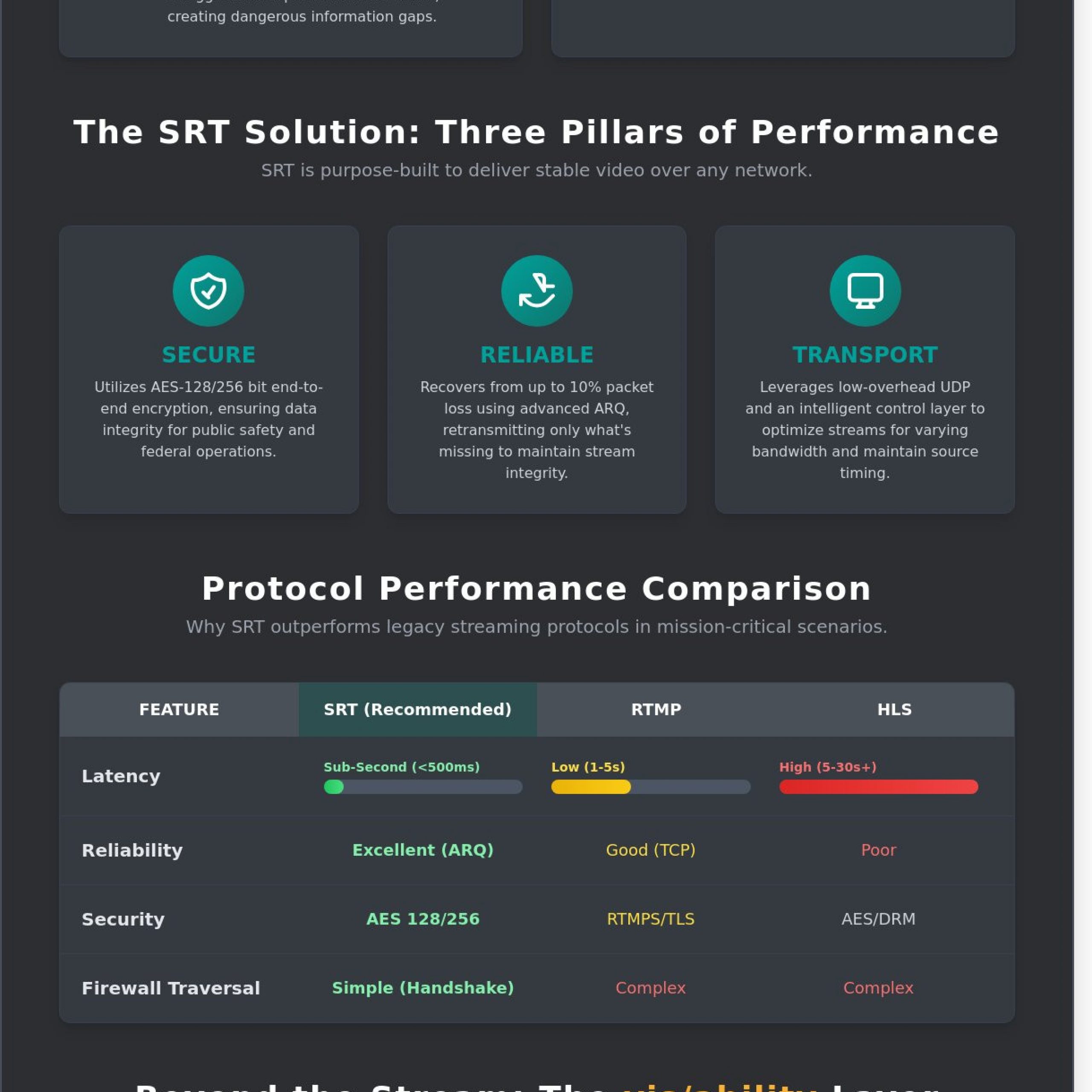
- Security: It utilizes AES-128 or 256-bit encryption to provide end-to-end data protection. This is a critical requirement for federal and public safety operations where data integrity is paramount.
- Reliability: Advanced packet loss recovery occurs through Automatic Repeat Request (ARQ). Unlike older methods that may drop the connection, ARQ identifies and retransmits only the missing packets. This preserves stream integrity even during 10% or higher packet loss on a public network.
- Transport: The mechanism optimizes streams for varying bandwidth conditions. It maintains the precise timing of the source stream so that operators see events exactly as they happen without the stuttering common in legacy systems.
True operational clarity requires more than just a stable stream. It requires vis/ability, an operational intelligence layer that surfaces through the video wall to present the right data at the exact moment a decision is required. This integration transforms a simple srt feed into a proactive tool for emergency management and infrastructure protection, moving the team from a state of data overload to clear, actionable intelligence.
How SRT Protocol Works: Technical Mechanics
SRT functions at the application layer, leveraging the User Datagram Protocol (UDP) as its foundation. While UDP offers the low-overhead speed required for live video, it lacks the error-correction mechanisms found in legacy protocols. This technology solves that problem by adding an intelligent control layer. The architecture is detailed in the SRT protocol specification, which outlines how the system handles packet loss without the crushing latency of traditional transmission methods.
The connection begins with a sophisticated handshake process. This mechanism allows the protocol to establish secure links across complex enterprise firewalls without requiring extensive IT intervention or manual port forwarding. Once connected, the protocol manages packet retransmission with high precision. If a packet drops, the system requests only that specific missing piece, maintaining a continuous stream. Operators control this through user-defined latency buffers. These buffers allow teams to set a precise delay, often as low as 120 milliseconds, to ensure stability on unpredictable networks.
Most control rooms already have the screens. What they’re missing is the layer that decides what goes on them, and escalates automatically when something needs attention. This is where vis/ability serves as the operational intelligence layer that surfaces through the video wall. It bridges the gap between fragmented data feeds and actionable insights.
UDP vs. SRT: Enhancing Speed with Intelligence
Standard UDP is fast, but it’s fundamentally unreliable because it sends data without confirming receipt. This protocol introduces an intelligence layer that monitors network health in real-time. It adjusts transmission parameters based on current bandwidth and jitter. For federal government and defense applications, this reliability is non-negotiable. When a drone feed or a remote surveillance stream falters, the mission is compromised. The protocol ensures visual data remains intact even over congested satellite or cellular links.
Encryption and Firewall Traversal
The protocol simplifies network configuration using three distinct modes: Caller, Listener, and Rendezvous. These modes allow streams to traverse firewalls without compromising strict security protocols. By utilizing AES-128 or AES-256 encryption, the protocol protects sensitive feeds, which is vital for maintaining a cybersecurity common operating picture. It streams high-resolution 4K data without the heavy overhead of older systems. This efficiency ensures that critical visual information reaches the vis/ability platform instantly, providing the clarity needed for rapid decision-making in high-stakes environments.
SRT vs. RTMP and HLS: Choosing the Right Protocol
Fragmented systems and siloed data feeds create a dangerous gap between the occurrence of an event and the tactical response. Most control rooms already have the screens. What they’re missing is the layer that decides what goes on them; it escalates automatically when something needs attention. While organizations often rely on legacy protocols to bridge these silos, these older standards offer only partial solutions. RTMP, originally developed in 2002, lacks the architecture to support modern compression standards like HEVC, while HLS remains tethered to high-latency delivery methods that fail in high-stakes environments. Secure Reliable Transport (SRT) addresses these shortcomings by providing a transport mechanism that maintains the speed of UDP with the error-correction capabilities of TCP.
For operations that require absolute precision, srt serves as the backbone for incident management software. It allows vis/ability, the operational intelligence layer that surfaces through the video wall, to ingest and distribute live feeds with total integrity. By moving away from legacy protocols, command centers eliminate the technical debt of outdated standards and ensure that their visual evidence is both current and actionable.
Latency Benchmarks for Operations
Sub-second latency is the non-negotiable requirement for effective command and control in any mission-critical environment. While traditional COTS-based streaming methods like HLS often introduce delays of 10 to 30 seconds due to their segment-based architecture, srt achieves glass-to-glass latencies as low as 120 milliseconds. This speed ensures that what an operator sees on the video wall is happening in near-real time, allowing for immediate intervention. For a deeper look at how this performance integrates with modern compression, our HEVC technical guide provides specific data on codec efficiency.
Reliability in Challenging Network Environments
Operational feeds frequently travel across “dirty” networks characterized by high jitter and significant packet loss. This is a common reality in transportation operations, where remote camera feeds from highways or rail lines must traverse unstable wireless or congested backhaul links. RTMP typically fails when packet loss exceeds 2 percent, resulting in frozen video or total connection collapse. In contrast, srt utilizes an Advanced Retransmission (ARQ) mechanism to recover lost packets without the massive bandwidth overhead of traditional protocols.
- Error Recovery: SRT handles up to 10 percent packet loss without visible degradation in video quality.
- Jitter Buffering: The protocol smooths out timing variations to prevent stuttering in high-traffic network conditions.
- Security: AES 128/256-bit encryption is built directly into the stream, protecting sensitive operational data.
Some organizations continue to use legacy standards because they are familiar, but these tools lack the automatic escalation capabilities inherent in vis/ability. Without a unifying hub to manage these feeds, even a reliable srt stream is just another data point in a crowded room. Vis/ability ensures that when a network fluctuates or an incident occurs, the system reacts intelligently to keep the most critical information front and center.
Implementing SRT in the Modern Control Room
Implementing srt requires a fundamental shift from proprietary, closed-circuit hardware to open-source software and flexible hardware foundations. Most control rooms already have the screens. What they’re missing is the layer that decides what goes on them, and escalates automatically when something needs attention. This is where the protocol becomes a vital component of a unified operating picture. While the protocol ensures the packet arrives, vis/ability provides the operational intelligence layer that surfaces the right data through the video wall at the exact moment it’s needed.
In public safety and emergency management, protocol interoperability isn’t just a technical preference; it’s a requirement for survival. When agencies use disparate systems, silos form, and critical information stays trapped in individual workstations. The srt protocol breaks these silos by allowing high-quality video to travel over standard internet connections without the latency issues that plague older formats. This interoperability ensures that a feed from a local police department can be instantly viewed by state emergency coordinators without complex transcoding hurdles.
From Remote Feeds to the Video Wall
Deploying an srt-enabled workflow involves placing encoders at the source, whether that’s a drone in the field or a remote traffic camera. These encoders convert raw video into the SRT format, which decoders at the central command center then receive. Many organizations rely on COTS solutions to provide the hardware foundation for these protocols. This approach avoids the vendor lock-in common with legacy systems. However, a video feed on a monitor isn’t situational awareness. The real value emerges when these feeds integrate into a central hub that manages the vis/ability of the data. Without this hub, the video wall remains a passive display rather than an active tool for incident resolution.
Scaling SRT Across Distributed Teams
For utilities and energy providers managing thousands of miles of infrastructure, visibility is often the biggest challenge. SRT supports mobile users and satellite offices by delivering stable video even over congested or unreliable networks. This stability is critical for addressing the human element of operations. A 2022 industry report noted that 42% of control room errors are linked to operator fatigue from poor visual quality. When a video feed flickers or lags, the human brain works harder to interpret the visual gaps. Stable video reduces this cognitive load and provides the certainty needed for quick, life-saving decisions.
The protocol is a tool, but it’s not the total solution. Without a central hub to coordinate these feeds, operators face control room situational awareness problems caused by data overload. Managing multiple data feeds in a dispatch center requires more than just a transport protocol; it requires an intelligent layer that surfaces what matters most. By bridging the gap between raw data and human judgment, organizations can move from a state of reactive monitoring to proactive management.
Beyond the Stream: Operational Intelligence with vis/ability
Raw video feeds, even those delivered via high-performance srt protocols, often remain trapped in silos. Dispatchers and operators frequently face control room situational awareness problems caused by an abundance of data without sufficient context. Relying on manual monitoring leads to cognitive overload and fatigue. A 2023 industry report found that operators monitoring more than four screens experience a 40% drop in detection accuracy after just twenty minutes. In high-pressure environments, these gaps in visibility lead to delayed responses.
Most control rooms already have the screens. What they’re missing is the layer that decides what goes on them, and escalates automatically when something needs attention. The vis/ability platform serves as this essential operational intelligence layer. It does not just display video; it orchestrates it. By surfacing through the video wall, vis/ability unifies srt streams with real-time geospatial data, IoT sensors, and CAD systems into a single, cohesive interface. It acts as the definitive bridge between raw data and human judgment, ensuring that the right information reaches the right person at the right time.
Automatic Escalation and Event-Driven Alerts
Fragmented systems often force operators to toggle between disparate applications to find the source of an alarm. This is a primary reason why operators miss incidents on the video wall during peak activity. vis/ability eliminates this friction by using incoming data to trigger automated workflows. When a sensor detects a perimeter breach or a utility grid failure, the platform immediately pulls the relevant video feed onto the main display. This transition shifts the team from reactive monitoring to proactive situational awareness. It solves the problem of how to manage multiple data feeds in a dispatch center by prioritizing the most critical events automatically.
The vis/ability Advantage
Standalone tools and basic protocols provide only a partial view of the operational landscape. They lack the logic required to prioritize information during a crisis. Activu fills these gaps by centralizing every visual and data asset into a unifying hub, providing the robust EOC common operating picture solutions that modern organizations require. Whether in a command center, a remote huddle room, or on a mobile device, teams see exactly what matters most at the moment it matters. This creates absolute operational clarity and ensures that mission-critical decisions are based on the most accurate, real-time intelligence available. To see how this technology integrates with your specific environment, contact Activu for a custom control room assessment.
Secure Your Stream for Real-Time Decision Making
Reliable video delivery is the foundation of any modern command center. By utilizing the srt protocol, organizations eliminate the risks of high latency and packet loss that often plague traditional streaming methods. This technical stability ensures your team sees every frame of critical data exactly when it happens. However, even the most robust stream is only a partial solution if it remains siloed or ignored during a crisis.
Most control rooms already have the screens. What they’re missing is the layer that decides what goes on them, and escalates automatically when something needs attention. This is where vis/ability transforms your workflow. It functions as an operational intelligence layer that surfaces through the video wall; it unifies fragmented systems into a single common operating picture. This approach ensures that operators aren’t overwhelmed by data but are instead empowered by clarity.
With over 40 years of experience in mission-critical visualization, Activu is trusted by federal agencies and Fortune 500 utilities. We provide end-to-end control room design and integration services that turn raw data into actionable intelligence. Elevate your situational awareness with the vis/ability platform today and ensure your team always has the visibility they need to succeed.
Frequently Asked Questions
What is the main advantage of using the SRT protocol?
SRT provides the ability to maintain high quality video streams over noisy networks without the high latency of traditional TCP based protocols. It uses an Intelligent Packet Recovery mechanism to ensure data integrity during transmission. Most control rooms already have the screens. What they’re missing is the layer that decides what goes on them, and escalates automatically when something needs attention. By integrating srt into the vis/ability platform, operators gain 100 percent visibility into remote feeds regardless of network jitter.
Is SRT better than RTMP for mission-critical streaming?
SRT outperforms RTMP because it utilizes ARQ to fix packet loss, whereas RTMP often fails when network conditions fluctuate. While some organizations still rely on RTMP, it creates a gap in situational awareness because it can’t handle the 5 to 10 percent packet loss common in field deployments. Vis/ability bridges this gap by showing how to manage multiple data feeds dispatch center staff rely on, unifying them into a single operational intelligence layer that surfaces through the video wall.
Does SRT work over the public internet?
SRT was engineered specifically to deliver low latency video over the public internet by using a UDP based transport architecture. It effectively manages the 20 to 30 milliseconds of jitter often found on standard business connections. This capability allows command centers to ingest feeds from remote sites without expensive dedicated fiber lines. When these srt feeds enter the vis/ability ecosystem, they’re automatically routed to the right screens when an incident is detected, solving common control room situational awareness problems.
Is the SRT protocol secure for sensitive government data?
SRT includes native support for AES 128 and 256 bit encryption, providing a secure tunnel for mission-critical video data. This ensures that sensitive intelligence remains protected as it traverses unmanaged networks. Security is only one part of the solution, however. Without vis/ability to manage these encrypted streams, data remains siloed in fragmented systems. Our platform acts as the central hub, decrypting and visualizing data only for authorized personnel in the EOC or mobile units.
How much latency does SRT add to a video stream?
SRT typically adds latency equal to 2.5 times the round trip time of the network connection, often resulting in sub-second delays. In a controlled environment with 20ms of network latency, the total end to end delay remains under 100 milliseconds. This speed is vital for real-time visualization in emergency operations. Most control rooms already have the screens. What they’re missing is the layer that decides what goes on them, and escalates automatically when something needs attention.
Can SRT be used with H.264 and HEVC (H.265) codecs?
SRT is a transport protocol that’s entirely codec agnostic, meaning it supports H.264, HEVC, and legacy MPEG-2 formats. This flexibility allows operators to use 4K HEVC streams to reduce bandwidth by 50 percent compared to H.264 without sacrificing quality. While codecs handle the compression, vis/ability handles the orchestration. It ensures that these various formats are seamlessly integrated into the common operating picture, preventing the silos that cause operators to miss incidents video wall displays should have caught.
What hardware is required to support SRT in a NOC?
SRT runs on standard x86 servers, hardware encoders like those from Haivision, or software based decoders within a NOC. It doesn’t require proprietary networking gear, which simplifies deployment across 24/7 environments. However, hardware alone is just a partial solution. Vis/ability provides the necessary operational intelligence layer that manages these hardware inputs. It transforms raw video into actionable intelligence, ensuring that the right feed appears on the video wall exactly when an operator needs to act.
How does SRT handle significant packet loss?
SRT handles packet loss by using a low latency retransmission request combined with a configurable buffer to resend missing data before the video frames are displayed. It can recover from 10 to 15 percent packet loss without visible artifacts in the stream. This technical reliability is essential for EOC common operating picture solutions. When network conditions degrade, vis/ability monitors these metrics and can automatically escalate alerts to the team if the stream quality drops below a defined threshold.