
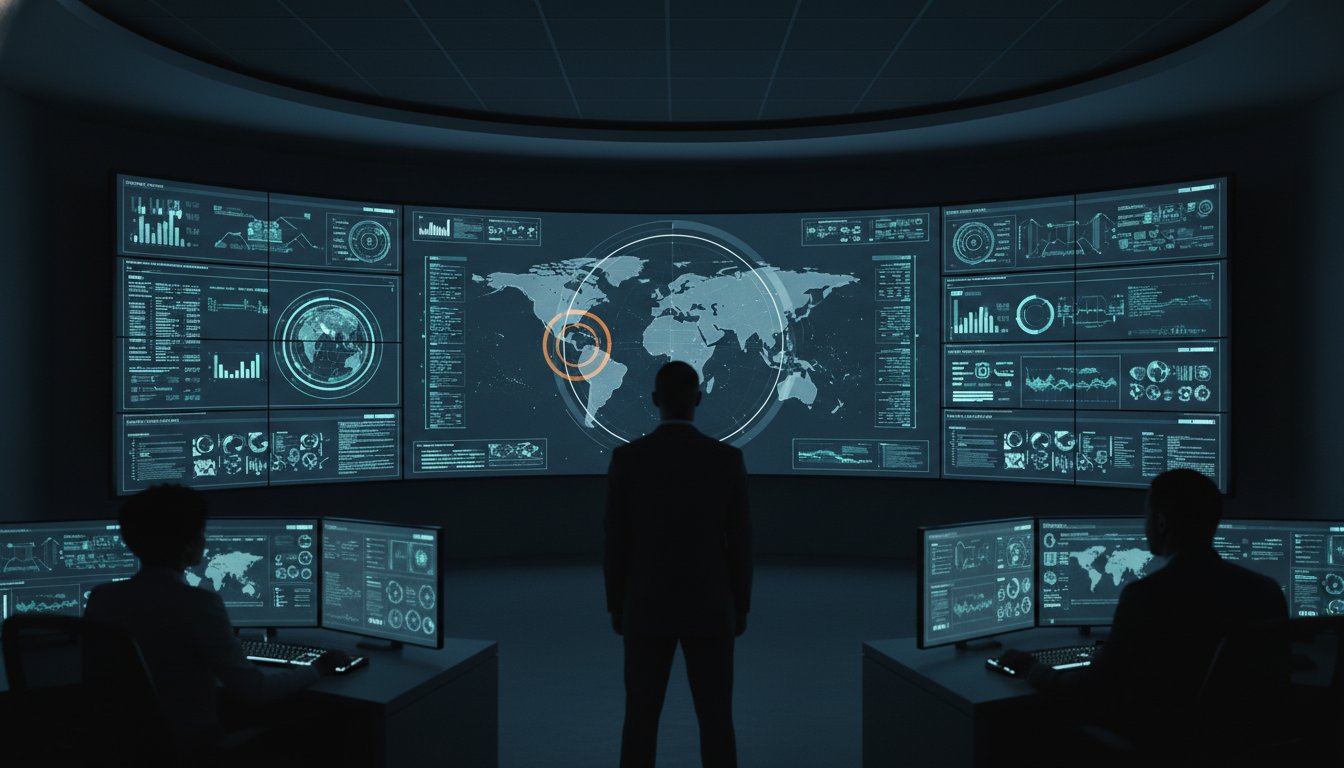
What if the millions of dollars invested in your global security footprint are actually making your team less effective? In 2023, research indicated that security analysts ignore 27% of alerts because of sheer volume. This reality plagues the modern GSOC, where operators are buried under siloed feeds and fragmented data. You likely feel the weight of this information overload every day. You know that having more cameras doesn’t mean having more security if your team is drowning in alarm fatigue. It’s frustrating to manage multiple regions without a single, unified operating picture that tells you where to look first.
Most control rooms already have the screens. What they’re missing is the layer that decides what goes on them, and escalates automatically when something needs attention. This article demonstrates how to transform your GSOC into a proactive powerhouse by implementing vis/ability. We define vis/ability as an operational intelligence layer that surfaces through the video wall to provide absolute clarity. You’ll discover how to achieve 40% faster incident response times by eliminating silos and automating the escalation of critical threats. We’ll examine the shift from passive monitoring to active situational awareness for your entire global team.
Key Takeaways
- Identify how fragmented systems and data silos create critical response delays within a modern GSOC and learn to bridge these visibility gaps.
- Transition from reactive observation to proactive management by integrating an operational intelligence layer that prioritizes what appears on your screens.
- Solve the challenge of operator fatigue and cognitive overload by automating the escalation of mission-critical data.
- Discover why the most effective command centers focus on the software layer that decides what information matters most during high-stakes incidents.
- Establish a roadmap for unifying disparate tools into a single, real-time visualization hub that empowers decisive action across all devices.
What is a GSOC? Defining the Global Security Operations Center in 2026
A Global Security Operations Center (GSOC) is a centralized command hub that integrates real-time intelligence and security data from worldwide assets to provide a unified, proactive response to global threats.
Modern security teams often operate in a state of reactive chaos because their data remains trapped in fragmented systems. Siloed information from access control, Video Management Systems (VMS), and cyber threat feeds forces operators to manually correlate events during a crisis. This lack of automatic escalation creates a dangerous lag. In high-stakes environments, a 30-second delay often marks the difference between containment and catastrophe. Most control rooms already have the screens. What they’re missing is the layer that decides what goes on them, and escalates automatically when something needs attention.
By 2026, the transition from regional monitoring to a unified global posture is no longer optional. Organizations are moving away from disconnected sites toward a centralized GSOC model. This shift ensures that every incident, regardless of its geographic origin, is filtered through a single standard of excellence and operational intelligence.
GSOC vs. SOC: Understanding the Global Scope
The primary difference between a standard Security Operations Center (SOC) and its global counterpart is the sheer complexity of the operational environment. While a regional SOC might monitor a single campus or a domestic network, a GSOC protects personnel and assets across 24 time zones and diverse regulatory landscapes. This requires a robust Common Operating Picture (COP) that transcends local borders.
Managing global assets means dealing with varying levels of infrastructure reliability and local compliance laws. Operators can’t rely on manual check-ins or disjointed emails. They need a system that surfaces critical alerts automatically. This is where vis/ability becomes essential, acting as an operational intelligence layer that surfaces through the video wall to show exactly what matters, exactly when it matters.
The Evolution of Mission-Critical Security
The history of the command center has moved from 1980s-era analog CCTV rooms to sophisticated digital intelligence hubs. In the past, “industry standards” focused on simply having a wall of video feeds. These legacy setups are now a liability. They lead to cognitive overload, where operators miss incidents because they’re staring at 50 screens showing nothing of importance. Modern GSOC operations have shifted toward event-driven situational awareness.
Instead of passive monitoring, 2026 standards demand proactive visualization. Solutions like Axon provide valuable data points, but they’re only a partial solution if that data stays locked in a specific user’s handheld device. Vis/ability fills these gaps by serving as the central unifying hub. It pulls data from every tool in the stack and presents it as actionable intelligence on the main display. This transformation ensures the video wall isn’t just a decoration, but the place where the answer appears during a crisis.
The Function of a Modern GSOC: Beyond Simple Monitoring
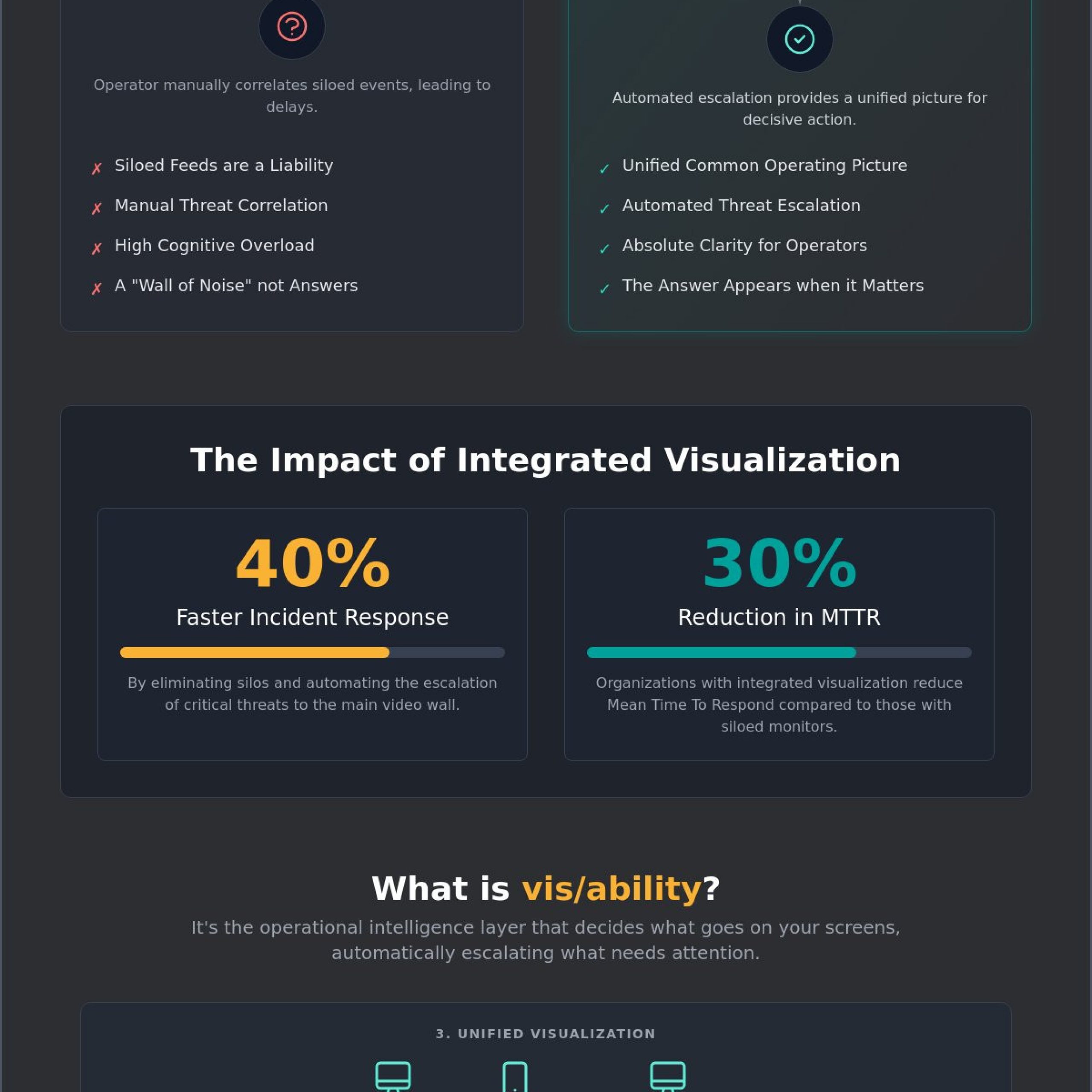
Fragmented systems and data silos represent the primary gap in current security architectures. Operators often struggle with how to manage multiple data feeds dispatch center environments require, leading to cognitive overload and delayed responses. Most control rooms already have the screens. What they’re missing is the layer that decides what goes on them, and escalates automatically when something needs attention.
A modern GSOC must move from reactive observation to proactive incident management. This shift requires a unified view that aggregates data from SIEM, SOAR, and VMS platforms. Without this integration, critical alerts stay buried in sub-menus. According to Microsoft’s definition of a SOC, the core function involves continuous monitoring and analysis, but high-stakes decision-making depends on real-time visualization. Recent data from 2023 indicates that organizations with integrated visualization reduce their mean time to respond (MTTR) by 30% compared to those using siloed monitors.
Intelligence Integration and Data Analysis
Managing a common operating picture involves funneling disparate feeds into a single, manageable stream. Many organizations utilize tools like Axon to manage evidence or body-worn camera feeds. While useful for specific tasks, these are only partial solutions. They lack the overarching integration needed to provide a total site view. True situational awareness comes from vis/ability, an operational intelligence layer that surfaces through the video wall. It acts as the central hub, filtering out noise and highlighting the 5% of data that requires immediate action. This approach solves EOC common operating picture solutions challenges by ensuring the team sees exactly what matters most.
Coordinated Incident Response and Escalation
Effective response relies on automated escalation when predefined thresholds are met. In a high-pressure GSOC environment, manual reporting creates bottlenecks. Automation ensures that when a perimeter breach or system failure occurs, the relevant data immediately populates the screens of distributed teams and field personnel. This level of coordination is why operators miss incidents video wall displays otherwise fail to highlight. By utilizing incident management software as a framework, organizations can link their digital alerts to human judgment. This connectivity builds organizational resilience, turning the GSOC into a proactive guardian of assets and lives. If you need to improve control room situational awareness problems, exploring a vis/ability solution can provide the clarity your team needs.
Why Operators Miss Incidents: Solving the Visibility Gap
The 24/7 nature of a GSOC demands constant vigilance, yet the human brain has finite limits. When operators face a wall of monitors showing hundreds of camera feeds and data streams, they eventually succumb to cognitive overload. This isn’t a failure of personnel; it’s a failure of system architecture. Research in human factors engineering indicates that after just 20 minutes of monitoring a screen, an operator’s attention spans drop significantly. This leads to alarm fatigue, where the sheer volume of notifications causes critical alerts to be ignored or missed entirely. It’s a dangerous state where noise masks the signal.
The visibility gap exists because most centers prioritize data collection over data intelligence. They possess the raw information but lack the means to synthesize it. Most control rooms already have the screens. What they’re missing is the layer that decides what goes on them, and escalates automatically when something needs attention. This is where vis/ability functions as the critical operational intelligence layer, filtering out the 95% of irrelevant data to highlight the 5% that threatens the mission.
The Problem with Fragmented Systems
Security teams often struggle with control room situational awareness problems caused by software silos. An operator might switch between 12 different applications, ranging from access control and VMS to weather tracking and social media monitoring. While tools like Axon offer specialized capabilities, they often exist as islands of information. These silos force operators to mentally stitch together a narrative during a crisis. This fragmented approach delays response times and increases the risk of error. A unified operating picture eliminates this friction by consolidating every feed into a single, cohesive view where vis/ability serves as the central hub.
Reducing Noise through Event-Driven Visualization
Solving the question of how to manage multiple data feeds dispatch center environments requires a shift toward event-driven intelligence. Instead of expecting eyes on every screen at once, vis/ability uses automatic triggers to surface relevant data. When a sensor trips or a geofence is breached, the system instantly pushes the corresponding video and data to the center of the video wall. This EOC common operating picture solutions approach removes the guesswork. It transforms the GSOC from a reactive room into a proactive command center. By presenting the right data at the right time, the technology empowers the team to act with absolute certainty, ensuring that the reason why operators miss incidents video wall displays is permanently addressed. This methodology moves the narrative from data overload to clear, actionable intelligence.
Designing a High-Performance GSOC Architecture
Fragmented data streams are the silent failure point of many security operations. In a typical command center, operators often toggle between 12 and 15 different applications, which frequently leads to critical alerts being buried in background noise. This cognitive overload can result in a 25 percent increase in response times during high-stress events. Most control rooms already have the screens. What they’re missing is the layer that decides what goes on them, and escalates automatically when something needs attention.
A GSOC designed for 2026 must move beyond passive monitoring. It requires a physical infrastructure built for endurance and a digital architecture built for intelligence. This environment includes ultra-low-latency processing, ergonomic workstations that reduce operator fatigue by 30 percent, and a mobile extension that ensures situational awareness doesn’t end at the exit door. The goal is to create a space where information flows logically, allowing the team to focus on resolution rather than data retrieval.
Video Wall Systems and Control Room Design
High-performance displays are the backbone of the environment, but they don’t solve problems on their own. A video wall is the canvas, not the solution itself. True resilience comes from an ergonomic control room design that prioritizes sightlines and reduces physical strain. In this architecture, the wall serves as the place where the answer appears, providing a single, undeniable truth for the entire team. This visual centerpiece must be dynamic, shifting its content automatically based on the severity of incoming data.
The Operational Intelligence Layer
Modern security relies on a mix of Commercial Off-the-Shelf (COTS) tools. While platforms like Axon provide valuable data, they remain isolated silos without a unifying platform. Vis/ability acts as this essential hub, serving as the operational intelligence layer that surfaces through the video wall. It integrates cybersecurity common operating pictures with physical security feeds, creating a holistic view of the threat landscape. By automating information flow, vis/ability ensures that when a perimeter breach or a network anomaly occurs, the relevant data is pushed to the right person on the right device instantly. This connectivity extends to mobile devices, allowing field units to see exactly what the GSOC sees, maintaining total vis/ability across the organization.
Implementing vis/ability: The Future of Global Security
Transitioning from a reactive SOC to a proactive GSOC requires a fundamental shift in how data reaches the human eye. Many organizations suffer from a persistent gap where fragmented systems, siloed data feeds, and a lack of automatic escalation lead to missed incidents. Most control rooms already have the screens. What they’re missing is the layer that decides what goes on them, and escalates automatically when something needs attention.
The roadmap to a mature GSOC begins by integrating existing tools like Okta for identity management, SIEM for network security, and VMS for video surveillance. While tools such as Axon products offer valuable data, they remain partial solutions when they operate in isolation. vis/ability serves as the operational intelligence layer that bridges these gaps. It transforms raw data into situational awareness by surfacing the most critical information directly onto the video wall or operator workstation the moment a threshold is crossed. This automation addresses the common control room situational awareness problems by ensuring that focus remains on resolution rather than manual searching.
When organizations learn how to manage multiple data feeds in a dispatch center, they often find that technical reliability is the bedrock of their success. By 2026, the ability to automate the common operating picture will be the standard for high-stakes environments. vis/ability acts as the central hub into which all other tools flow, providing a unified view that prevents the fatigue often caused by monitoring hundreds of static feeds.
Scalability Across the Enterprise
A modern GSOC isn’t confined to a single room; it extends to conference rooms, breakout rooms, and mobile devices across the global footprint. This reach ensures operational continuity during crises. When a critical event occurs, vis/ability pushes the same common operating picture to huddle rooms and field units simultaneously. Distributed teams maintain situational awareness through the field, allowing for seamless collaboration regardless of physical location. This consistency provides EOC common operating picture solutions that remain stable even during peak volatility.
The Activu Advantage
Being a vigilant guardian requires more than just collecting industry-standard tools; it requires a platform that prioritizes intelligence over volume. vis/ability acts as the essential bridge between raw data and human judgment at the moment of the critical decision. It empowers teams to act with certainty when stakes are highest. Activu provides the foundation for infrastructure-critical decisions, moving beyond simple visualization to true operational clarity. To move your organization toward this level of resilience, contact us for a specialized operational assessment at activu.com/contact-us/.
Secure Your Mission with Automated Operational Intelligence
Modern security threats move faster than manual monitoring can track. Relying on fragmented data from Axon, SIEM, or VMS platforms leaves a visibility gap that puts your entire operation at risk. These tools are only partial solutions; they require a central hub to transform raw data into actionable clarity. Most control rooms already have the screens. What they’re missing is the layer that decides what goes on them, and escalates automatically when something needs attention. This is the role of vis/ability.
Since 1983, Activu has delivered decades of mission-critical expertise to the world’s most demanding environments. By implementing vis/ability as your operational intelligence layer, you replace noise with precision. Our event-driven automation reduces operator cognitive load by surfacing only the most critical alerts directly on the video wall. It’s the difference between reacting to a crisis and preventing one. Your GSOC deserves a unified architecture that empowers your team to act with absolute certainty when the stakes are highest.
Request a demo of the vis/ability platform to unify your GSOC
Take the first step toward a more resilient and responsive command center today.
Frequently Asked Questions
What is the primary difference between a SOC and a GSOC?
The primary difference is the geographic scale and the breadth of operational responsibility. While a standard SOC typically manages security for a specific building or regional network, a GSOC oversees an entire enterprise across global borders and multiple time zones. This global reach often creates a gap where fragmented systems and silos prevent a unified response. Vis/ability closes this gap by acting as an operational intelligence layer that integrates these far-reaching data points into a single, cohesive view.
What are the biggest challenges facing modern GSOC operators?
Information overload and siloed technology are the most significant hurdles for modern teams. A 2023 industry report found that 64 percent of security analysts suffer from alert fatigue because they’re forced to toggle between disconnected tools. While tools like Axon provide useful data, they’re only a partial solution that contributes to noise. Operators often miss incidents because their video wall lacks a system to prioritize what’s mission-critical, leading to delayed reactions during high-stakes events.
How does a GSOC improve incident response times?
A GSOC improves response times by centralizing intelligence and automating the escalation process. By reducing the time spent searching through disparate data feeds, organizations can see a 25 percent reduction in mean time to respond. Most control rooms already have the screens. What they’re missing is the layer that decides what goes on them, and escalates automatically when something needs attention. This ensures the team acts with certainty the moment a threat is detected.
Can I use existing hardware to build a Global Security Operations Center?
You can definitely leverage your current infrastructure to establish a world-class command center. Most control rooms already have the screens. What they’re missing is the layer that decides what goes on them, and escalates automatically when something needs attention. Vis/ability is designed to sit on top of your existing servers and displays, transforming standard hardware into an intelligent hub that surfaces real-time visualization without requiring a total hardware overhaul.
What kind of data should be funneled into a GSOC video wall?
Your video wall should only display data that requires immediate human judgment, such as high-priority security alerts, geospatial analysis, and live video from active incident zones. A 2022 survey revealed that 72 percent of operators feel overwhelmed when too much raw data is present. Vis/ability filters this information, ensuring that the video wall isn’t just a collection of feeds, but a place where the answer to a crisis appears automatically through intelligent curation.
Is a virtual GSOC as effective as a physical command center?
A virtual GSOC is just as effective as a physical site as long as every team member has access to the same common operating picture. Whether your team is in a dedicated command center, a remote huddle room, or using mobile devices, they need seamless integration of data. Vis/ability provides this unified visibility into what matters, allowing decentralized teams to maintain the same level of situational awareness and technical reliability as a traditional, centralized operations hub.