
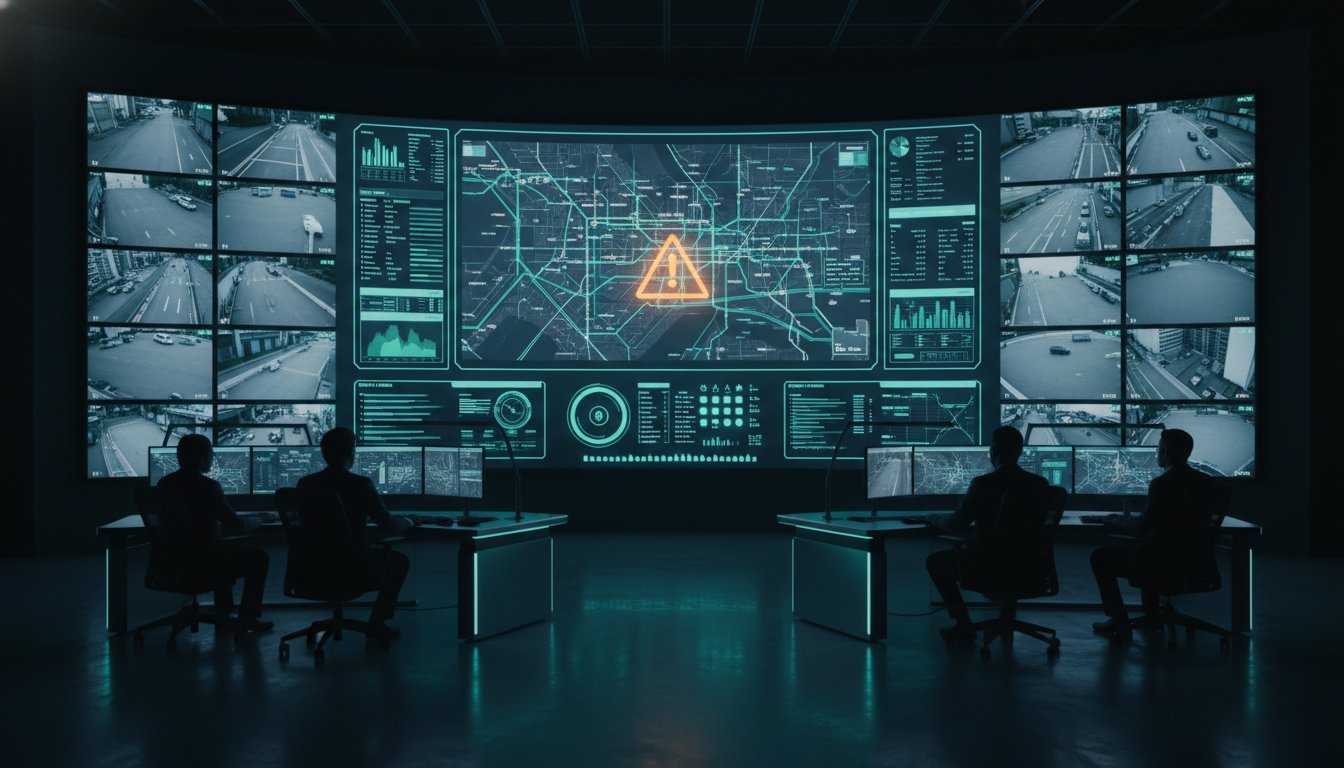
At 4:42 PM on a rainy Tuesday, a multi-vehicle collision on a major interstate begins as a series of disconnected pings across four different agency silos. Operators in the TMC stare at a grid of static camera feeds, unaware that the critical data they need is buried in a separate CAD system or a transit sensor. This fragmentation creates a gap where manual escalation takes minutes instead of seconds. You know that managing a modern traffic network isn’t about a lack of data; it’s about the paralyzing volume of it. Federal Highway Administration data shows traffic incidents cause 25 percent of all highway delays, yet many teams still struggle with operator fatigue from monitoring static screens.
Most control rooms already have the screens. What they’re missing is the layer that decides what goes on them, and escalates automatically when something needs attention. This article demonstrates how to bridge the gap between fragmented data and actionable intelligence to ensure operational continuity. We’ll explore how vis/ability, an operational intelligence layer that surfaces through the video wall, provides a unified operating picture. You’ll learn how this technology transforms the command center into a proactive hub where automated incident escalation improves public safety and traffic flow.
Key Takeaways
- Identify the high cost of fragmented systems and the operational gap between raw traffic data and mission-critical intelligence.
- Understand the core functions of a modern TMC as the central hub for regional network monitoring, incident detection, and coordinated dispatch.
- Learn why most control rooms already have the screens but lack the intelligence layer required to automatically escalate critical events.
- Reduce “time to awareness” for secondary accidents by streamlining CAD, CCTV, and third-party data into a unified common operating picture.
- Future-proof your infrastructure with vis/ability to enable event-driven situational awareness and automated response for 2026 and beyond.
The Operational Gap in Today’s Traffic Management Centers
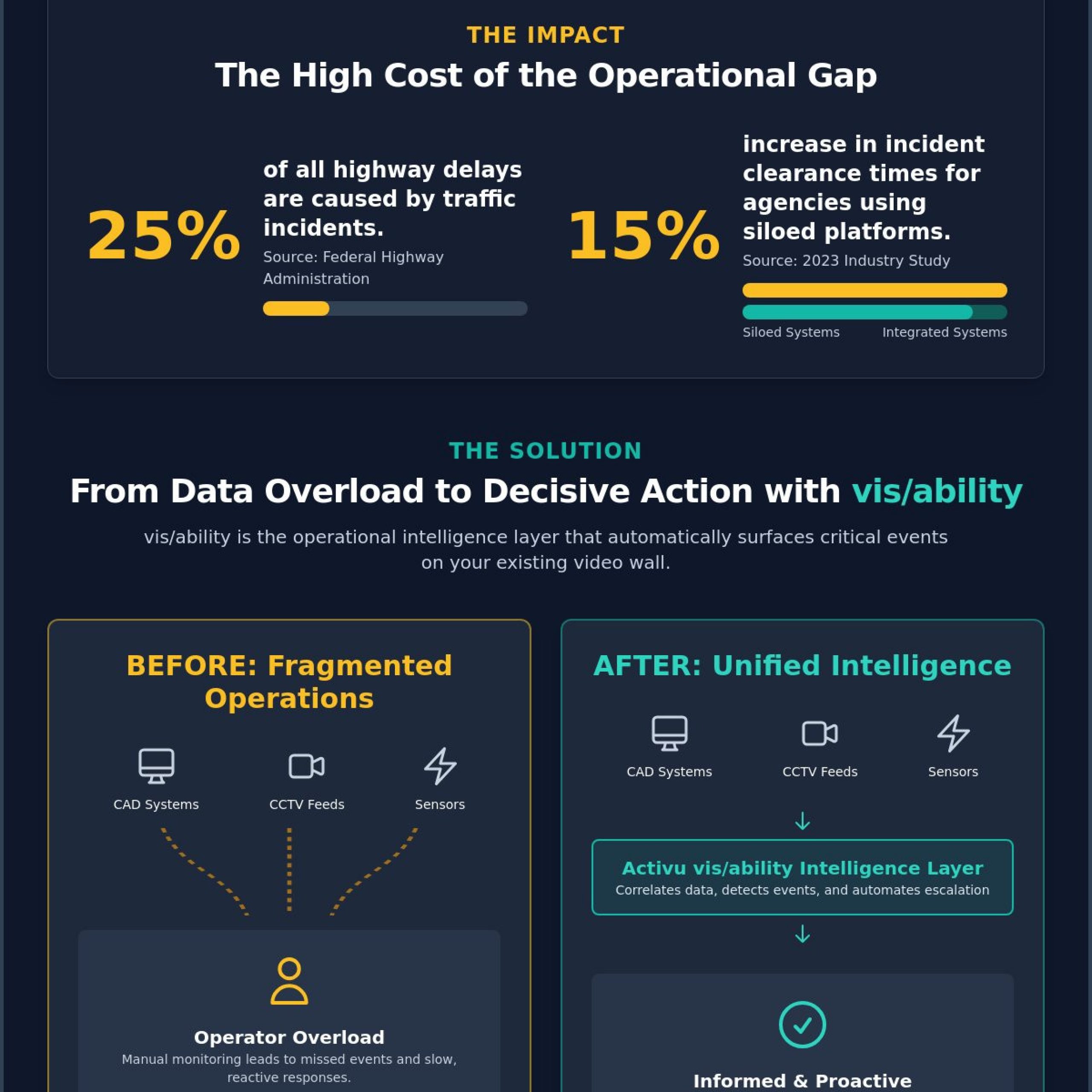
Modern traffic management relies on a complex Advanced Traffic Management System to monitor road networks. However, a critical disconnect persists between the collection of raw data and the delivery of actionable intelligence. A standard TMC receives thousands of data points every minute from sensors, GPS probes, and weather stations. Without a unifying architecture, this information remains trapped in fragmented databases. This fragmentation creates a high cost for mission-critical transportation environments. A 2023 industry study found that agencies using siloed platforms experience a 15% increase in incident clearance times compared to integrated environments.
Operators face a relentless stream of visual input. Monitoring 200 or more camera feeds simultaneously leads to cognitive fatigue within the first 20 minutes of a shift. This psychological toll increases the risk that a stalled vehicle or a secondary crash will go unnoticed. These operators aren’t just managing traffic; they’re managing information overload. This is one of the most common control room situational awareness problems that prevents agencies from reaching their safety goals.
Siloed Systems and Communication Breakdowns
Agencies often rely on disparate software tools that don’t communicate. This creates a barrier when responding to road incidents. Manual data entry during a time-sensitive emergency consumes precious seconds that first responders don’t have. While some organizations use tools like Axon for evidence or CAD systems for dispatch, these are only partial solutions. They lack the ability to provide a unified, real-time common operating picture across the entire organization. Most TMC facilities struggle to share real-time visibility with field units. This lack of integration prevents a seamless response. You can learn more about how we address these challenges in transportation control rooms.
The Lack of Automatic Escalation
Critical incidents are often missed because the responsibility for detection rests solely on human observation. When an operator is forced to juggle how to manage multiple data feeds dispatch center style, human error becomes inevitable. The operational gap is the space between data collection and human judgment. Most control rooms already have the screens. What they’re missing is the layer that decides what goes on them, and escalates automatically when something needs attention.
We define this essential layer as vis/ability. It’s the operational intelligence layer that surfaces through the video wall to ensure that the answer appears exactly when it’s needed most. This technology bridges the divide between massive data streams and decisive action. It solves the mystery of why operators miss incidents video wall feeds often obscure, transforming a wall of monitors into a proactive tool for public safety.
What is a TMC? Defining the Modern Traffic Management Center
A TMC serves as the central hub for monitoring and managing regional transportation networks. It’s the nerve center where data from thousands of endpoints converges to ensure public safety and efficient mobility. Historically, these centers relied on simple CCTV monitoring. Today, they’ve evolved into data-driven hubs utilizing Intelligent Transportation Systems (ITS) to manage 24/7/365 operations. The core functions of a modern TMC include rapid incident detection, dispatch coordination among stakeholders, and the real-time dissemination of public information to commuters.
In many centers, fragmented systems and data silos create a dangerous lag in response times. Operators juggle disparate feeds from CAD, weather sensors, and traffic cameras, yet they lack a unified way to see the big picture. This fragmentation is a primary reason why operators miss incidents video wall displays are supposed to highlight. Most control rooms already have the screens. What they’re missing is the layer that decides what goes on them; it escalates automatically when something needs attention. This operational intelligence layer, which we define as vis/ability, surfaces critical information through the video wall only when it matters most.
Successful operations require seamless collaboration between the DOT, state police, and EMS. Research from the Intelligent Transportation Management Center archives suggests that leveraging big data for proactive safety can reduce secondary crashes by as much as 20%. Achieving this requires moving beyond raw data toward actionable intelligence.
Core Components of a High-Functioning TMC
Modern centers must integrate sensor data, weather feeds, and telematics into a single hub. While Computer-Aided Dispatch (CAD) systems are essential, they are only partial solutions. Without a unifying layer, CAD data remains trapped in a single workstation rather than providing EOC common operating picture solutions for the entire team. To ensure operators can handle these high-stakes environments without fatigue, organizations often invest in specialized control room design services to optimize ergonomics and visual flow.
TMC vs. NOC: Understanding the Differences
While a Network Operations Center (NOC) focuses on digital infrastructure, a TMC manages physical assets and human lives in motion. This creates unique control room situational awareness problems that require geospatial precision. TMC operators don’t just need to know if a sensor is down; they need to see how a stalled vehicle on a specific bridge deck affects the entire regional corridor. These transportation hubs require event-driven visualization that automatically surfaces the right camera feed based on a GPS trigger or a 911 call. If you’re struggling with how to manage multiple data feeds dispatch center workflows, discover how vis/ability creates clarity out of complex data streams.
Beyond the Video Wall: The Intelligence Layer Missing in Most TMCs
Operators in a modern TMC face a relentless influx of data from fragmented systems, sensor networks, and legacy software. These silos often force staff into a reactive posture where they spend valuable time manually searching for information while incidents escalate in the field. This fragmentation is the primary reason why operators miss incidents video wall displays are meant to highlight. Most control rooms already have the screens. What they’re missing is the layer that decides what goes on them, and escalates automatically when something needs attention.
The solution isn’t more monitors; it’s the implementation of an operational intelligence layer. vis/ability serves as this essential bridge between raw data and human judgment. It transforms the display surface from a passive grid of video feeds into a proactive tool that surfaces the answer when seconds matter. By integrating disparate tools into a single, cohesive environment, it ensures that every person in the command center, as well as those on mobile devices or in remote huddle rooms, sees the same mission-critical reality.
The Limitation of Standard Video Wall Software
Many organizations rely on basic display software that functions merely as a pixel-pusher. These products fail to provide true situational awareness because they lack the logic to prioritize information. While some teams use software to manage layouts, these tools don’t solve the underlying control room situational awareness problems. They require an operator to know where an incident is occurring before they can display it. This manual process is a significant bottleneck in high-stakes environments.
Common tools, including those from providers like Axon, offer only partial solutions that remain isolated from the broader operational picture. vis/ability functions as the central unifying hub for all visual information. It integrates these individual tools but adds the necessary intelligence to make them useful for the entire team. Instead of just mirroring a desktop, it ensures that the most relevant data is always front and center, regardless of the source or the platform.
Escalating Automatically When It Matters Most
Effective management requires a shift from “monitor and wait” to a proactive model driven by real-time intelligence. This transition is powered by event-driven triggers that replace manual searching. When a specific threshold is met, such as a traffic sensor detecting a sudden drop in speed or a CAD system logging a high-priority accident, vis/ability automatically pushes the relevant camera feeds and geospatial data to the wall. This ensures that the team is looking at the problem before they even receive a radio call.
Surfacing the answer rather than just the data is what defines a modern TMC. This automation addresses the challenge of how to manage multiple data feeds dispatch center staff deal with daily. By filtering out the noise and presenting only what is essential for the current crisis, automated escalation reduces the cognitive load for staff and allows them to act with absolute certainty. This proactive approach ensures that the video wall is not just a collection of screens, but a dynamic tool for mission-critical decision-making. You can learn more about this technology at activu.com/visability/.
Solving the Incident Management Crisis in Transportation Hubs
Transportation hubs today face a critical gap. Operators struggle with fragmented systems and silos that delay response. They’re often forced into “swivel-chair” operations, manually jumping between Computer-Aided Dispatch (CAD), Waze traffic alerts, and hundreds of CCTV feeds. This friction increases the “time to awareness,” the interval between an event occurring and a dispatcher seeing it. In high-speed environments, every second lost increases the risk of secondary accidents by approximately 2.8 percent for every minute the primary incident remains active. Most control rooms already have the screens. What they’re missing is the layer that decides what goes on them; it escalates automatically when something needs attention. Activu’s vis/ability acts as this operational intelligence layer, surfacing critical data through the video wall when it matters most.
Managing Multiple Data Feeds for Faster Dispatch
Relying on standalone tools like Axon for body-worn video or Juvare for emergency management creates a disjointed workflow. These platforms provide valuable data, but they’re only partial solutions. Without a central hub, staff must divide their attention across multiple monitors, leading to cognitive overload and missed hazards. vis/ability integrates these disparate tools into one unified view. It transforms raw telematics and sensor data into actionable intelligence. By centralizing visibility, a TMC ensures that field technicians and dispatchers share the same common operating picture, whether they’re in the command center or using mobile devices on the shoulder of a highway.
Reducing Incident Response Times with Real-Time Visualization
Real-time visualization is the direct link between situational awareness and saved lives. When a hazard appears, vis/ability doesn’t just show the video; it correlates the location with nearby assets and emergency units. This level of clarity is vital for public safety teams who must coordinate across jurisdictional lines. Shared visual data eliminates the ambiguity of voice-only radio traffic. It allows inter-agency partners to see the exact scope of a crisis simultaneously. This proactive approach has been shown to reduce incident clearance times by up to 30 percent in major metropolitan corridors. By removing the guesswork, vis/ability empowers TMC operators to act with absolute certainty when every second counts.
Future-Proofing the TMC with vis/ability
The evolution of the TMC toward 2026 requires a shift from passive monitoring to event-driven situational awareness. Currently, many traffic centers face a critical gap. Operators struggle with fragmented systems, disconnected sensors, and data silos that force them to manually scan dozens of feeds. This fragmentation is a primary cause of control room situational awareness problems. When an incident occurs, the delay between the event and the human response can be measured in lives and infrastructure damage. While tools like Axon products provide valuable data, they remain partial solutions that lack the context of the wider operational environment.
Most control rooms already have the screens. What they’re missing is the layer that decides what goes on them, and escalates automatically when something needs attention. Activu provides this through vis/ability, an operational intelligence layer that surfaces through the video wall. It acts as the central hub, pulling data from disparate ITS sensors and geospatial feeds into a single, cohesive view. By the time 2026 arrives, the expectation for national transportation infrastructure will be total visibility, not just reactive viewing. Activu remains the trusted partner for these projects because our software ensures that when stakes are highest, the right information is already where it needs to be.
Integrating Cybersecurity into Traffic Operations
Traffic management is no longer just about asphalt and signals; it’s about the network. Protecting ITS infrastructure from unauthorized access is a mission-critical requirement for modern agencies. vis/ability enables a cybersecurity common operating picture by visualizing network health alongside live traffic flow. If a roadside unit goes offline or a network node shows unusual latency, the system alerts the team immediately. This integration is vital for Operational Continuity: Ensuring Mission-Critical Resilience in 2026. By monitoring both physical and digital threats, operators maintain total continuity without switching between disconnected security dashboards.
The Path to a Unified Operating Picture
Transitioning from siloed monitors to a unified platform begins with vendor-neutral application integration. This solves the common problem of how to manage multiple data feeds dispatch center teams face daily. Unlike proprietary systems that lock agencies into specific hardware, vis/ability scales across huddle rooms, conference centers, and mobile apps. This software-based approach allows a shift supervisor in a breakout room or a technician on a mobile device to see the exact same intelligence as the command center. Organizations looking for EOC common operating picture solutions find that vis/ability provides the clarity needed to act with certainty. It’s time to move beyond the limitations of standard video walls where operators miss incidents. Contact Activu to design your next-generation TMC.
Modernize Your Traffic Operations for Total Situational Awareness
Managing a modern traffic management center requires more than just displaying camera feeds. It demands an integrated approach that eliminates data silos and ensures operators see exactly what they need when every second counts. Fragmented systems often leave teams reacting to old information, but vis/ability provides the operational intelligence layer necessary to bridge that gap. Most control rooms already have the screens. What they’re missing is the layer that decides what goes on them, and escalates automatically when something needs attention.
Activu leverages over 40 years of mission-critical experience to support federal and state DOT agencies in their most demanding environments. By implementing event-driven automation that reduces response times, you empower your team to act with certainty. This technology ensures that critical insights flow seamlessly from your data sources to the video wall, huddle rooms, and mobile devices. You’ve built the infrastructure; now it’s time to give it the intelligence it needs to protect the public and keep traffic moving. Request a Demo of the vis/ability Platform for Your TMC. We look forward to helping you achieve a new standard of operational clarity.
Frequently Asked Questions
What does TMC stand for in a transportation context?
TMC stands for Traffic Management Center, the central hub where agencies monitor road networks and manage traffic flow. These facilities serve as the nerve center for regional transportation, processing data from thousands of sensors and cameras. Most control rooms already have the screens. What they’re missing is the layer that decides what goes on them, and escalates automatically when something needs attention. Without this layer, a TMC remains a collection of isolated data points rather than a cohesive intelligence unit.
How does a Traffic Management Center improve road safety?
A Traffic Management Center improves road safety by reducing secondary crashes by 20 percent through faster incident detection and response. When operators identify a stall or crash within 60 seconds, they can dispatch help before traffic builds up. Vis/ability acts as the operational intelligence layer that surfaces through the video wall, ensuring that the most critical sensor data or CAD alerts appear immediately. This automation removes the manual burden of searching through 500 camera feeds to find one active emergency.
What is the difference between a TMC and an EOC?
A TMC focuses on daily traffic operations and infrastructure health, while an Emergency Operations Center (EOC) activates for specific large-scale disasters or planned events. While their missions differ, both suffer from fragmented systems and data silos. Most control rooms already have the screens. What they’re missing is the layer that decides what goes on them, and escalates automatically when something needs attention. Vis/ability bridges these environments, allowing a TMC to share a common operating picture with an EOC during a crisis.
Can vis/ability integrate with existing CCTV and CAD systems?
Vis/ability integrates directly with existing CCTV networks and Computer-Aided Dispatch (CAD) systems to create a unified workflow. Standalone CAD or CCTV tools often fail because they provide only a partial solution, forcing operators to toggle between 10 different windows. Vis/ability solves this by pulling these feeds into a single hub. It detects specific triggers within your CAD data and automatically pushes the relevant camera feed to the video wall when an incident occurs, eliminating manual search time.
Why do operators often miss incidents on standard video walls?
Operators miss incidents because the human brain can’t effectively monitor more than 4 video streams for longer than 20 minutes without losing focus. In a room with 50 or 100 screens, critical details get lost in the noise. This explains why operators miss incidents on video walls that lack automated intelligence. Vis/ability fixes this gap by serving as an operational intelligence layer. Instead of showing static grids, it only surfaces what matters based on real-time data triggers.
Is vis/ability available on mobile devices for field units?
Vis/ability is fully accessible on mobile devices, tablets, and remote laptops to ensure field units stay informed. This extension solves the common problem of information silos between the command center and the first responders on the ground. Most control rooms already have the screens. What they’re missing is the layer that decides what goes on them, and escalates automatically when something needs attention. By pushing the same mission-critical view to a smartphone, field supervisors gain 100 percent situational awareness.
How does a Common Operating Picture (COP) benefit a TMC?
A Common Operating Picture ensures that every stakeholder, from the TMC manager to the state police, sees the exact same data in real time. This synchronization eliminates the 5 to 10 minute delays caused by verbal status updates or emailed screenshots. Vis/ability creates this COP by serving as the intelligence layer that surfaces through the video wall. It transforms a wall of screens into a singular source of truth, allowing teams to make decisions with absolute certainty during high-stakes events.
What are the key components of a modern Traffic Management Center?
A modern TMC requires high-definition sensors, robust fiber-optic networks, and an operational intelligence layer like vis/ability. While many agencies invest in hardware, they often overlook the software needed to manage data overflow. Most control rooms already have the screens. What they’re missing is the layer that decides what goes on them, and escalates automatically when something needs attention. Without this, the hardware is just a passive display. Vis/ability acts as the central hub that makes these components work as one system.