

Bringing Harmony to the Chaos of the Command Center
As tornado season arrives, vis/ability is revolutionizing Emergency Operations Centers (EOCs), enabling them to take proactive measures before tornadoes strike, and respond in real-time when they do.
While technology continues to deliver faster, more actionable information, it often overwhelms operators with data that becomes difficult to manage during an incident. vis/ability, powered by AI, orchestrates the control room ensuring all the data is in harmony, interpreting what matters most in the moment, and routing the right information to the right people when an incident occurs.
The Legacy of Tornado Preparedness
On March 18, 1925, the deadliest tornado in US history—the Tri-State Tornado—devastated communities across Missouri, Illinois, and Indiana. The scale of destruction was unprecedented.
One Storm:
695
Lives Lost
15,000+
Homes Destroyed
3 States
Missouri • Illinois • Indiana
Entire towns were leveled, schools, churches, factories gone. This catastrophe spurred gradual yet vital advancements: improved forecasting, federal involvement, and heightened community awareness. By the late 20th century, tornado-prone areas had developed EOCs with integrated weather tracking, robust communication systems, and pre-planned emergency responses—measures that could have mitigated the Tri-State Tornado’s destruction.
The Evolution of EOCs
Today, EOCs are indispensable in tornado-prone communities, transforming disaster response from reactive chaos to coordinated strategy. But that coordination is only as strong as the systems behind it —and the operators working those systems are increasingly overwhelmed by the sheer volume of data streaming in.
“The challenge isn’t access to data—it’s coordinating the massive influx of information and communications effectively.”
Cutting-Edge Advancements in Tornado Management
Modern EOCs benefit from a remarkable array of technological advancements. Each of these tools is valuable. But without a conductor, operators are left clicking between dashboards, out of sync between team members, and agencies manually managing tools and video walls during the exact moment when every second counts.
Doppler and Phased-Array Radar
Enhances tornado tracking, providing 10–15 minutes of lead time for warnings.
Warn-on-Forecast (WoF)
Advanced severe-weather forecasting initiative led by NOAA, with FEMA and local emergency managers as key partners and end-users.
Multi-Radar Multi-Sensor (MRMS)
Integrates radar, satellites, and surface data to generate detailed storm maps.
Mobile Apps and Alerts
Deliver instant emergency notifications to the public.
New Tornado Detection Algorithm (NTDA)
Uses machine learning to analyze radar data, improving tornado probability accuracy.
Predictive Analytics
Anticipates resource needs — medical supplies, shelter, and personnel — based on storm forecasts.
Drones
Equipped with weather sensors, drones assist in post-tornado damage assessment.
Climate Adaptation
Updates risk maps and resource allocation based on climate-driven trends like La Niña.
How vis/ability is Elevating EOCs
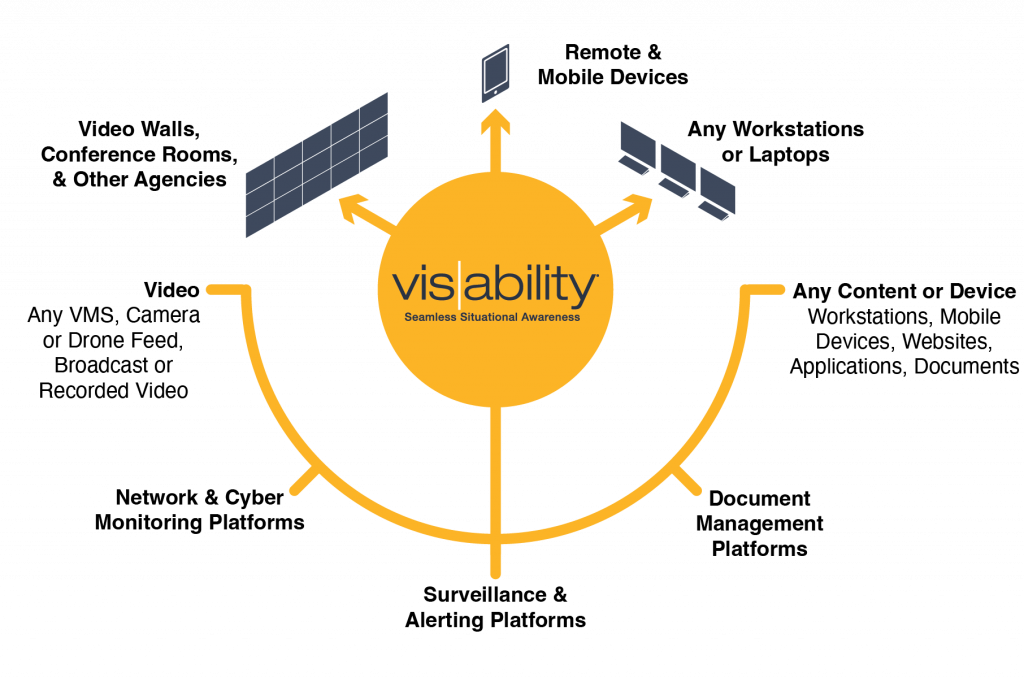
vis/ability is the AI-powered Video Wall Controller and command center orchestration platform that integrates these assets into a networked, seamless, user-friendly interface, delivering a real-time, tailored view of every incident. Its hardware-light design enhances accessibility without sacrificing security, allowing teams to adapt swiftly in dynamic scenarios. Many EOCs don’t even need to replace their existing video walls to gain the benefits of vis/ability—it works with the infrastructure you already have.
Where legacy video wall controllers simply display hard-wired content, vis/ability uses AI to understand context, anticipate needs, and act. It’s the difference between a screen that shows you data and a system that tells you what the data means, what to do next, and who needs to see it.
Proactive, AI-Driven Orchestration
vis/ability doesn’t wait for an operator to notice a threat and manually assemble a response. Its AI continuously monitors incoming signals—weather feeds, sensors, alerts, camera analytics—and proactively triggers the right workflows the moment conditions warrant. A tornado warning in a specific county doesn’t just ping a dashboard; it pulls up the relevant radar overlay, field cameras, shelter locations, and resource inventories onto the video wall and pushes role-specific views to every operator workstation—automatically.
Automated Real-Time Alerts
More than notifications — vis/ability takes action. When an incident occurs, critical content automatically appears on video walls, scaled and positioned for maximum situational awareness.
Dynamic Dashboards
Operators receive an instantly-customized view of the necessary apps, cameras, and systems on workstations, remote screens, and mobile devices—eliminating the need to switch between tools or search for vital data during a crisis.
Live Drone and Mobile Streaming
Teams on-site stream real-time mobile video or live drone feeds directly into the EOC, putting decision-makers on the ground and in the air at the most critical moments.
By streamlining response operations with intelligent orchestration, vis/ability empowers EOCs to manage tornadoes more effectively than ever before—ensuring communities are prepared and protected.
When the storm hits, every tool in your EOC needs to play on cue
vis/ability is the conductor that keeps the orchestra in time — turning a chaotic command center into a coordinated performance, every time.
Transforming Crisis Response
vis/ability eliminates communication barriers, ensuring seamless data sharing between internal teams and external agencies. Whether in the control room, the field, or a crisis briefing, your team stays connected and informed.
Thousands of command centers worldwide trust Activu vis/ability for mission-critical operations in law enforcement, utilities, transportation, and emergency management.

See vis/ability in action
Contact us today or request a demo to see how the leading AI-powered Video Wall Controller and command center orchestration platform can transform your control room.