
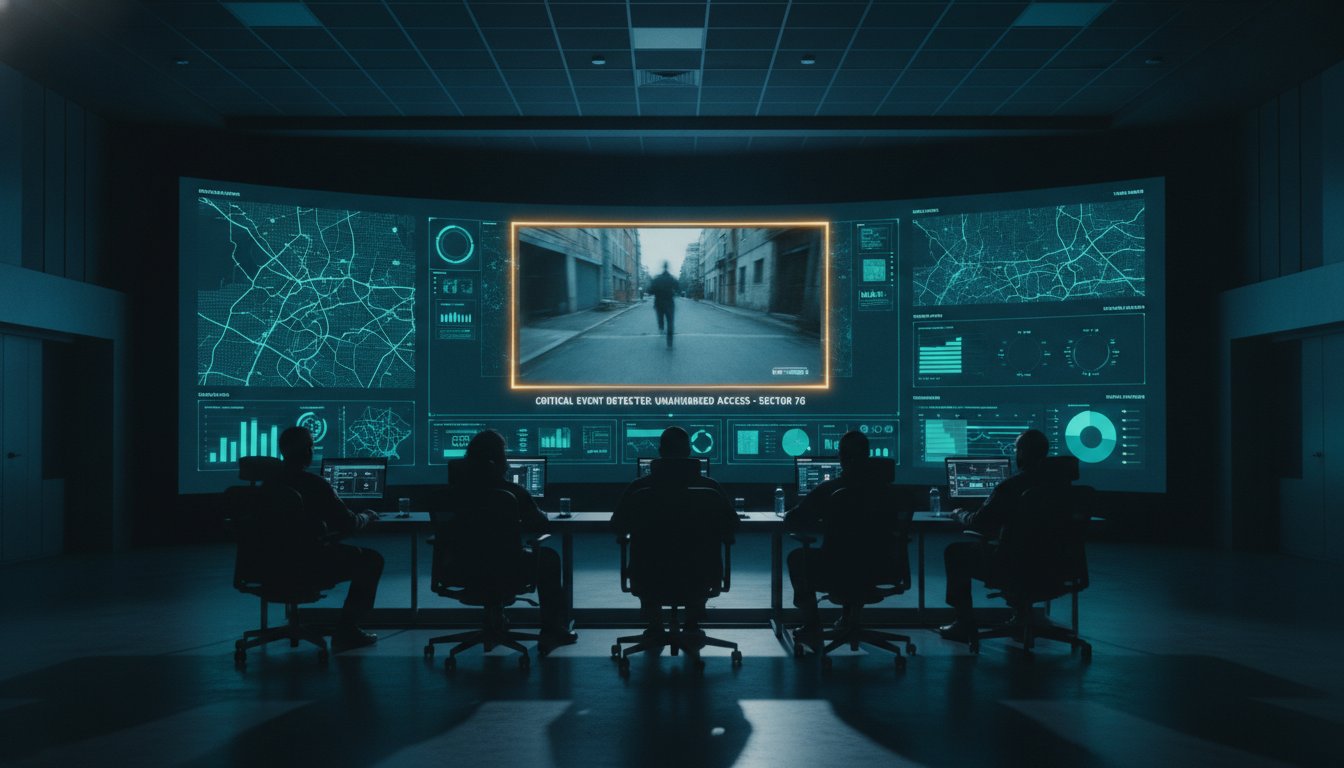
Why are your operators still expected to monitor 30 stagnant camera feeds and catch the one second of movement that signals a breach? In high-stakes command centers, fragmented data streams create dangerous blind spots that no amount of manual switching can fix. Most control rooms already have the screens. What they’re missing is the layer that decides what goes on them; and escalates automatically when something needs attention. Effective VMS integration with video wall software serves a higher purpose than merely viewing more cameras. It creates a proactive environment where the system identifies threats before a human eye even blinks.
We recognize that the current operational reality for many dispatch and emergency operations centers is defined by constant fatigue and delayed response times. You’ve likely invested in sophisticated tools like Axon, yet these often provide only a partial solution, leaving your team to navigate siloed platforms during a crisis. This article explores how to transform these disconnected inputs into a unified operational intelligence layer. You’ll discover how to automate incident escalation and ensure seamless collaboration between your command center and mobile field units. We’ll show you how to replace raw data with actionable clarity, positioning your team to act with absolute certainty when every second counts.
Key Takeaways
- Identify why excessive screen counts often decrease situational awareness and how to transition from passive monitoring to active intelligence.
- Contrast the limitations of proprietary “Smart Wall” features with a platform-agnostic intelligence layer that ingests any VMS or data stream.
- Learn how VMS integration with video wall software facilitates programmatic orchestration, allowing the system to decide what is displayed based on real-time triggers.
- Discover the mechanism for automated escalation that ensures critical incidents are never lost among stagnant camera feeds.
- Explore how a unified operating picture empowers team collaboration across the command center, huddle rooms, and mobile devices.
The Limitations of Fragmented Surveillance in Mission-Critical Operations
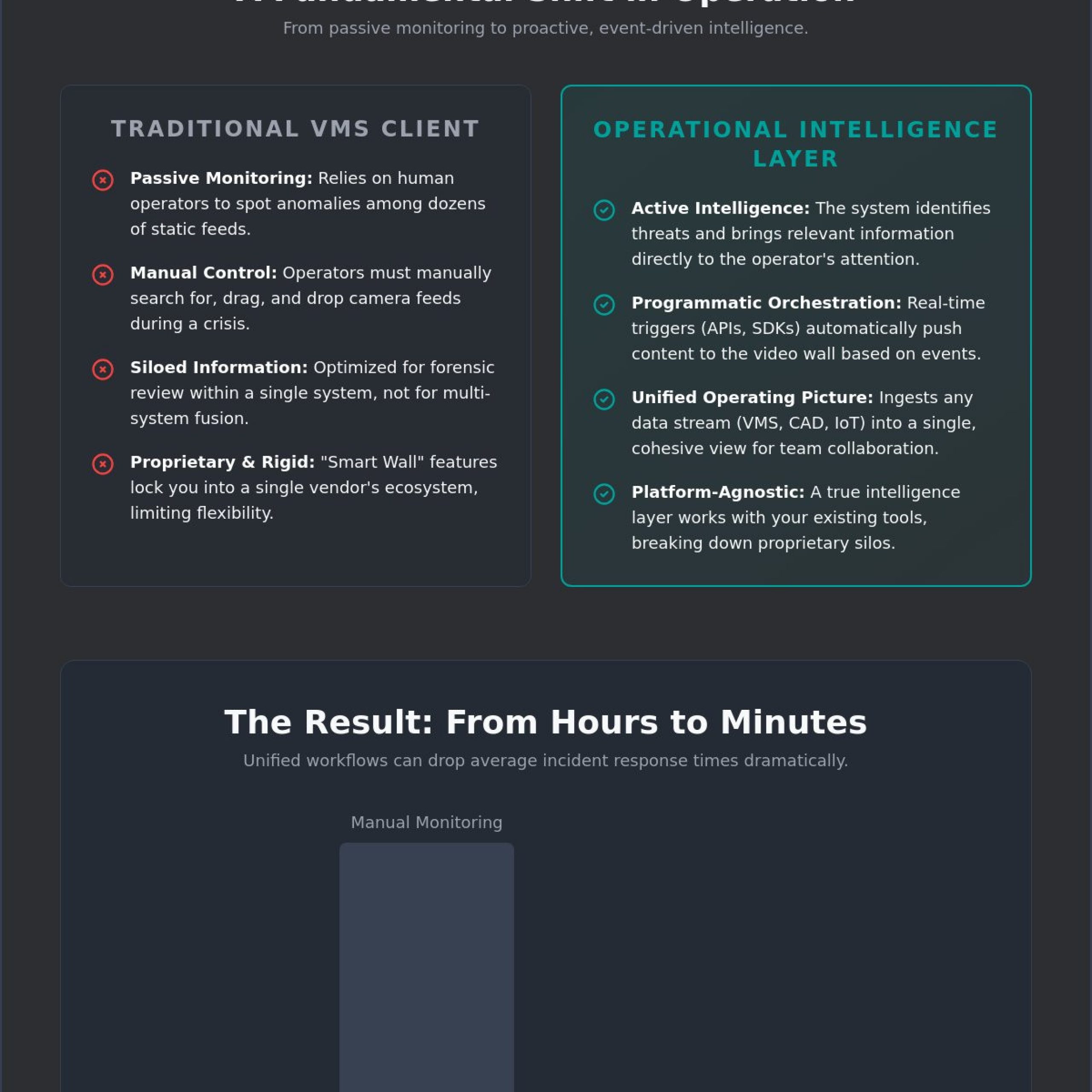
In high-stakes environments, the instinctive response to rising security threats is often to add more hardware. This results in the “Wall of Glass” trap, where operators are surrounded by dozens of screens but possess less clarity than before. When a Video Management System (VMS) operates in isolation, it forces personnel to act as the human integration point. This manual process is inherently slow and prone to error. Without sophisticated VMS integration with video wall software, incident response times suffer because data remains trapped within proprietary interfaces. Standard VMS clients are optimized for forensic review or localized monitoring. They lack the orchestration capabilities required for complex, multi-agency fusion centers where every second determines the outcome of a mission.
The Reality of Operator Cognitive Overload
Monitoring dozens of stagnant feeds leads to a psychological phenomenon known as change blindness. Operators eventually stop seeing the screen after prolonged exposure to repetitive visuals. In a mission-critical command center, identifying critical anomalies in a sea of raw data is a monumental task for any human. Research indicates that unified workflows can drop average incident response times from 45 minutes to approximately 8 minutes, yet many centers still rely on manual observation. The risk of missing high-consequence events increases when operators must manually toggle between surveillance and data platforms. This cognitive load doesn’t just cause fatigue; it creates a dangerous gap in the defensive perimeter that sophisticated threats are designed to exploit.
Siloed Data: The Invisible Barrier to Situational Awareness
Disparate streams of VMS, Computer-Aided Dispatch (CAD), and IoT data create a fragmented narrative of an ongoing incident. Technical friction occurs when moving data between proprietary security ecosystems, preventing a cohesive response across departments. While organizations often implement powerful tools like Axon for specific field operations, these systems only provide a partial solution. Without a unifying layer, they become another silo that requires manual attention to integrate into the full common operating picture. This siloed approach is the invisible barrier to true situational awareness, as it prevents the “big picture” from ever forming. To overcome these gaps, organizations require a unified incident management software framework. This framework serves as the bedrock for operational readiness, ensuring that critical information flows where it is needed most without manual intervention.
What is VMS Integration with Video Wall Software?
At its core, VMS integration with video wall software represents the programmatic orchestration of video streams within a mission-critical environment. It moves beyond the simple act of displaying a camera feed on a monitor. Instead, it establishes a bidirectional communication channel where the video wall acts as a dynamic canvas for the Video Management System. This integration relies heavily on robust Application Programming Interfaces (APIs) and Software Development Kits (SDKs) to bridge the gap between the surveillance backend and the visual frontend. By leveraging these tools, command centers can automate how content is pushed to the wall, ensuring that operators aren’t wasting precious seconds manually dragging and dropping windows during a high-stakes event.
Real-time tactical response demands absolute technical reliability. Low-latency streaming is not a luxury; it is a requirement for operational readiness. When seconds matter, any delay between an event occurring and its appearance on the video wall can lead to catastrophic failure. High-performance integration ensures that video packets are processed and rendered with minimal overhead. Most control rooms already have the screens. What they’re missing is the layer that decides what goes on them; and escalates automatically when something needs attention. This is where a dedicated operational intelligence layer transforms raw visual data into a tool for decisive action. You can explore how these components fit together by reviewing the vis/ability platform for your command center.
Software-Defined Visualization vs. Hardware Switching
Traditional command centers often relied on hardware-based matrix switching, which utilized rigid, proprietary hardware to route signals. While stable, these systems offer little flexibility and are difficult to scale. Software-defined visualization represents a shift toward IP-based video distribution. This approach allows for infinitely customizable layouts that can change instantly based on the severity of an incident. By utilizing commercial off the shelf (COTS) hardware, organizations reduce long-term costs and avoid vendor lock-in. Software-defined systems provide the agility needed to ingest diverse data streams beyond just video, such as web dashboards or geospatial maps, into a single, unified view.
Protocol Compatibility: SRT, HEVC, and H.264
Operational efficiency depends on the system’s ability to handle diverse video codecs. H.264 remains the most common standard for surveillance, but high-resolution environments increasingly require High Efficiency Video Coding (HEVC) to maintain visual clarity without saturating the network. High-efficiency video coding plays a vital role in reducing network bandwidth requirements while maintaining the high-fidelity imagery necessary for forensic identification. For distributed operations, Secure Reliable Transport (SRT) has become essential. It provides a secure, low-latency method for delivering video across unpredictable networks, such as the public internet or mobile links. Supporting these diverse protocols ensures that your video wall remains a reliable hub for every incoming data stream, regardless of its source or format.
VMS Client vs. Operational Intelligence Layer: A Strategic Comparison
A standard VMS client is a specialized tool designed for a specific task: managing and reviewing video footage. Organizations frequently utilize platforms like Milestone or Genetec for their surveillance needs, but these tools are built primarily for the security desk. When you transition to a command center environment, the requirements change significantly. VMS integration with video wall software must do more than just mirror a workstation screen. It should act as an active orchestration engine that synchronizes video with non-video data, such as geospatial maps, cybersecurity alerts, and IoT sensor streams. Relying on a VMS client alone results in passive viewing, where operators must still manually interpret whether a specific feed requires attention. True operational readiness requires a shift from watching screens to managing an event-driven environment.
Why Proprietary ‘Smart Walls’ Are Often Partial Solutions
Proprietary “Smart Wall” features often suffer from a walled garden problem. These modules are designed to display video from within their own ecosystem but struggle to ingest external web applications, live dashboards, or third-party data feeds. Organizations using tools like Axon or Milestone often find that these systems provide only a partial solution for a full common operating picture. For example, a tactical lead cannot easily overlay a live weather radar or a CAD dispatch map directly onto a proprietary video wall layout without significant technical friction. Additionally, sharing these proprietary views with mobile field units or remote stakeholders is often cumbersome, requiring specialized licenses or hardware that slow down the flow of information during a crisis. This siloed approach prevents the command center from becoming the unified hub it needs to be.
The Role of the Operational Intelligence Layer
The operational intelligence layer serves as the central hub into which all other mission-critical tools flow. It is the unifying platform that makes every other piece of software more useful for the entire team. Most control rooms already have the screens. What they’re missing is the layer that decides what goes on them; and escalates automatically when something needs attention. This layer empowers everyone, from the operator at the desk to the executive in a huddle room or the responder on a mobile device. By positioning the vis/ability platform as the benchmark for this technology, organizations can move beyond fragmented surveillance. It ensures that the right information reaches the right person at the moment of a pivotal decision, transforming raw data into certain action. This approach replaces manual switching with automated clarity, allowing your team to focus on the mission rather than the technology.
Building an Event-Driven Common Operating Picture
Most control rooms already have the screens. What they’re missing is the layer that decides what goes on them; and escalates automatically when something needs attention. This shift represents the transition from constant, vigilant monitoring to management by exception. In this model, VMS integration with video wall software ensures that operators only interact with data when a specific threshold is crossed. Instead of staring at dozens of stagnant cameras, the team focuses on a single, high-priority incident that the system has already identified and visualized. This programmatic approach eliminates the noise of everyday operations, allowing personnel to reserve their cognitive energy for the moments that truly matter.
Automating the Escalation Workflow
When a VMS motion alert or an AI analytic detects a perimeter breach, the system shouldn’t wait for a human to notice. An automated escalation workflow immediately triggers a specific video wall layout, pulling the relevant camera feed to the center while surrounding it with supporting data. VMS integration with video wall software facilitates this “push” mechanism, ensuring that relevant information finds the operator, rather than the operator hunting for information. By prioritizing essential information automatically, you significantly reduce the time-to-insight. This speed is the difference between a contained incident and a full-scale operational failure.
Integrating Diverse Data for Total Visibility
True visibility requires more than just video. Combining VMS feeds with a cybersecurity common operating picture allows teams to correlate physical breaches with digital threats in real time. For the transportation and utility sectors, integrating geospatial data ensures that field assets are viewed in their proper geographic context. This automation doesn’t replace human judgment; it empowers it. By handling the rote tasks of data retrieval and layout management, the system provides a clear canvas upon which experts can make informed decisions. To see how your center can achieve this level of readiness, you can contact our design team for a consultation.
vis/ability: Unifying VMS Feeds for Mission-Critical Success
vis/ability stands as the definitive operational intelligence layer for complex environments where fragmented data is a liability. While organizations often rely on standalone VMS clients, these tools frequently act as silos that restrict the flow of information during urgent operations. vis/ability unifies these disparate feeds by ingesting any VMS, web application, or real-time data stream into a single, cohesive interface. This platform serves as the central hub that makes every other tool in your arsenal more effective for the entire team. Most control rooms already have the screens. What they’re missing is the layer that decides what goes on them; and escalates automatically when something needs attention. By implementing VMS integration with video wall software through vis/ability, you transition from a reactive posture to a state of proactive situational awareness where clarity is the standard.
Extending Visibility Beyond the Command Centre
The Link feature within vis/ability ensures that critical VMS views aren’t trapped within the physical walls of the command center. It facilitates seamless collaboration by sharing real-time data with mobile users and huddle rooms, ensuring that field units and executives see the same common operating picture. This capability is vital for federal and defense operations, where secure and immediate information sharing determines mission success. By maintaining a synchronized view across distributed teams, the platform ensures operational continuity even during the most volatile incidents. It bridges the gap between raw surveillance and human judgment, allowing for decisive action regardless of a team member’s location or device.
Next Steps: Transitioning to an Intelligent Video Wall
Transitioning to an intelligent video wall begins with a comprehensive audit of your current VMS silos. You must identify the critical integration gaps where data remains inaccessible or requires manual intervention to visualize. Selecting the right VMS integration with video wall software requires a human-centric approach that prioritizes operator clarity over technical complexity. The goal is to build a system that supports the team rather than overwhelming them with stagnant feeds. A well-designed system will prioritize essential information at the moment of a pivotal decision, acting as the bedrock for all future operations. If you’re ready to move beyond fragmented feeds and achieve total visibility, contact Activu for a tailored system assessment. Our experts will help you design a solution that transforms your data into a powerful engine for operational success.
Achieving Operational Readiness through Intelligent Integration
Transitioning from fragmented surveillance to a unified operating picture is a strategic necessity for high-stakes environments. Proprietary silos and cognitive overload compromise response times, but effective VMS integration with video wall software eliminates these barriers by automating the prioritization of essential information. This transformation ensures that your team acts with certainty rather than reacting to noise, turning raw data into actionable intelligence at the moment of a pivotal decision.
Take the first step toward a proactive situational awareness model today. Request a Demo of the vis/ability Operational Intelligence Layer to see how we can empower your team to act with greater certainty. Your command center is the engine of your success, and it’s time to provide it with the visibility it deserves.
Frequently Asked Questions
What is the difference between a VMS client and video wall software?
A VMS client is a dedicated tool for managing cameras and reviewing footage at a single workstation, whereas video wall software acts as an orchestration layer for the entire room. While a VMS client focuses primarily on the video itself, VMS integration with video wall software allows for the aggregation of disparate data sources, such as web apps and GIS, into a unified display. This integration transforms a passive viewing experience into an active hub for operational intelligence.
Can I integrate multiple different VMS brands into a single video wall?
You can integrate multiple VMS brands into a single, unified view by utilizing a platform-agnostic intelligence layer. This approach eliminates the “walled garden” problem often found in proprietary systems, allowing feeds from different vendors to coexist on the same screen. It ensures that your common operating picture remains complete regardless of the underlying camera hardware, providing a seamless experience for the entire command team.
How does VMS integration help reduce operator fatigue?
Integration reduces fatigue by shifting the team’s focus from passive monitoring to management by exception. Instead of requiring personnel to watch dozens of stagnant feeds, the system uses automated triggers to highlight only the specific cameras that require immediate attention. Most control rooms already have the screens. What they’re missing is the layer that decides what goes on them; and escalates automatically when something needs attention.
Is it possible to automate video wall layout changes based on VMS alerts?
Automation of layout changes is a core benefit of sophisticated VMS integration with video wall software. When a VMS alert or AI analytic detects a perimeter breach or anomaly, the software instantly triggers a “critical incident” layout that pushes relevant cameras and data to the wall. This programmatic response ensures that the team receives essential information without manual intervention, allowing them to focus entirely on the mission.
Do I need to replace my existing cameras to use advanced video wall software?
How does integrated video wall software handle cybersecurity and network health data?
Integrated software treats cybersecurity and network health data as high-priority inputs alongside traditional video feeds. By ingesting real-time dashboards from network monitoring tools, the system provides a cybersecurity common operating picture that correlates physical and digital threats. This holistic view allows personnel to identify if a camera outage is a simple hardware failure or part of a larger, coordinated cyberattack on the facility.
Can VMS feeds be shared with mobile devices through the video wall platform?
Secure data sharing with mobile devices is a primary feature of an operational intelligence layer. Personnel in the field can access the same real-time VMS feeds and data dashboards viewed in the command center, which ensures total synchronization across the entire team. This capability is essential for federal and defense operations where distributed situational awareness is a requirement for maintaining operational continuity during a crisis.
What are the bandwidth requirements for streaming high-resolution VMS feeds to a video wall?
Bandwidth requirements vary based on the number of concurrent streams and the codecs used, such as H.264 or HEVC. High-efficiency video coding can reduce bandwidth needs by approximately 50% compared to older standards while maintaining the visual clarity required for tactical response. The system manages these streams programmatically to ensure the network remains resilient and responsive, even during high-volume events that demand maximum visibility.