
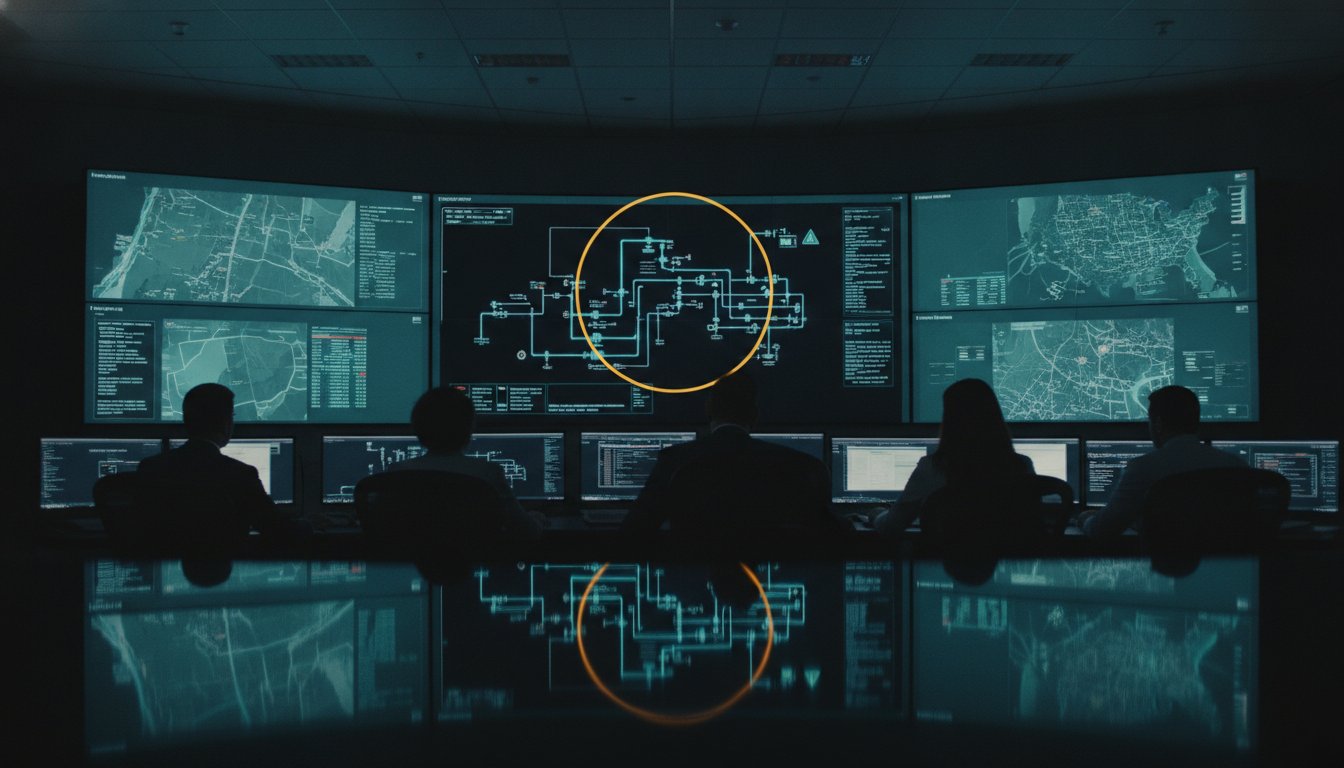
What if the very data meant to protect your infrastructure is the reason your operators are missing critical incidents? With the average annual cost of SCADA-related downtime reaching $4.2 million, the stakes for operational visibility have never been higher. Most teams currently struggle with fragmented systems and siloed data, where critical alerts in platforms like Ignition or AVEVA remain trapped on individual workstations. This creates a dangerous reliance on manual escalation and contributes to significant operator fatigue as staff monitor dozens of static screens. Successfully integrating SCADA systems on a video wall requires moving beyond basic screen mirroring toward a strategy of event-driven visual intelligence.
Most control rooms already have the screens. What they’re missing is the layer that decides what goes on them, and escalates automatically when something needs attention. This guide explains how to resolve the disconnect between raw data and actionable judgment by implementing vis/ability as your operational intelligence layer. You’ll learn how to create a unified common operating picture that automates the escalation of critical data and fosters seamless collaboration between the control room and field units. We will outline the methodology for transforming your facility into a proactive command center where every decision is backed by clear, visual intelligence.
Key Takeaways
- Eliminate information silos by identifying the causes of monitor-wall blindness and the resulting gaps in situational awareness.
- Transition from simple screen mirroring to native integration through APIs and web-based interfaces for more resilient data visualization.
- Support mission-critical decision making by applying a framework that filters out noise and prioritizes the most urgent operational data.
- Learn the technical requirements for integrating SCADA systems on a video wall using automated, event-driven visual triggers.
- Build a unified common operating picture that bridges the gap between field teams and command centers during critical events.
The Fragmented Reality of Modern SCADA Monitoring
High-stakes operations in energy, utilities, and manufacturing depend on an endless stream of telemetry to maintain stability. Supervisory Control and Data Acquisition (SCADA) systems serve as the bedrock of this data collection, yet raw data is not the same as actionable intelligence. In many control rooms, this information remains trapped within individual workstations or specific software instances. When a critical anomaly occurs, the gap between the event and the operator’s awareness can lead to catastrophic delays. Most control rooms already have the screens. What they’re missing is the layer that decides what goes on them, and escalates automatically when something needs attention.
The challenge of integrating SCADA systems on a video wall is often misunderstood as a simple hardware connection problem. If an operator must manually toggle between different applications to verify an alarm, the system has already failed to provide true situational awareness. Real operational intelligence requires a platform that unifies these disparate feeds into a single, cohesive view. Without this, teams remain reactive, buried under a mountain of data that obscures the very incidents they are meant to prevent.
Identifying Gaps in Fragmented Control Room Systems
Disparate applications are the primary enemies of a true common operating picture. When SCADA data lives in one silo, GIS mapping in another, and surveillance feeds in a third, operators lose precious seconds navigating between interfaces. This fragmentation creates a hidden operational cost. The mental effort required to correlate a pressure drop in a SCADA HMI with a physical location on a map or a live camera feed slows response times. Siloed data doesn’t just cause inconvenience; it is the leading cause of delayed incident response in mission-critical environments.
Why Operators Miss Incidents on a Static Video Wall
Human psychology plays a decisive role in control room failure. In high-density data environments, the brain naturally begins to filter out “visual noise.” When a video wall displays the same static grids hour after hour, operators experience monitor-wall blindness. They stop seeing the subtle changes that signal a developing crisis. Some organizations use systems that prioritize high-quality video streams and low latency, but pristine video is useless if it is not the right video at the right time. Effectively integrating SCADA systems on a video wall means moving away from static displays. It requires a transition to proactive intelligence where the technology identifies the anomaly and forces it to the foreground, ensuring the human element is always focused on the most critical decision at hand.
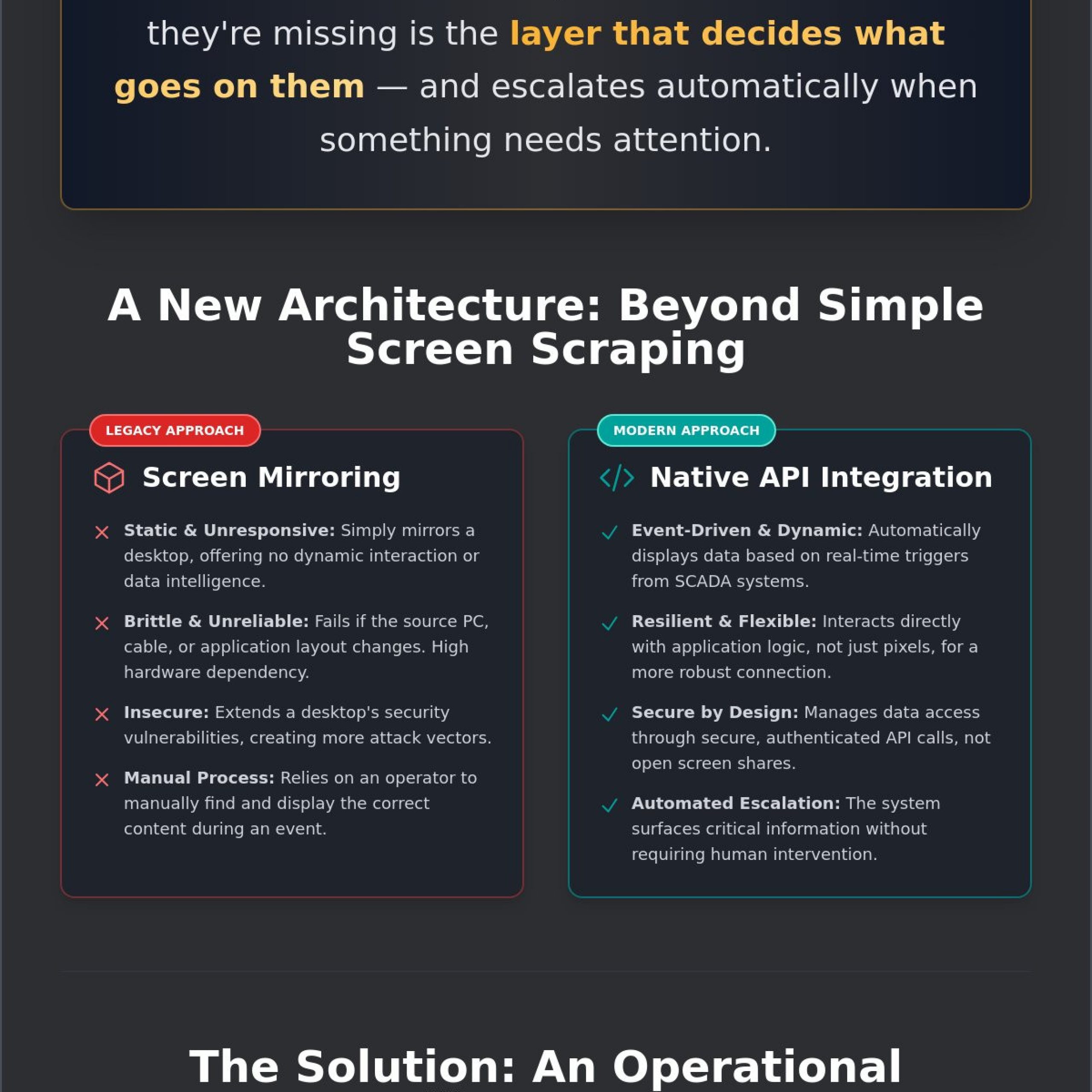
Technical Integration Architecture: Beyond Simple Screen Scraping
Traditional methods of displaying data often rely on basic HDMI extension or hardware-based “screen scraping.” These legacy approaches are insufficient for the high-stakes demands of modern critical infrastructure. Integrating SCADA systems on a video wall effectively requires a transition to native application integration. This architectural shift allows the display system to interact directly with the application logic rather than just mirroring a static desktop. By leveraging APIs and web-based interfaces, such as those found in Ignition 8.3.3 or SIMATIC WinCC Unified V21, organizations can create a dynamic environment where data flows seamlessly between the field and the command center.
Security remains a paramount concern in these environments. With NERC CIP-003-9 enforceable as of April 1, 2026, and CIP-012-2 taking effect on July 1, 2026, the protection of real-time operational data is a legal and operational mandate. Proper integration must account for Operational Technology Cybersecurity to prevent vulnerabilities when connecting OT systems to the broader network. Utilizing secure transport protocols like SRT and HEVC ensures that sensitive grid or process data remains encrypted and resilient against interception while maintaining the low latency required for real-time monitoring.
Integrating Real-Time Data Feeds and Web Applications
Modern SCADA HMIs are increasingly browser-based, which simplifies the process of bringing them onto large-scale displays. However, managing high-bitrate video feeds alongside low-bandwidth telemetry data requires sophisticated bandwidth management. The vis/ability platform optimizes these streams, ensuring that critical SCADA tags are prioritized over less urgent visual noise. This technical reliability allows teams to maintain a steady state of operational readiness without overtaxing their network infrastructure.
The Limits of Standalone Tools Like Axon and Juvare
Many organizations utilize specialized tools like Axon or Juvare for incident management and dispatch. While these applications are useful for their specific functions, they often exist as silos that only provide a partial solution for situational awareness. They lack the native ability to unify with live SCADA telemetry or external geospatial feeds in a single view. To achieve a full common operating picture, these tools must flow into a unifying layer. This integration ensures that an incident logged in a management tool immediately triggers the relevant SCADA visuals on the video wall. You can explore how this unified approach improves response times by reviewing our vis/ability platform capabilities.
Solving the Cognitive Load Crisis in Control Rooms
Control room operators face a constant barrage of data. In high-stakes environments, the sheer volume of telemetry can lead to decision paralysis. Integrating SCADA systems on a video wall must address this cognitive load crisis by prioritizing operational readiness. The goal is technical reliability that empowers human judgment rather than overwhelming it. This is the ‘Critical Decision’ framework. It treats technology as the essential bridge between raw data and certain action. By utilizing event-driven situational awareness, the system filters out non-essential background noise. It ensures that when a crisis occurs, the operator isn’t searching for the cause. They’re already looking at it. This focus on essential information is the bedrock of a stable operation.
Most control rooms already have the screens. What they’re missing is the layer that decides what goes on them, and escalates automatically when something needs attention.
Automating Information Prioritization
Effective layout management reduces fatigue and sharpens focus. Automated triggers are essential for maintaining this clarity. When a SCADA alarm hits a specific threshold, the video wall layout should change instantly to display the affected asset and its surrounding environment. This eliminates the need for manual intervention during a crisis. For example, visualizing NERC CIP compliance or network health in real-time allows for immediate oversight of cybersecurity posture. The most critical data must always occupy the primary field of view. This prevents operators from missing incidents because they were buried under secondary telemetry. Intelligent layouts ensure that the video wall remains a tool for clarity, not a source of confusion.
Human-Centric Design for 24/7 Mission-Critical Environments
Human-centric design is non-negotiable for 24/7 mission-critical environments. Color-coding and geospatial data maps significantly improve response times. They allow for instant recognition of status across a massive display area. Unified interfaces also reduce the “mental context switching” tax that occurs when jumping between different software silos. This approach is evident in Activu’s approach to Public Safety, where clarity is the priority. By aligning technology with human perception, organizations transform their control rooms from reactive monitoring hubs into proactive intelligence centers. This shift allows operators to act with greater certainty, even when stakes are at their highest. Ergonomic visualization ensures that the team remains alert throughout their entire shift, sustaining operational excellence.
Implementing Event-Driven Visualization Strategies
Operational intelligence must also extend beyond the physical walls of the command center. A true common operating picture remains incomplete if field technicians are operating in the dark. By extending the vis/ability platform to mobile devices, organizations ensure that the same visual intelligence used by dispatchers is available to those on the front lines. This seamless collaboration reduces the risk of miscommunication during high-stakes repairs or emergency responses. Most control rooms already have the screens. What they’re missing is the layer that decides what goes on them, and escalates automatically when something needs attention.
Step 1: Auditing Your Current Data Silos
The first stage of implementation involves a rigorous audit of existing information gaps. You must determine which SCADA feeds are essential for the entire team to monitor and which are better suited for individual workstations. Evaluating the technical readiness of your Video Wall Systems is critical at this stage. You should identify the specific “entry points” for operational pain, such as the moments where operators currently struggle to correlate an alarm with a physical location. Identifying these friction points allows you to build a visualization strategy that directly solves for situational awareness failures.
Step 2: Configuring Automated Escalation Workflows
Configuration involves building the logic that governs how information moves across the facility. You can set up workflows that automatically promote a data feed from a huddle room or an individual desk to the main video wall when an alert reaches a critical severity level. These notification-driven layouts should be tested under simulated stress to ensure operational continuity. Testing validates that the technical architecture can handle high-bandwidth telemetry and video concurrent with a major event. To begin building your event-driven environment, contact our control room design experts for a detailed technical assessment.
The vis/ability Advantage: Transforming Data into Action
The vis/ability platform serves as the bedrock for critical decision-making by acting as the primary operational intelligence layer. While some organizations opt for hardware-centric bundles like Command 360, these solutions often function as sophisticated switchers rather than an intelligent escalation layer. Integrating SCADA systems on a video wall with Activu provides a proactive defense against operational failure. It transforms a wall of static monitors into a Cybersecurity Common Operating Picture, ensuring that network health and telemetry are viewed through a single lens of technical reliability. This level of oversight is essential for protecting critical infrastructure against both physical and digital threats.
Operational readiness requires that visibility extends far beyond the physical boundaries of the command center. Mobile vis/ability ensures that the same event-driven intelligence available to operators is delivered directly to field teams on their mobile devices. This eliminates the information gap that typically exists between the dispatcher and the technician. Most control rooms already have the screens. What they’re missing is the layer that decides what goes on them, and escalates automatically when something needs attention. Activu positions itself as the vigilant guardian of your operations, providing the technical certainty required when stakes are at their highest.
A Unified Platform for Utilities, Transportation, and Defense
Mission-critical environments require solutions tailored to their specific regulatory and operational demands. For Utilities and Energy providers, this means an intelligence layer that simplifies NERC CIP compliance through automated reporting and real-time security visualization. In complex Transportation hubs, vis/ability manages intricate logistics by unifying SCADA telemetry with geospatial tracking and surveillance. This same architecture supports federal government and defense operations, where the ability to aggregate disparate data into a single, secure stream is vital for maintaining national security and operational readiness.
From Raw Data to Clear Judgment
The transition from complex, siloed applications to a unified operating picture is the definitive step toward operational excellence. Integrating SCADA systems on a video wall should not add to the operator’s burden; it must alleviate it. By prioritizing essential information and automating the escalation of critical alerts, the technology empowers individuals to act with greater certainty. Technical tools are only as effective as the clarity they provide to the human element at the center of the operation. To see how your team can achieve a higher state of situational awareness, request a demo of the vis/ability platform and secure your operational future.
Securing the Future of Operational Intelligence
Operational excellence is no longer defined by the volume of data you collect, but by the speed and accuracy of your response to it. Successfully integrating SCADA systems on a video wall requires moving beyond static displays toward a dynamic, event-driven intelligence layer. This transition ensures that critical telemetry is automatically prioritized, reducing operator fatigue and eliminating the gaps that lead to missed incidents. Most control rooms already have the screens. What they’re missing is the layer that decides what goes on them; it escalates automatically when something needs attention.
Since 1983, Activu has served as a trusted partner for federal defense, national utilities, and major transportation hubs. Our patented vis/ability platform provides the technical reliability required to transform fragmented data into a unified common operating picture. We provide the bedrock upon which the most critical decisions are made, ensuring your team acts with absolute certainty when the stakes are at their highest. By aligning your technology with the human element of your operation, you create a resilient environment capable of navigating any complexity.
Ready to unify your operations? Contact Activu to design your intelligent control room.
Your facility can achieve a new state of clarity and safety with the right operational intelligence layer in place.
Frequently Asked Questions
Can vis/ability integrate with legacy SCADA systems using serial protocols?
Yes, vis/ability integrates with legacy SCADA through intermediate gateways or by ingesting the HMI via secure web interfaces. The platform acts as a unifying hub that translates disparate protocol data into a visual format suitable for the entire team. This approach ensures that older infrastructure doesn’t become a blind spot in your modern command center, maintaining technical reliability across the entire asset lifecycle.
How does event-driven visualization reduce operator fatigue in control rooms?
Event-driven visualization reduces fatigue by ensuring operators only interact with data that requires a decision. Instead of staring at hundreds of static data points, the system remains in a quiet state until a SCADA trigger occurs. This management by exception approach preserves mental energy for high-stakes problem solving rather than routine monitoring, effectively eliminating the common issue of monitor-wall blindness.
What is the difference between a standard video wall and an operational intelligence layer?
A standard video wall simply displays pixels, while an operational intelligence layer provides the logic for what those pixels represent. Most control rooms already have the screens. What they’re missing is the layer that decides what goes on them, and escalates automatically when something needs attention. This layer provides the context and automation necessary for integrating SCADA systems on a video wall effectively.
Does integrating SCADA on a video wall help with NERC CIP compliance?
Integrating SCADA systems on a video wall through vis/ability supports NERC CIP compliance by providing real-time visibility into your cybersecurity posture. It helps meet requirements like CIP-012-2 by securing and visualizing real-time data exchanged between control centers. The platform also creates a visual audit trail of incident response, which is vital for regulatory reporting and demonstrating operational readiness during audits.
Can field technicians see the same SCADA data as the control room on their mobile devices?
Field technicians can access the same visual intelligence as the control room using Mobile vis/ability. This extension of the common operating picture ensures that the person at the substation sees the same alarm data and geospatial context as the dispatcher. Unified visibility reduces errors and accelerates the safe restoration of services by ensuring everyone operates from a single version of the truth.
What happens if the primary network fails during a SCADA-triggered event?
The vis/ability platform is built with high-availability architectures to ensure operational continuity during network disruptions. Redundant servers and failover protocols maintain the display of critical SCADA data even if primary communication paths are compromised. This technical reliability is a core requirement for mission-critical operations where downtime isn’t an option and human judgment depends on uninterrupted data flow.
Is vis/ability a COTS solution, and what are the benefits for mission-critical ops?
vis/ability is a Commercial Off-the-Shelf (COTS) solution, which offers significant advantages for mission-critical readiness. Unlike custom-coded projects that carry high development risks, a COTS platform provides a proven, stable environment with regular security updates and a lower total cost of ownership. it allows organizations to deploy sophisticated situational awareness tools that are already hardened for high-stakes environments.
How do you manage multiple data feeds in a dispatch center without overloading operators?
Managing multiple data feeds requires an automated prioritization strategy that filters out visual noise. The vis/ability platform uses intelligent layout management to promote critical feeds to the primary field of view only when an incident occurs. This ensures that dispatchers aren’t overloaded with routine telemetry, allowing them to focus exclusively on the anomalies that threaten grid stability or public safety.