
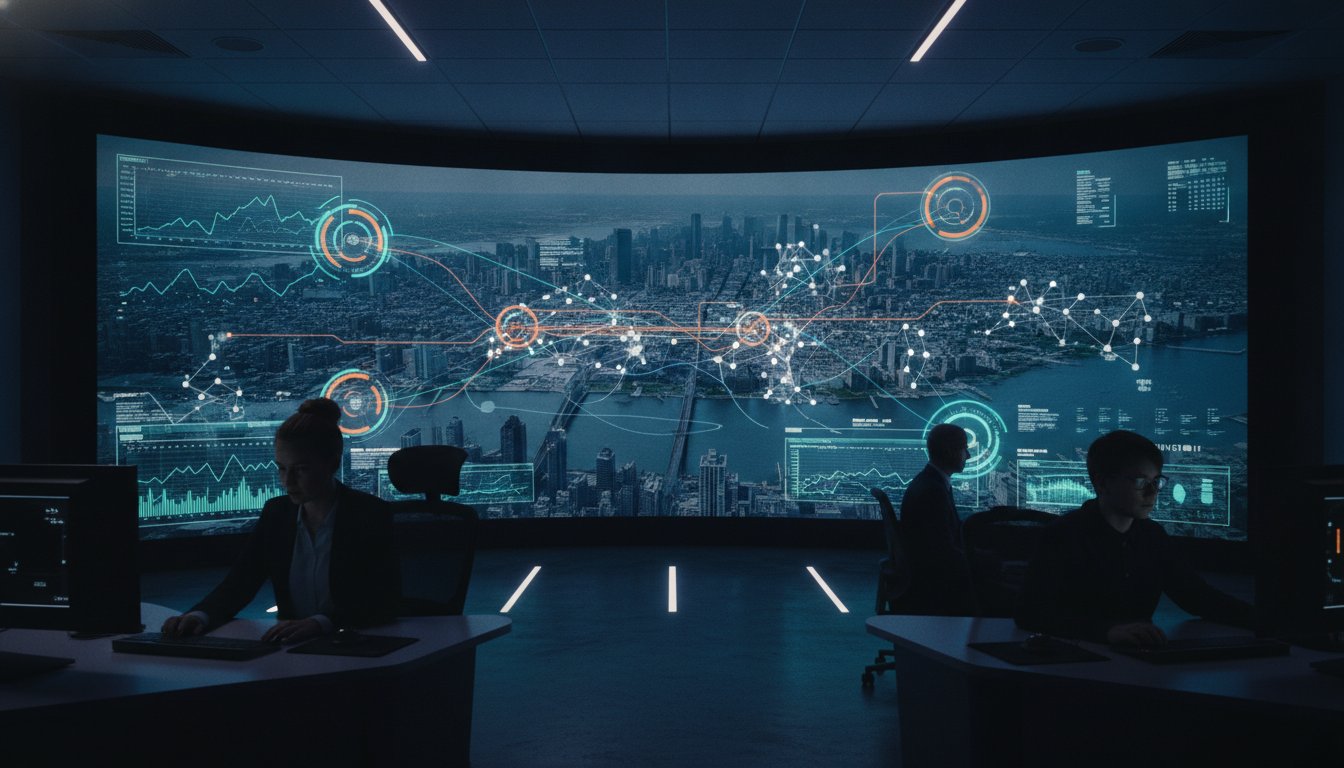
If your video wall went dark during a critical response, would your team lose their eyes on the field, or would the system’s intelligence layer already have a backup plan in motion? Many agencies view video wall system lifecycle management as a cycle of hardware depreciation and expensive screen replacements. You likely recognize the frustration of managing siloed feeds that refuse to communicate, leaving operators to filter through visual clutter while high-stakes incidents unfold. The high cost of hardware refreshes often feels disconnected from actual operational ROI, leaving a gap between technical spend and mission readiness.
Most control rooms already have the screens. What they’re missing is the layer that decides what goes on them, and escalates automatically when something needs attention. This article explores how to move beyond basic maintenance to implement a strategic operational intelligence layer. You will learn how to build a unified common operating picture that ensures your control room remains resilient, responsive, and scalable throughout its entire lifecycle. We will outline the path from fragmented data to a resilient system that empowers your team to act with absolute certainty when the stakes are at their highest.
Key Takeaways
- Shift your focus from reactive hardware maintenance to a proactive strategy that ensures your command center remains responsive during high-stakes operations.
- Implement a robust framework for video wall system lifecycle management that prioritizes the integration of disparate data feeds over simple hardware refreshes.
- Identify the missing operational intelligence layer that filters screen clutter and automatically escalates critical data when a pivotal incident occurs.
- Learn how to unify specialized tools into a single common operating picture to eliminate silos and empower decision-makers across all devices.
- Future-proof your infrastructure with an event-driven situational awareness model that provides absolute clarity when stakes are at their highest.
The Fragmented Reality of Modern Control Room Lifecycle Management
Many organizations fall into the “set it and forget it” trap. They view the installation of a high-resolution display as a destination rather than the start of a complex operational journey. This mindset is the primary failure point in video wall system lifecycle management. When you treat high-stakes infrastructure as a static asset, you ignore the evolving nature of data and the increasing speed of modern threats. In a mission-critical environment, a system that doesn’t evolve is a system that eventually fails during a crisis.
The Hidden Gaps in Siloed Operations
Data silos represent a silent tax on operational efficiency. In a typical SOC, NOC, or GSOC, operators often jump between separate applications that don’t speak to one another. This fragmentation forces the human brain to act as the integration layer, manually correlating data from disparate feeds while the clock is ticking. This process is inherently slow. It creates operator fatigue, which isn’t just a staffing concern; it’s a critical vulnerability. When screens are cluttered with noise and irrelevant data, operators default to “screen staring” rather than active situational awareness. This passive state is where critical incidents are missed, as the human element is overwhelmed by sheer visual volume without any intelligent filtering.
Why Hardware-First Thinking Fails in 2026
The foundational components of Video Wall Technology have advanced significantly, yet many agencies remain tethered to proprietary hardware controllers that face rapid obsolescence. In 2026, relying on a hardware-first approach is a liability. Buying more pixels does not solve the problem of information overload. Pixels without context lead to delayed incident response and wasted capital. Most control rooms already have the screens. What they’re missing is the layer that decides what goes on them, and escalates automatically when something needs attention.
Effective video wall system lifecycle management requires moving away from the reactive maintenance of physical panels toward a proactive, intelligence-driven model. This shift ensures that your visualization strategy evolves alongside your data, maintaining operational readiness long after the initial hardware installation. By focusing on the intelligence layer rather than the glass, you secure a resilient common operating picture that remains responsive to the unique pressures of emergency response and geospatial oversight.
The 5 Pillars of a Sustainable Video Wall System Lifecycle
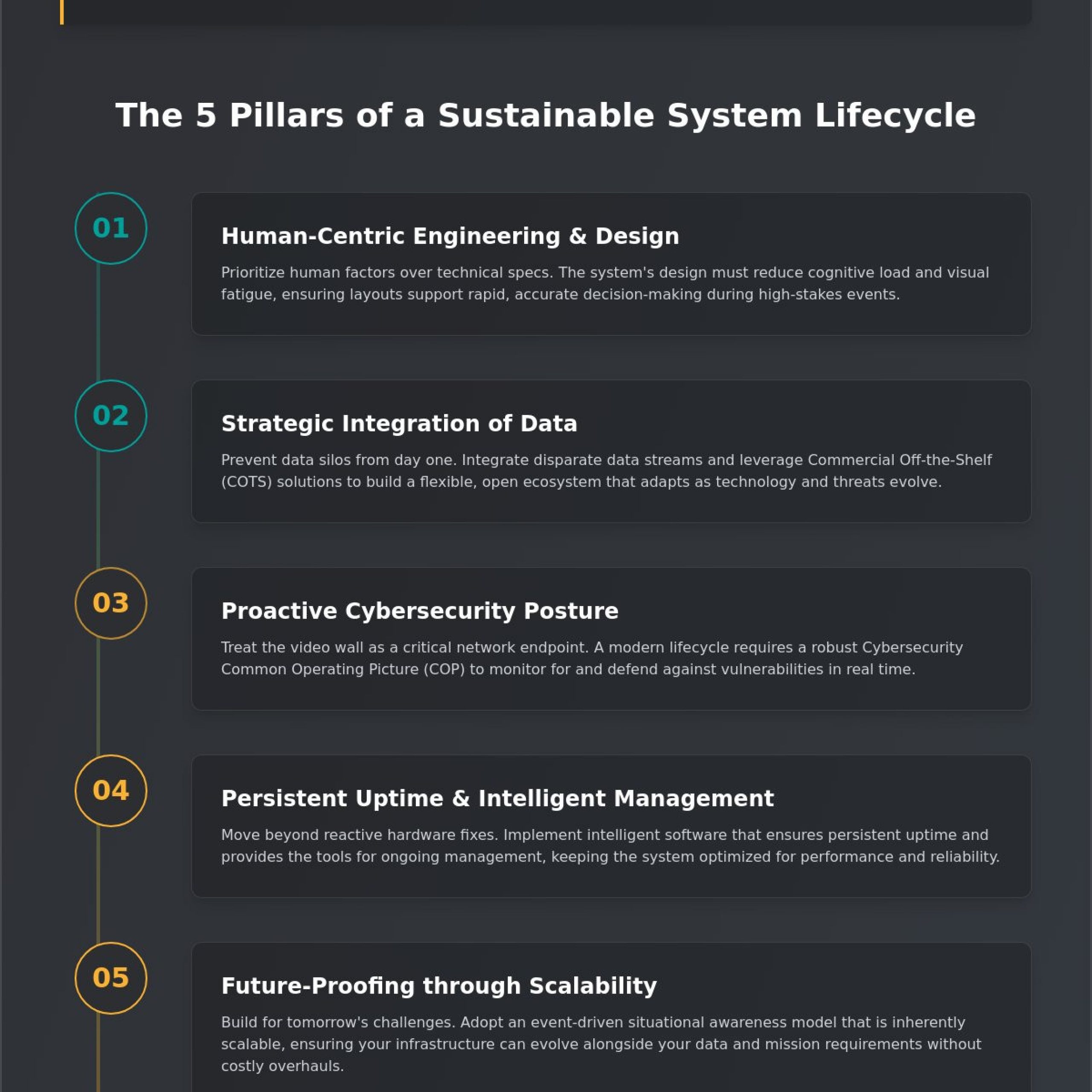
Sustainable video wall system lifecycle management demands a structured methodology that transcends the physical lifespan of an LED panel. It requires a framework that accounts for the constant evolution of data streams and the shifting needs of the operators who manage them. By adopting a five-pillar approach, agencies can move from a state of constant technical catch-up to a position of enduring operational strength. This process ensures that every component, from the initial design to the final software update, serves the primary mission of clarity and speed.
Phase 1 & 2: Building the Foundation
The engineering phase must prioritize human factors over technical specifications. Design should focus on reducing cognitive load, ensuring that the layout of information supports rapid decision-making rather than contributing to visual fatigue. Incorporating Commercial Off-the-Shelf (COTS) solutions provides the flexibility needed to adapt as new technologies emerge. This approach aligns with the future of control rooms, where the focus shifts from proprietary hardware toward open, integrated ecosystems that support an agile response. Integrating disparate data streams at this stage prevents the formation of silos that plague older, more rigid installations.
Phase 3 & 4: Maintaining the Common Operating Picture
Ongoing management must include a dedicated focus on cybersecurity and persistent uptime. A modern lifecycle strategy treats the video wall as a critical endpoint, requiring a robust Cybersecurity Common Operating Picture (COP) to monitor for vulnerabilities in real time. Intelligent software monitoring ensures that the system remains active 24/7, identifying potential failures before they impact the mission. Operational readiness in 2026 is the ability to maintain a persistent, secure, and automated flow of intelligence that scales instantly to meet the demands of an evolving threat landscape. This phase moves the operation from reactive maintenance to a state of event-driven visualization, where the system anticipates the needs of the team.
The final pillar is the ability to scale and evolve. Your plan must account for distributed teams, allowing the same common operating picture to flow from the command center to huddle rooms and mobile devices. Most control rooms already have the screens. What they’re missing is the layer that decides what goes on them, and escalates automatically when something needs attention. This is why video wall system lifecycle management must focus on the software that unifies the hardware. By implementing the vis/ability platform, you transform your environment from a collection of monitors into a cohesive, future-proof intelligence hub that grows with your operational requirements.
Beyond the Hardware: The Operational Intelligence Layer
True video wall system lifecycle management must address the brain of the command center, not just its visual output. While hardware serves as the physical interface, the operational intelligence layer functions as the central hub that dictates the flow of information. This layer acts as the essential bridge between raw, unfiltered data and the human judgment required to act upon it. Shifting your focus from display management to information prioritization ensures that your team remains focused on the mission rather than the technology. By prioritizing the intelligence layer, you transform your infrastructure into a resilient asset that evolves alongside your operational needs.
Why Most Control Rooms Stop at the Screen
There is a persistent misconception that increasing screen real estate automatically improves situational awareness. This hardware-first approach often results in significant technical debt. Organizations accumulate a patchwork of displays and cables without a unifying platform to manage the content. This lack of cohesion forces operators to manually search for information across multiple feeds, leading to missed incidents and delayed responses. Investing in the vis/ability Platform allows you to move beyond the limitations of raw pixels and implement a system that understands the context of your operations.
Implementing an Escalation-First Management Strategy
Most control rooms already have the screens. What they’re missing is the layer that decides what goes on them, and escalates automatically when something needs attention. An escalation-first strategy automates the visualization of critical alerts, ensuring that the most vital information is presented to the entire team the moment a threshold is crossed. This approach reduces visual noise and highlights essential, actionable intelligence. By automating these processes, you eliminate the risk of operator oversight during high-stress events. The ROI of automated escalation is found in the absolute clarity it provides during a crisis, transforming your video wall from a passive monitor into a proactive tool for mission success.
By defining the operational intelligence layer as the core of your lifecycle strategy, you ensure that your investment maintains its value. This perspective moves beyond the physical lifespan of the equipment and focuses on the long-term utility of the information provided. It empowers your team to act with greater certainty, knowing that the system is actively working to surface the data that matters most.
Integrating External Platforms into Your Lifecycle Strategy
A comprehensive strategy for video wall system lifecycle management must account for the entire ecosystem of tools that feed into your operation. Organizations often adopt high-performance platforms for specific tasks, such as digital evidence management or specialized SIEM platforms for network security. While these tools are powerful in their respective domains, they frequently operate as isolated islands of data. True lifecycle management ensures these platforms don’t become new silos that fragment your team’s attention during a crisis. If your visualization strategy doesn’t unify these feeds, you’re merely managing a collection of screens rather than a cohesive intelligence hub.
The Limitations of Partial Situational Awareness Tools
When alerts are siloed within a single application, the risk of a missed incident increases exponentially. A SIEM alert might indicate a digital breach while a field camera shows suspicious physical activity, but if these data points don’t converge, the operator is left to connect the dots manually under pressure. This is why complex environments require a “platform of platforms.” Such a unifying layer aggregates data from every source, providing a level of context that individual tools cannot offer on their own. Without this integration, your technical spend on specialized monitoring only adds to the visual noise. For a deeper look at how this integration impacts your command center, consult The Video Wall: Strategic Guide.
Extending the Lifecycle to Mobile and Huddle Rooms
Mobile vis/ability bridges the gap between the command center and the tactical edge. It allows field personnel to see the same common operating picture as the dispatchers, ensuring everyone acts on the same verified intelligence. This level of integration is vital for Public Safety Solutions, where seconds matter and information must be shared instantly across different environments. By including mobile and remote sites in your video wall system lifecycle management, you create a truly scalable and responsive infrastructure that maintains its value over time. To see how your fragmented feeds can be unified into a single, actionable intelligence layer, speak with our integration experts today.
Securing Operational Continuity with Activu vis/ability
Resilience in high-stakes environments is built upon technical reliability and the ability to maintain clarity during chaos. A successful strategy for video wall system lifecycle management must move beyond the physical lifespan of hardware to embrace a platform that evolves alongside the mission. Activu vis/ability provides this essential foundation, serving as the bedrock upon which critical decisions are made. By implementing an operational intelligence layer, agencies ensure that their command center remains a proactive asset rather than a collection of depreciating screens. Most control rooms already have the screens. What they’re missing is the layer that decides what goes on them, and escalates automatically when something needs attention.
The transition to an event-driven situational awareness model is a fundamental shift in how operations are managed. Traditional systems rely on manual monitoring, which inherently leads to cognitive overload as data volumes increase. vis/ability solves this by aggregating disparate data streams into a single, cohesive view that prioritizes essential information. This intelligent filtering reduces the burden on operators, allowing them to focus on the pivotal moments that define a successful response. It transforms the video wall from a passive display into an active partner that anticipates the needs of the team based on real-time triggers and geospatial oversight.
vis/ability: The Unifying Hub for Distributed Teams
Modern operations often span multiple locations, from the central command center to huddle rooms and mobile field units. Maintaining Operational Continuity & Resilience requires a seamless flow of intelligence across all these touchpoints. vis/ability acts as the central hub, ensuring that every team member acts with greater certainty because they’re all viewing the same verified common operating picture. This unification eliminates the fragmented communication that often occurs when field data is siloed from headquarters. It provides a level of technical integration that remains steady even as individual hardware components are refreshed or replaced over time.
Taking the Next Step in Your Lifecycle Journey
Effective video wall system lifecycle management is a continuous process of assessment and optimization. It begins with identifying the current gaps in your situational awareness, such as fragmented data feeds or delayed incident escalations. Activu stands as a long-term partner in your mission-critical success, providing the tools and expertise needed to future-proof your infrastructure. Our platform is designed to scale with your organization, ensuring that your investment in visualization remains relevant as new threats and technologies emerge. To see how vis/ability can transform your operational reality, request a tailored demo today and experience the clarity of a truly unified command center.
Advancing Your Mission-Critical Infrastructure
Activu brings over 40 years of mission-critical experience to your operation, providing patented event-driven situational awareness technology used by Global 500 companies and federal agencies. Our platform unifies disparate feeds into a single, actionable common operating picture, empowering your team to act with absolute certainty when stakes are at their highest. You can now move beyond the limitations of raw pixels and secure a future-proof environment that scales across all distributed touchpoints.
Request a Demo of the vis/ability Operational Intelligence Platform to bridge the gap between raw data and human judgment. Your operation deserves the clarity and reliability that only a dedicated operational intelligence layer can provide.
Frequently Asked Questions
What is the typical lifespan of a mission-critical video wall system?
Mission-critical displays typically offer a lifespan between 50,000 and 100,000 operational hours, which translates to roughly five to ten years of continuous use. However, effective video wall system lifecycle management views the hardware as only one component of the timeline. The software layer often requires more frequent updates to maintain compatibility with evolving data streams and cybersecurity standards.
How does lifecycle management differ for a NOC vs. a retail video wall?
Lifecycle management for a NOC prioritizes persistent uptime and technical reliability, whereas retail environments focus on visual aesthetics and consumer engagement. In a command center, the system must support event-driven situational awareness and complex data integration. Retail walls don’t face the same high-stakes pressure to provide a common operating picture during an emergency response.
Can I upgrade my video wall software without replacing my existing screens?
You can certainly upgrade your management software without replacing your physical display panels. Most control rooms already have the screens. What they’re missing is the layer that decides what goes on them, and escalates automatically when something needs attention. Adding an operational intelligence layer like vis/ability allows you to extend the utility of legacy hardware by providing the advanced filtering and automation it currently lacks.
How does an operational intelligence layer reduce operator fatigue?
An operational intelligence layer reduces fatigue by filtering out visual noise and prioritizing essential data. When the system automatically identifies and highlights critical incidents, operators no longer need to scan dozens of static feeds for anomalies. This shift from passive monitoring to active, event-driven visualization allows the team to remain focused and analytical when the stakes are highest.
What are the common pitfalls in control room lifecycle planning?
Common pitfalls include “set it and forget it” thinking and failing to account for the rapid obsolescence of proprietary hardware. Many organizations invest heavily in pixels but neglect the integration layer needed to unify fragmented data feeds. This leads to a failure in video wall system lifecycle management, resulting in high technical debt and a system that can’t scale to meet new operational demands or distributed team requirements.
Is it possible to integrate mobile field data into a legacy video wall system?
Integrating mobile field data into legacy systems is possible through an operational intelligence hub. By acting as a central bridge, vis/ability pulls in geospatial data and field feeds from mobile devices and displays them alongside your existing command center assets. This ensures that the legacy wall remains a relevant part of a modern, unified common operating picture.
How do I ensure my video wall system remains NERC CIP or cybersecurity compliant?
Cybersecurity compliance is maintained through regular software signing, encryption, and the implementation of a Cybersecurity Common Operating Picture. For industries like utilities, ensuring NERC CIP compliance requires a lifecycle plan that includes persistent monitoring of all network endpoints. Centralizing control through a secure software platform reduces the risk of vulnerabilities inherent in unmanaged, siloed hardware.
What is the difference between a video wall controller and an operational intelligence platform?
A video wall controller is a hardware device primarily responsible for routing signals and managing pixel layouts. In contrast, an operational intelligence platform serves as the brain of the operation, managing the prioritization and escalation of information. While a controller handles the “how” of display, the platform manages the “what” and “why,” ensuring that the right data reaches the right person at the right time.