

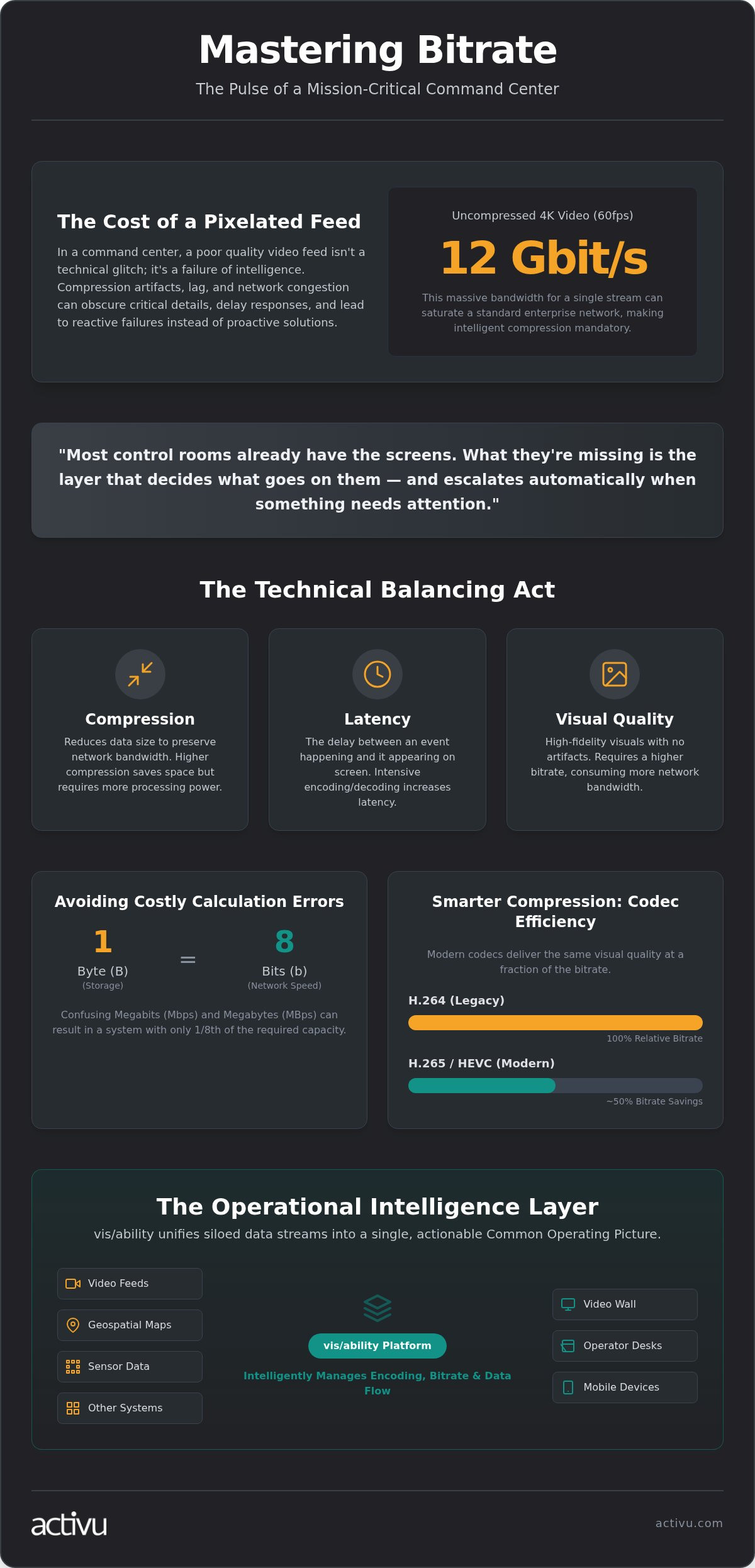
A pixelated feed in a command center is more than a technical annoyance; it’s a failure of intelligence that can stall a critical response. When visual artifacts obscure a suspect’s movement or network congestion delays an emergency alert, the gap between an incident and its visualization becomes a liability. Managing bitrate effectively is the difference between a fragmented, siloed view of operations and a unified, actionable picture. Most control rooms already have the screens. What they’re missing is the layer that decides what goes on them; it escalates automatically when something needs attention.
Siloed data feeds often function as partial solutions that require a unifying layer to create a full common operating picture. Organizations frequently struggle with the massive bandwidth demands of uncompressed video, such as the 12 Gbit/s required for a single 4K60 stream under SMPTE ST 2110 standards. This article provides the technical roadmap to master these nuances. You’ll learn to eliminate lag in real-time feeds and optimize network bandwidth for simultaneous data streams. By the end, you’ll understand how Activu Corporation implements an operational intelligence layer that ensures visual precision for decision-makers when the stakes are highest.
Key Takeaways
- Learn how optimized bitrate ensures the precision of geospatial maps and high-resolution sensor data during active operations.
- Evaluate the technical trade-offs between encoding compression and processing latency to maintain real-time situational awareness.
- Understand why a dedicated operational intelligence layer is required to manage data flow and automate what appears on your video wall.
- Identify practical steps to audit network bandwidth and define visual requirements for different data types to prevent congestion.
Beyond the Definition: Why Bitrate Dictates Operational Clarity
In a mission-critical environment, data isn’t just viewed; it’s interrogated. Bitrate represents the volume of data transmitted every second to your display systems. It’s the pulse of a command center’s visual nervous system. In control rooms, this metric determines the precision of text, geospatial maps, and high-resolution sensor data. When bitrates are insufficient, display systems struggle to render fine details. This results in compression artifacts that can hide subtle but critical changes in data. A blurred digit on a sensor or a blocky video feed can mean the difference between a proactive response and a reactive failure. Most control rooms already have the screens. What they’re missing is the layer that decides what goes on them, and escalates automatically when something needs attention.
The Stakes of Data Fidelity in Command Centers
Visual precision is the bedrock of any GSOC or Fusion Center. In these environments, operators must distinguish between normal activity and emerging threats at a glance. In a cybersecurity common operating picture, compression noise is particularly dangerous. It interferes with threat detection by masking anomalies in network traffic visualizations or creating “ghost” alerts that distract personnel. High visual fidelity also addresses the human element. Operators working 12-hour shifts face significant visual fatigue when forced to stare at low-quality streams. Crisp, clear data allows the brain to process information with less effort, maintaining operational readiness throughout the entire watch.
Bit vs. Byte: Avoiding Common Calculation Errors
Technical alignment across departments begins with a clear Bit rate definition. Confusion often stems from the 8:1 ratio between bits and bytes. Network engineers measure streaming speed in Megabits per second (Mbps), while database managers often discuss storage in Megabytes per second (MBps). This distinction is vital. If a strategist plans a system based on Megabytes but the network provides Megabits, the resulting stream will only have one-eighth of the necessary capacity. Standardizing this terminology during the initial control room design phase prevents these costly errors. It ensures that every stakeholder, from IT to operations, understands the bandwidth requirements needed to maintain a high-fidelity common operating picture.
The Technical Mechanics: Encoding, Bandwidth, and Latency
Encoding serves as the critical mechanism that compresses raw sensor and video data into a manageable bitrate. This process is governed by a fundamental trade-off: higher compression levels preserve network bandwidth but introduce significant processing latency. In a command center where sub-second response times are the baseline, this delay is unacceptable. Processing raw 4K video generates massive data volumes. Without efficient encoding, a single stream can saturate a standard network. However, if the encoding is too intensive, the time required to pack and unpack the data creates a lag that separates the operator from the reality of the field. Mission-critical systems require a balance where visual fidelity is maintained without sacrificing the real-time nature of the feed.
Impact of Codecs on Bitrate Efficiency
Modern operations rely on sophisticated codecs to balance these competing priorities. While H.264 remains common in many legacy environments, High Efficiency Video Coding (HEVC or H.265) provides a superior alternative by delivering comparable visual quality at approximately 50% less bitrate. This efficiency is vital when scaling operations across multiple sites or mobile devices. Many standalone data sources provide essential streams, but they only offer a partial solution for a command center. They lack the unifying layer needed to create a full common operating picture across disparate systems. The vis/ability platform fills this gap by managing these complex streams automatically. It selects the optimal codec and transport protocol based on current network health and the mission-priority of the data.
Calculating Bandwidth for Multi-Window Displays
Network throughput must account for the aggregate load of every active window on a video wall. A 4K display hosting 20 or more simultaneous feeds can easily exceed several hundred Mbps. As established, uncompressed streams far exceed the limits of standard 1 GbE enterprise networks, making intelligent compression mandatory. Engineers must design for peak capacity rather than average use. During active incident management, data becomes “bursty.” Multiple high-resolution feeds might trigger simultaneously as a situation escalates. If the network isn’t Rate-Distortion Optimized, the resulting congestion leads to dropped frames at the exact moment clarity is most needed.
Most control rooms already have the screens. What they’re missing is the layer that decides what goes on them, and escalates automatically when something needs attention. This operational intelligence layer prevents network saturation by prioritizing critical feeds while intelligently throttling background data. To ensure your infrastructure can handle these high-tempo demands, it’s worth exploring how integrated situational awareness from Activu Corporation can stabilize your data environment.
Balancing Quality and Network Load in the Operations Center
High-stakes operations demand visual fidelity, but an unmanaged high bitrate can quickly become a liability. For forensic analysis and geospatial oversight, maximum detail is non-negotiable. Identifying a specific license plate or a minute change in a pressure gauge requires every bit of data the sensor can provide. However, the cost of this clarity is often high latency and increased network expenditure. When every feed is set to maximum quality, the network faces a sustained load that can lead to system stutter or total failure during a crisis. Unlike gaming environments where high settings are a preference, in a utility or public safety environment, an over-provisioned stream that crashes the network is a catastrophic failure.
Most control rooms already have the screens. What they’re missing is the layer that decides what goes on them; it escalates automatically when something needs attention.
Without this layer, operators are forced to manually manage bandwidth or, worse, suffer through lagging feeds when a situation escalates. Static configurations fail to account for the dynamic nature of emergencies. A dispatch center or emergency operations center cannot afford a network bottleneck because a routine background feed consumed the bandwidth needed for a live tactical stream. Dynamic adjustment is the only way to maintain a reliable common operating picture in a distributed environment.
Prioritizing Critical Feeds Over Routine Monitoring
Effective stream management requires a shift from static settings to dynamic prioritization. This involves allocating a higher bitrate to active incident zones while simultaneously throttling background feeds. Implementing Near-optimal bitrate adaptation allows the system to respond to changing network conditions in real-time without operator intervention. By integrating incident management software, organizations can automate these priorities based on event severity. When an alarm is triggered, the operational intelligence layer recognizes the event and automatically elevates the stream quality for the relevant area, ensuring decision-makers see the most critical data with absolute clarity.
The Role of COTS Hardware in Bitrate Management
The hardware infrastructure supporting these streams is a frequent point of failure. Many organizations rely on commercial off-the-shelf (COTS) components that were never designed for the sustained load of 24/7 mission-critical video. Standard enterprise switches often lack the backplane capacity to handle dozens of simultaneous high-resolution streams, leading to packet loss and jitter. Reliability in these environments requires more than just high-spec hardware. It demands a redundant architecture and an intelligent platform from Activu Corporation that acts as the central hub. While fragmented surveillance tools and data sources offer valuable insights, they remain partial solutions without a unifying layer to manage the underlying technical complexities of the network and ensure that data flows stay within a manageable bandwidth budget.
Optimizing Video Wall Feeds for Real-Time Decision Support
Optimizing video wall feeds is not about aesthetic quality. It is about reducing the time between an event occurring and a human taking action. Every millisecond of latency introduced by an unoptimized bitrate represents a window where a situation can spiral out of control. Most control rooms already have the screens. What they’re missing is the layer that decides what goes on them, and escalates automatically when something needs attention. Without this intelligence, operators are often left staring at pixelated feeds or frozen frames during the exact moments they need total clarity.
Achieving zero-latency situational awareness requires a methodical approach to stream management. Follow these five steps to ensure your visual intelligence layer is performing at peak capacity:
- Step 1: Audit your existing network capacity. Establish a baseline bandwidth budget. If your infrastructure relies on 1 GbE networks, it cannot support multiple uncompressed 4K streams, which require 12 Gbit/s each.
- Step 2: Define visual requirements for each data type. Static data like text-heavy dashboards requires higher clarity and lower compression than motion video. You don’t need the same quality for a hallway camera as you do for a geospatial map.
- Step 3: Implement an operational intelligence layer. Centralize management to ensure data flows are prioritized based on mission needs rather than hardware limitations.
- Step 4: Configure automated escalation triggers. Ensure that when a critical incident occurs, the system automatically increases the quality of relevant feeds to provide maximum forensic detail.
- Step 5: Test latency end-to-end. Measure the delay from the sensor source to the operator’s display to identify bottlenecks in the encoding or switching path.
Reducing Cognitive Overload Through Visual Hierarchy
High-resolution feeds are demanding for both the network and the human brain. In NOC and SOC environments, constant exposure to low-fidelity or flickering streams accelerates operator fatigue. By using a visual hierarchy, you can render critical alerts at maximum fidelity while de-emphasizing secondary data. This approach ensures that “Red” alerts are always rendered with absolute precision, directing the operator’s focus where it matters most while conserving bandwidth on routine monitoring windows.
Mobile and Distributed Considerations
Managing bitrate for field personnel on 5G/LTE networks presents unique challenges. Field teams require mobile vis/ability that remains synchronized with the command center wall. This requires real-time transcoding to deliver actionable intelligence without overwhelming limited mobile bandwidth. By syncing high-bitrate wall feeds with low-bandwidth mobile devices, you ensure that every team member, regardless of location, operates from the same common operating picture.
Ready to eliminate visual lag and unify your data feeds? Contact our team today to learn how vis/ability can transform your operational intelligence.
vis/ability: The Intelligent Layer for Seamless Data Integration
Strategic decision-making requires a platform that removes technical friction. The vis/ability platform acts as the operational intelligence layer that bridges the gap between raw data and human judgment. It functions as the central hub of the modern command center, unifying disparate data streams into a single, cohesive view. By automating the technical complexity of bitrate management, it ensures the right data reaches the right person at the optimal quality without manual network tuning. Most control rooms already have the screens. What they’re missing is the layer that decides what goes on them, and escalates automatically when something needs attention. This platform ensures that technical constraints like bandwidth never hinder the speed of your response.
Unlike partial solutions that leave operators to toggle between fragmented windows, vis/ability provides a full common operating picture across the entire organization. It manages the stream prioritization discussed in previous sections without requiring manual intervention from IT staff. This automation allows the team to remain focused and analytical when stakes are at their highest. The system effectively translates complex network variables into clear, actionable intelligence, ensuring that every display contributes to the mission.
Unifying Disparate Systems
Bridging the gap between siloed applications and the display surface is essential for rapid response. While organizations often utilize specialized tools for field data or network monitoring, these systems frequently operate in isolation. They only provide a partial solution and require a unifying layer to create a truly integrated environment. vis/ability overcomes these shortcomings by serving as the central intake for all operational data. It integrates cybersecurity feeds with physical security and geospatial oversight, providing a unified view of organizational health in GSOC environments.
Future-Proofing Your Control Room
Operations must scale as technology evolves. Preparing for next-generation bitrate requirements, including the transition to 8K resolution and beyond, is a core strength of the vis/ability platform. It manages increased data volumes without overtaxing your existing infrastructure by intelligently routing streams based on mission priority. This proactive approach maintains resilience through even the most demanding high-tempo events. The platform is the quiet, powerful engine that empowers individuals to act with greater certainty. Contact Activu Corporation to design a bitrate-optimized control room that secures your organization’s operational future.
Secure Your Operational Intelligence Layer
Mastering bitrate is more than a technical optimization; it’s a foundational requirement for zero-latency situational awareness. By establishing a clear bandwidth budget and implementing automated escalation triggers, you ensure that critical data remains visible when every second counts. Technical reliability in high-stakes environments depends on more than just high-end displays. It requires an intelligent hub that manages the underlying data flow to prevent network saturation during active incidents. This methodical approach to stream management transforms raw data into actionable intelligence.
Activu Corporation provides this bedrock for organizations across the Federal Government and Defense sectors. Our platform is specialized for the unique demands of Transportation and Utilities, where system uptime and operational resilience are non-negotiable. By automating stream prioritization, the vis/ability platform reduces operator fatigue and ensures that decision-makers always operate with absolute clarity. Most control rooms already have the screens. What they’re missing is the layer that decides what goes on them; it escalates automatically when something needs attention. Take control of your data streams and eliminate the visual gaps that stall response times. Request a Demo of the vis/ability Platform to see how we unify your common operating picture and empower your team to act with greater certainty.
Frequently Asked Questions
What is a good bitrate for a 4K control room feed?
A professional 4K feed requires significantly higher capacity than standard consumer streaming. While high-quality platforms like Curiosity Stream and YouTube suggest 35 to 68 Mbps for 4K uploads, mission-critical environments often require 100 to 800 Mbps per stream to maintain data fidelity. Uncompressed 4K60 video using SMPTE ST 2110 standards demands approximately 12 Gbit/s. Selecting the correct bitrate depends on your specific visual requirements for text clarity versus motion video within the command center.
How does bitrate affect latency in real-time monitoring?
Latency is influenced by the relationship between data volume and encoding intensity. High bitrates can saturate a network, causing packet loss and significant delay. Conversely, low bitrates achieved through heavy compression add processing time during the encoding and decoding phases. Achieving zero-latency situational awareness requires a balanced approach where the operational intelligence layer manages these trade-offs automatically to ensure real-time visualization across all displays.
Can I use standard office networks for high-bitrate video walls?
Standard office networks are typically insufficient for the sustained load of 24/7 video wall streaming. While a 1 GbE network might handle a few compressed streams, it will fail under the aggregate load of multiple high-resolution windows. Mission-critical environments require dedicated infrastructure with sufficient backplane capacity. Most control rooms already have the screens. What they’re missing is the layer that decides what goes on them; it escalates automatically when something needs attention.
What is the difference between constant and variable bitrate in operations?
Constant bitrate (CBR) maintains a steady data flow regardless of image complexity, providing a predictable and stable network load. Variable bitrate (VBR) adjusts based on the complexity of the scene, which can save bandwidth during periods of inactivity but risks network spikes during high-tempo operations. For most command centers, CBR is preferred for its reliability, though intelligent platforms can now manage VBR more effectively by prioritizing critical incident data when needed.
How do I reduce bitrate without losing essential data clarity?
Reducing data volume without sacrificing clarity requires the use of efficient codecs like HEVC (H.265), which provides high quality at 50% less bandwidth than legacy standards. You can also implement a visual hierarchy by rendering critical alert windows at maximum fidelity while throttling background monitoring feeds. This ensures that essential text and geospatial data remain sharp for decision-makers while optimizing the overall network budget for the entire facility.
What role does an IPTV encoder play in managing bitrate?
Does vis/ability work with existing high-bitrate encoders?
Yes, vis/ability is designed to act as the central hub that integrates with your existing high-performance encoders. It serves as the unifying platform that makes these hardware tools useful for the entire team. By managing the output of your current encoders, vis/ability ensures that the common operating picture remains stable across the video wall, huddle rooms, and mobile devices, regardless of the underlying hardware manufacturer or specific stream protocol.
How can I manage bitrate for remote or mobile operators?
Managing data for field personnel requires real-time transcoding to adapt high-bandwidth wall feeds for 5G or LTE networks. Mobile vis/ability ensures that remote operators receive actionable intelligence without experiencing the lag associated with high-bandwidth streams on unstable connections. The system automatically adjusts the stream quality based on the mobile device’s current connectivity, maintaining synchronization between the command center and the field teams to ensure a unified response.