
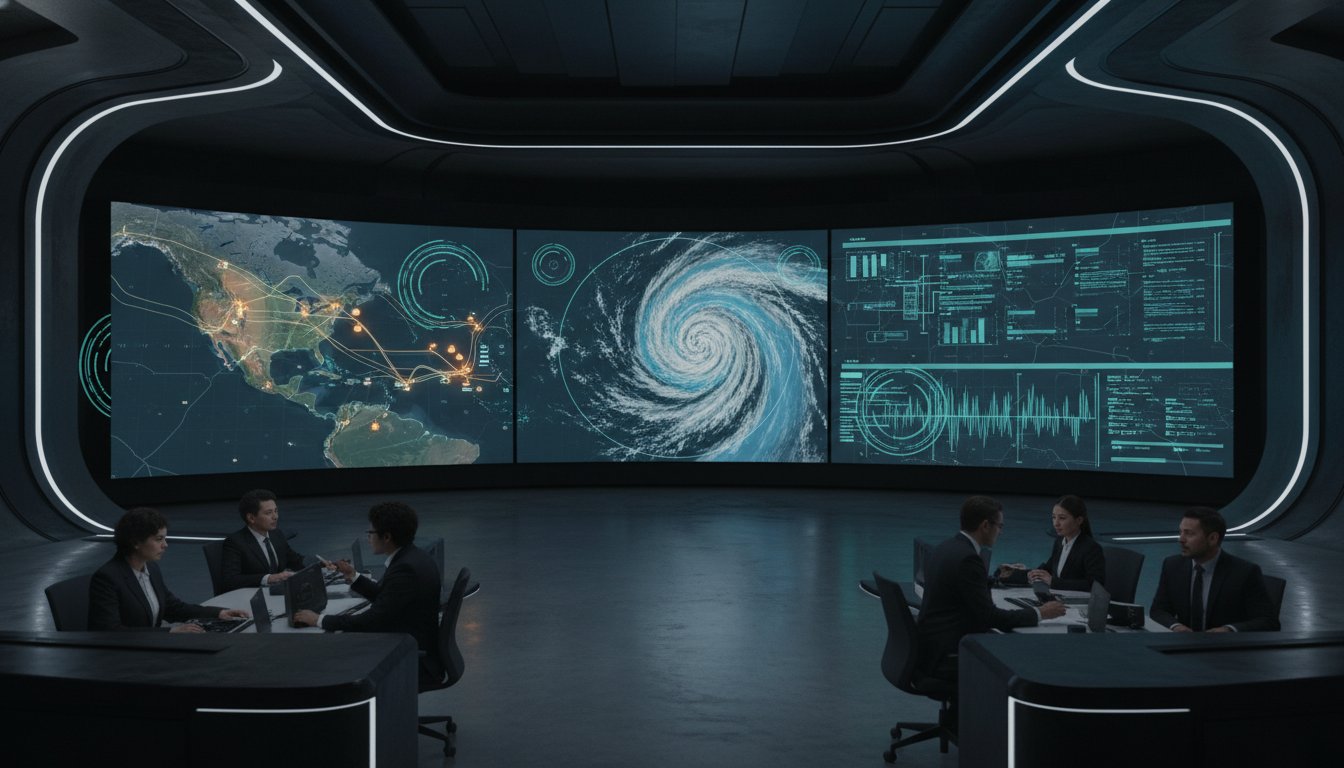
As of 2024, smart meter installations in North America reached 82%, yet this influx of data often leads to paralysis rather than performance. You know that simply adding more monitors doesn’t solve the problem of data silos between departments or the cognitive overload operators face during extreme storm events. Implementing effective utility operations center solutions requires a shift from passive observation to active intelligence.
Most control rooms already have the screens. What they’re missing is the layer that decides what goes on them, and escalates automatically when something needs attention. In this guide, you’ll learn how to transform fragmented data streams into a unified, event-driven common operating picture for mission-critical management. We will explore how Activu Corporation provides the operational intelligence layer necessary to reduce mean time to resolution (MTTR) and ensure seamless collaboration between the NOC and field technicians.
Key Takeaways
- Identify the root causes of operator cognitive overload and how fragmented data streams from SCADA, weather, and security systems delay critical decision-making.
- Learn how to implement utility operations center solutions that function as an operational intelligence layer, automating the escalation of grid events.
- Understand why standalone tools only provide a partial view and require a central hub to ensure seamless collaboration between the NOC and field technicians.
- Establish a secure, reliable transport protocol for mission-critical data that maintains situational awareness across command centers, huddle rooms, and mobile devices.
- Discover how to engineer digital and physical environments simultaneously to transform raw data into a unified common operating picture.
The Fragmentation Crisis in Modern Utility Operations Centers
Modern utility managers face an information paradox. While data streams are more abundant than ever, operational clarity remains elusive. Systems for Supervisory Control and Data Acquisition (SCADA), environmental sensors, and physical security feeds often operate in isolation. This digital fragmentation forces operators to act as the integration layer, manually correlating data across disconnected interfaces during a grid emergency. This manual overhead wastes critical seconds and increases the risk of human error when the stakes are highest.
Most control rooms already have the screens. What they’re missing is the layer that decides what goes on them, and escalates automatically when something needs attention. Without this intelligence, the video wall becomes a passive display that demands constant attention but offers no guidance on where that attention is most needed. This lack of prioritization is the primary driver of cognitive overload in high-pressure dispatch environments, where the ability to distinguish signal from noise is a matter of grid reliability.
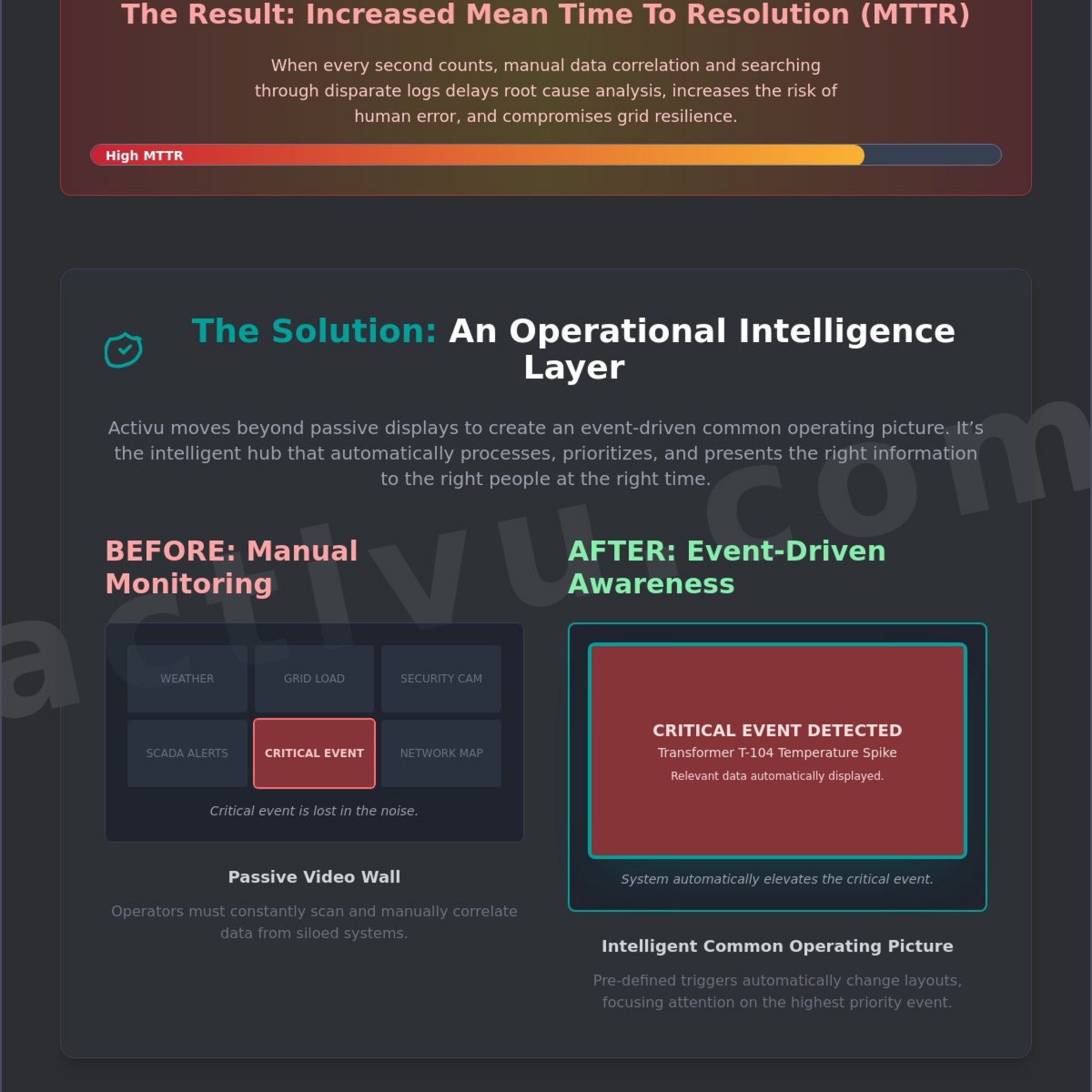
Fragmented situational awareness carries a measurable cost to grid resilience. When data is siloed, the mean time to resolution (MTTR) increases because identifying the root cause of an event requires searching through disparate logs and dashboards. Effective utility operations center solutions must bridge these gaps to shift the team from reactive monitoring to a proactive, event-driven management style. This transition is essential for maintaining stability as the grid becomes increasingly complex and decentralized.
Why Operators Miss Incidents on Traditional Video Walls
Traditional video walls often suffer from the “wallpaper effect,” where static layouts lead to operator complacency. When a display rarely changes, the brain begins to filter out the information as routine background noise. This effect is compounded when multiple unintegrated data feeds create a chaotic environment where critical alarms are indistinguishable from routine notifications. This lack of clarity directly impacts NERC CIP compliance, as manual reporting becomes a labor-intensive process prone to oversight. When every feed is treated with equal importance, nothing is truly visible.
The Limitations of Tool-Specific Dashboards
A high-quality SCADA system is a foundational tool, but it doesn’t constitute a complete utility-energy solutions framework. Specialized dashboards excel at monitoring specific assets, yet they lack the geospatial and environmental context required for rapid incident response. This creates a gap between the control room’s vision and the field team’s execution. Real efficiency requires a unifying platform that makes every specialized tool useful for the entire team, regardless of their location or role.
Beyond the Screens: The Operational Intelligence Layer
Hardware is no longer the bottleneck in critical environments. Most utility operations center solutions provide high-resolution displays and sophisticated encoders, yet operators still struggle to identify the signal within the noise. The true challenge lies in information management. Most control rooms already have the screens. What they’re missing is the layer that decides what goes on them, and escalates automatically when something needs attention. This is the operational intelligence layer, a central hub that processes disparate data streams to ensure that human attention is always directed toward the highest priority event.
Traditional video wall management treats the display as a static canvas for pixels. This approach is insufficient for the complexities of electric grid modernization, where reliability depends on the ability to react to millisecond changes in load and frequency. An operational intelligence layer shifts the paradigm from manual monitoring to event-driven situational awareness. It doesn’t just show data; it understands the context of that data, ensuring that a critical alarm in a remote substation doesn’t get lost behind a routine weather map.
Automating Visibility for Critical Grid Events
Automation is the only way to combat cognitive overload during a storm or a cyber intrusion. By setting specific triggers, the system automatically alters the video wall layout when real-time data crosses a predefined threshold. If a transformer temperature spikes or a security perimeter is breached, the relevant camera feeds and telemetry charts immediately take center stage. This ensures the right information reaches the right person at the right time without requiring a manual search. The operational intelligence layer is the bridge between raw data and human judgment.
vis/ability: The Unifying Platform for Utility Teams
Operational clarity shouldn’t be confined to the walls of the NOC. The vis/ability platform extends this intelligence to huddle rooms, administrative offices, and mobile devices. When an incident occurs, the same common operating picture (COP) used by the dispatchers is instantly available to executives and field supervisors. This synchronization eliminates the friction of verbal “status updates” and allows distributed teams to act with the same degree of certainty as those in the command center. If you’re ready to move beyond simple displays and implement a truly intelligent hub, you can connect with our engineering team to discuss your specific requirements.
Evaluating Integration Capabilities for SCADA, Weather, and Cyber Feeds
Technical integration is the primary hurdle for most utility operations center solutions. While specific platforms excel at managing digital evidence or asset-specific telemetry, they often function as closed ecosystems. This creates a “swivel-chair” workflow where operators must manually correlate data across disconnected interfaces. A truly unified platform must be capable of ingesting any application feed, whether it is a legacy SCADA system or a modern weather intelligence API, without the need for extensive custom coding or proprietary connectors.
Most control rooms already have the screens. What they’re missing is the layer that decides what goes on them, and escalates automatically when something needs attention. Without this intelligence, even the most advanced data feeds remain passive. Integration should not simply mean displaying more windows on a wall; it must mean the intelligent aggregation of data so that a substation alarm automatically triggers the display of local lightning strikes and perimeter security cameras. This level of integrated situational awareness ensures that the response is immediate and contextually accurate.
The Shortcomings of Fragmented Monitoring Tools
Fragmented tools inevitably lead to a disjointed response. When security teams monitor physical threats in one application while grid operators track load balance in another, the organization remains vulnerable to coordinated incidents. Standalone monitoring tools lack the cross-functional visibility required to see how an environmental event might be masking a cyber intrusion. You can find more strategies for overcoming these silos in our Video Wall Strategic Guide. The goal is to move away from tool-specific silos and toward an environment where every data point contributes to a single, authoritative common operating picture.
Building a Cybersecurity Common Operating Picture
Holistic resilience requires the convergence of physical and digital security. As utilities face increasingly sophisticated threats, visualizing cybersecurity posture alongside physical grid assets is no longer optional for NERC CIP compliance. Integrating data from SIEM and SOAR platforms into the main operations center view allows for a faster response from the Security Operations Center (SOC). When network anomalies are visualized in the same geospatial context as physical infrastructure, teams can instantly determine if a localized outage is a mechanical failure or the result of a malicious network breach. This unified visibility is the bedrock of modern grid defense.
Critical Features for Utility Incident Management and Escalation
Reliability in a utility environment is defined by its weakest link. For most organizations, that link is the human operator’s ability to manage a flood of incoming data during a crisis. High-pressure dispatch centers often struggle to triage information from ten or more disparate sources while maintaining the 24/7 uptime required for mission-critical infrastructure. While some platforms focus solely on low-latency video transport, effective utility operations center solutions must go further. They need the logic to prioritize and escalate feeds based on incident severity rather than just moving pixels from one screen to another.
Most control rooms already have the screens. What they’re missing is the layer that decides what goes on them, and escalates automatically when something needs attention. Secure transport protocols ensure that remote data reaches the command center without compromise, but without an intelligence layer, that data is just noise. True resilience comes from a system that identifies a critical event, such as a localized grid failure or a security breach, and pushes the necessary visuals to the entire team. This automated approach ensures that operators don’t miss incidents because they were focused on the wrong dashboard.
Mobile vis/ability: Situational Awareness in the Field
Maintaining a common operating picture shouldn’t stop at the control room door. Supervisors and technicians in the field need the same real-time insights as the dispatchers to ensure safety and speed during restoration efforts. By breaking the tether to the physical command center, mobile integration allows field teams to contribute live video and status updates back to the central hub. This bi-directional flow is a core component of modern incident management software. It ensures that every stakeholder, from the field tech to the operations manager, sees the same authoritative data at the same moment.
Designing for Operational Continuity
True operational continuity requires robust redundancy and automatic failover mechanisms. In the event of a network outage or extreme weather, visibility must remain constant to prevent a total loss of situational awareness. These requirements are especially vital as utilities adapt to NERC EOP-012-3 standards for extreme cold weather preparedness, which mandate stricter corrective actions and validation. You can explore these resilience strategies in depth in our Operational Continuity Guide. If your current setup lacks this level of automated resilience, schedule a technical consultation with our team to evaluate your infrastructure.
Implementing a Unified Common Operating Picture with Activu
Most organizations approach control room upgrades as a hardware procurement exercise. They focus on pixel pitch, bezel width, and console durability. While these physical factors matter, they don’t solve the underlying crisis of data fragmentation. Activu takes a different approach by engineering the physical and digital environments simultaneously. We ensure that the architecture of the room supports the flow of information rather than obstructing it. This holistic methodology transforms the control room from a passive monitoring space into a proactive hub for grid resilience.
Most control rooms already have the screens. What they’re missing is the layer that decides what goes on them, and escalates automatically when something needs attention. Activu’s vis/ability platform serves as this operational intelligence layer. It acts as the central hub into which all other utility tools flow, providing the necessary context for human judgment. By focusing on the moment of the critical decision, we bridge the gap between raw data and certain action.
Moving from procurement to implementation requires a partner that understands the high-stakes reality of utility management. Our process begins by identifying the specific gaps in your current situational awareness posture. We analyze how data moves from the NOC to field technicians and back. This ensures that the resulting utility operations center solutions aren’t just a collection of screens, but a proactive engine for mission-critical reliability. We guide your team through every stage of the redesign, ensuring that the transition to an event-driven common operating picture is seamless and secure.
Control Room Design Services for Utilities
Effective utility operations center solutions integrate hardware, software, and ergonomics to maximize efficiency. Our professional design services prioritize the human element within the digital space. We recognize that an operator’s ability to act with certainty is the bedrock of reliability. By optimizing sightlines and data visualization patterns, we reduce the cognitive load that leads to errors during extreme weather events. Explore our specialized SOC/NOC solutions to see how we blend physical infrastructure with digital intelligence.
Taking the Next Step Toward Operational Clarity
Transitioning to an event-driven common operating picture is a strategic shift. It requires moving away from static monitoring and toward a dynamic, automated environment. If your team is struggling with data silos or delayed incident response, it’s time to evaluate your current technology stack. We offer tailored demos of the vis/ability platform designed specifically for your unique utility environment. This allows you to see exactly how your SCADA, weather, and security feeds will look when unified into a single view. Contact Activu for a consultation to begin transforming your raw data into actionable intelligence.
Achieving Absolute Grid Visibility
Modern grid management requires more than just monitoring; it requires an intelligent filter for the noise of fragmented data. You’ve learned how unifying SCADA, weather, and cyber feeds into a single common operating picture reduces mean time to resolution and ensures compliance with NERC reliability standards. Most control rooms already have the screens. What they’re missing is the layer that decides what goes on them, and escalates automatically when something needs attention. Deploying robust utility operations center solutions is the final step in moving from reactive firefighting to proactive grid resilience.
Activu remains the trusted partner for high-stakes environments. With over 40 years of mission-critical experience and a Red Dot Award-winning design approach, we provide the technical reliability your infrastructure demands. Our U.S.-based engineering and 24/7 support ensure that your operations never go dark, regardless of environmental challenges. Request a Demo of Activu’s vis/ability Platform to see how we empower your team to act with absolute certainty. You have the data; it’s time to gain the visibility that matters.
Frequently Asked Questions
What are the core components of a utility operations center solution?
The core components include integrated data feeds, an operational intelligence layer, and a unified common operating picture. These systems combine SCADA, geospatial weather data, and security telemetry into a single interface. Modern utility operations center solutions prioritize automated escalation to ensure operators focus on mission-critical events rather than routine background data, which is essential for maintaining grid stability.
How does a common operating picture improve NERC CIP compliance?
A common operating picture centralizes audit trails and real-time monitoring of both physical and cyber assets. By visualizing network health alongside grid status, utilities can more effectively meet NERC CIP requirements. This unified view simplifies the mandatory validation of constraints required by standards like EOP-012-3, which went into effect on October 1, 2025, to ensure cold weather preparedness.
Can vis/ability integrate with our existing SCADA and ADMS platforms?
Yes, vis/ability is designed to ingest application feeds from any existing SCADA or ADMS platform without requiring custom coding. It acts as the central hub where all other tools flow, making them more useful for the entire team. This allows organizations to leverage their current software investments while adding a proactive intelligence layer that coordinates disparate data streams into one view.
How do you manage multiple data feeds without overwhelming operators?
Management of multiple feeds is achieved through an event-driven logic layer that filters noise based on predefined triggers. Most control rooms already have the screens. What they’re missing is the layer that decides what goes on them, and escalates automatically when something needs attention. This ensures that only the most relevant telemetry is displayed during high-stress grid events, preventing cognitive overload.
What is the difference between a video wall processor and an operational intelligence layer?
A video wall processor is a hardware device that moves pixels and manages window layouts manually. An operational intelligence layer, such as vis/ability, is a software-driven hub that understands the context of the data. It automates the display of information based on real-time incidents, shifting the operator’s role from a manual monitor to an informed decision-maker who can act with certainty.
How does mobile situational awareness help utility field teams during outages?
Mobile situational awareness extends the common operating picture to technicians on the ground via tablets and smartphones. This bi-directional flow allows field teams to see the same real-time grid status as the NOC while contributing live video back to the command center. This synchronization is vital for reducing mean time to resolution during extreme weather events when every second counts.
Why do operators miss critical incidents on standard video wall systems?
Operators miss incidents due to the “wallpaper effect,” where static displays lead to cognitive complacency over long shifts. When multiple unintegrated data feeds create a wall of noise, the human brain naturally ignores subtle changes. Modern utility operations center solutions solve this by using automated triggers to highlight anomalies, ensuring that critical events never go unnoticed by the operations team.
What are the security requirements for utility control room software?
Security requirements include end-to-end encryption, multi-factor authentication, and air-gapped compatibility for high-security environments. Given that 40% of OT networks experienced a cyber intrusion in 2025, software must be built with advanced threat detection. vis/ability 6.7G, released October 23, 2024, meets these stringent federal and military standards to ensure absolute reliability in mission-critical utility environments.