
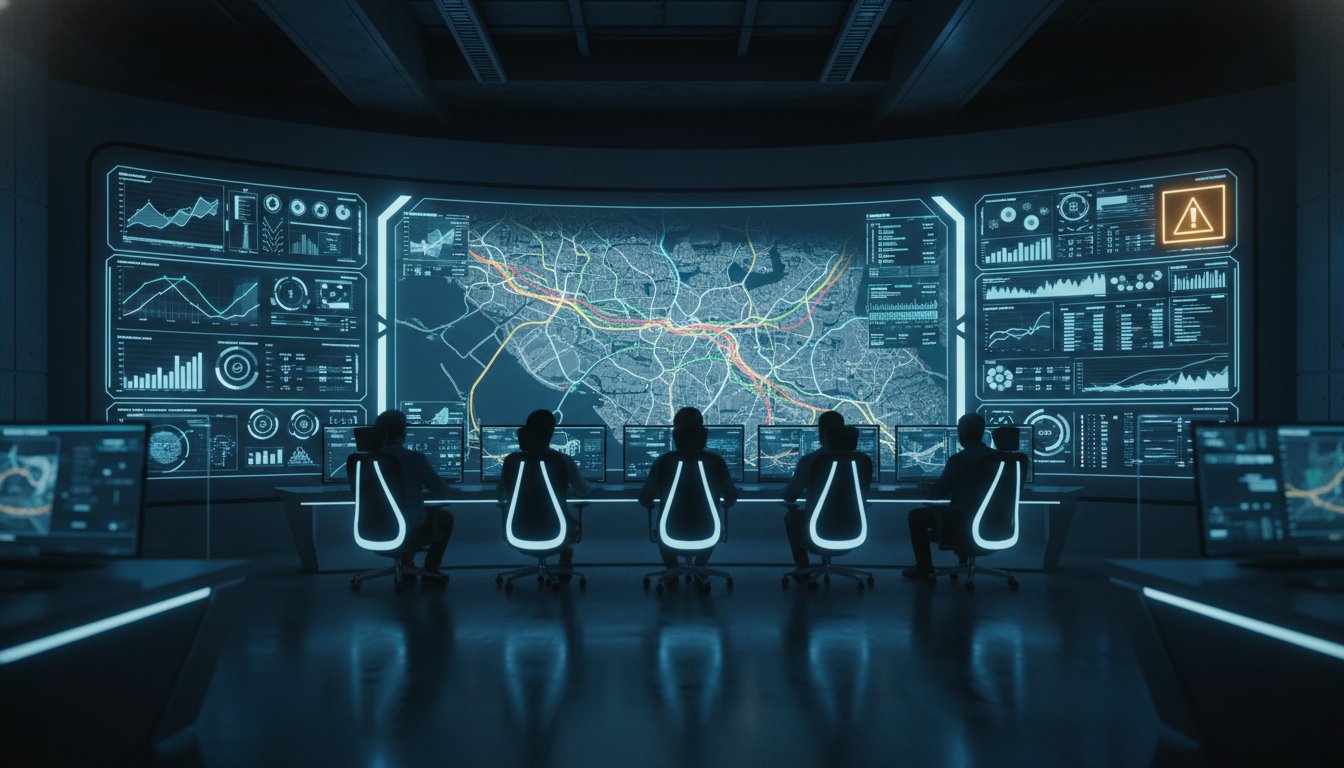
Data overload is the silent enemy of effective traffic management. Most agencies operate with 12 or more disconnected systems, forcing operators to monitor static screens until fatigue sets in. Selecting the right transportation management center software is not about adding more feeds to your wall; it is about ensuring your team sees exactly what matters when seconds count. Industry data shows that siloed information can delay emergency response times by over 4 minutes during peak congestion. Most control rooms already have the screens. What they’re missing is the layer that decides what goes on them, and escalates automatically when something needs attention.
You understand that fragmented systems and siloed data lead to missed incidents and exhausted personnel. This guide identifies the critical gaps in your current setup and shows you how to unify disparate streams into a single, actionable operational picture. We will explore how to implement an operational intelligence layer that automates incident escalation and streamlines collaboration between your control room and field units, moving your team from a state of reactive monitoring to proactive situational awareness.
Key Takeaways
- Identify the operational gaps created by disconnected CCTV, SCADA, and CAD systems that prevent a true common operating picture.
- Learn how modern transportation management center software acts as an operational intelligence layer to filter noise and prioritize critical alerts.
- Understand that most control rooms already have the screens; what they’re missing is the layer that decides what goes on them and escalates automatically when something needs attention.
- Evaluate why individual tools like GIS or incident management systems only provide partial solutions without a central hub to unify the team.
- Develop a phased implementation strategy that integrates existing hardware and software without disrupting mission-critical traffic operations.
Evaluating the Challenges of Modern Transportation Management Centers
Managing city infrastructure requires a specialized approach that differs fundamentally from commercial logistics. While fleet management tools focus on individual vehicle telematics or load profitability, a Department of Transportation (DOT) requires transportation management center software designed for high-stakes public safety and traffic flow. This software serves as the nervous system for Advanced Traffic Management Systems (ATMS), integrating disparate sensors and cameras into a coherent operational view. Unlike logistics platforms that track private assets, these systems must oversee thousands of miles of public roadway and the millions of citizens who use them daily.
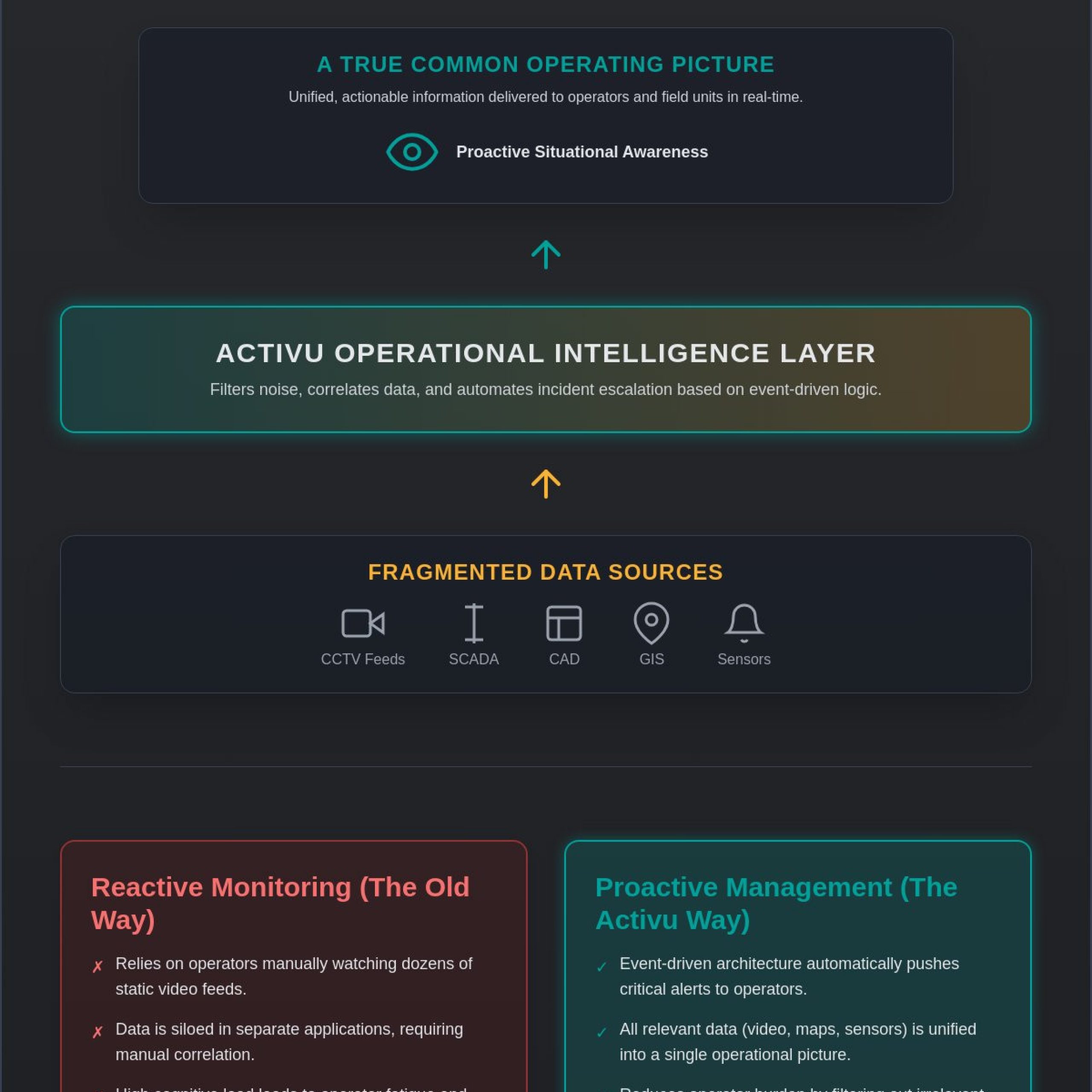
The primary challenge in modern centers isn’t a lack of data, but the isolation of that data. CCTV feeds, SCADA systems for tunnel ventilation, and Computer Aided Dispatch (CAD) often exist on separate networks or hardware. When an incident occurs, operators must manually pivot between screens, losing precious seconds. This fragmentation causes significant cognitive load. Research into human factors indicates that operator performance can drop by as much as 25 percent after just two hours of monitoring static video feeds. Most control rooms already have the screens. What they’re missing is the layer that decides what goes on them, and escalates automatically when something needs attention.
The Problem with Fragmented Traffic Systems
Disconnected feeds create a dangerous delay in incident verification. If a road sensor triggers an alert but the corresponding camera feed is buried three sub-menus deep, the response time suffers. Organizations using non-integrated software often pay a high price in both licensing costs and operational inefficiency. Relying on standalone video tools might help with recording, but it doesn’t provide the real-time infrastructure context needed to manage a multi-vehicle collision during a storm. Operators need a platform that pulls these threads together into a single common operating picture.
Moving from Reactive to Proactive Infrastructure Management
Traditional monitoring is reactive. It relies on an operator happening to look at the right screen at the exact moment a collision occurs. In high-volume environments, this model is unsustainable and prone to error. The shift toward proactive transportation management requires an event-driven architecture. Instead of watching dozens of cameras, the system should alert the team when a vehicle stops in a live lane or when flood sensors reach a critical threshold. This transition ensures that the most relevant data is always visible to the people who need to make life-saving decisions, establishing true situational awareness rather than simple data collection.
Critical Features for Next-Generation TMC Software
Next-generation transportation management center software must prioritize deep integration over simple connectivity. It’s not enough to just see a feed. The system must aggregate data from weather sensors, inductive loops, and acoustic sensors to create a comprehensive data model. By 2030, the volume of data from connected vehicle-to-infrastructure (V2I) systems is expected to increase tenfold. Your software must scale to meet this demand without requiring a hardware replacement. Cybersecurity is equally critical. Protecting the network from intrusion requires encryption that meets FIPS 140-2 standards, ensuring that traffic signals and message boards remain under secure control.
Event-Driven Situational Awareness
High-volume traffic environments generate a constant stream of noise. Effective transportation management center software uses logic-based triggers to filter this noise. Most control rooms already have the screens. What they’re missing is the layer that decides what goes on them, and escalates automatically when something needs attention. This is why incident management software is vital. It identifies a stalled vehicle in a 65 mph lane and immediately changes the visualization to show the relevant camera and the nearest emergency unit. By hiding irrelevant data during routine operations, you reduce the cognitive burden on your team. This dynamic approach ensures that the most critical information is always front and center when an incident occurs.
Collaboration Tools for Distributed Teams
A TMC is the hub of a regional response. The U.S. DOT publication on Next-Generation Transportation Management Systems emphasizes the shift toward integrated corridor management. This requires sharing a common operating picture with external partners. While some agencies use standalone digital evidence platforms for recording, those tools often lack the real-time situational context needed for active traffic management. They only provide a partial solution because they don’t integrate with the broader infrastructure, leaving operators to manually bridge the gap during an emergency. A unified hub ensures that dispatchers and field engineers see the same data on their mobile devices. This mobile extension allows a technician at a signal cabinet to see the same diagnostic data as the supervisor in the center, facilitating a 20 percent faster repair cycle. To learn how to unify these disparate feeds, explore the vis/ability operational intelligence layer.
The Operational Intelligence Layer: Deciding What Matters
Effective transportation management center software must do more than simply display data. It must interpret it. In high-stakes environments, the difference between a minor slowdown and a catastrophic pileup is often measured in seconds. Traditional systems function as passive repositories, forcing operators to act as human filters for thousands of data points. This leads to decision fatigue and missed indicators. Generic checklists often focus on standard feature sets, but they ignore the critical intelligence required to present data to human operators. By the time an incident is manually identified, the window for effective intervention has often closed.
Most control rooms already have the screens. What they’re missing is the layer that decides what goes on them, and escalates automatically when something needs attention. This operational intelligence layer acts as a filter, ensuring that human judgment is applied only where it’s most needed. By prioritizing visibility into what matters, the system transforms from a background tool into a proactive partner. It provides a steady reassurance that no critical event will go unnoticed.
Connecting Data to the Moment of Decision
Research suggests that when operators face more than 4 concurrent video feeds, their ability to detect subtle changes diminishes significantly. The vis/ability platform modernizes existing infrastructure by aggregating complex streams into a unified operating picture. Instead of siloed feeds, operators see a consolidated view that highlights anomalies across CCTV, weather, and traffic sensors. This approach moves beyond simple visualization. It creates a bridge between raw data and the human judgment required for life-saving actions.
Automated Escalation and Workflow Integration
Speed of response is the primary metric of success for any TMC. Automated escalation ensures that critical events bypass the noise of routine operations. For instance, if a wrong-way driver is detected by a roadside sensor, the software shouldn’t just log the alert. It should immediately push the relevant camera feed to the center of the video wall and trigger the appropriate standard operating procedure (SOP).
Integrating these SOPs directly into the visualization layer reduces the time between detection and response by an average of 30 percent in high-density urban areas. This automation doesn’t replace the human operator. Instead, it empowers them to act with greater certainty. By the time an operator looks at the screen, the system has already provided the context needed to authorize a dispatch or activate digital signage. This ensures that your transportation management center software acts as the quiet, powerful engine behind every successful operation.
Unifying Fragmented Transportation Systems
Data silos remain the primary obstacle to effective infrastructure management. While many agencies utilize Computer Aided Dispatch (CAD) for incident logging or GIS mapping for asset tracking, these tools often function in isolation. They offer only a partial view of the operational environment. Without a unifying layer, operators must manually correlate a CAD alert with a camera feed, a process that frequently fails during high-stress events. Effective transportation management center software acts as the central hub into which all these disparate tools flow. It transforms fragmented data into a cohesive, actionable narrative.
Most control rooms already have the screens. What they’re missing is the layer that decides what goes on them, and escalates automatically when something needs attention. By implementing an operational intelligence layer, agencies can leverage COTS (Commercial Off-the-Shelf) flexibility to integrate new technologies without the constraints of proprietary hardware. This flexibility is vital for centers that must manage hardware cycles spanning 10 years or more, ensuring the system remains relevant as new sensors emerge.
Integrating CCTV and Sensor Networks
Proprietary camera management systems often restrict data sharing across departments, creating walled gardens of information. Modernizing these environments requires pulling data from legacy SCADA systems, such as tunnel ventilation or drainage pumps, into a modern web-based interface. This ensures technical data is accessible to non-engineers during an emergency. Low-latency video delivery is essential for real-time incident verification. By integrating transportation-specific data, such as road weather information systems (RWIS) and loop detectors, the center achieves a level of visibility that standalone VMS platforms can’t provide. Centers with integrated sensor networks respond to incidents 12 percent faster than those using siloed systems.
Unifying Public Safety and Traffic Data
The overlap between traffic management and public safety is growing. Real-Time Crime Centers (RTCC) and TMCs often monitor the same geographical areas but through different lenses. Using operational industries frameworks allows for the management of cross-agency data, breaking down the traditional barriers between traffic engineering and emergency dispatch. This synergy ensures that when a first responder is dispatched, they have the same situational awareness as the control room operator. According to the Federal Highway Administration, integrated corridor management can reduce travel time delay by up to 10 percent. To bridge these silos in your own facility, contact our experts for a system audit.
Implementing a Resilient TMC Software Solution
Modernizing a facility begins with a rigorous audit of the current ecosystem. You must identify precisely where legacy hardware limits your ability to process high-velocity data streams. A phased implementation strategy is essential to ensure that daily traffic operations continue without interruption. Most control rooms already have the screens. What they’re missing is the layer that decides what goes on them, and escalates automatically when something needs attention. Deploying new transportation management center software should not be a disruptive event but a calculated evolution that enhances your existing investments.
Professional control room design services play a pivotal role during this software rollout. Proper layout and ergonomic planning ensure that the physical environment supports the digital intelligence layer. This alignment is critical for event-driven workflows, where the system proactively alerts the team to anomalies. Training your personnel to trust automated triggers requires a shift in mindset from passive watching to active response. When the software handles the initial detection and visualization, operators are free to focus on the human element of incident management, ensuring that life-saving decisions are made with absolute clarity.
Designing for Operational Continuity
Resilience is the bedrock of infrastructure management. Ensuring operational continuity during a software transition requires planning for redundancy at every level of the visualization chain. An “always-on” common operating picture prevents the information blackouts that can occur during system updates or hardware failures. By maintaining a steady flow of actionable intelligence, your center remains prepared for high-stakes decisions at any hour. This mission-critical resilience ensures that the infrastructure remains visible and manageable, even during complex system migrations.
Next Steps for Your Transportation Management Center
Success in modernizing your facility is measured by concrete metrics. Agencies typically aim for a 15 to 20 percent reduction in incident response times within the first 12 months of deploying an operational intelligence layer. Building a business case for transportation management center software requires highlighting these efficiency gains and the resulting improvements in public safety. To begin your transition from a reactive posture to a state of total situational awareness, schedule a consultation with our experts to conduct a comprehensive system audit and gap analysis.
Advancing Your Operational Intelligence
Transitioning to a modern operational intelligence layer is the only way to overcome the limitations of fragmented data. Your team doesn’t need more screens to monitor; they need the ability to act with certainty when the stakes are highest. By integrating disparate systems into a unified common operating picture, you eliminate the delays inherent in manual incident verification. Most control rooms already have the screens. What they’re missing is the layer that decides what goes on them, and escalates automatically when something needs attention. This shift toward event-driven situational awareness is proven to reduce response times and prevent operator fatigue.
Activu has spent over 40 years designing mission-critical environments for major DOTs and public safety agencies nationwide. Our experience ensures that your transportation management center software functions as a reliable bedrock for life-saving decisions. We provide the technical reliability needed to maintain calm amidst the complexity of urban infrastructure. You can move beyond the limitations of siloed tools and achieve total visibility into what matters most. Request a consultation to see how vis/ability unifies your TMC operations and empowers your team to protect the citizens they serve.
Frequently Asked Questions
What is the difference between logistics TMS and TMC software?
Logistics TMS platforms focus on private asset management, driver schedules, and load profitability. In contrast, transportation management center software is designed for public infrastructure management, traffic flow, and emergency response. While logistics tools track a specific vehicle, a TMC system monitors the entire roadway environment, including sensors, weather stations, and public safety feeds, to ensure regional mobility.
Can transportation management center software integrate with my existing CCTV cameras?
Yes, modern platforms are engineered to be hardware-agnostic and can ingest feeds from most existing IP and analog camera systems. This integration overcomes the limitations of proprietary video management systems that often trap data in silos. By pulling these disparate feeds into a single operational intelligence layer, agencies can leverage their current hardware investments while gaining a unified view of the network.
How does event-driven situational awareness reduce operator fatigue?
Event-driven situational awareness uses automated triggers to surface only the data that requires immediate action. This prevents cognitive overload by removing the need for operators to monitor dozens of static screens for hours. Most control rooms already have the screens. What they’re missing is the layer that decides what goes on them, and escalates automatically when something needs attention. This ensures the team remains focused on critical incidents rather than routine traffic.
What is a common operating picture in the context of a traffic management center?
A common operating picture is a single, identical display of real-time data shared across all stakeholders and agencies. It unifies CCTV video, CAD alerts, and GIS mapping into one interface so that traffic engineers and first responders see the same reality. This alignment eliminates the ambiguity of verbal reports and ensures that every decision is based on the same set of verified facts.
Is it necessary to replace my current video wall hardware to upgrade my software?
No, upgrading your software does not require a total hardware overhaul. The operational intelligence layer is designed to work with your existing displays and workstations. Most control rooms already have the screens. What they’re missing is the layer that decides what goes on them, and escalates automatically when something needs attention. You can modernize your workflow by adding this intelligent management layer to your current physical infrastructure.
How does TMC software improve response times for highway incidents?
The software reduces response times by automating the detection to visualization pipeline. When a sensor identifies a stopped vehicle, the system immediately pushes the nearest camera feed to the center of the video wall. Industry data indicates that this automated escalation can reduce incident verification times by 12 percent or more. Faster verification leads to quicker dispatch of emergency services and more effective clearing of the roadway.
Can field units access the TMC software on mobile devices?
Yes, mobile vis/ability extends the reach of the command center to personnel on the roadside. Field units can access the same common operating picture on tablets or smartphones, ensuring they have full context before arriving at an incident. This seamless data sharing between the control room and mobile devices improves safety for first responders and ensures that everyone is working from the same intelligence.
What are the cybersecurity requirements for transportation management center software?
Systems must comply with federal standards such as FIPS 140-2 for data encryption and align with the NIST Cybersecurity Framework. Protecting critical national infrastructure requires transportation management center software to offer robust, role-based access controls and secure data streams. These protocols prevent unauthorized access to sensitive traffic control systems and ensure that the integrity of the operational environment is never compromised.