
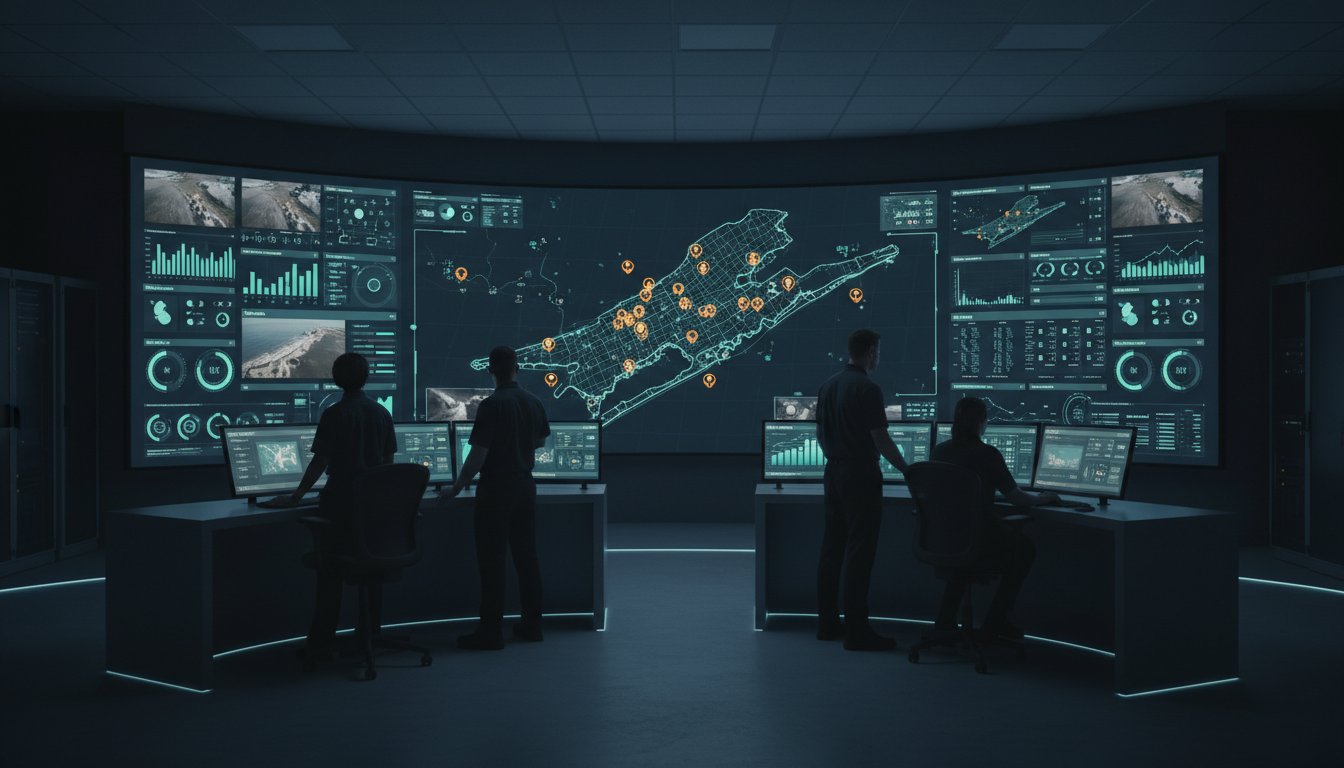
The sheer volume of data streaming into a modern command center has become a liability rather than an asset. When critical alerts are buried under 15 different sub-menus, your emergency operations center technology often obstructs the mission instead of serving it. You likely recognize the daily frustration of watching operators manage 12 different logins while a high-priority incident develops unnoticed in a siloed feed. This cognitive load doesn’t just cause fatigue; it creates dangerous gaps in situational awareness that can delay response times by several minutes.
You know that speed is the only metric that matters during a crisis, yet fragmented systems continue to slow your team down. Most control rooms already have the screens. What they’re missing is the layer that decides what goes on them, and escalates automatically when something needs attention. This article demonstrates how to transform these disconnected data points into a unified common operating picture by implementing a modern operational intelligence layer. We’ll examine how to automate incident detection and shave 60 seconds off response times by ensuring that your field units and command staff see exactly what they need, exactly when they need it.
Key Takeaways
- Identify the shift from static monitoring to dynamic, event-driven intelligence to ensure your team stays ahead of rapidly evolving incidents.
- Learn how to integrate fragmented emergency operations center technology into a cohesive system that delivers a single source of truth for all stakeholders.
- Understand the role of an operational intelligence layer in automating incident escalation, ensuring that the most critical data reaches the right screens at the right time.
- Bridge the gap between siloed applications and mission-critical decision-making by unifying disparate data feeds into one globally useful interface.
- Facilitate seamless coordination by extending full situational awareness from the command center to field responders on any mobile device.
The Operational Reality of Modern Emergency Operations Center Technology
Modern emergency operations center technology represents far more than a collection of monitors and workstations. It’s a complex ecosystem of hardware and software designed to provide real-time situational awareness. In mission-critical environments, the focus has shifted from static monitoring to dynamic, event-driven intelligence. Legacy systems often rely on the assumption that more data equals better decisions. However, when data volume exceeds human processing capacity, the traditional “big screen” approach fails. Efficiency requires a human-centric design where technology empowers the operator instead of burying them under a mountain of irrelevant pixels. A successful Emergency Operations Center (EOC) must prioritize clarity over volume, ensuring that every piece of information on display serves a specific tactical purpose.
The Problem of Fragmented Systems and Siloed Data
Leadership faces significant cognitive gaps when GIS, weather alerts, and Computer-Aided Dispatch (CAD) systems remain isolated. These disparate tools create a fragmented view of the operational landscape, forcing personnel to toggle between windows to piece together a narrative. Specialized tools like Axon provide valuable data, but they often function as partial solutions that require a unifying layer to create a full common operating picture. Information blindness occurs when a critical alert stays hidden behind a non-integrated application window or a secondary tab. During high-stress incidents, the friction of manual data correlation slows response times and increases the risk of error. Most control rooms already have the screens. What they’re missing is the layer that decides what goes on them, and escalates automatically when something needs attention.
Operator Fatigue and the Limits of Manual Monitoring
Monitoring hundreds of video feeds is psychologically exhausting and ultimately unsustainable. Industry research indicates that after only 20 minutes of watching monitors, an operator’s attention level drops significantly, often leading to missed events. This cognitive decline is why operators miss incidents in legacy EOC designs. Relying on a person to spot a needle in a digital haystack is a primary failure point that puts infrastructure and lives at risk.
Modern emergency operations center technology must move toward proactive notification systems that surface anomalies automatically. This is where vis/ability acts as the operational intelligence layer. It serves as the central hub where all other tools flow, transforming raw data into actionable intelligence for the entire team. By automating the transition from routine monitoring to active incident response, the technology ensures human judgment is applied exactly where and when it’s needed most, providing a steady foundation of clarity amidst the chaos of a crisis.
Core Capabilities of a Common Operating Picture (COP)
Emergency operations center technology often fails during the most critical moments because data remains trapped in silos. When a multi-agency response begins, decision-makers face a fragmented landscape of telemetry, CAD data, and sensor alerts. A Common Operating Picture (COP) serves as the single source of truth, ensuring that every stakeholder sees the same tactical reality. This alignment is vital for NIMS-compliant management, particularly following the 2017 updates that emphasized integrated information systems. Standardized reporting and clear chains of command rely on shared data to maintain a unified command structure.
Most control rooms already have the screens. What they’re missing is the layer that decides what goes on them, and escalates automatically when something needs attention. Without this intelligence, the video wall becomes a passive display rather than an active tool. Effective Intelligent EOC Design requires a platform that harmonizes local, state, and federal data streams into a unified interface. This ensures that a county sheriff and a federal agency representative are looking at identical coordinates and timestamps when seconds matter.
Real-Time Visualization and Geospatial Integration
Dynamic map overlays provide the necessary geographic context for incoming sensor data. Simply seeing an alert is insufficient; operators must see where it sits in relation to critical infrastructure, evacuation routes, and personnel. Integrating live video feeds with these geospatial assets provides immediate tactical clarity. This level of 24/7 visibility is the hallmark of mission critical operations. When a brush fire or a water main break occurs, the ability to visualize the proximity of assets to the hazard reduces response times and improves safety outcomes for field teams.
Interoperability Standards and Data Harmonization
Proprietary walled garden systems create dangerous bottlenecks during large-scale incidents. Solutions like Axon offer valuable body-cam and evidence data, but they only provide a partial view of the operational landscape. They require a unifying layer to create a full common operating picture. Emergency operations center technology must utilize COTS (Commercial Off-The-Shelf) solutions that support open standards like CAP (Common Alerting Protocol).
Data from 50 or more disparate manufacturers must be normalized to ensure it contributes to a single, actionable view. When systems don’t talk to each other, operators miss incidents. vis/ability acts as the operational intelligence layer, pulling these fragmented feeds into a cohesive platform. This ensures that the entire team, whether in a huddle room or on mobile devices, has the intelligence needed to act with certainty. You can unify your operational intelligence to eliminate data silos and ensure no critical alert goes unnoticed.
The Operational Intelligence Layer: Deciding What Matters
Operational silos create a dangerous lag in response times. When data lives in separate tabs and siloed applications, operators spend more time searching for information than acting on it. Most control rooms already have the screens. What they’re missing is the layer that decides what goes on them, and escalates automatically when something needs attention.
Activu’s vis/ability platform serves as this essential operational intelligence layer. It sits above your existing hardware, acting as a unifying hub that aggregates disparate feeds into a cohesive view. Unlike standard display drivers, this software focuses on the “why” behind the visual, ensuring that the most critical data is always front and center. It transforms emergency operations center technology from a passive display of information into a proactive partner in decision-making.
Moving Beyond Static Video Wall Systems
Legacy video walls often rely on “preset” layouts that an operator must manually select. This approach is reactive and prone to human error during high-stress incidents. Modern situational awareness requires event-driven visualization. When a sensor detects a chemical leak or a security breach, the system should instantly trigger a layout change that surfaces the relevant cameras and diagnostic data. This dynamic approach ensures that the team isn’t looking at a routine dashboard when they should be focused on a burgeoning crisis.
The effectiveness of this orchestration depends on how it aligns with specific EOC organizational models, which often dictate how information flows between local and state agencies. To understand how software intelligence pairs with physical infrastructure, our strategic guide on video walls provides a roadmap for achieving hardware-software synergy.
Automation and Escalation Workflows
Automation removes the manual burden of “switching inputs” when seconds count. Intelligent software monitors “heartbeat” data from critical systems to detect failures or anomalies before they are reported by a human. For example, if 911 call volume in a specific precinct exceeds a 20% threshold over its rolling average, vis/ability can automatically push the Computer-Aided Dispatch (CAD) map and nearby traffic feeds to every screen in the room.
This automated escalation reduces the time between “event detected” and “action taken” by eliminating the need for an operator to identify the problem and then manually find the right camera feed. By delegating the monitoring of routine thresholds to the operational intelligence layer, emergency operations center technology empowers the human team to focus entirely on strategy and life-saving intervention. It ensures that when the stakes are highest, the right information finds the right people instantly.
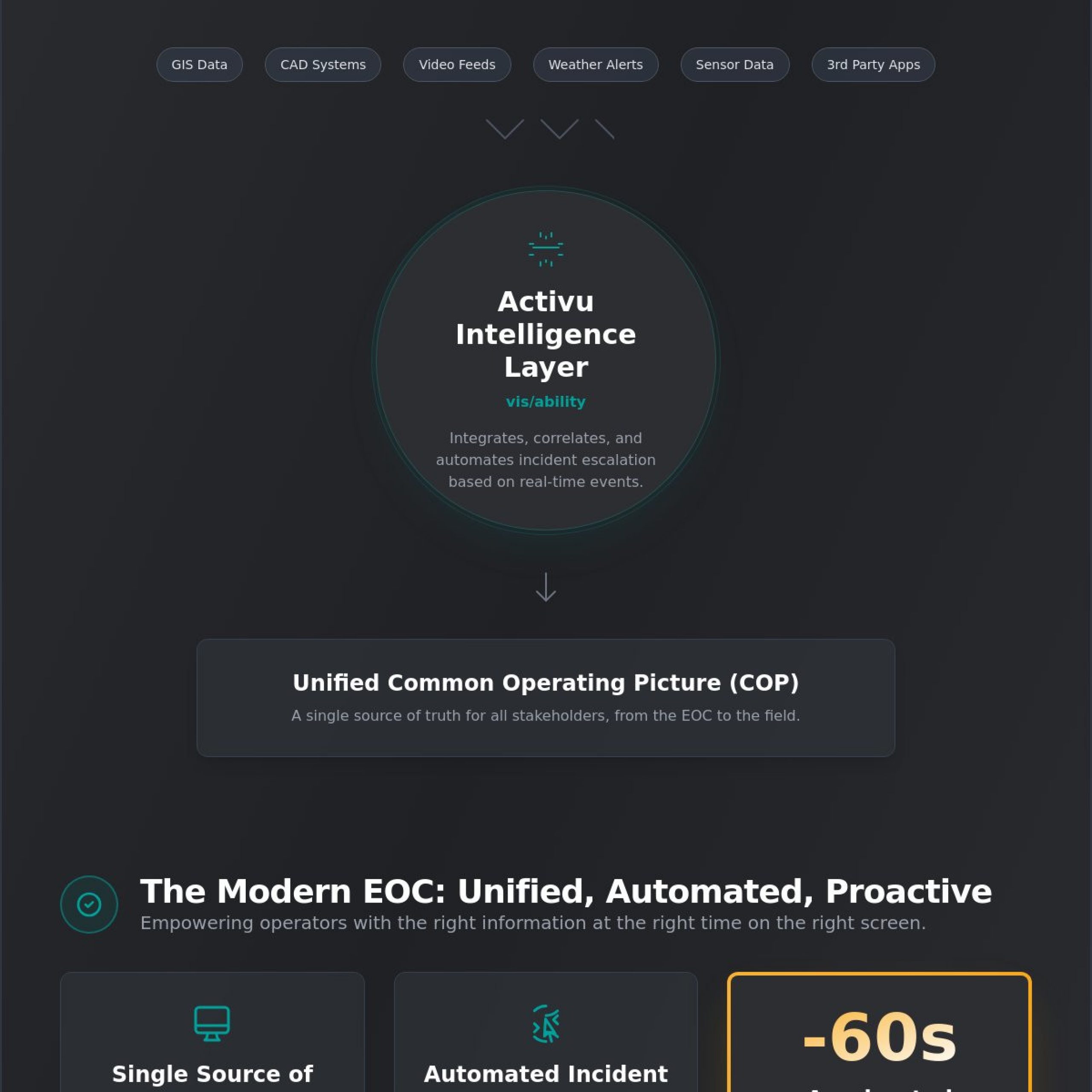
Unifying Disparate Tools into a Single Interface
Operational silos create dangerous blind spots during a crisis. In a high-pressure dispatch center or fusion center, an operator cannot afford to waste 15 seconds switching between a CAD system, a weather feed, and a live camera stream. This friction delays response times and fractures situational awareness. Most emergency operations center technology relies on isolated point solutions that offer deep data but narrow visibility. These tools work well for individual tasks but fail to inform the broader team without manual intervention.
Most control rooms already have the screens. What they’re missing is the layer that decides what goes on them, and escalates automatically when something needs attention. vis/ability serves as this operational intelligence layer, acting as the central hub where specific data becomes globally useful. By integrating disparate applications into a single interface, it ensures that critical information moves from a single workstation to the entire EOC team instantly. Secure, low-latency streaming is vital here, as it allows remote data sources to reach decision-makers without the lag that often plagues standard browser-based tools.
Integrating Public Safety and Incident Management Tools
Point solutions like Axon provide essential body-worn camera footage, but that data is often trapped within its own ecosystem. vis/ability enhances these tools by sharing their live feeds with the entire EOC team in context with other assets. According to a 2023 industry survey, 68% of command centers report that data silos are their primary operational bottleneck. Integrating incident management software with live visualization solves this by creating a unified common operating picture. When an incident occurs, the system automatically pulls relevant feeds from platforms like Juvare or Axon onto the main display, removing the manual burden from operators who are already managing complex data feeds.
Cybersecurity and Network Health Visualization
Modern emergency operations center technology must account for both physical and digital threats. A cyberattack on local infrastructure is just as disruptive as a natural disaster, yet many centers still monitor these risks in separate rooms. Physical and cyber security must be monitored in parallel. Visualizing threat intelligence within the EOC allows for a faster SOC and GSOC response when seconds matter. Network operations data also contributes to operational continuity. If a critical network node fails, vis/ability highlights the impact on the map immediately. This allows IT teams to reroute traffic and maintain the center’s integrity before situational awareness is lost.
Stop managing individual tools and start orchestrating your intelligence. Explore how vis/ability unifies your EOC ecosystem.
Extending Visibility from the EOC to the Field
Critical response fails when information stops at the EOC walls. Field responders often operate on verbal updates while commanders in the center look at real-time geospatial data. This gap creates friction, increases cognitive load, and delays action. Most control rooms already have the screens. What they’re missing is the layer that decides what goes on them, and escalates automatically when something needs attention.
Modern emergency operations center technology must function as a mobile asset. It serves as the operational intelligence layer, acting as a central hub where all other tools flow. By unifying disparate data points, vis/ability ensures that the right information reaches the right person, regardless of their physical location. This approach moves beyond simple video distribution, turning the EOC into a proactive engine of intelligence.
Mobile vis/ability and Remote Collaboration
Field commanders require the same visual intelligence as EOC staff to make high-stakes decisions. While tools like Axon provide essential video feeds, they often remain siloed, offering only a partial view of the environment. These tools require a unifying layer to create a complete common operating picture. Using tablets and smartphones, personnel can now view the exact content displayed on the main video wall. This capability allows a seamless field-to-EOC and EOC-to-field information flow, where on-the-ground reality informs the command center in real time. Remote stakeholders also participate in decision-making from any location. A 2023 review of mission-critical systems suggests that real-time visual collaboration can reduce decision-making cycles by up to 30% during active incidents. This ensures expertise is never locked behind a desk.
Planning for Operational Continuity and Resilience
Resilience in EOC design depends on moving away from hardware-heavy legacy systems. Traditional setups often suffer from single points of failure and limited scalability. A software-defined approach provides the bedrock for operational continuity, offering five-nines (99.999%) technical reliability. This architecture allows agencies to scale their operations as demand grows, ensuring the system remains stable during the most intense crises. Activu stands as the trusted partner for end-to-end public safety and transportation solutions. To future-proof your operations, follow these steps:
- Audit existing hardware to identify bottlenecks in data distribution.
- Implement a software-defined layer to unify fragmented systems.
- Enable secure, platform-agnostic mobile access for all field leadership.
- Establish automated escalation protocols to highlight critical incidents instantly.
Investment in emergency operations center technology is an investment in clarity. To ensure your center is prepared for the complexities of modern response, contact our team today for a professional EOC technology assessment.
Command the Chaos with Operational Intelligence
Modern emergency management requires more than just high-definition displays or fragmented data streams from platforms like Axon or Juvare. While these tools provide valuable data, they often leave operators overwhelmed by information silos. True operational clarity comes from unifying these disparate feeds into a single, actionable interface that reaches from the command center to the mobile devices of field personnel. This shift from passive monitoring to active intelligence ensures your team acts with certainty when every second counts.
Most control rooms already have the screens. What they’re missing is the layer that decides what goes on them, and escalates automatically when something needs attention. Activu provides this essential operational intelligence layer, turning raw data into decisive action. Trusted by federal agencies and global GSOCs, our event-driven automation reduces response time by up to 30%. By integrating seamlessly with your existing GIS platforms and situational awareness tools, vis/ability ensures that your emergency operations center technology serves the mission rather than complicating it.
See how vis/ability transforms your EOC technology into an operational intelligence hub.
Your team deserves a platform that provides absolute clarity when the stakes are at their highest.
Frequently Asked Questions
What is the most important technology for an Emergency Operations Center?
The most vital emergency operations center technology is the operational intelligence layer that unifies fragmented data into a single point of truth. While CAD systems or radio networks are essential, they often operate in silos that delay critical decision-making. A central platform like vis/ability integrates these disparate inputs, ensuring that 100 percent of your team sees the same critical data at the same moment to move from chaos to clarity.
How does an EOC common operating picture improve incident response?
A common operating picture reduces decision-making time by providing a synchronized view of the theater of operations. In a 2023 study of emergency response workflows, teams using unified visualization layers reduced their time to identify critical incidents by 40 percent. By removing the need to manually toggle between browser tabs or local workstations, operators focus on the 5 percent of data that actually dictates the outcome of the response.
Can existing video walls be upgraded with new situational awareness software?
You can upgrade existing hardware by implementing a software-defined operational intelligence layer. Most control rooms already have the screens. What they’re missing is the layer that decides what goes on them, and escalates automatically when something needs attention. Adding vis/ability allows agencies to leverage their current display investments while gaining modern capabilities like automated content triggers and secure remote collaboration across the entire organization.
How do you manage multiple data feeds in a high-pressure EOC environment?
Managing 50 or more data feeds requires an automated orchestration system rather than manual monitoring. Operators cannot track every camera and sensor simultaneously without missing critical cues. vis/ability acts as a filter, using event-driven logic to surface only the relevant feeds when specific thresholds are met. This approach ensures that the most critical 10 percent of information is always front and center during an escalation.
What is the difference between a video wall processor and an operational intelligence layer?
A video wall processor is a hardware component that manages pixel placement and signal routing. In contrast, an operational intelligence layer like vis/ability is the cognitive brain of the EOC. While the processor handles the mechanics of the display, the intelligence layer handles the context and the priority. It identifies critical events across integrated systems and pushes that context to the screens automatically, removing human lag from the process.
Is mobile access to EOC data secure for field responders?
Mobile access is secured through AES 256-bit encryption and multi-factor authentication protocols. Field responders receive the same high-resolution common operating picture as the command center, ensuring total alignment between the EOC and the boots on the ground. By extending the operational intelligence layer to mobile devices, agencies ensure that 100 percent of their personnel operate from the same verified data set regardless of their location.
What are the common mistakes in EOC technology procurement?
The most frequent mistake is prioritizing hardware specifications over software functionality. Agencies often spend 80 percent of their budget on high-end displays while neglecting the software required to manage them. This leads to dark screen syndrome, where expensive video walls remain underutilized because they’re too difficult to update during a crisis. Procurement should focus on the intelligence layer that makes all other tools, including hardware, more effective.
How does event-driven visualization reduce operator fatigue?
Event-driven visualization reduces fatigue by eliminating the need for constant, passive monitoring of static feeds. When a system only displays content in response to specific triggers, it lowers the cognitive load on operators by 30 percent or more. Instead of scanning 20 screens for an anomaly, the team waits for the operational intelligence layer to flag the one incident that requires their professional judgment and immediate action.