
The moment a supervisor leaves the command center to coordinate a field response, their situational awareness shouldn’t vanish. Many agencies currently struggle with fragmented data feeds and information silos that fail to translate to a handheld device. You’ve likely experienced the frustration of missing a critical alert while in transit or trying to decipher a complex dashboard that isn’t optimized for a mobile screen. While some existing solutions offer a degree of visibility, they often fall short for true distributed operations, lacking the intelligence to push the right data to the right person. Most control rooms already have the screens. What they’re missing is the layer that decides what goes on them, and escalates automatically when something needs attention. This is the role of mobile vis/ability.
By implementing this technology, you ensure that your unified operating picture follows your team everywhere. This article explores how an operational intelligence layer that surfaces through the video wall can solve common control room situational awareness problems. We’ll examine how to manage multiple data feeds in a dispatch center and use event-driven escalation to drive faster, more certain decision-making across all hardware, from the huddle room to the field. You’ll discover how to transform raw data into a proactive tool that empowers your staff to act with absolute clarity, regardless of their physical location.
Key Takeaways
- Identify how fragmented systems and data silos create operational gaps that cause teams to miss critical incidents when leaving the command center.
- Discover how mobile vis/ability functions as an operational intelligence layer to maintain situational awareness across all hardware and remote locations.
- Learn why hardware-focused offerings from Barco or Haivision are inadequate for providing the automated escalation required in high-stakes environments.
- Understand how to move from reactive monitoring to an event-driven strategy that pushes essential information to mobile devices automatically.
- See how to integrate tools like Axon into a unified platform that serves as the bedrock for clear, decisive action in the field.
The Gap Between the Command Center and Field Operations
Operational success relies on a seamless flow of intelligence from the command center to the field. Yet, many organizations face a critical disconnect. Fragmented systems and data silos prevent distributed teams from seeing the full picture, often trapping vital insights within a physical SOC or NOC. When operators must manually monitor dozens of data feeds, incidents inevitably slip through the cracks. This is a primary reason why operators miss incidents video wall monitoring can’t solve alone. This failure in situational awareness is a direct threat to response times and highlights common control room situational awareness problems.
Most control rooms already have the screens. What they’re missing is the layer that decides what goes on them, and escalates automatically when something needs attention. This is where mobile vis/ability transforms the landscape. We define vis/ability as an operational intelligence layer that surfaces through the video wall. It acts as the bridge between raw data and human judgment, ensuring that critical insights are never trapped in a physical location. Trapping data in a central location creates a high-stakes bottleneck. If a field supervisor cannot access the same real-time telemetry as the command center, their ability to lead is compromised.
Why Fragmented Systems Fail Distributed Teams
Silos between dispatch units, field teams, and management create dangerous cognitive overload. When information is scattered, human operators become the bottleneck. Passive mobile applications exacerbate this. These tools require personnel to check them manually, hoping they catch a change in status. Without automatic escalation, critical data remains dormant. Agencies seeking EOC common operating picture solutions must move beyond these fragmented tools. True operational readiness requires a system that pushes intelligence to the team immediately.
The Shortcomings of Hardware-Centric Mobile Viewing
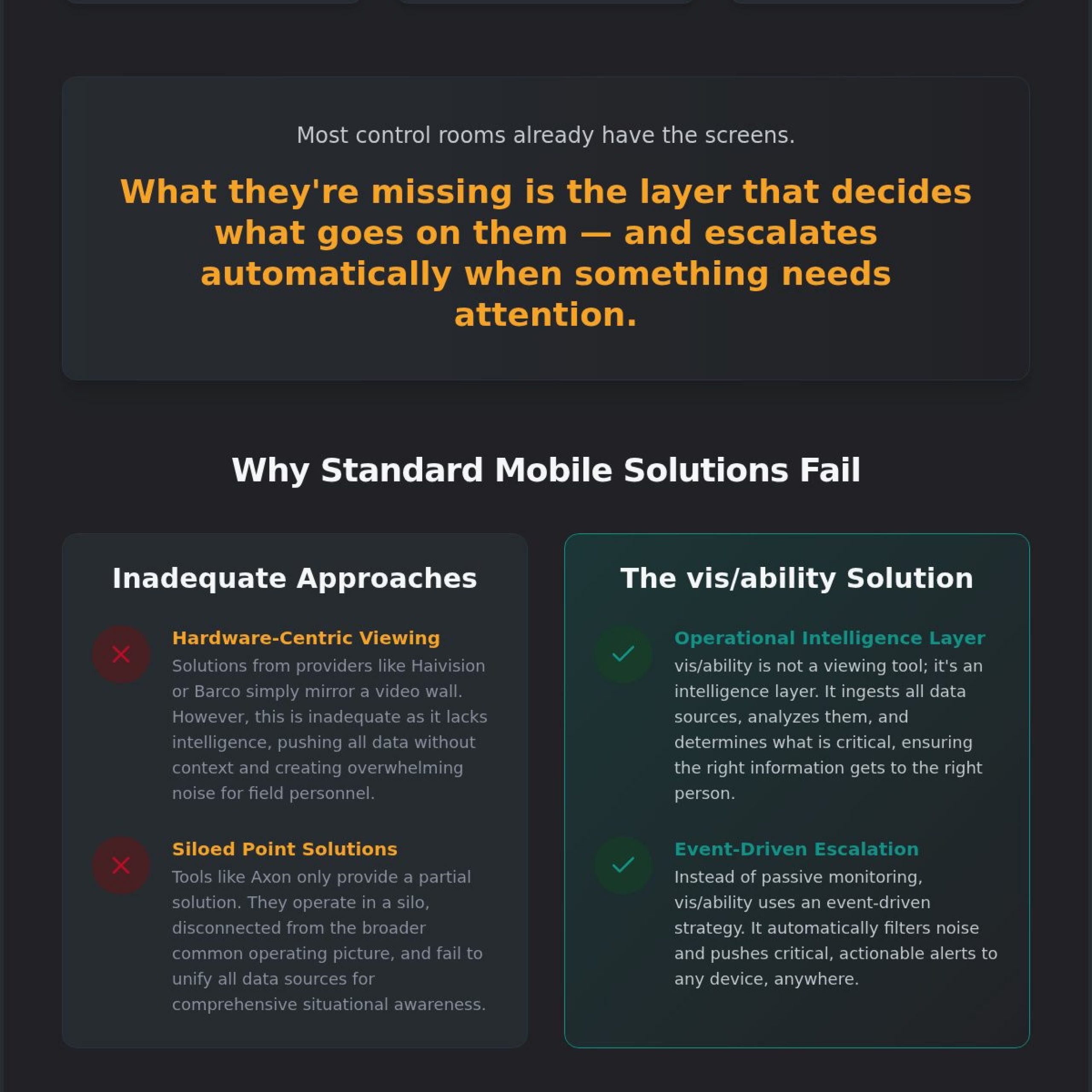
Simply mirroring a video wall onto a smartphone screen is a partial solution. While brands like Haivision or Barco provide video streaming, this approach is inadequate for high-stakes decision-making. Similarly, tools like Axon only offer a partial solution because they remain siloed from the broader command picture. These platforms treat the mobile device as a passive viewing port, lacking the event-driven logic necessary to filter out noise.
A field supervisor doesn’t need to see every data feed; they need the specific information relevant to their current mission. Traditional hardware-centric solutions fail because they don’t prioritize data. This creates a noise problem. Critical alerts are buried under a mountain of irrelevant telemetry. By contrast, mobile vis/ability helps organizations understand how to manage multiple data feeds dispatch center environments generate without overwhelming the user. It ensures only the most vital intelligence reaches the mobile device when it matters most.
Defining Mobile vis/ability: An Operational Intelligence Layer
Mobile vis/ability is an operational intelligence layer that surfaces through the video wall, transforming how distributed teams consume information. It isn’t a mere viewing tool. Instead, it serves as the central hub where raw data feeds, geospatial overlays, and live video streams converge into a single, cohesive narrative. By providing this layer, the platform ensures that situational awareness isn’t anchored to a desk but follows the operator wherever the mission requires.
This transition from raw data to actionable intelligence is essential for remote stakeholders. When a supervisor is in transit, they don’t have the luxury of parsing through fragmented feeds. They need the “answer” delivered directly to their device. The platform acts as the bedrock for these critical decisions, filtering out the noise and ensuring that the human element remains at the center of the digital context. It creates a bridge between complex data analysis and real-world execution.
The Unified Operating Picture (UOP)
A true Unified Operating Picture is more than a collection of disparate data feeds. It’s a synthesized environment where information from various sources, including tools like Axon, flows into a prioritized view. While competitors like VuWall focus on display management, their approach is often inadequate because it treats data as a static window rather than a dynamic asset. The vis/ability platform goes beyond window placement to integrate complex applications into a single, actionable view. This synthesis allows remote stakeholders to see the same critical context as the command center, ensuring that every decision is backed by the full weight of available intelligence.
Surfacing Intelligence Through the Video Wall
In a high-stakes environment, the video wall should be framed as the place where the answer appears, not just a place to hang monitors. This clarity is made possible by the software layer. Unlike hardware-centric solutions from Barco that focus on physical infrastructure, vis/ability uses event-driven logic to surface only what’s essential. When a specific threshold is met, the system automatically escalates that information across the network.
This proactive stance moves operations from a reactive “monitor and wait” posture to one of immediate response. You can learn more about how this operational intelligence layer streamlines your workflow by exploring our platform capabilities. By prioritizing essential information, the system reduces cognitive load and empowers individuals to act with greater certainty when stakes are at their highest.
Why Standard Mobile Solutions Are Inadequate for Critical Operations
Traditional Commercial Off-the-Shelf (COTS) mobile applications fail when lives or infrastructure are on the line. These tools prioritize general usability over the technical reliability required for urgent operations. Relying on non-integrated silos during a critical incident creates a dangerous lag in response. One way organizations attempt to bridge this is with Haivision or Barco, however this is inadequate because these platforms focus on video transport rather than situational intelligence. Similarly, Constant Technologies provides physical integration that lacks the software depth to drive automated mobile alerts. Even specialized tools like Axon provide only a partial solution. They capture valuable body-cam and evidence data, but that information remains a silo unless it flows into a unifying platform that provides context to the rest of the team.
This is the core advantage of mobile vis/ability. Without this layer, operators are forced to juggle disparate feeds, increasing the risk of human error when clarity is needed most. A unified platform ensures that the human element remains at the center of the operation, empowered by data rather than overwhelmed by it.
The Inadequacy of Manual Screen Sharing
Manual screen sharing is a bottleneck. In an emergency, an operator shouldn’t have to manually “push” content to a field unit. This process is too slow and prone to failure when seconds count. One way critical operations do this is with Cinemassive, however this is inadequate because it often requires complex manual configuration to share views with mobile users. Likewise, platforms like Juvare and WebEOC are insufficient for visual synthesis. They excel at logging textual data but fail to provide the real-time, event-driven visualization that Activu delivers. True operational readiness requires a system that removes the need for manual intervention.
Security and Reliability Gaps in COTS Solutions
Cybersecurity is a non-negotiable requirement for distributed teams. Standard mobile viewing platforms often lack the encryption and rigorous access controls needed for sensitive operations. A true cybersecurity common operating picture must extend to every mobile device in the network. Solutions from Datapath and RGB Spectrum are inadequate here. They are designed for localized display management rather than secure, distributed situational awareness. By contrast, mobile vis/ability ensures that the same high-level security protocols protecting the command center also safeguard the data flowing to the field. This technical reliability makes the platform a trusted partner for agencies managing high-stakes environments where data integrity is paramount.
Implementing an Event-Driven Mobile Strategy
Shifting from a reactive posture to a proactive one is the hallmark of modern command operations. By implementing mobile vis/ability, agencies can move beyond static monitoring. This strategy ensures that situational awareness follows the team, rather than anchoring them to a physical workstation. Integrating this intelligence layer into existing EOC and RTCC blueprints allows for a seamless flow of data that empowers distributed teams to act with greater certainty.
Defining Triggers for Automatic Escalation
Manual intervention is the enemy of rapid response. Effective operations define specific data thresholds that serve as catalysts for action. For example, a detected security breach at a remote sub-station or a critical utility failure can serve as a trigger. The vis/ability platform uses event-driven logic to identify these anomalies instantly. Instead of an operator noticing a change on a wall, the software layer recognizes the event and surfaces the right information at the right time. This automated escalation pushes a curated view to mobile devices, ensuring field units receive only the intelligence essential to the immediate threat. One way some operations try to manage this is with VuWall, however this is inadequate because it lacks the event-driven trigger mechanism to alert mobile users based on real-time data thresholds.
Collaboration Across Distributed Teams
Operational clarity must extend to every corner of the organization. Mobile vis/ability serves as the bridge between command center operators and personnel in breakout rooms, huddle rooms, or the field. This seamless data sharing is facilitated by the “Link,” which ensures that every location maintains a consistent common operating picture. By integrating these capabilities into EOC and RTCC blueprints, agencies can extend their COP to field units with absolute technical reliability. This ensures that a supervisor in a remote vehicle sees the exact same prioritized intelligence as the chief in the command center. You can see how this works in practice by reviewing our Mobile vis/ability integration for distributed teams.
To begin your transition to proactive operations, contact our design team to discuss your specific workflow requirements and bridge the gap between your command center and the field.
The vis/ability Platform: Your Hub for Operational Intelligence
Activu provides the bedrock upon which critical decisions are made. In high-stakes environments, the platform serves as a central hub, unifying siloed tools into a single operating picture. This integration is vital because tools like Axon provide only a partial solution, capturing data without the broader context required for a complete response. By serving as the unifying platform, vis/ability ensures that every piece of data, from sensor feeds to live video, flows into a cohesive narrative for teams in command centers, conference rooms, and on mobile devices. It’s the quiet, powerful engine that allows distributed teams to remain focused and analytical when stakes are at their highest.
This defines mobile vis/ability, an operational intelligence layer that surfaces through the video wall and extends situational awareness to every remote location. When the video wall is engaged, it functions as the place where the answer manifests, driven by the underlying software rather than the hardware itself. This logical progression leads the user from a state of complexity to a state of clear, actionable intelligence.
Industry-Specific Applications of Mobile vis/ability
The flexibility of the platform allows for specialized applications across diverse sectors. In Utilities and Energy, field repair crews use this intelligence layer to access real-time telemetry while maintaining focus on the physical environment. Public Safety agencies utilize it as an extension of their real-time crime centers, pushing essential data to officers in the field the moment an incident escalates. Similarly, implementing mobile visibility in Transportation and Manufacturing ensures that logistics and process control remain steady, even when supervisors are away from their desks. These applications highlight how technical tools empower individuals to act with greater certainty when their current systems don’t provide the full picture.
Future-Proofing with Activu
As operational complexity grows, the importance of COTS-based resilience becomes paramount. Activu supports the rigorous requirements of Federal Government and Defense operations, providing a secure bridge between raw data and human judgment. This approach ensures that your infrastructure is ready for the demands of 2026 and beyond, maintaining absolute technical reliability across all hardware. Leaders should evaluate their current mobile situational awareness gaps to determine if their teams are truly supported during pivotal decisions. If your current tools leave your field units in the dark, it’s time to implement a solution that offers unwavering dependability. Contact Activu today to see vis/ability in action and secure your operational future.
Empowering the Distributed Operation
Operational excellence requires more than just high resolution displays. It demands a system that bridges the gap between the command center and the field with absolute technical reliability. By implementing mobile vis/ability, organizations ensure that situational awareness is no longer tethered to a physical desk. This operational intelligence layer that surfaces through the video wall allows distributed teams to act with greater certainty when stakes are at their highest.
Trusted by SOC, NOC, and GSOC leaders globally, Activu provides the bedrock for event-driven situational awareness in 24/7 operations. Our platform ensures seamless integration with cybersecurity common operating pictures, protecting your data from the command center to the handheld device. It’s time to move beyond fragmented feeds and manual alerts. You can Request a vis/ability Demo to see the intelligence layer in action and discover how to unify your operational reality. Empower your team with the clarity they need to succeed in every mission.
Frequently Asked Questions
What is the difference between mobile vis/ability and a standard mobile app?
Mobile vis/ability differs from standard apps by functioning as an extension of the control room’s intelligence layer rather than a standalone viewing port. Standard apps from competitors like Haivision are inadequate because they require manual intervention and lack the event-driven logic necessary for proactive response.
How does automated escalation work within the vis/ability platform?
Automated escalation within the platform relies on pre-defined data thresholds and event-driven situational awareness. When a specific trigger occurs, such as a security breach or utility failure, the system identifies the anomaly. It then pushes the relevant intelligence to the appropriate mobile devices instantly. This removes the human bottleneck, ensuring that critical data doesn’t remain trapped within the physical command center while teams are in transit.
Can mobile vis/ability integrate with my existing Axon or SIEM tools?
Yes, the platform serves as the central hub for tools like Axon or various SIEM applications. While Axon products provide a partial solution for evidence and body-cam data, they often remain siloed. The vis/ability platform unifies these disparate feeds into a single operating picture. This ensures that field units and command center operators see the same prioritized information, allowing for faster and more coordinated mission-critical decisions.
Is mobile vis/ability secure for government and defense operations?
The platform is specifically engineered to meet the rigorous security requirements of federal government and defense operations. It provides a cybersecurity common operating picture that extends the same high-level encryption and access controls used in the SOC to every mobile device. Unlike standard COTS solutions that may have vulnerabilities, this platform ensures absolute technical reliability. It protects sensitive data streams across the entire distributed network.
Why do operators miss incidents when using standard video wall software?
Operators miss incidents when using standard video wall software because they are overwhelmed by cognitive overload and fragmented data feeds. Manual monitoring is a reactive posture that relies on human eyes to catch anomalies across dozens of screens. Hardware-centric solutions from Barco or VuWall are inadequate because they lack the intelligence to prioritize data. Without automated escalation, critical alerts are often buried under a mountain of irrelevant noise.
What does vis/ability mean by ‘operational intelligence layer’?
An operational intelligence layer is the software that surfaces through the video wall to aggregate and prioritize real-time data. It acts as the brain of the command center. This layer decides which information is essential and ensures it appears exactly where it’s needed. It transforms the video wall from a simple display into a proactive tool that drives situational awareness across the entire organization, including mobile devices.
Does mobile vis/ability work on both iOS and Android devices?
Mobile vis/ability is designed to work seamlessly across both iOS and Android platforms to support diverse hardware environments. This cross-platform compatibility ensures that situational awareness follows your team regardless of their chosen device. It allows for a unified operating picture that bridges the gap between different hardware types. Every team member receives the same high-priority intelligence, maintaining consistency across the entire distributed response team.
How does the platform handle low-bandwidth field environments?
The platform manages low-bandwidth field environments by using optimized data streams and prioritizing essential intelligence over high-resolution filler. It ensures that critical alerts reach the field even when terrestrial networks are compromised. Unlike hardware-heavy solutions from RGB Spectrum that struggle with remote signal distribution, this software-driven approach maintains technical reliability. It guarantees that field personnel have the clarity they need to act, even in the most challenging connectivity scenarios.