
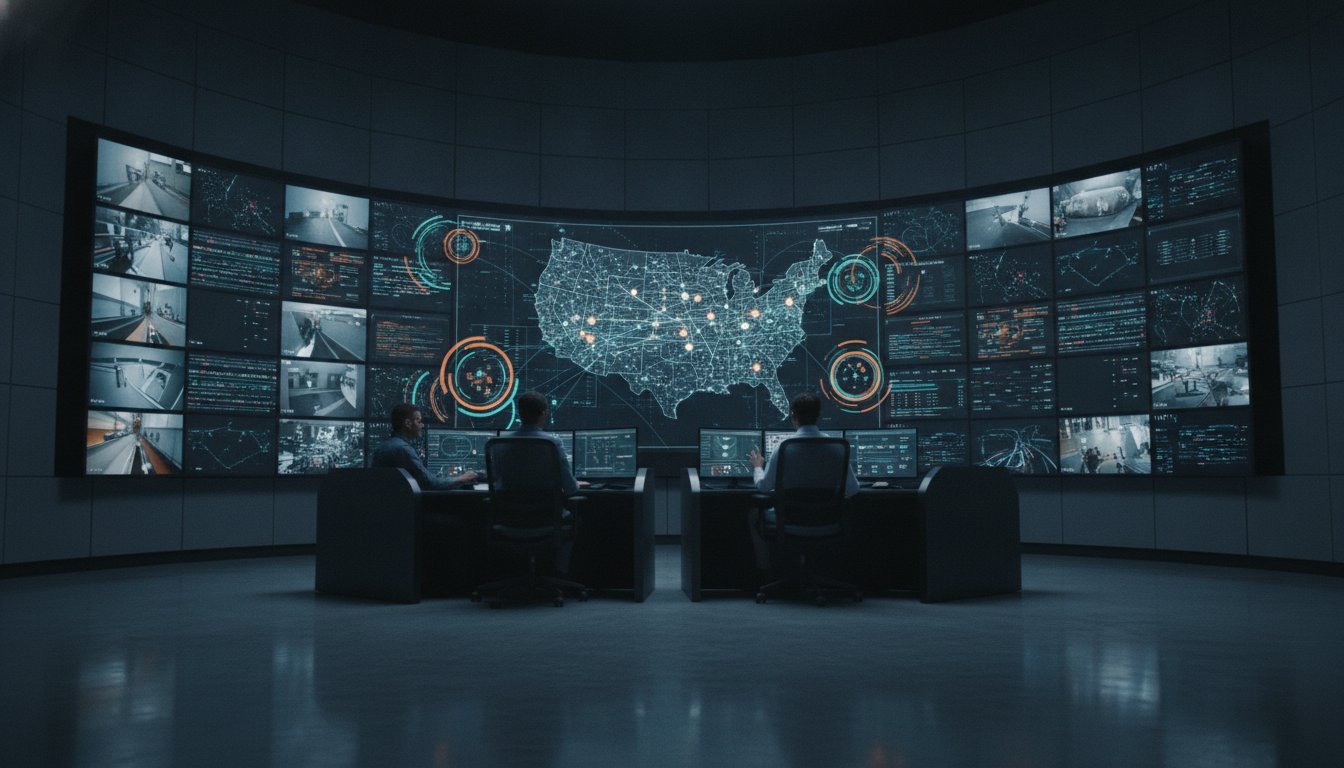
In a high-stakes command environment, a three-second delay isn’t just a technical glitch; it’s a failure of operational intelligence that can compromise an entire mission. You’ve likely seen your network struggle under the weight of unmanaged video streams or felt the frustration of siloed data caused by incompatible proprietary protocols. When every second counts, you can’t afford to wonder if the feed on your video wall is the one that actually matters right now. Selecting the correct AV over IP standards is no longer just an IT checkbox. It’s the strategic foundation for maintaining a common operating picture across every site in your organization.
Most control rooms already have the screens. What they’re missing is the layer that decides what goes on them, and escalates automatically when something needs attention. This article provides a strategic framework to help you choose the protocols that eliminate latency and unify your operating picture. We’ll examine how to transform your existing hardware into a responsive, event-driven ecosystem that empowers your team to act with absolute certainty. By moving beyond hardware limitations toward a unified operational intelligence layer, you can ensure your infrastructure supports 4K and 8K distribution without exhausting your operators or your bandwidth.
Key Takeaways
- Eliminate data silos by unifying fragmented video streams into a clear common operating picture for faster incident response.
- Compare the performance of H.264, HEVC, and SMPTE ST 2110 to find the right balance between high-fidelity 4K visuals and network load.
- Learn how to select AV over IP standards that support seamless, low-latency video distribution across mission-critical networks.
- Adopt a strategic framework for auditing your infrastructure and implementing resilient, commercial off-the-shelf hardware solutions.
- Discover how an operational intelligence layer automates feed escalation to reduce operator fatigue and focus attention on the most vital data.
The Crisis of Complexity: Why AV over IP Standards Matter
Proprietary lock-in is a significant threat in mission-critical environments. When you rely on closed systems, you lose the ability to scale or integrate new technologies as they emerge. Interoperability isn’t just a technical preference; it’s the bedrock of operational resilience. It ensures that every sensor, camera, and data stream can communicate across the network without friction. Most control rooms already have the screens. What they’re missing is the layer that decides what goes on them, and escalates automatically when something needs attention. This is where vis/ability functions as the operational intelligence layer, serving as the central hub that unifies these disparate streams into a single, actionable view.
Identifying Gaps in Situational Awareness
Siloed video feeds are more than just a technical hurdle; they directly contribute to operator fatigue and missed incidents. When operators must manually toggle between different platforms to find the information they need, their cognitive load increases, and their reaction time slows. Many SOC and NOC environments struggle to manage feeds from specialized security and video surveillance platforms or various SIEM tools. While these tools provide valuable data, they only offer a partial solution. Without a unifying layer, these feeds remain isolated, forcing operators to piece together the common operating picture manually. Simply adding more screens to a wall doesn’t improve visibility. True clarity comes from a standardized layer that prioritizes essential information and filters out the noise.
The Shift from Proprietary to Standardized Architecture
The evolution of video distribution has moved rapidly from rigid matrix switchers to fluid IP networks. Matrix switchers limited operations to a fixed number of inputs and outputs, often requiring expensive, specialized cabling. Modern architecture leverages standard network switches to route signals anywhere the network reaches. This shift allows for distributed operations where teams in huddle rooms, command centers, and on mobile devices all see the same high-fidelity data. Adopting an IPMX open standard approach ensures that your infrastructure remains future-proof and vendor-agnostic. This flexibility is vital for scaling operations across multiple sites or integrating new 4K and 8K sources. AV over IP standards are the common language of mission-critical data.
Technical Deep Dive: Comparing H.264, HEVC, and SMPTE ST 2110
Selecting the right AV over IP standards is a matter of balancing fidelity, latency, and network capacity. H.264, or Advanced Video Coding (AVC), remains the most widely deployed legacy standard. Its strength lies in universal compatibility. Almost any existing network hardware or end-point device can decode an H.264 stream. However, it struggles to maintain image integrity when scaling to 4K resolution at lower bitrates. For mission-critical environments, this loss of detail can be the difference between identifying a threat and missing it entirely.
Other professional AV environments might utilize NDI or SDVoE. While these protocols offer low latency and high quality, they often require specific 10G network architectures or proprietary hardware that can lead to the lock-in issues mentioned earlier. They provide a partial solution but lack the overarching logic needed for a global operating picture. Most control rooms already have the screens. What they’re missing is the layer that decides what goes on them, and escalates automatically when something needs attention. The vis/ability platform acts as this essential hub, unifying these disparate codecs into a single, cohesive interface.
HEVC (H.265) and the 4K Revolution
High Efficiency Video Coding (HEVC) is the strategic choice for modern 4K distribution over constrained bandwidth. It achieves this through Coding Tree Units (CTUs). Unlike H.264, which uses 16×16 macroblocks, HEVC utilizes CTUs up to 64×64 pixels. This allows for much more efficient processing of high-resolution images, especially in areas with minimal movement. For remote operations and mobile responders, HEVC ensures that a clear 4K image reaches a handheld device without saturating the cellular or satellite link. The trade-off is the demand for increased processing power; your hardware must have the GPU capability to handle the intensive decoding required for HEVC streams.
SMPTE ST 2110: The Standard for Zero Latency
For broadcast-grade operations where even a few milliseconds of delay are unacceptable, SMPTE ST 2110 is the premier choice. It differs from other standards by separating audio, video, and metadata into independent streams. This allows a control room to process a video feed while sending the associated audio or telemetry data to a different destination without the overhead of de-multiplexing. Implementing ST 2110 requires a robust infrastructure, typically 10G or 25G networks, and precise synchronization via Precision Time Protocol (PTP). You should prioritize ST 2110 in EOC or SOC environments where real-time tactical response is the primary objective. To ensure your infrastructure is ready for these high-demand standards, you can consult with our design specialists for a comprehensive audit.
Bandwidth vs. Fidelity: Balancing Performance in the NOC and SOC
Managing high-fidelity video distribution requires a cold-eyed assessment of the bandwidth tax. While 4K HEVC streams offer exceptional clarity, running multiple concurrent feeds across a mission-critical network can quickly lead to saturation. In a SOC or NOC, the network load isn’t just a number on a dashboard; it’s a direct limit on your team’s ability to respond. Most control rooms already have the screens. What they’re missing is the layer that decides what goes on them, and escalates automatically when something needs attention. Relying solely on raw pixel counts without an intelligent delivery strategy is a recipe for system crashes during the moments you need them most.
Latency is the silent enemy of effective situational awareness. When emergency response teams deal with real-time data, a delay of even a few hundred milliseconds can result in a fragmented common operating picture. Effective AV over IP standards must prioritize low-latency delivery without sacrificing the visual clarity needed for precise human judgment. Activu Corporation shifts the focus from simple display management to information prioritization. By framing the video wall as a decision-support tool, the system ensures that high-density data is visible only when it provides actionable intelligence, rather than overwhelming the network with irrelevant background noise.
Optimizing Bitrates for Real-Time Response
Ensuring stream integrity during high-motion events requires sophisticated bitrate management. Constant Bitrate (CBR) provides predictable network usage but may struggle with pixelation during complex scenes in public safety environments. Variable Bitrate (VBR) offers better fidelity during action but risks sudden bandwidth spikes that can choke a network. Utilizing Secure Reliable Transport (SRT) helps mitigate these risks by providing packet loss recovery and jitter prevention over unpredictable networks. This ensures that even when a situation escalates, the visual data remains stable and clear for the entire operations team.
Remote Visibility and Mobile Integration
Operational success often depends on extending the common operating picture beyond the walls of the command center. Field units rely on LTE and 5G connections where bandwidth is notoriously volatile. Highly compressed AV over IP standards like HEVC allow these mobile responders to access the same high-fidelity feeds as the dispatch center. This integration ensures that every stakeholder, whether in a huddle room or on a mobile device, acts with the same certainty. You can explore how these Mobile vis/ability solutions bridge the gap between the command center and the field, ensuring intelligence flows wherever it is needed most.

Operational Resilience: A Framework for Implementing AVoIP Standards
Operational resilience begins with a rigorous audit of your network and display infrastructure. You can’t layer new technologies onto a foundation that lacks the capacity to handle high-bandwidth streams. Identifying existing bottlenecks ensures that your transition to AV over IP standards doesn’t lead to unexpected downtime. Most control rooms already have the screens. What they’re missing is the layer that decides what goes on them, and escalates automatically when something needs attention. This intelligent layer provides the necessary structure to manage diverse feeds without overwhelming your IT staff.
Resilience is built on a COTS (Commercial Off-the-Shelf) hardware strategy. Proprietary hardware often creates a single point of failure and limits your ability to source replacements during a crisis. By utilizing standardized components, you ensure that your system remains maintainable and scalable. Integrating these streams into a Cybersecurity Common Operating Picture allows for real-time monitoring of both physical and digital threats. Establishing redundancy through automated failover protocols ensures that 24/7 operations continue even if a primary network path is compromised.
Interoperability and Vendor Neutrality
Modern video wall controllers must decode disparate standards simultaneously to maintain a unified operating picture. Relying on a single vendor’s ecosystem creates a proprietary trap that hinders long-term growth. Use API integration to automate feed escalation; this allows your system to react to external triggers without manual operator intervention. This approach values results over rhetoric, ensuring that your infrastructure remains vendor-agnostic and ready for future upgrades. It’s about building a system that adapts to your needs rather than forcing your needs to fit the system.
Cybersecurity and Network Integrity
Protecting IP video streams requires more than just a firewall. Unauthorized access or stream injection can compromise the integrity of your entire operation. Implementing AES-256 encryption is essential for securing sensitive data, though you must account for its impact on codec latency. A well-designed system balances this security with operational efficiency. Constant monitoring of network health prevents situational awareness blackouts, ensuring that your team always has access to the intelligence they need. To begin your infrastructure transformation, you can contact our team for a strategy session.
Beyond the Codec: vis/ability as the Operational Intelligence Layer
Technology alone cannot solve the problem of information overload. While hardware encoders and decoders provide the transport, they don’t provide the context. Most control rooms already have the screens. What they’re missing is the layer that decides what goes on them, and escalates automatically when something needs attention. The vis/ability platform serves as this critical operational intelligence layer. It acts as the central hub where disparate AV over IP standards and data streams converge into a single common operating picture. By unifying these protocols, vis/ability ensures that technical tools empower individuals to act with greater certainty when stakes are at their highest.
Siloed tools like Axon or specific SIEM platforms provide valuable data, but they often offer only a partial solution; they require a unifying layer to create a full common operating picture. Without this central hub, these inputs remain fragmented, forcing operators to manually bridge the gap between raw data and human judgment. vis/ability transforms this reactive monitoring into a proactive, event-driven process. It doesn’t just display video. It manages the flow of intelligence across the entire operation, ensuring that the human element remains at the center of the digital context.
Automating the Common Operating Picture
Manual intervention is a bottleneck in emergency response. vis/ability automates the common operating picture by triggering specific video feeds based on real-time alerts and telemetry. This reduces cognitive load by filtering for essential information only, preventing the “more screens” fallacy from compromising situational awareness. Whether it’s a security breach or a tactical maneuver, the system ensures the right data reaches the right person at the right time. This methodical approach leads the team from a state of complexity to a state of clear, actionable intelligence.
Unifying Distributed Teams
Operational success depends on seamless collaboration between the command center, huddle rooms, and field units. vis/ability provides a consistent experience across all devices, ensuring that distributed teams maintain a unified view of the mission. This capability is essential in Public Safety and Federal Defense, where geospatial oversight and rapid response are paramount. By selecting the right AV over IP standards and layering them with intelligent management, you build a resilient infrastructure that supports the most demanding environments. To see how this platform can transform your operations, you can request a vis/ability demo for your control room.
Unifying Your Common Operating Picture
Transitioning from fragmented hardware to a cohesive network requires a deliberate choice of AV over IP standards. We’ve analyzed how balancing compression efficiency with ultra-low latency ensures that critical data remains visible and actionable across every site. Most control rooms already have the screens. What they’re missing is the layer that decides what goes on them; it escalates automatically when something needs attention. This operational intelligence layer transforms a simple wall of monitors into a strategic decision-support engine.
Activu provides the bedrock for high-stakes decisions in environments trusted by Federal Defense and global utilities. Our platform delivers event-driven situational awareness that reduces response times through seamless integration with COTS and legacy hardware. You can move beyond the limitations of siloed data and network saturation. Empower your team to act with absolute certainty when the mission is on the line. See how vis/ability unifies your mission-critical video streams.
Frequently Asked Questions
What is the most common AV over IP standard for 24/7 control rooms?
H.264 remains the most prevalent legacy standard due to its universal compatibility across diverse network hardware and endpoint devices. However, modern 24/7 operations increasingly adopt HEVC for 4K distribution and SMPTE ST 2110 for ultra-low latency tactical response. The choice depends on your specific balance of bandwidth availability and the requirement for high-fidelity visuals during critical incidents.
How does HEVC (H.265) compare to H.264 for mission-critical video?
HEVC provides approximately 50% better compression than H.264, allowing high-fidelity 4K video to travel over constrained networks without causing saturation. This efficiency makes it the strategic choice for remote operations and mobile responders who rely on volatile connections. While HEVC requires more significant processing power for decoding, the result is a clearer common operating picture in environments where bandwidth is at a premium.
Can I mix different AV over IP standards on the same video wall?
You can mix disparate AV over IP standards on a single display surface if you utilize a unifying operational intelligence layer. Most control rooms already have the screens. What they’re missing is the layer that decides what goes on them, and escalates automatically when something needs attention. vis/ability unifies these different streams, ensuring that H.264, HEVC, and data feeds appear seamlessly to the operator.
What is the impact of AV over IP on network security?
Shifting video to the network exposes streams to potential unauthorized access or injection, requiring a Cybersecurity Common Operating Picture for constant oversight. Implementing AES-256 encryption is vital for protecting sensitive mission-critical data as it moves across the LAN or WAN. A well-designed system monitors network health to prevent situational awareness blackouts and ensures that only authenticated users can access the intelligence hub.
Does AV over IP introduce significant latency in real-time operations?
Latency varies significantly based on the chosen protocol and the underlying network configuration. SMPTE ST 2110 offers near-zero, broadcast-grade latency by sending uncompressed data, while compressed standards like HEVC introduce a small amount of delay for processing. Proper network optimization and the use of high-performance hardware minimize these effects, ensuring that real-time incident response remains fluid and accurate across all sites.
What hardware is required to support 4K HEVC streams in a SOC?
Supporting 4K HEVC requires COTS hardware equipped with high-performance GPUs capable of intensive decoding tasks. Your network infrastructure should ideally support 10G or 25G speeds to handle the cumulative load of multiple high-fidelity streams during a major event. This hardware strategy avoids proprietary traps and ensures your SOC remains scalable as your operational requirements and data density evolve.
What does SMPTE ST 2110 stand for in the context of AVoIP?
SMPTE ST 2110 stands for the Society of Motion Picture and Television Engineers standard for Professional Media Over Managed IP Networks. It is a suite of AV over IP standards that separate audio, video, and ancillary metadata into independent streams. This architecture allows for precise synchronization and granular control of data, making it the premier choice for high-stakes tactical environments where every millisecond matters.
How does vis/ability integrate with existing AVoIP encoders?
vis/ability acts as a vendor-agnostic hub that pulls streams from diverse encoders via standard APIs and network protocols. It addresses the shortcomings of siloed tools like Axon by providing a full common operating picture that incorporates all available data feeds into one view. This integration ensures that your existing hardware investments remain useful while providing the automated escalation layer necessary for modern, event-driven operations.