
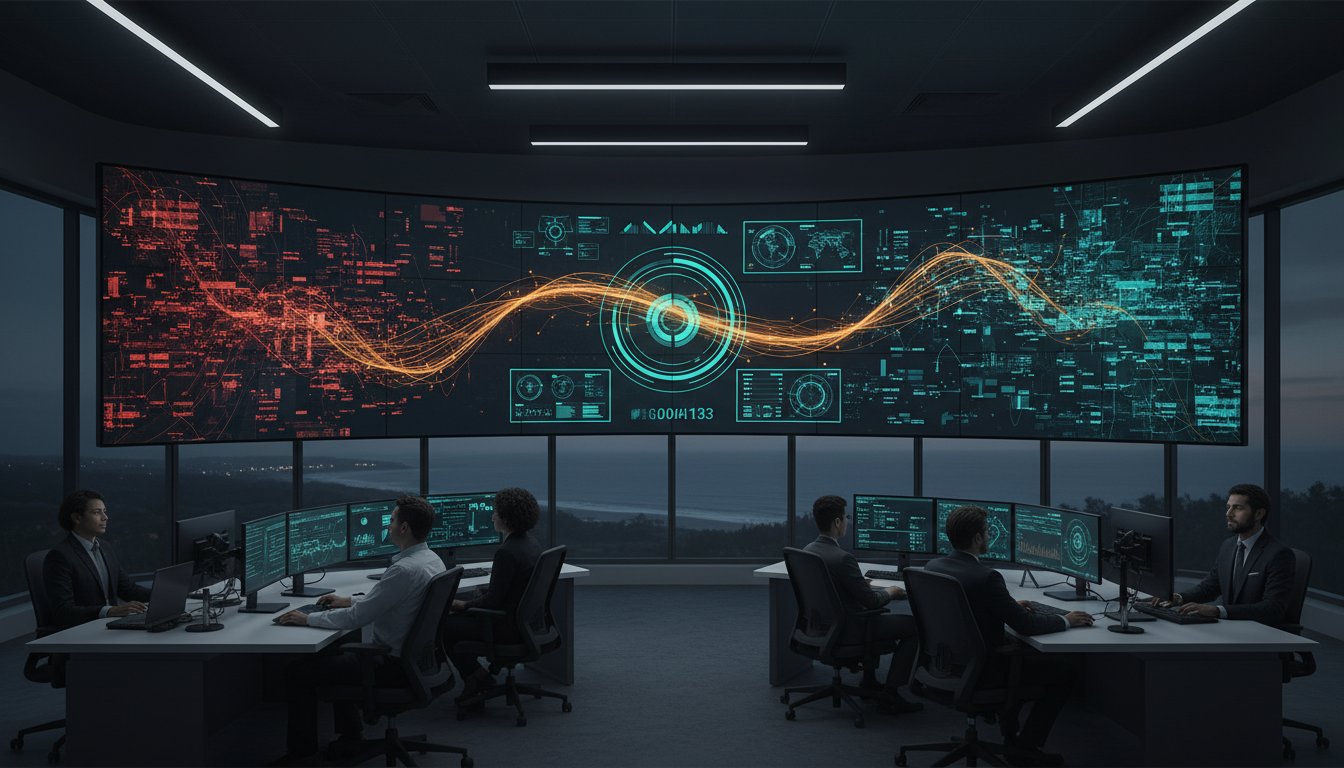
A standard SOC often fails not because it lacks information, but because it possesses too much of it in disconnected silos. When a critical incident occurs, operators are forced to toggle between fragmented systems; this often wastes the 240 seconds that separate a contained event from a total system failure. A 2023 industry report found that 93% of security professionals feel overwhelmed by alert volume, which leads to cognitive overload and missed signals. Most control rooms already have the screens. What they’re missing is the layer that decides what goes on them, and escalates automatically when something needs attention.
You understand that true situational awareness requires more than just more monitors. This article shows you how to transform your SOC from a reactive monitoring hub into a proactive, mission-critical engine. We’ll define vis/ability as the operational intelligence layer that surfaces through the video wall to create a unified operating picture. We’ll explore how this bridge between raw data and human judgment reduces mean time to resolution across command centers, huddle rooms, and mobile devices to ensure your team acts with absolute certainty when the stakes are highest.
Key Takeaways
- Identify the visibility gaps caused by fragmented data streams and siloed systems that lead to overlooked incidents in mission-critical environments.
- Transform your SOC from a reactive monitoring hub into a proactive central nervous system that serves as the foundation for organizational resilience.
- Evaluate the shortcomings of standard security tools that provide only a partial solution without integration into physical operational workflows.
- Implement an automated escalation framework that moves your team from passive monitoring to event-driven situational awareness.
- Leverage vis/ability as the operational intelligence layer that decides what information surfaces on the video wall to ensure clarity during high-stakes decisions.
The Visibility Gap: Why Traditional Security Operations Centers Struggle
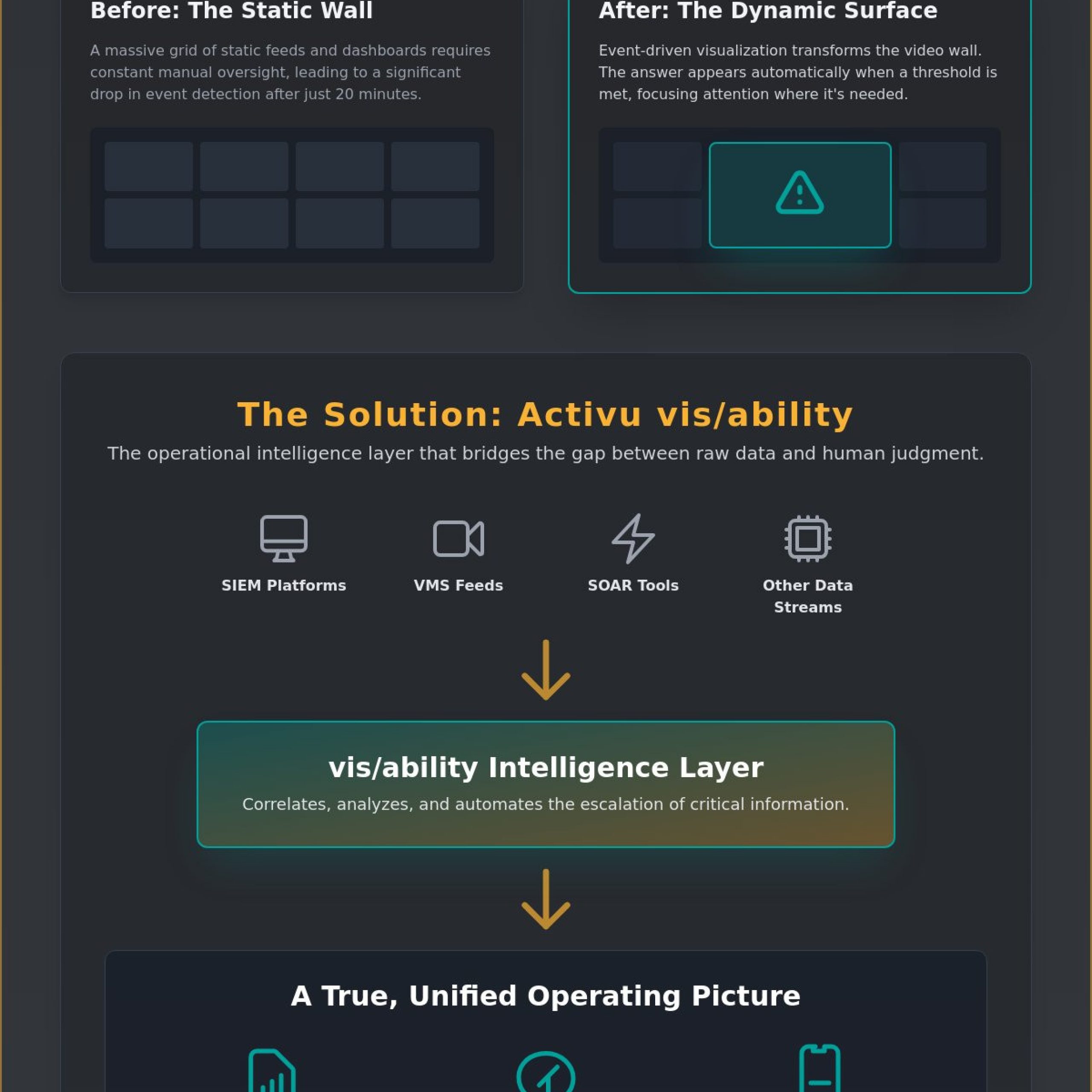
The modern Security Operations Center (SOC) often functions as a collection of disconnected technologies rather than a unified defense mechanism. This fragmentation creates a pervasive gap between the arrival of raw data and the execution of a critical decision. Operators frequently manage separate streams from SIEM platforms, VMS feeds, and SOAR tools, yet these systems rarely communicate in a way that supports rapid response. Most control rooms already have the screens. What they’re missing is the layer that decides what goes on them, and escalates automatically when something needs attention.
Without this automated intelligence, technical teams face common control room situational awareness problems. A 2023 industry study found that analysts at high-volume centers ignore nearly 30% of alerts due to sheer volume. This isn’t a failure of personnel; it’s a failure of architecture. When a system lacks automatic escalation, the responsibility for identifying a threat falls entirely on human observation. In 24/7 environments, cognitive fatigue is a constant risk. We define vis/ability as the necessary intelligence layer that bridges this divide, ensuring the right information reaches the team at the exact moment it matters.
The Problem of Fragmented Data Silos
Specialized tools provide deep technical insights, but they often exist in isolation. These silos prevent a holistic view of the operational landscape and complicate how to manage multiple data feeds in a dispatch center or SOC. Having more data frequently leads to less clarity because the team must manually correlate events across different interfaces. This friction slows response times in mission-critical sectors where seconds determine the outcome of an incident. Vis/ability acts as the central hub, pulling these disparate threads into a single, actionable stream that provides a true common operating picture.
Why Operators Miss Incidents on the Video Wall
Traditional video walls often suffer from the “wall of glass” problem. They display a massive grid of static camera feeds and dashboards that require constant manual oversight. This approach is reactive and prone to error. Research indicates that after just 20 minutes of continuous monitoring, an operator’s ability to detect a specific event on a screen drops significantly. Organizations need event-driven visualization to overcome these limitations. Instead of a static display, vis/ability transforms the video wall into a dynamic surface where the answer appears automatically when a threshold is met, moving the team from a state of data overload to clear, actionable intelligence.
What is a SOC? Redefining the Mission-Critical Environment
A Security Operations Center, or SOC, serves as the central nervous system of organizational resilience. It’s the location where raw telemetry transforms into defensive action. While a standard IT SOC might focus exclusively on network logs and server health, a mission-critical operations center manages a unified cyber-physical posture. This distinction is vital; in high-stakes environments like power grids or transit hubs, a digital breach often carries immediate physical consequences. The modern mission demands a transition away from isolated security silos toward a converged model where every sensor, camera, and data stream contributes to a single defensive front.
Operational failures often stem from a specific gap: fragmented systems that force analysts to toggle between dozens of disconnected screens. Most control rooms already have the screens. What they’re missing is the layer that decides what goes on them, and escalates automatically when something needs attention. This is where the video wall evolves from a passive display into a collaborative hub. It becomes the place where the answer appears, driven by an intelligence layer that filters out the noise to focus on what actually matters.
Core Components of a Modern SOC
The effectiveness of a SOC relies on the synergy between human expertise and the technology stack. Tier 1 analysts provide the first line of monitoring, filtering alerts to identify genuine threats. Incident responders and SOC managers then take command to neutralize those threats and refine long-term strategy. This workflow should align with established frameworks, such as NIST’s Computer Security Incident Handling Guide, to ensure repeatable success.
The technology stack must go beyond simple sensors and SIEM tools. True operational intelligence requires a visualization layer that bridges the gap between raw data and human judgment. Many organizations rely on tools like Axon or standard VMS platforms, but these often remain trapped in their own silos. For a truly integrated environment, teams need specialized SOC/NOC solutions that unify these inputs into a single, actionable interface.
The Common Operating Picture (COP)
A Common Operating Picture (COP) is the single source of truth for all stakeholders. It ensures that the manager in the command center, the technician in a breakout room, and the responder on a mobile device are all looking at the same real-time data. This level of situational awareness is impossible when data is trapped behind proprietary software or limited to a physical room.
To be effective, a COP must integrate geospatial data and live video feeds into a fluid visual narrative. This is the essence of vis/ability. It’s the operational intelligence layer that surfaces critical insights on the video wall exactly when they’re needed. By automating the escalation of relevant data, vis/ability empowers operators to act with absolute certainty. You can see how this intelligence layer transforms decision-making by exploring the vis/ability platform.
Why Standard Security Tools are Only a Partial Solution
Many organizations rely on specialized tools like Axon for evidence or specific SIEMs to track network anomalies. These tools are necessary components, but they remain incomplete solutions. They often promise a “single-pane-of-glass” view, yet this vision frequently stops at the edge of a single monitor. It fails to integrate with the physical reality of a high-stakes command center. When a critical incident occurs, the digital alert needs to become a physical reality for the entire team. Most control rooms already have the screens. What they’re missing is the layer that decides what goes on them, and escalates automatically when something needs attention.
vis/ability serves as this unifying hub, pulling data from disparate tools and placing it where it can be acted upon. It moves beyond the limitations of a desktop application by bridging the gap between digital data and the physical SOC environment.
The Limitations of Software-Only Platforms
Software platforms like Axon provide vital data, but they lack the broader visualization context required for a full team response. In a mission-critical SOC, information trapped in a single user’s workstation is information lost. Standard tools often fail to escalate alerts across distributed displays automatically, leaving teams to rely on manual communication during a crisis. This bottleneck is a common failure point addressed in the framework for building and managing a SOC. Without an integrated platform that connects digital alerts to the physical space, operators are left juggling windows instead of managing threats. For those overseeing complex environments, more information on integrated SOC operations highlights how to move beyond these standalone limitations.
Closing the Gap with Operational Intelligence
True operational intelligence is the filter that separates noise from necessity. The vis/ability layer decides what information is mission-critical at any given second. It transitions the SOC from monitoring raw data feeds to executing actionable intelligence. This shift empowers human judgment. Instead of searching for the right camera feed or map during a security breach, the relevant visual appears automatically based on pre-defined triggers. This focus on the human element ensures that operators spend their cognitive energy on decisions, not on navigating software interfaces. It turns the command center into a proactive environment where visibility is the foundation of every action. By centralizing these feeds, organizations can achieve a common operating picture that extends from the main video wall to remote huddle rooms and mobile devices.
Transitioning to a Proactive SOC: A Framework for Escalation
Traditional SOC environments often struggle with fragmented systems that force operators to toggle between dozens of disconnected feeds. This creates a dangerous gap where critical signals get lost in the noise of routine monitoring. Most control rooms already have the screens; what they’re missing is the layer that decides what goes on them and escalates automatically when something needs attention. By implementing vis/ability, organizations transform the video wall from a passive display into an active participant in incident response.
Implementing Event-Driven Situational Awareness
Shifting from reactive monitoring to event-driven awareness means the system alerts the operator, rather than the operator hunting for the incident. This transition solves the problem of why operators miss incidents on the video wall by focusing attention only on what matters. It moves the team from a state of constant scanning to a state of decisive action.
- Step 1: Identify critical data triggers across disparate systems. Connect your SIEM, VMS, and IoT sensors into a unified hub. While tools like Axon capture vital evidence, they are only partial solutions because they remain siloed from the broader operational view. vis/ability integrates these feeds to surface data when it hits specific thresholds, such as a 20% surge in unauthorized login attempts or a specific geospatial alert at a restricted perimeter.
- Step 2: Define escalation protocols for different threat levels. Establish logic that dictates how information travels. A low-level maintenance alert might only appear on a single workstation, but a high-priority security breach must trigger a site-wide alert. This ensures that the level of visual urgency matches the severity of the threat.
- Step 3: Automate the visual layout changes on the video wall. When a trigger occurs, the software immediately changes the video wall layout. It clears away routine data to display high-resolution maps, live camera feeds of the affected area, and relevant emergency procedures. This automation ensures that the answer appears exactly where the team is looking.
Extending the SOC to Distributed Teams
The Common Operating Picture (COP) shouldn’t be confined to the four walls of the command center. In high-stakes environments, such as those found in Federal Government and Defense, field units need the same intelligence as the command staff. Mobile vis/ability allows field teams to receive real-time visual updates on their handheld devices, ensuring they aren’t operating on outdated radio reports or incomplete text descriptions.
Collaboration tools within the platform reduce response times by providing a shared view of the incident. Whether a team member is in a breakout room, a huddle room, or a remote vehicle, they see the same data as the SOC manager. This synchronization eliminates the confusion caused by siloed communication and ensures that decisions are based on a single, verified source of truth. It empowers every person in the chain of command to act with greater certainty when stakes are at their highest.
Request a demo of vis/ability to see how automated escalation can secure your operations.
Activu vis/ability: The Central Hub for Mission-Critical SOCs
In many high-pressure environments, the primary obstacle to security isn’t a lack of data; it’s the fragmentation of that data. Operators often struggle with control room situational awareness problems because critical information remains trapped in isolated silos. Cybersecurity dashboards, VMS feeds, and CAD systems frequently operate independently, forcing personnel to manually correlate events during a crisis. While tools like Axon provide valuable localized data, they remain partial solutions that cannot offer a comprehensive view of the entire operational landscape. This fragmentation is the primary reason why operators miss incidents video wall displays should have caught. Without a unifying layer, these feeds create cognitive noise rather than clarity.
Most control rooms already have the screens. What they’re missing is the layer that decides what goes on them, and escalates automatically when something needs attention. Activu vis/ability serves as this definitive operational intelligence layer. It’s the software that transforms the video wall from a passive display into an active decision-support tool. By integrating complex applications and disparate data streams into a single, cohesive interface, vis/ability ensures that the most critical information surfaces exactly when it’s needed. This technical authority is essential in high-stakes environments where every second dictates the outcome of an incident.
Unified Operating Picture for Global Operations
Modern GSOCs and fusion centers require a unified operating picture that spans global assets and local infrastructure. Activu supports these mission-critical environments through specialized design services that optimize the synergy between hardware and software. This approach solves the persistent challenge of how to manage multiple data feeds dispatch center teams face daily. By creating a seamless flow of information between central command, remote breakout rooms, and mobile devices, vis/ability provides the EOC common operating picture solutions necessary for coordinated response. You can find detailed technical specifications on the Activu vis/ability Platform page.
Securing the Future of Mission-Critical Operations
The ultimate impact of a well-implemented SOC is the reduction of operator fatigue and a measurable increase in decision certainty. When systems automatically escalate relevant data, operators no longer waste time monitoring static feeds. This transition from reactive monitoring to proactive management fulfills the core Activu promise: visibility into what matters. It’s about providing the bedrock of reliability that infrastructure-critical decisions require. To begin designing a future-proof control room, Contact Us for a tailored assessment of your operational needs.
Secure the Mission with Automated Intelligence
Relying on fragmented data feeds and manual monitoring creates a visibility gap that no standard tool can bridge alone. While organizations use specialized software for incident management, these platforms remain partial solutions without a central hub to unify the operational picture. Achieving true situational awareness in the SOC requires a proactive approach to escalation that removes the burden of manual sorting from the operator.
Most control rooms already have the screens. What they’re missing is the layer that decides what goes on them, and escalates automatically when something needs attention. Activu vis/ability provides this critical intelligence layer, surfacing the right data at the moment it matters most. Our platform is trusted by Federal Government and Defense agencies to maintain infrastructure-critical operations through a Red Dot level focus on clarity and design. By automating the transition from data to decision, we’ve proven that response times drop and certainty increases when the stakes are highest.
Request a demo of the vis/ability platform to see how we unify your SOC operations
Your team deserves the confidence that comes from total visibility.
Frequently Asked Questions
What is the primary function of a Security Operations Center (SOC)?
A Security Operations Center (SOC) serves as the centralized hub for monitoring, detecting, and responding to cyber and physical threats. It bridges the gap between raw data streams and human decision-making. Most control rooms already have the screens. What they’re missing is the layer that decides what goes on them, and escalates automatically when something needs attention. By implementing vis/ability, teams move from reactive monitoring to proactive threat mitigation across the entire enterprise.
How does a SOC differ from a Network Operations Center (NOC)?
A SOC focuses on identifying and neutralizing security threats while a Network Operations Center (NOC) ensures network performance and uptime. While the NOC manages the health of the infrastructure, the SOC protects the assets within it. Organizations often struggle with silos between these two units. According to 2023 industry benchmarks, 65 percent of organizations report delayed responses because these teams don’t share a unified visualization layer for critical data.
Why is situational awareness critical in a SOC environment?
Situational awareness provides operators with the context needed to understand the scope and impact of an unfolding incident. Without it, analysts are buried under 10,000 daily alerts, leading to cognitive overload. This is where vis/ability becomes essential. It acts as an operational intelligence layer that surfaces critical data through the video wall. This ensures the right person sees the right information at the exact moment an escalation occurs, reducing errors.
What are the biggest challenges in modern SOC management?
Fragmented systems and “alert fatigue” are the most significant hurdles in modern management. A 2023 Ponemon Institute study found that 60 percent of security professionals feel overwhelmed by the volume of data feeds. Most control rooms already have the screens. What they’re missing is the layer that decides what goes on them, and escalates automatically when something needs attention. This lack of automation forces operators to manually toggle between disparate tools.
Can a SOC be managed remotely or via mobile devices?
Modern operations allow for remote and mobile management through secure, browser-based interfaces. Stakeholders can access the same intelligence in huddle rooms or on mobile devices that exists in the central command center. This capability ensures that decision-makers aren’t tethered to a physical desk during a crisis. By extending vis/ability to remote endpoints, organizations maintain a consistent operational posture across 100 percent of their global footprint, regardless of the user’s location.
How does event-driven visualization improve SOC response times?
Event-driven visualization improves response times by automatically populating the video wall with relevant data when a specific trigger occurs. This eliminates the manual search for camera feeds or dashboards during an emergency. Case studies from 2022 indicate that automated escalation can reduce mean time to respond (MTTR) by up to 30 percent. Operators no longer waste seconds navigating menus; the answer simply appears on the wall where it’s needed most.
What is the difference between a SOC and a GSOC?
A SOC typically focuses on a specific region or function, whereas a Global Security Operations Center (GSOC) manages security operations across an entire enterprise. The GSOC acts as the central unifying hub where all regional data flows. While some organizations use basic monitoring tools, these often fail to scale. Vis/ability fills these gaps by providing a single pane of glass that integrates global feeds into one actionable environment for the team.
Why do most SOCs fail to provide a true Common Operating Picture?
Most fail because they rely on fragmented systems that don’t talk to each other. Operators miss incidents because they’re looking at the wrong screen at the wrong time. Most control rooms already have the screens. What they’re missing is the layer that decides what goes on them, and escalates automatically when something needs attention. True common operating pictures require a platform that surfaces intelligence rather than just displaying more video feeds.