

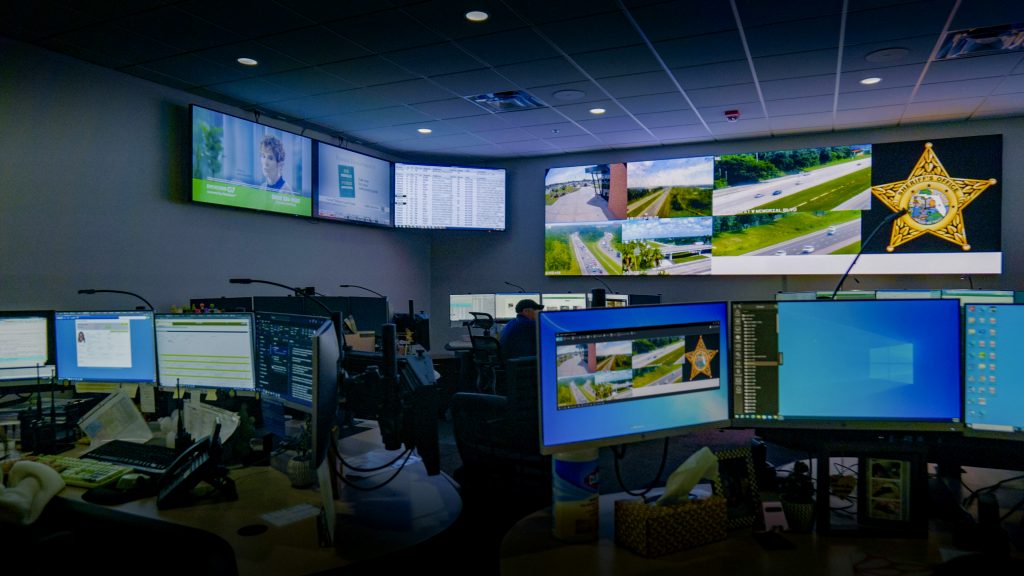
You finally received the green light to upgrade or build a new control room. It’s an important investment, and the decision you make can have a lasting impact, not only on your career but on your agency, your operations team, and your ability to respond when every second counts.
But before committing to a vendor or a solution, do your homework. Don’t simply take a vendor’s word for it. Make sure you understand your operational needs, know what to look for, and have explored all options available to you.
Here are 11 essential questions to ask your vendor before moving forward.
Question 1
Does the video wall system rely on dedicated hardware at each workstation?
Consider this…
Using a software-based video wall allows you to share content to the wall without having an special hardware at each workstation. This results in less cabling, lower cost, and simpler setup.
Some video wall systems require a dedicated encoder for every source, plus a vendor decoder for every display or workstation in the room. Each new source adds hardware, cabling, and cost, and ties future expansion to that vendor’s equipment.
Question 2
Will you be locked into the vendor’s proprietary products?
Consider this…
Using a vendor-agnostic platform lets you choose what’s best for your team, and works with standard IT infrastructure and policies. Some video wall systems use their own displays and hardware, which means every time you expand or upgrade you’ll need to purchase additional equipment from them.
Using a vendor’s proprietary products can make it difficult to incorporate other third-party solutions, external sources, or cloud platforms. This can result in requesting vendor support and additional fees.
Question 3
Will it work with the tools you already use, and the ones you’ll add later?
Consider this…
Your control room should connect to your VMS, PSIM, KVM, and conferencing and collaboration tools without heavy customization, and grow with you as new tools come along.
While some vendors say they are vendor-agnostic, you’ll often find that integrating legacy or third-party solutions require their support. If you want additional integration, it may come down to their development schedule, and conflicts can come into play with what you’re looking to integrate.
Question 4
What’s included in the price, and what costs extra?
Consider this…
Ask up front about layered licensing, programming fees, hardware bundling and usage-based charges. It’s important to know if the video wall requires the support of a service technician to make changes to the content on the wall. If so, you’ll be paying additional fees for those services, while struggling with an inflexible common operating picture.
Also, find out what it costs to train and certify your operators. As the hardware ages and you need maintenance work, what are those costs? Also, is there the possibility of any pricing change mid-contract?
Question 5
Does the video wall system rely on dedicated hardware at each workstation?
Consider this…
Expect fast, expert, U.S.-based support from people who know control rooms. Some vendors are slow to respond once the job is done, and their response times can be days or even weeks. It’s not uncommon for smaller agencies to wait longer than enterprise accounts for support.
Ask whether support is in-house or outsourced, whether the vendor monitors your system proactively or only reacts when something breaks.
Question 6
How easy is the system to learn and use?
Can operators easily access the information they need during a crisis? Does it have an intuitive interface?
Consider this…
With today’s technology advancements, a control room platform should no longer require a complex setup, extensive training, or certifications to use the system. Modern video wall platforms should have an intuitive and user-friendly interface that allows operators to quickly access the information they need, whether viewing specific dashboards, managing displays, or collaborating with teams outside the control room.
In mission-critical environments, simplicity and ease-of-use are essential to making informed decisions and responding quickly.
Question 7
Is it possible to take video wall display information and share it with teams outside the control room, whether it’s team members working out in field or external agencies collaborating to resolve an issue?
Consider this…
Regardless of whether you’re responding to a traffic accident on a major freeway, an armed suspect, power outage, student protests, or another type of emergency situation, in today’s technology-driven world, you need the flexibility to share video wall information with teams, internally and externally, no matter where they are. If you can’t do this, it’s antiquated and you will be the outlier.
Question 8
How reliable is the system?
Can it operate continuously, 24/7, without interruption, even during software updates, operating systems changes, or network disruptions?
Consider this…
Reliability and resilience are essential in mission-critical control rooms where downtime is not an option. The video wall platform should be designed for continuous 24/7 operation, maintaining stable video wall and source management even as systems evolve.
Look for a solution that handles high-resolution feeds, multiple video walls, Remote Desktop Protocol (RDP) sources, and display scaling without artifacts, dropped frames, or unexpected interruptions.
Updates and system changes should not compromise operations or require extensive manual reconfiguration. The platform should also scale as operational needs grow without requiring a complete system redesign.
Question 9
What is the deployment process, and how long will it take for the system to be fully operational?
Consider this…
Video wall platforms are NOT created equal. Some will require additional training, paid certifications, complex configurations, or the involvement of a dealer before you can get your system up and running. Limited support from the vendor or the need for a third party for installation and verification can lengthen your deployment timeline. You want a solution that has fewer components that need configuration, with a less-complicated deployment process and, as a result, a shorter time to get the system up and running.
Question 10
Does the system meet the security, compliance, and data governance requirements for your control room?
Consider this…
Before you get too far into the planning process, it’s important to ensure that the vendor and its solution meet your specific environment’s certification and security requirements.
Is the vendor ISO 27001 certified? How are software updates and security patches managed? For public safety and other sensitive operations, consider capabilities such as data governance, role-based access, audit logs, and on-premises deployment. Depending on your industry and requirements, additional needs may include listing on the GSA Schedule, NERC-CIP compliance, and other network protocol standards.
Make sure the solution meets your security requirements today while accommodating evolving compliance needs.
Question 11
Where is the software and hardware developed and manufactured?
Does the vendor have a U.S.-based operation and supply chain?
Consider this…
When it comes to mission-critical operations, it is important to know where your technology and products are being developed, manufactured, and supported. A vendor that is U.S.-based with domestic development and production can offer greater supply chain visibility, more direct access to technical expertise, and fewer challenges with overseas production or support, including tariff challenges. It can also simplify communication, troubleshooting, and issue resolution, while reducing exposure to certain geopolitical, regulatory, and supply chain disruptions.
Look for a video wall solution that is developed and manufactured in the USA and provides direct access to the people behind the technology for your public safety, security, government, and critical infrastructure applications.
The Bottom Line
Whether you’re building a new control room or command center, or modernizing an existing one, this is a significant long-term investment that will impact your organization’s operations for years to come. Don’t focus solely on the initial price tag, the displays, or what a vendor promises today. Consider how the system will perform, adapt, and scale as your operational needs evolve, and new technologies emerge.
Just as important, choose a vendor that understands the demands of your environment, is transparent about costs and capabilities, and stands behind its technology long after installation. The right solution should give your team flexibility, reliability, and control to meet today’s challenges while preparing for what’s ahead.
Do your homework, ask the tough questions, and make sure you’re investing in a solution that works for your team, not one that locks you into the vendor.
Are you looking to enhance your control room? Schedule a demo with Activu today.
Control Room Planning Worksheet
When upgrading or building a command or control room, there’s much more to consider than the display screens and physical space. Use this short worksheet to gather your thoughts and needs for a more productive design process.