
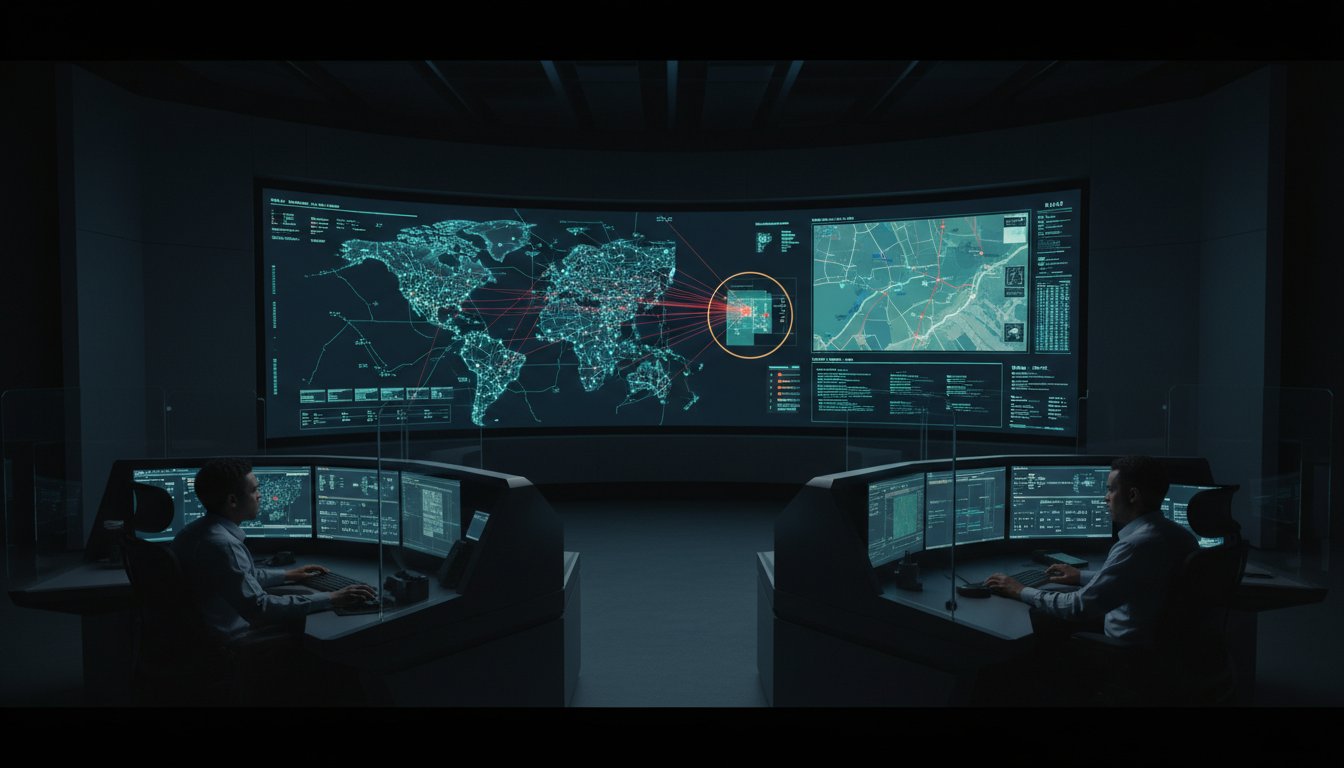
What if the greatest threat to your grid reliability isn’t a physical storm, but the 40 percent of critical alarms that go unnoticed during a peak event? Operators in a modern utility control room manage a staggering volume of data across SCADA, GIS, and field telematics. You’ve likely seen how these systems operate as isolated islands, creating a gap that forces teams to manually correlate information while SAIDI numbers climb. Most control rooms already have the screens. What they’re missing is the layer that decides what goes on them, and escalates automatically when something needs attention.
This is where vis/ability serves as your operational intelligence layer. It’s the engine that surfaces critical insights through the video wall, turning a wall of monitors into a proactive tool for decision making. In this article, you’ll learn how to solve control room situational awareness problems by bridging the gap between raw data and decisive action. We’ll explore how to automate incident escalation to achieve faster restoration times and maintain a unified operating picture across your entire enterprise. By the end, you’ll understand how to turn fragmented feeds into a mission-critical asset that empowers your team to act with absolute certainty.
Key Takeaways
- Identify the critical operational gaps caused by fragmented SCADA, AMI, and IoT data streams that lead to missed incidents and delayed response times.
- Understand how the vis/ability operational intelligence layer transforms existing displays into proactive tools that automatically escalate mission-critical information.
- Integrate siloed software like GIS and telematics into a unified operating picture to overcome the technical limitations of standalone visualization tools.
- Develop a resilient Common Operating Picture (COP) for the Utility Control Room that ensures seamless coordination between the NOC and EOC during major grid events.
- Future-proof your operations by extending real-time situational awareness to mobile devices, providing field crews with the same clarity available in the command center.
The Critical Gap in Utility Grid Management: Why Operators Miss Incidents
Modern grid operators face a relentless data deluge. Since 2010, the volume of incoming data points from Advanced Metering Infrastructure (AMI), SCADA systems, and IoT sensors has increased by more than 10,000 percent. While this data holds the key to grid stability, it often creates massive control room situational awareness problems. When a storm front moves through a service territory or a substation transformer nears a critical thermal limit, the sheer speed of information can paralyze decision-making. Operators frequently struggle with how to manage multiple data feeds dispatch center environments produce, leading to a state where more information actually results in less clarity.
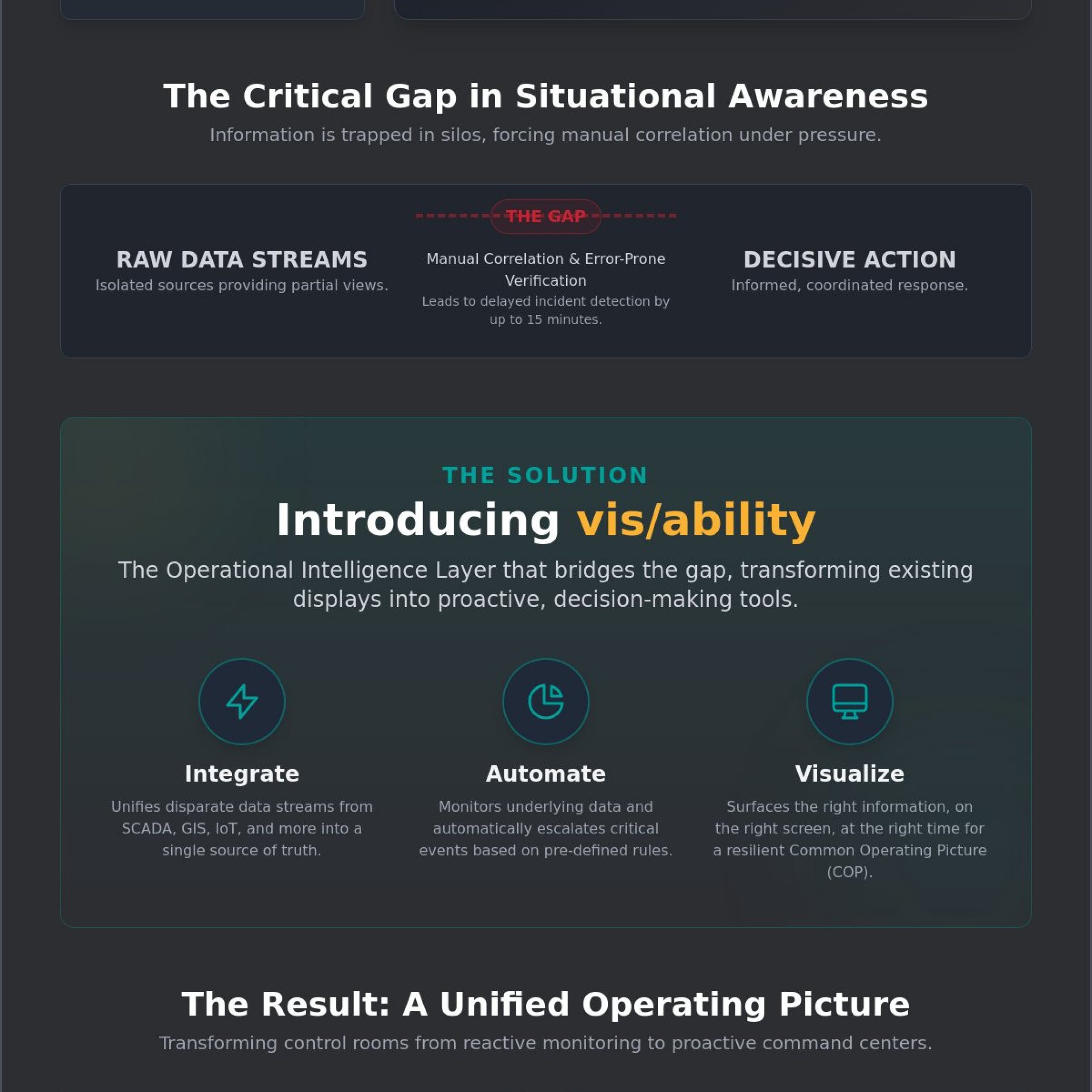
The core of the issue lies in the gap between data collection and actionable intelligence. In a typical utility control room, information is trapped within proprietary software stacks that do not communicate. Without a unifying hub, the burden of correlation falls entirely on the human operator. This manual process is slow, prone to error, and insufficient for the complexities of a decentralized, renewable-heavy grid.
The Problem with Fragmented Utility Data Silos
Fragmented systems create dangerous blind spots. When Geographic Information Systems (GIS) and Outage Management Systems (OMS) operate in isolation, the disconnect causes significant delays in identifying the root cause of a fault. For every minute an operator spends toggling between windows to verify a field report against a SCADA alarm, the System Average Interruption Duration Index (SAIDI) climbs. Industry data suggests that siloed information can delay incident verification by as much as 15 minutes during the initial phase of a grid event. Traditional monitoring relies on an “always-on” philosophy, forcing staff to watch thousands of data points that remain within normal parameters. This creates a environment where EOC common operating picture solutions are needed but rarely realized through standard software alone.
Operator Fatigue and the Risk of Missed Alarms
The psychological toll of monitoring static feeds is a primary factor in why operators miss incidents video wall displays should have caught. During a standard 12-hour shift, the human brain naturally filters out repetitive visual stimuli. Critical alarms become buried in routine noise, particularly when systems like Axon or standard SCADA packages provide only a partial view of the operational landscape. These tools are useful, yet they lack the intelligence to prioritize themselves based on the severity of a developing situation. It’s a fundamental challenge in mission critical operations where resilience depends on immediate visibility.
Most control rooms already have the screens. What they’re missing is the layer that decides what goes on them and escalates automatically when something needs attention. This is where vis/ability changes the operational dynamic. As an operational intelligence layer, vis/ability monitors the underlying data streams from every siloed system. It doesn’t wait for an operator to find a problem; it surfaces the critical incident through the video wall the moment a threshold is crossed. By automating the escalation process, it eliminates cognitive overload and ensures the entire team sees the answer exactly when they need to act.
Defining vis/ability: The Operational Intelligence Layer for Utility Control Rooms
Utility operators often find themselves submerged in a sea of disconnected applications. Between SCADA systems, geospatial maps, and real-time weather feeds, the sheer volume of data is rarely the problem. The real challenge is the gap created by fragmented systems and information silos. When a storm hits or a transformer fails, operators shouldn’t have to manually hunt for the right camera feed or outage map. This lack of automatic escalation creates a dangerous delay between seeing a problem and reacting to it. Most control rooms already have the screens. What they’re missing is the layer that decides what goes on them, and escalates automatically when something needs attention.
This is where vis/ability functions as the operational intelligence layer for the Utility Control Room. It’s the software bridge that surfaces through the video wall to present only what’s relevant to the current mission. While a SCADA system acts as the nervous system of the utility, vis/ability serves as the brain. It integrates these disparate data streams into a single, unified hub. Unlike simple hardware switchers or screen-sharing tools that merely move pixels from one place to another, vis/ability understands the context of the data it displays. It ensures that critical information isn’t just available, but visible the moment it matters.
Transitioning from Video Walls to Intelligent Surfaces
The traditional approach to a Utility Control Room often centers on the physical hardware of the video wall. However, a wall is only as effective as the information it displays. vis/ability shifts the focus from the glass to the intelligence of the surface. It aggregates live video, application windows, and web-based dashboards into a cohesive environment. This eliminates the need for operators to toggle between separate workstations during high-stress events. By consolidating these streams, the vis/ability platform transforms a static display into a dynamic asset that adapts to the operator’s needs.
The Role of Event-Driven Situational Awareness
In a mission-critical environment, manual monitoring is a liability. vis/ability utilizes event-driven logic to automate situational awareness. For instance, if a substation alarm reaches a specific severity threshold, the system doesn’t wait for an operator to notice. It automatically reconfigures the display layout, pulling the relevant GIS data and security feeds to the forefront. This immediate reconfiguration creates a Common Operating Picture (COP) that extends beyond the main command center. Whether the team is in a breakout room, a huddle room, or monitoring via mobile devices, everyone sees the same prioritized data. This level of automation is how organizations move from reactive monitoring to proactive management. To learn how to implement these automated workflows in your facility, you can speak with our solutions team.
Integrating SCADA, GIS, and Telematics into a Unified Operating Picture
The modern Utility Control Room often suffers from a critical gap between data collection and decisive action. This gap is caused by fragmented systems, isolated data silos, and a lack of automatic escalation during emergencies. Operators are forced to toggle between SCADA, GIS, and telematics, losing precious seconds as they hunt for the right information. Most control rooms already have the screens. What they’re missing is the layer that decides what goes on them, and escalates automatically when something needs attention. Activu’s vis/ability fills this void as an operational intelligence layer that surfaces through the video wall, providing the clarity needed to manage complex infrastructure across command centers, conference rooms, and mobile devices.
The Limitations of Standalone SCADA Visualization
SCADA remains the foundation for grid monitoring, yet it lacks the collaborative context required for modern incident response. Raw telemetry tells an operator that a breaker tripped, but it doesn’t show the proximity of field crews or the real-time weather conditions threatening the site. Organizations that rely solely on SCADA visualization often suffer from control room situational awareness problems because the data is trapped in a single-user interface. While some teams use Axon for field video or evidence management, it remains a partial solution that doesn’t integrate with grid telemetry. Without a unifying hub, these tools provide only a narrow view that fails the team during a crisis. By integrating these feeds into Utility & Energy Solutions, vis/ability transforms raw data into collective intelligence that is accessible to everyone from the dispatch floor to the huddle room.
Creating a Cybersecurity Common Operating Picture
The convergence of IT and OT security introduces new risks to the Utility Control Room. Grid status no longer exists independently of network health. Operators must now monitor for cyber threats alongside physical infrastructure failures to maintain NERC CIP compliance. The 2023 NERC State of Reliability report highlights that cyber-related risks to the bulk power system are increasing in complexity, making it vital to visualize network health alongside grid status. vis/ability acts as the central hub where network security alerts meet grid telemetry. It allows teams to manage multiple data feeds in a dispatch center by automatically escalating security anomalies to the video wall. This ensures that when a cyber event impacts physical assets, the response is immediate and coordinated across both IT and operations teams. This unified approach explains why operators miss incidents video wall alerts less frequently when vis/ability is managing the visual priority.
- SCADA: Provides the “what” of the grid status.
- GIS: Provides the “where” of assets and crews.
- Telematics: Provides the “who” and “how” of field movement.
- vis/ability: Provides the “now” by unifying all feeds into a single, actionable picture.
Building a Resilient Common Operating Picture (COP) for Utility EOCs
The transition from a blue-sky day to a major grid outage reveals a dangerous gap in the traditional Utility Control Room. Fragmented systems, siloed data feeds, and a lack of automatic escalation create a fog of war that slows restoration efforts. Most control rooms already have the screens. What they’re missing is the layer that decides what goes on them, and escalates automatically when something needs attention. This layer is vis/ability, an operational intelligence layer that surfaces through the video wall to provide absolute clarity.
During a 2022 storm event, industry data showed that some utilities experienced a 30 percent delay in decision-making because the NOC and EOC were not synchronized on the same data. By implementing vis/ability, organizations bridge this divide. It ensures that when a critical threshold is met, the relevant GIS maps, weather overlays, and SCADA alerts move from the operator’s desk to the main video wall and into every connected conference room instantly. This solves the primary control room situational awareness problems that plague legacy environments.
Design for Collaborative Decision-Making
Effective EOC design goes beyond ergonomics; it focuses on the velocity of information. In a high-pressure environment, manual data entry and screen switching are failure points. Our blueprint utilizes automated incident layouts that trigger the moment a storm warning is issued or a substation goes offline. This automation ensures that teams don’t waste seconds searching for the right dashboard. By integrating Incident Management Software, vis/ability surfaces the most critical telemetry, providing the clarity needed to act. This approach addresses EOC common operating picture solutions by removing the manual burden from the operator and showing how to manage multiple data feeds dispatch center teams rely on.
Managing Distributed Teams During Grid Restoration
Grid restoration requires coordination with regional offices and remote managers who are not physically present in the main Utility Control Room. Maintaining Operational Continuity requires extending the COP to huddle rooms and mobile devices without compromising NERC-compliant data handling. Vis/ability allows a manager on a tablet to see the exact same secure data stream as the chief dispatcher. This prevents the why operators miss incidents video wall problem by ensuring that critical alerts follow the person, not just the room. It creates a unified front where intelligence flows seamlessly from the field to the boardroom, keeping all stakeholders aligned on the path to restoration.
Ensure your team has the clarity to lead through any crisis. Contact Activu to secure your operations.
The Future of Situational Awareness: Automated Escalation and Mobile vis/ability
The modern utility landscape demands a shift from passive monitoring to proactive grid management. Utility directors face a persistent gap between detecting an anomaly and executing a field response. Traditional monitoring often leaves dispatchers toggling between SCADA alerts, weather feeds, and asset management software, losing seconds when every moment counts. Most control rooms already have the screens. What they’re missing is the layer that decides what goes on them; it escalates automatically when something needs attention. Activu fills this void by transforming the Utility Control Room into a proactive engine of grid reliability through vis/ability, an operational intelligence layer that surfaces critical insights directly onto the video wall.
This transition moves the needle from simply observing data to mastering it. By automating the escalation process, the system ensures that the most relevant information finds the operator, rather than forcing the operator to hunt for it. This reduces the cognitive load on staff during peak demand or emergency events, allowing for calmer, more precise decision-making. When the operational intelligence layer identifies a threshold breach, it instantly populates the video wall with the necessary context, such as geospatial maps, live camera feeds, and real-time sensor data.
Mobile vis/ability: Situational Awareness in the Field
Situational awareness cannot stop at the control room door. When a transformer fails or a line goes down, field crews require the same high-fidelity visual data available to dispatchers. Through vis/ability Link, organizations extend their operational intelligence to any mobile device securely. This ensures that a technician on-site sees the exact SCADA overlay or drone feed viewed by the supervisor miles away. By providing this unified view, utilities can reduce mean time to repair (MTTR) by up to 25 percent in complex outage scenarios. Secure sharing protocols mean that sensitive grid data remains protected while ensuring every stakeholder operates from a single version of the truth.
Starting the Transformation: From Gap to Solution
Moving from a reactive posture to proactive grid management requires a shift in how data is surfaced. Current hardware silos often lead to missed incidents; industry data suggests that human error or data overload accounts for nearly 65 percent of operational delays in high-stress environments. Activu integrates with your existing hardware, whether you use legacy LCD arrays or modern LED walls, to provide an intelligent overlay that prioritizes critical alerts. This avoids the “rip and replace” cycle and focuses on adding value to your current infrastructure.
Utility leaders should start with a pilot of the vis/ability platform to witness how automated escalation clarifies the path to resolution. This allows your team to experience the impact of a unified common operating picture without disrupting ongoing operations. To begin your upgrade and bridge the gap between fragmented data and decisive action, Contact Us for a technical consultation and demonstration.
Transforming Grid Data into Operational Certainty
Maintaining a resilient grid requires more than just collecting data. While tools like SCADA and GIS provide essential information, they often remain siloed, contributing to control room situational awareness problems where operators miss incidents because they’re overwhelmed by fragmented feeds. True operational intelligence requires a hub that unifies these streams into a single, proactive picture. Most control rooms already have the screens. What they’re missing is the layer that decides what goes on them, and escalates automatically when something needs attention.
Activu bridges this gap with vis/ability, the operational intelligence layer that surfaces through the video wall to provide visibility into what matters. Since 1983, we’ve provided 24/7 mission-critical support for major ISOs and utility providers nationwide. Our NERC CIP compliant visualization framework ensures your Utility Control Room remains secure while delivering clarity during peak demand or emergency events. Whether you’re in the main center, a remote huddle room, or using a mobile device, the right information finds you when it matters most.
Request a Demo of the vis/ability Platform for Your Utility Control Room
Your team deserves the confidence that comes from total visibility.
Frequently Asked Questions
What are the most common situational awareness problems in utility control rooms?
Situational awareness problems in a utility control room typically stem from fragmented data across 10 or more disconnected software platforms. This fragmentation creates a gap where critical alerts are buried under routine telemetry, leading to delayed responses. Most control rooms already have the screens. What they’re missing is the layer that decides what goes on them, and escalates automatically when something needs attention. By closing this gap, vis/ability ensures that urgent grid anomalies move to the foreground before they escalate into outages.
How do you manage multiple data feeds in a utility dispatch center?
Managing multiple data feeds in a utility dispatch center requires a central unifying hub rather than a collection of independent monitors. Traditional setups force dispatchers to manually scan SCADA, weather, and fleet GPS feeds, which can lead to a 30 percent increase in response times during peak loads according to 2022 operational studies. vis/ability integrates these streams into a single intelligence layer. It filters out the noise so that only the data relevant to the current mission reaches the team.
What is a Common Operating Picture (COP) for a Utility EOC?
A Common Operating Picture for a Utility EOC is a real-time, unified visualization of the entire infrastructure that combines SCADA telemetry, GIS mapping, and asset health. It eliminates the problem where the transmission team sees different data than the distribution team. vis/ability provides this EOC common operating picture solution by pulling disparate data into a single view. This ensures every stakeholder, from the boardroom to the field, acts on the same intelligence during a 1 in 50 year storm event.
Why do operators often miss critical incidents on large video walls?
Operators miss incidents because of cognitive overload and the biological limits of human attention. Research from the Human Factors and Ergonomics Society shows that after 20 minutes of monitoring static screens, an operator’s detection rate for subtle changes drops by over 50 percent. Most control rooms already have the screens. What they’re missing is the layer that decides what goes on them, and escalates automatically when something needs attention. vis/ability solves this by highlighting incidents through automated triggers.
Can vis/ability integrate with our existing SCADA and GIS software?
vis/ability integrates with your existing SCADA and GIS software by acting as a sophisticated overlay that pulls data from these sources without requiring a system overhaul. While tools like ArcGIS or Axon platforms provide valuable data, they often remain isolated and only provide a partial solution for the entire team. vis/ability bridges this gap, serving as the central point where these tools become truly useful. It transforms individual software outputs into shared team intelligence across the utility control room.
How does an intelligent video wall help with NERC CIP compliance?
An intelligent video wall helps with NERC CIP compliance by providing an auditable trail of what was displayed and who had access to specific information. Compliance standards like NERC CIP-007 require strict control over system access and monitoring. vis/ability automates the logging of visual data distribution and ensures that only authorized personnel view sensitive grid information. This shifts compliance from a manual reporting burden to a built-in feature of the operational workflow, providing absolute technical reliability.
What is the difference between a standard video wall and an operational intelligence layer?
The difference lies in the transition from passive display to proactive automation. A standard wall is just a group of pixels that requires a human to manually choose the input, often leaving critical data hidden in a silo. vis/ability is the intelligence layer that understands the context of the data. Most control rooms already have the screens. What they’re missing is the layer that decides what goes on them, and escalates automatically when something needs attention.
Is Mobile vis/ability secure enough for utility field operations?
Mobile vis/ability uses end to end encryption and secure authentication to meet the rigorous standards of utility field operations. It extends the utility control room into the field, allowing technicians to see the same Common Operating Picture as the dispatchers. Whether on a tablet in a service truck or a smartphone at a substation, the connection remains secure. This ensures that field teams have visibility into what matters without compromising the utility’s cybersecurity posture during mission-critical repairs.