
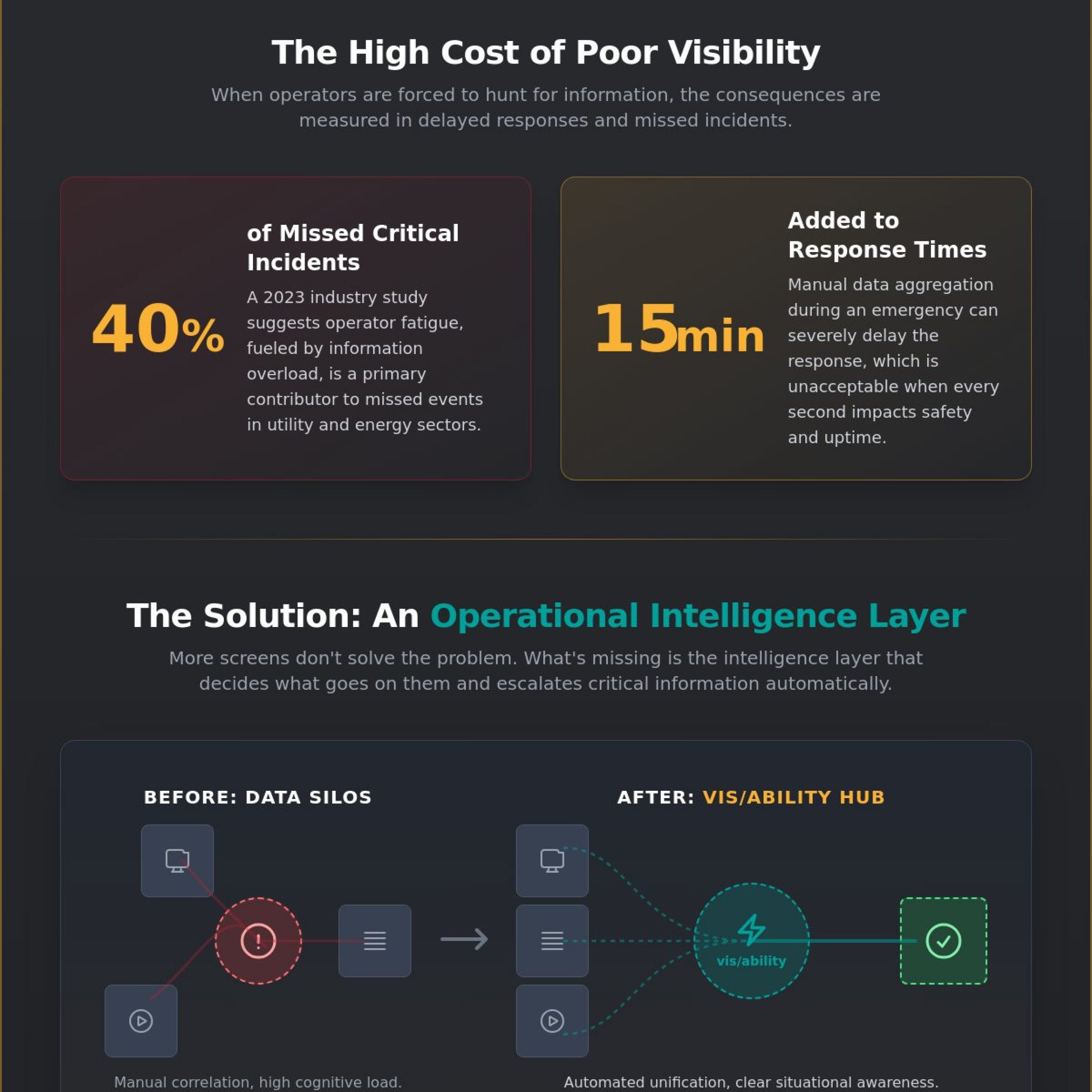
How many critical alerts did your team overlook during the last shift because they were buried under 12 different legacy dashboards? In mission-critical environments, the sheer volume of data often creates a dangerous fog rather than clarity. You likely manage a complex Process Control environment where fragmented systems and data silos prevent a unified view. This fragmentation leads to operator fatigue, which a 2023 industry study suggests contributes to 40 percent of missed critical incidents in utility and energy sectors.
You know that having more monitors doesn’t solve the problem of information overload. Most control rooms already have the screens. What they’re missing is the layer that decides what goes on them, and escalates automatically when something needs attention. This article demonstrates how to bridge that intelligence gap by implementing vis/ability, an operational intelligence layer that surfaces through the video wall to provide true situational awareness. We’ll examine how to automate data escalation and create a unified operating picture that reduces response times and empowers your team to act with absolute certainty.
Key Takeaways
- Identify the “visibility gap” where fragmented data silos and disconnected systems create critical blind spots in mission-critical hubs.
- Understand why standard monitoring fails and how to move beyond “more screens” to a system that automatically surfaces and escalates urgent incidents.
- Learn to integrate an intelligent visualization layer into your Process Control workflow to turn raw data into decisive human action.
- Discover how to architect a resilient control room that maintains total situational awareness across video walls, remote breakout rooms, and mobile devices.
The Evolution of Industrial Process Control: Identifying the Visibility Gap
By 2026, Process Control has moved far beyond simple mechanical regulation. It’s no longer just about maintaining pressure levels or monitoring flow rates through isolated sensors. In modern mission-critical hubs, it has evolved into a discipline of operational intelligence. This shift requires a move away from reactive monitoring toward a proactive, event-driven management style where data doesn’t just exist; it acts. The challenge is that while the volume of data has exploded, the ability to interpret it in real time has lagged behind.
This creates a dangerous “Visibility Gap.” Fragmented systems and data silos within command centers lead to blind spots that can compromise an entire operation. When a critical event occurs, operators often find themselves staring at dozens of disconnected screens, trying to piece together a coherent story from disparate sources. Most control rooms already have the screens. What they’re missing is the layer that decides what goes on them, and escalates automatically when something needs attention.
Traditional SCADA and HMI displays are failing to meet the needs of enterprise-wide situational awareness. These legacy interfaces were designed for individual machines or localized loops, not for the high-stakes, interconnected environment of a 21st-century control room. When an incident scales, these static displays offer no path toward clarity, leaving teams to drown in a sea of red icons and unprioritized alerts.
The Limitations of Legacy Control Systems
Isolated vendor platforms, such as legacy SCADA or early iterations of Axon, provide only partial solutions to complex operational problems. These tools often function as “information islands” where data is trapped within a specific department or technical silo. During a crisis, the cost of this isolation is measured in seconds and minutes. A 2023 industry analysis found that manual data aggregation during an emergency can delay response times by up to 15 minutes. This delay is unacceptable in manufacturing process control environments where every second impacts safety and uptime.
Defining vis/ability as an Operational Intelligence Layer
We define vis/ability not as a simple display or a video wall driver, but as the sophisticated software layer that unifies these disparate data streams. It functions as the central hub for the entire team. Instead of requiring an operator to hunt for a specific camera feed or sensor reading, vis/ability surfaces critical intelligence automatically based on predefined triggers. It transforms the existing video wall from a passive monitor into an active participant in the decision-making process. By bridging the gap between raw data and human judgment, it ensures that when the stakes are at their highest, the right information appears exactly where it’s needed most.
Achieving Situational Awareness in Complex Process Environments
Control rooms often suffer from a visibility gap. Fragmented systems and silos between IT and OT create an environment where critical alerts are easily missed. Without automatic escalation, operators are forced to manually toggle between dozens of feeds, losing precious seconds during a mission-critical event. True situational awareness requires more than just displaying these feeds; it demands a system that contextualizes data in real-time to bridge the intelligence gap.
Managing Multiple Data Feeds in the Modern Control Room
Modern dispatch centers are overwhelmed by the sheer volume of incoming streams. A 2023 industry report indicated that operators in high-pressure environments often manage up to 15 different software interfaces simultaneously. Simply adding more monitors doesn’t solve the problem of cognitive overload. Tools like Axon provide valuable video evidence, yet they remain isolated components of a larger puzzle. Without a unifying hub, these sensors, telematics, and external intelligence feeds remain noise rather than actionable intelligence.
Most control rooms already have the screens. What they’re missing is the layer that decides what goes on them, and escalates automatically when something needs attention. This is where vis/ability functions as the operational intelligence layer. It aggregates disparate data points into a coherent narrative, ensuring that the most relevant information is front and center during a crisis. By acting as a central hub, it transforms the video wall into the place where the answer appears, rather than just another source of distraction.
The Requirement for a Common Operating Picture (COP)
A Common Operating Picture (COP) acts as the single source of truth for every stakeholder involved in Process Control. Whether it’s an engineer on the floor or an executive in the C-suite, everyone needs to see the same critical information at the same time. Achieving this requires bridging the divide between Information Technology (IT) and Operational Technology (OT), ensuring that geospatial analysis and real-time video feeds are contextualized within the broader operational framework.
By implementing vis/ability, organizations transform their video wall from a passive display into an active decision-support tool. This integration allows for:
- Real-time geospatial analysis of field assets to identify the exact location of faults.
- Automatic escalation of sensor alerts to the main display when thresholds are breached.
- Seamless sharing of visual data across mobile devices, remote huddle rooms, and conference spaces.
When incident management depends on seconds, fragmented systems are a liability. Vis/ability ensures that when a threshold is breached, the relevant video and data feeds appear automatically. This eliminates the delay caused by manual searching and allows teams to act with absolute technical reliability. Organizations looking to harden their infrastructure should explore how Process Control solutions provide the clarity needed to manage complex operations effectively.
The Human Element: Why Operators Miss Incidents in Process Control
Fragmented systems and isolated data silos create a dangerous fog in the modern control room. When critical infrastructure or industrial outputs are on the line, the gap between raw data and human judgment becomes a liability. Operators often find themselves buried under a mountain of telemetry, trying to discern a genuine crisis from routine background noise. Most control rooms already have the screens. What they’re missing is the layer that decides what goes on them; it escalates automatically when something needs attention.
The psychology of visibility suggests that humans cannot effectively process information on static, cluttered displays during high-stress events. Research from the U.S. Chemical Safety Board has identified “alarm flooding” as a primary factor in industrial disasters, where operators may face more than 30 alarms per minute. In these environments, 70 percent of incidents are attributed to human error, which is often just a symptom of poor information design. Without an intelligent layer to surface what matters, the video wall becomes a decorative expense rather than a functional tool for Process Control.
Reducing Operator Fatigue and Cognitive Overload
Cognitive load is the total amount of mental effort required to process information in the working memory during 24/7 mission-critical operations. When screens are filled with non-essential data, the brain’s ability to identify anomalies slows down. vis/ability functions as an operational intelligence layer that filters out this noise. It ensures that only the data relevant to the current operational state reaches the operator. By prioritizing ergonomic visualization, organizations can protect long-term operational health and reduce the burnout associated with constant, manual monitoring of hundreds of data points.
The Role of Automatic Escalation in Response Times
Event-driven triggers fundamentally change the speed of a command center by removing the burden of manual discovery. In many organizations, operators must manually toggle through views or search for specific camera feeds when a sensor trips, a process that can add 5 to 10 minutes to critical response windows. vis/ability eliminates this delay by automatically changing video wall layouts the moment a specific threshold is met. Unlike traditional displays that remain static until a human intervenes, this system pushes the emergency feed to the center of the room instantly. This proactive approach ensures that the entire team sees the problem as it happens, turning the video wall into the central hub where the answer appears through automated intelligence. This level of automation is essential for maintaining effective Process Control in environments where every second dictates the outcome of a mission-critical event.
Architecting a Resilient Control Room for 2026 and Beyond
Designing for mission critical operations requires a departure from legacy hardware-centric models. Today, many organizations struggle with fragmented systems and data silos that delay response times during high-stakes incidents. This intelligence gap leaves operators drowning in raw data without clear direction. Most control rooms already have the screens. What they’re missing is the layer that decides what goes on them; it escalates automatically when something needs attention.
Resilience in 2026 starts with Commercial Off-The-Shelf (COTS) flexibility. Relying on proprietary hardware often leads to vendor lock-in, which can increase long-term maintenance costs by 30% compared to open standards. By prioritizing COTS components, you ensure the system remains agile and easy to upgrade as technology evolves. This approach allows for a more robust Process Control environment where the focus remains on operational outcomes rather than managing hardware limitations.
Extending Visibility to Remote and Mobile Stakeholders
Field teams and traveling executives can’t be tethered to a physical desk. True vis/ability functions as an operational intelligence layer that surfaces through the video wall and extends to every mobile device. When a critical threshold is met in a Process Control workflow, the system must push that specific visual context to a technician’s tablet or a remote huddle room instantly. This unified hub eliminates the friction between the NOC and the field. It allows teams to transition from the main wall to a breakout room without losing a single data point, ensuring that the person closest to the problem has the best information to solve it.
Cybersecurity and Operational Continuity
Cybersecurity isn’t a feature to be bolted on later. It must be baked into the visualization layer itself. A Cybersecurity Common Operating Picture allows operators to monitor network health alongside physical assets, preventing cyber-physical attacks that could compromise critical infrastructure. According to 2024 industry benchmarks, organizations that integrate security telemetry into their primary visualization tools reduce incident detection times by 40%. This integration is vital for maintaining operational continuity. By visualizing the digital landscape, you protect the physical operation from evolving threats, ensuring the answer always appears on the wall when it matters most.
Ready to bridge the gap between your data and your decisions? Explore our command center solutions to build a more resilient operation.
vis/ability: The Central Unifying Hub for Process Control
Mission-critical environments suffer when fragmented systems create silos. Operators in utilities, transportation, and public safety often face control room situational awareness problems because their data is trapped in separate, disconnected applications. These silos prevent a unified response during high-pressure emergencies where every second impacts the outcome. Most control rooms already have the screens. What they’re missing is the layer that decides what goes on them, and escalates automatically when something needs attention. Activu vis/ability serves as this essential operational intelligence layer, surfacing critical insights directly through the video wall to eliminate the gap between raw data and decisive human action.
Seamless Integration with Your Existing Toolset
Modern manufacturing and process control workflows rely on a variety of specialized tools to maintain 24/7 uptime. Organizations often utilize platforms like Axon for digital evidence or specific SCADA systems for technical metrics; however, these tools remain partial solutions when they exist in isolation. Without a unifying layer, operators must manually correlate information across multiple monitors, which is a primary reason why operators miss incidents video wall displays should have highlighted. vis/ability integrates with these diverse sources without requiring a rip and replace of your current systems. It effectively solves the challenge of how to manage multiple data feeds dispatch center staff encounter by pulling disparate inputs into a single, cohesive view. The video wall ceases to be a passive display and becomes the place where the answer appears, providing the clarity required for EOC common operating picture solutions.
Future-Proofing Through Event-Driven Visualization
Investing in a software-defined visualization layer ensures long-term ROI that static hardware cannot match. While hardware-centric rooms become obsolete as soon as new data sources emerge, vis/ability scales with the organization. The platform functions seamlessly across a global network of operations centers, huddle rooms, and even mobile devices for remote stakeholders. This flexibility allows a Process Control environment to remain agile as mission requirements evolve over years of service. Activu understands the high-stakes reality where a brief delay can result in significant infrastructure failure or safety risks. By transitioning from reactive monitoring to a state of total situational awareness, teams gain the confidence to act with certainty. Contact Activu for a tailored assessment of your current control room gap to ensure your team always has visibility into what matters most.
Modernize Your Operational Command and Control
Effective Process Control requires more than just monitoring data. It demands the elimination of the intelligence gap that leads to human error. Since 1983, Activu has supported federal defense agencies and national transportation hubs by solving the problem of fragmented information silos. Most control rooms already have the screens. What they’re missing is the layer that decides what goes on them, and escalates automatically when something needs attention.
The vis/ability platform acts as this essential operational intelligence layer that surfaces through the video wall. It transforms your existing display from a passive screen into an active partner that surfaces critical events across command centers, huddle rooms, and mobile devices. By providing the only event-driven situational awareness for distributed teams, it ensures your operators don’t miss incidents during high-stakes moments. Major utilities rely on this technology to maintain a common operating picture when infrastructure is at risk. You can bridge your visibility gap and empower your team with absolute technical reliability.
Request a tailored demo of the vis/ability platform for your operations center.
Frequently Asked Questions
What are the most common process control situational awareness problems?
Data fragmentation and alarm fatigue represent the most critical control room situational awareness problems. Operators often face 150 or more unique alerts per hour, leading to cognitive overload. This gap occurs because disparate systems don’t communicate, forcing humans to manually correlate data. Most control rooms already have the screens. What they’re missing is the layer that decides what goes on them, and escalates automatically when something needs attention.
How do you manage multiple data feeds in a high-volume dispatch center?
You manage multiple data feeds by integrating them into a centralized operational intelligence layer rather than viewing them in isolation. A typical dispatch center handles 10 or more software platforms simultaneously. Tools like Axon provide partial visibility, but they remain siloed. vis/ability acts as the unifying hub, pulling SCADA, CAD, and GIS data into a single pane of glass. This approach eliminates the need for manual toggling between applications during high-stress incidents.
What is the difference between a standard video wall and an operational intelligence layer?
A standard video wall displays static feeds, while an operational intelligence layer like vis/ability dynamically manages content based on real-time events. Standard setups often require manual intervention to change layouts, which creates a 30 second delay during emergencies. Most control rooms already have the screens. What they’re missing is the layer that decides what goes on them, and escalates automatically when something needs attention. vis/ability transforms the wall into a proactive decision support tool.
Why do operators miss critical incidents even when the data is on the screen?
Operators miss critical incidents because of change blindness and the sheer volume of irrelevant visual data. Research shows that human attention drops by 25 percent after just 20 minutes of monitoring screens. When 50 cameras are active, the brain cannot process every single anomaly. This is why operators miss incidents video wall displays. vis/ability solves this by filtering out the noise and only surfacing the specific data feed that requires immediate action.
How can an EOC common operating picture solution improve disaster response?
EOC common operating picture solutions improve response by synchronizing every stakeholder around a single, verified version of the truth. During a 2022 multi-agency exercise, teams using unified visualization reduced coordination errors by 40 percent. vis/ability bridges the gap between fragmented field reports and the command center. It ensures that decision makers in the EOC, breakout rooms, and huddle rooms see the same critical intelligence simultaneously, accelerating the deployment of resources.
Can vis/ability integrate with my existing SCADA and security camera feeds?
Yes, vis/ability integrates directly with legacy SCADA systems and VMS platforms to centralize your process control environment. It doesn’t replace your current infrastructure; it makes it more effective by breaking down the silos between operational and security data. While some organizations rely on basic VMS software, those tools lack the logic to prioritize feeds. vis/ability ingests these streams and uses event-driven logic to ensure the most relevant data reaches the operator instantly.
Is it possible to extend control room visibility to mobile devices in the field?
You can extend full control room visibility to mobile devices, ensuring field personnel and remote executives have the same intelligence as the command center. vis/ability delivers a secure, responsive view of the common operating picture to tablets and smartphones. This eliminates the 5 minute information lag often caused by verbal radio descriptions. Whether in a conference room or a remote site, users access the same high-resolution data, maintaining continuity across the entire mission-critical operation.
How does event-driven visualization reduce response times in manufacturing?
Event-driven visualization reduces response times by automatically surfacing critical failures the moment a threshold is breached in your process control system. In manufacturing environments, a 10 minute delay in identifying a line stoppage can cost thousands in lost productivity. vis/ability monitors your data feeds and instantly changes the video wall layout when an incident occurs. Most control rooms already have the screens. What they’re missing is the layer that decides what goes on them, and escalates automatically when something needs attention.