
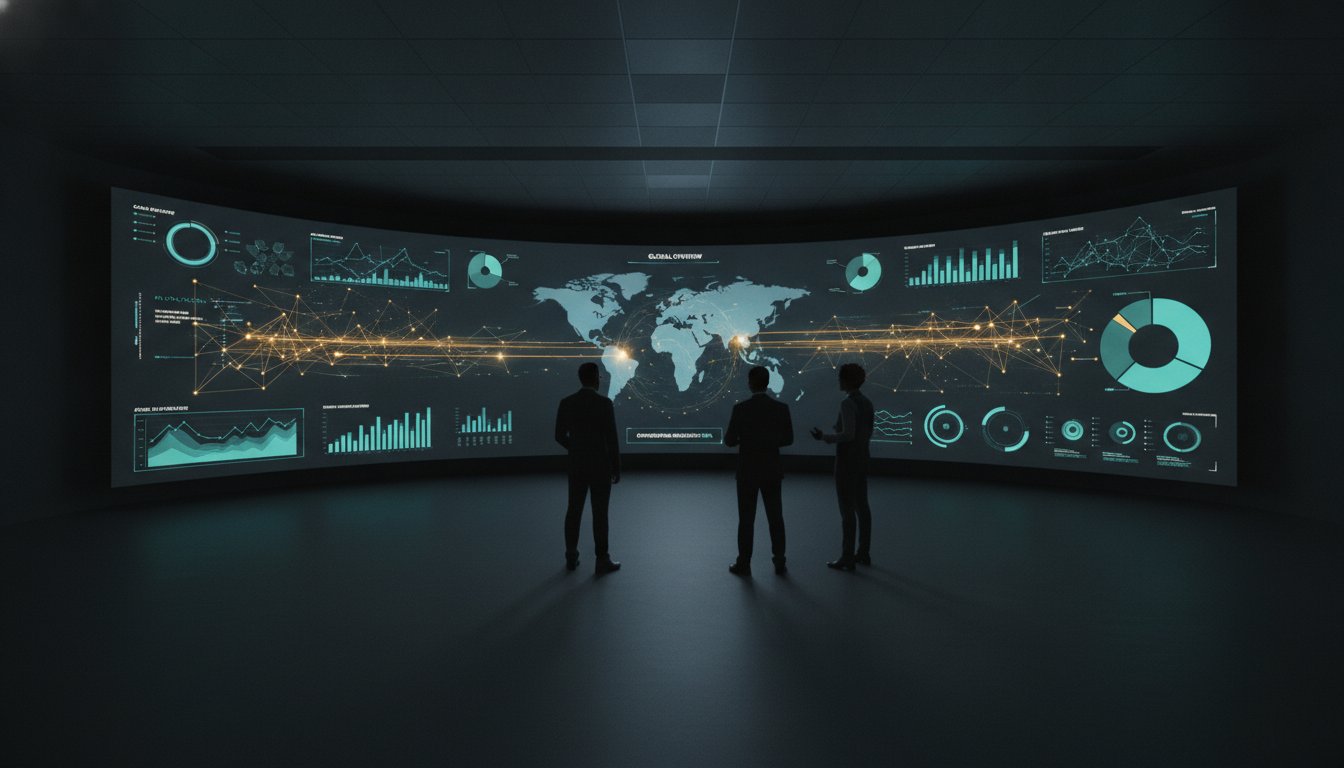
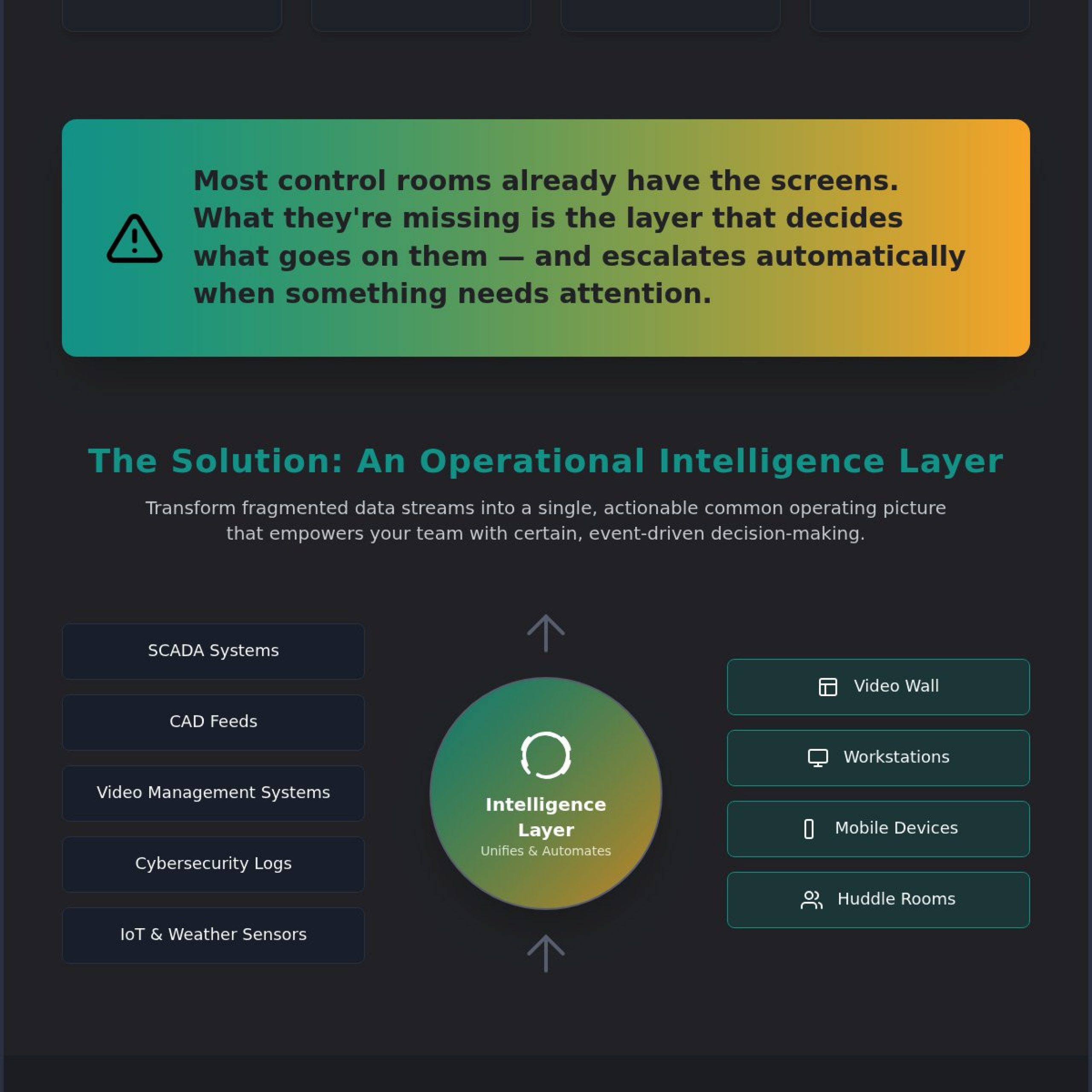
Having more screens in a command center doesn’t equate to having more control; it often just creates more noise. You’ve likely felt the tension of a high-stakes environment where data silos prevent a unified view and operator fatigue sets in from monitoring dozens of disconnected feeds. When critical incidents occur, information overload can lead to missed details and delayed responses. Most control room software solutions focus on the display rather than the decision. Most control rooms already have the screens. What they’re missing is the layer that decides what goes on them, and escalates automatically when something needs attention.
This article explores how to transform these fragmented data streams into a single, actionable operating picture that empowers your team with certain decision-making. By implementing a true operational intelligence layer, you can move beyond simple visualization to achieve real-time situational awareness across the command center and the field. We’ll examine how the right platform unifies disparate tools into a central hub, ensuring that essential information reaches the right person at the right moment, whether they’re at a workstation, in a huddle room, or on a mobile device.
Key Takeaways
- Identify the hidden costs of data silos and why traditional video management systems often fail to provide the situational awareness needed during a crisis.
- Shift your perspective from viewing displays as hardware to seeing control room software solutions as the intelligent brain of your operation.
- Learn how to move beyond static monitoring by implementing an automated layer that decides which information hits the screen when attention is most required.
- Connect the command center with field responders by leveraging mobile visibility and remote huddle rooms for synchronized incident management.
- Discover how a unifying platform like vis/ability serves as a central hub, making your existing operational tools more effective for every team member.
The Crisis of Fragmented Data in Modern Command Centers
Modern command centers face a relentless deluge of information. Data arrives from disparate sources: SCADA systems, CAD feeds, weather sensors, and cybersecurity logs. This fragmentation isn’t just an IT hurdle; it’s a strategic vulnerability. When critical systems don’t talk to each other, the burden of correlation falls entirely on the human operator. This reliance on manual synthesis often leads to the very failures the command center was built to prevent. High-stakes environments demand a level of cohesion that fragmented systems simply cannot provide.
Traditional control room software solutions often prioritize the mechanics of display rather than the utility of intelligence. A standard Video Management System (VMS) or a collection of individual dashboards provides eyes, but they lack a central brain. Operators find themselves managing the tools instead of managing the mission. This reactive posture creates a dangerous lag between the onset of an event and the execution of a response. To maintain operational readiness, organizations must look beyond the individual screen and toward a unified strategy.
Identifying Gaps in Situational Awareness
Siloed data creates persistent blind spots for shift supervisors and directors. The “swivel-chair” effect occurs when an operator must jump between multiple applications to understand a single event. This friction wastes precious seconds. Beyond the technical lag, there’s a psychological reality to consider. Monitoring a static video wall for hours leads to cognitive tunneling. Operators naturally lose focus, making it easy to miss the subtle anomalies that signal a burgeoning crisis. Most control rooms already have the screens. What they’re missing is the layer that decides what goes on them, and escalates automatically when something needs attention.
The Operational Cost of Information Overload
In sectors like utilities and public safety, the cost of information overload is measured in risk and downtime. Manual data correlation significantly delays decision-making. If a cybersecurity threat triggers an alert in one system while a physical sensor detects a breach in another, the connection must be made instantly. Fragmented visibility prevents this. Achieving enterprise-wide resilience requires a unified operating picture that filters out the noise. It’s about moving from a state of constant monitoring to a state of readiness. Without a layer to unify these feeds, the command center remains a collection of parts rather than a cohesive force. Leaders in public safety and critical infrastructure require a more sophisticated approach to manage these complexities.
The transition from reactive monitoring to proactive, event-driven operations is no longer optional. It’s a requirement for survival in a world where data moves faster than human judgment can keep up with. By identifying these gaps early, organizations can begin to build the bedrock of a truly intelligent command operation.
Defining the Operational Intelligence Layer
Effective control room software solutions act as the central nervous system for high-stakes environments. While a video wall provides the visual canvas, the software layer provides the logic. It’s the difference between seeing a problem and understanding it. In a 24/7 mission-critical environment, technical reliability isn’t a feature; it’s the baseline. This operational intelligence layer processes thousands of data points to ensure that human operators aren’t buried under irrelevant information.
Beyond Basic Visualization
True intelligence requires deep application integration. It isn’t enough to simply “window” an application on a screen. The software must ingest data from those applications and process it into a format that supports rapid decision-making. This transforms raw telemetry and video into actionable insights. The operational intelligence layer is the unifying software hub for mission-critical data. Unlike standard video management, which is often passive, this platform is active. It monitors for specific triggers and changes the display dynamically based on the current threat or operational status.
Organizations looking to enhance their response capabilities often start by exploring event-driven situational awareness to reduce the time between detection and action.
The Architecture of a Common Operating Picture
A robust common operating picture requires the aggregation of diverse data types. This includes geospatial mapping, live video, and real-time telemetry from IoT or SCADA systems. Synchronizing this data across all display surfaces, from the main video wall to individual workstations, ensures every team member operates from the same set of facts. This synchronization eliminates the discrepancies that often lead to miscommunication during an incident. Modern control room software solutions must provide this level of absolute technical reliability to maintain a proactive stance.
Modern operations also require the integration of cybersecurity posture into the physical security environment. A digital breach can have physical consequences; therefore, the operational intelligence layer must provide visibility into both worlds simultaneously. Most control rooms already have the screens. What they’re missing is the layer that decides what goes on them, and escalates automatically when something needs attention. This automated escalation ensures that when a threshold is crossed, the right data finds the right person immediately. By centralizing these feeds, the platform becomes the bedrock of operational readiness.
Solving the Visualization Gap: The Missing Layer
Investment in command center technology often follows a hardware-first trajectory. Organizations frequently prioritize high-resolution displays and expansive video walls, assuming that more visual real-estate naturally leads to better oversight. This hardware-centric approach creates a significant operational bottleneck. Commercial-off-the-shelf (COTS) displays are essentially passive components; they lack the inherent logic required to prioritize information during a crisis. Without specialized control room software solutions, these screens become expensive wallpaper rather than strategic assets.
The gap between raw data and human judgment is bridged by software, not glass. Most control rooms already have the screens. What they’re missing is the layer that decides what goes on them, and escalates automatically when something needs attention. Relying on manual intervention to update a video wall during an unfolding incident is a recipe for failure. The software must act as the orchestrator, ensuring that the most critical data points are elevated above the background noise of daily operations.
Why Screens Alone Are Not Enough
A common failure in mission-critical environments is the “wall-as-a-wallpaper” phenomenon. When a video wall displays the same static feeds for hours, operators naturally become desensitized to the visual field. This psychological fatigue is why operators miss incidents on a video wall even when the evidence is clearly visible. Software-driven escalation mitigates this risk by dynamically altering the visual environment when a threshold is met. By forcing relevant data to the forefront, the system re-engages operator attention exactly when it matters most. For a deeper look at balancing these elements, consider this strategic guide to mission-critical situational awareness.
Transitioning from Static to Dynamic Displays
Modern operations require a shift from static monitoring to dynamic, event-driven visualization. Static layouts are rigid and require manual reconfiguration, which is the last thing an operator should be doing during an emergency. Intelligent control room software solutions automate layout management based on real-time triggers. If a SIEM alert indicates a cybersecurity breach or a CAD system flags a high-priority 911 call, the display should update instantly to show the relevant geospatial data and camera feeds.
This automation reduces the cognitive burden on the team. Instead of hunting for information across dozens of applications, the right information reaches the right person at the right time. This transition ensures that the command center functions as a proactive hub rather than a reactive viewing gallery. By removing the manual labor of display management, you empower your staff to focus entirely on the pivotal decisions that determine the outcome of an operation.
Orchestrating Collaboration Across the Distributed Enterprise
High-stakes operations don’t stop at the glass walls of the command center. In modern incident management, the ability to project intelligence to field units and remote stakeholders is just as critical as the visualization within the room itself. Effective control room software solutions must act as a bridge, ensuring that every level of the organization maintains a consistent SITREP. When a crisis unfolds, the value of the command center is measured by its ability to synchronize action across the entire distributed enterprise.
Bridging the Gap to Field Operations
Field units often operate within a dangerous information vacuum. While some organizations utilize specialized platforms like Axon for tactical video, these tools often provide only a partial solution. They capture the immediate scene but lack the broader context of the entire operational landscape. Without a unifying layer to create a full common operating picture, field data remains siloed and disconnected from the strategic oversight of the command center. Mobile vis/ability tools solve this by pushing real-time data from the GSOC directly to mobile devices in the field. This ensures that tactical responders have the same geospatial and telemetry data as the shift supervisor. Secure, low-latency transmission is the bedrock of this capability, allowing for certain action in environments where every second counts.
To see how this works in practice, you can explore the distributed collaboration features of the vis/ability platform to connect your remote teams.
Collaborative Decision-Making in High-Stakes Scenarios
A unified operating picture must extend into huddle rooms, regional offices, and executive suites. Miscommunication during a critical event is frequently rooted in disparate visibility; if different teams are looking at different data, their conclusions will inevitably diverge. True situational awareness requires synchronizing visibility across every display surface in the organization. Most control rooms already have the screens. What they’re missing is the layer that decides what goes on them, and escalates automatically when something needs attention. This automated escalation ensures that when a threat is detected, the relevant visualization is instantly shared with every stakeholder who needs to see it.
By establishing a shared, real-time visualization of the threat landscape, organizations can eliminate the ambiguity of verbal reports. This synchronization allows for a more fluid transition from analysis to action. When the GSOC, regional leads, and mobile units all operate from the same intelligence hub, the organization moves as a single, cohesive unit. This level of orchestration is the hallmark of a mature, resilient operation that values precision over rhetoric.
vis/ability: The Hub for Unified Operational Intelligence
Centralize your operational data within a single, authoritative hub. The vis/ability platform serves as the operational intelligence layer that unifies video walls, huddle rooms, and mobile devices into a cohesive ecosystem. While many organizations invest heavily in hardware, sophisticated control room software solutions are defined by their ability to process complexity into clarity. Most control rooms already have the screens. What they’re missing is the layer that decides what goes on them, and escalates automatically when something needs attention. This platform provides that essential logic, ensuring your team remains focused on the mission rather than the technology.
Unifying Your Mission-Critical Ecosystem
Operational efficiency depends on the seamless integration of specialized tools. Whether you are managing power grids, transportation networks, or public safety responses, vis/ability aggregates real-time data and video streams into a unified interface. It makes existing tools more useful for the entire team by filtering out the noise and highlighting the anomalies that require immediate judgment. For instance, while tactical tools provide essential field data, they often offer only a partial solution. vis/ability unifies these feeds with SIEM and SOAR tools to create a comprehensive cybersecurity common operating picture. This event-driven automation ensures that when a threshold is met, the system reacts instantly. You can explore sector-specific solutions for SOC, NOC, and GSOC environments to see how this integration strengthens resilience.
Built for Absolute Reliability
Activu engineers solutions for the most demanding, high-stakes environments on the planet. Top-tier organizations trust the vis/ability platform because it offers the technical reliability required for 24/7 operations. It isn’t just a visualization tool; it’s the bedrock upon which critical decisions are made. The platform’s architecture is designed to handle the massive data volumes of modern enterprises while maintaining a calm, clear interface for the operator. This steady reassurance allows directors and shift supervisors to act with greater certainty when stakes are at their highest.
Designing a control room that prioritizes actionable intelligence is a strategic undertaking. It requires a partner that understands the intersection of human factors, ergonomics, and advanced data analysis. Moving from a state of information overload to a state of operational readiness starts with a clear assessment of your current gaps. To begin transforming your command center into a hub of unified intelligence, contact Activu for a tailored control room software assessment. Our experts will help you bridge the gap between raw data and decisive action.
Securing Operational Readiness through Intelligent Integration
Modern operations require a definitive shift from passive monitoring to active intelligence. You’ve seen how fragmented data streams create strategic vulnerabilities and how software-driven escalation prevents critical oversights. Most control rooms already have the screens. What they’re missing is the layer that decides what goes on them, and escalates automatically when something needs attention. This transition ensures that your team remains focused on the mission rather than the mechanics of the display.
By implementing advanced control room software solutions, your organization can finally unify its mission-critical ecosystem. The vis/ability platform provides event-driven automation that drastically reduces time-to-action, a capability already proven in the most demanding Federal Defense and Public Safety environments. It offers seamless integration with existing tools like Axon, ensuring that field data is never siloed from the command center. This synchronization is the bedrock of a resilient operation.
Don’t let information overload dictate your response times. Request a Demo of the vis/ability Operational Intelligence Layer to transform your command center into a hub of certain decision-making. You have the power to turn raw data into a decisive advantage for your entire enterprise.
Frequently Asked Questions
What is the primary function of control room software solutions?
The primary function is to transform fragmented data streams into a unified, actionable operating picture. Most control rooms already have the screens. What they’re missing is the layer that decides what goes on them, and escalates automatically when something needs attention. These control room software solutions ensure that raw telemetry and video become intelligence that supports rapid human judgment during critical incidents.
How does control room software help reduce operator fatigue?
It reduces fatigue by automating the prioritization of essential information. Instead of forcing operators to monitor dozens of static feeds for hours, the software dynamically updates layouts based on real-time events. This approach prevents cognitive tunneling and ensures that the team only focuses on data that requires a decision, preserving mental resources for high-stakes moments.
Can I integrate my existing VMS or SIEM into a unified operating picture?
Yes, existing VMS or SIEM tools integrate directly into the vis/ability platform. While specialized tools provide essential tactical data, they often function as partial solutions on their own. vis/ability unifies these disparate feeds into a central hub, making your current investments more effective and accessible for the entire team across the command center and the field.
What is the difference between a video wall controller and situational awareness software?
A video wall controller manages pixels and hardware placement, while situational awareness software provides the underlying operational logic. The software acts as the intelligence layer that manages what information is displayed and when. It bridges the gap between passive hardware and the proactive requirements of high-stakes decision-making.
How does mobile visibility improve incident response times?
Mobile visibility ensures that field units operate with the same SITREP as the command center. By pushing real-time geospatial and telemetry data to mobile devices, response teams eliminate the ambiguity of verbal reports. This synchronization reduces the lag between incident detection and tactical resolution, allowing for faster, more certain action.
Is it possible to automate display escalations based on external data triggers?
Automation is a core feature of event-driven control room software solutions. The system monitors external triggers, such as a cybersecurity alert or a physical sensor breach, and automatically updates the display environment. This proactive escalation ensures that critical incidents are never overlooked due to information overload or human error.
What sectors benefit most from specialized control room software?
Organizations in public safety, utilities, transportation, and defense see the greatest impact. These sectors operate in mission-critical environments where fragmented data can lead to operational failure. Any operation requiring 24/7 situational awareness and absolute technical reliability benefits from a unified intelligence layer to manage complexity.
How does a common operating picture improve cybersecurity response?
It provides a unified view of both IT and OT environments, allowing for faster correlation of threats. By integrating cybersecurity posture into the physical security interface, SOC and NOC teams can identify digital breaches that have immediate physical consequences. This visibility allows for a more cohesive and certain response to complex threats.