
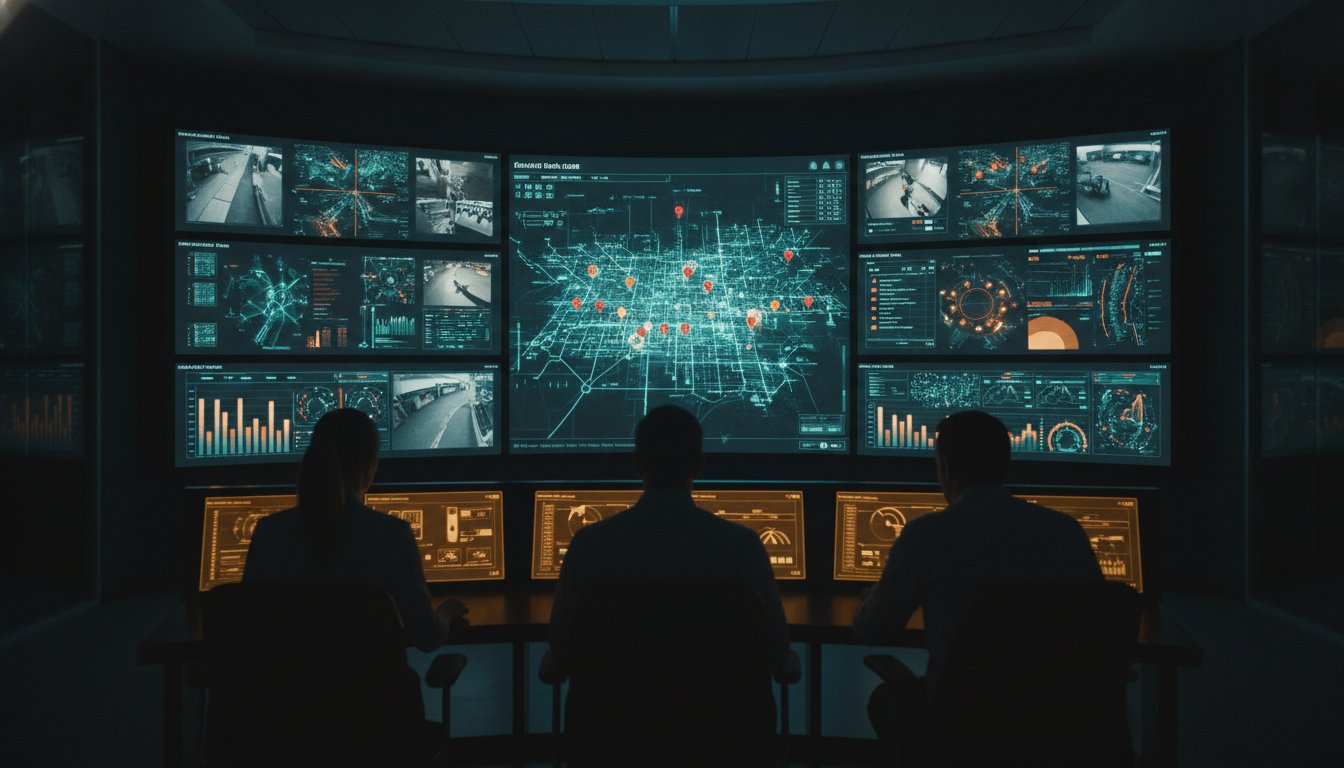
The moment a critical incident unfolds, the primary obstacle isn’t a lack of information, but the paralyzing volume of it. You likely manage a sophisticated suite of tools, from VMS to CAD systems, yet your operators still struggle to find the signal in the noise. Monitoring dozens of screens across fragmented systems leads to inevitable fatigue and delayed response times. You know that having more data doesn’t equate to better decisions if that data remains trapped in silos.
Most control rooms already have the screens. What they’re missing is the layer that decides what goes on them; and escalates automatically when something needs attention. This article demonstrates how a collaborative crisis management platform, serving as a dedicated operational intelligence layer, unifies your command center and field units. You’ll discover how vis/ability transforms raw data into a common operating picture that automates incident detection and eliminates manual escalation bottlenecks. We’ll examine the shift from passive monitoring to proactive, intelligent orchestration, ensuring your team maintains control when stakes are highest.
Key Takeaways
- Identify why fragmented data sources like CAD and CCTV often fail operators during the most critical moments of an incident.
- Learn how a collaborative crisis management platform functions as an operational intelligence layer to unify disparate systems into a single common operating picture.
- Discover the mechanics of event-driven situational awareness and how automated escalation reduces response times by prioritizing essential information.
- Understand how to extend real-time visibility beyond the control room to field units and mobile teams through Mobile vis/ability.
- See how to transform existing video wall systems from passive displays into active hubs for mission-critical collaboration and decision-making.
Why Traditional Crisis Response Systems Fail Under Pressure
Control rooms often operate under the illusion that more technology equals more security. In reality, the proliferation of specialized tools frequently creates a fragmentation trap. When a critical incident occurs, clarity vanishes behind a wall of disconnected dashboards. You might have sophisticated Computer-Aided Dispatch (CAD), Security Information and Event Management (SIEM), and hundreds of CCTV feeds. Yet, these systems rarely communicate. Without a unifying collaborative crisis management platform, your operators are forced to bridge these gaps manually, often during the most stressful minutes of their shift.
The Information Silo Problem in Modern Control Rooms
Data silos are the primary enemy of operational readiness. Modern command centers are often collections of independent software islands. Disconnected dashboards force operators to function as manual data integrators, physically moving their eyes between screens to piece together a narrative. Critical alerts often stay buried in sub-menus or get lost in the volume of background noise. Effective crisis management requires more than just accumulating data; it requires the intelligent prioritization of that data. Without a central hub, “more data” simply creates more obstacles to clear awareness.
- Disconnected CAD systems prevent real-time geospatial context during rapid deployments.
- Isolated SIEM logs delay the correlation of physical and digital security threats.
- Manual CCTV switching slows down the visual verification of remote environmental alarms.
Cognitive Overload and the Human Element
The human element remains the most vulnerable part of any high-stakes operation. Monitoring multiple high-pressure feeds for 24 hours a day causes profound cognitive fatigue. When an incident escalates, the sudden influx of information from fragmented systems leads to decision paralysis. Operators aren’t just tired; they’re overwhelmed by the task of filtering noise to find actionable intelligence. A true collaborative crisis management platform must alleviate this burden. It should act as a filter, ensuring that the team only sees what is essential for the mission at hand. This reduction in cognitive load is vital for maintaining the steady reassurance and technical reliability required in mission-critical environments like public safety and emergency operations.
The Architecture of a Modern Collaborative Crisis Management Platform
Architecting a collaborative crisis management platform demands a shift from passive storage to active orchestration. Modern operations cannot rely on databases that merely record history; they require engines that drive response. This unified architecture aggregates real-time data and high-definition video streams into a single, accessible environment. By integrating disparate applications, the platform creates a unified operating picture that supports immediate, decisive action. It isn’t just a place to store information, but a system that actively manages the flow of intelligence.
Defining the Operational Intelligence Layer
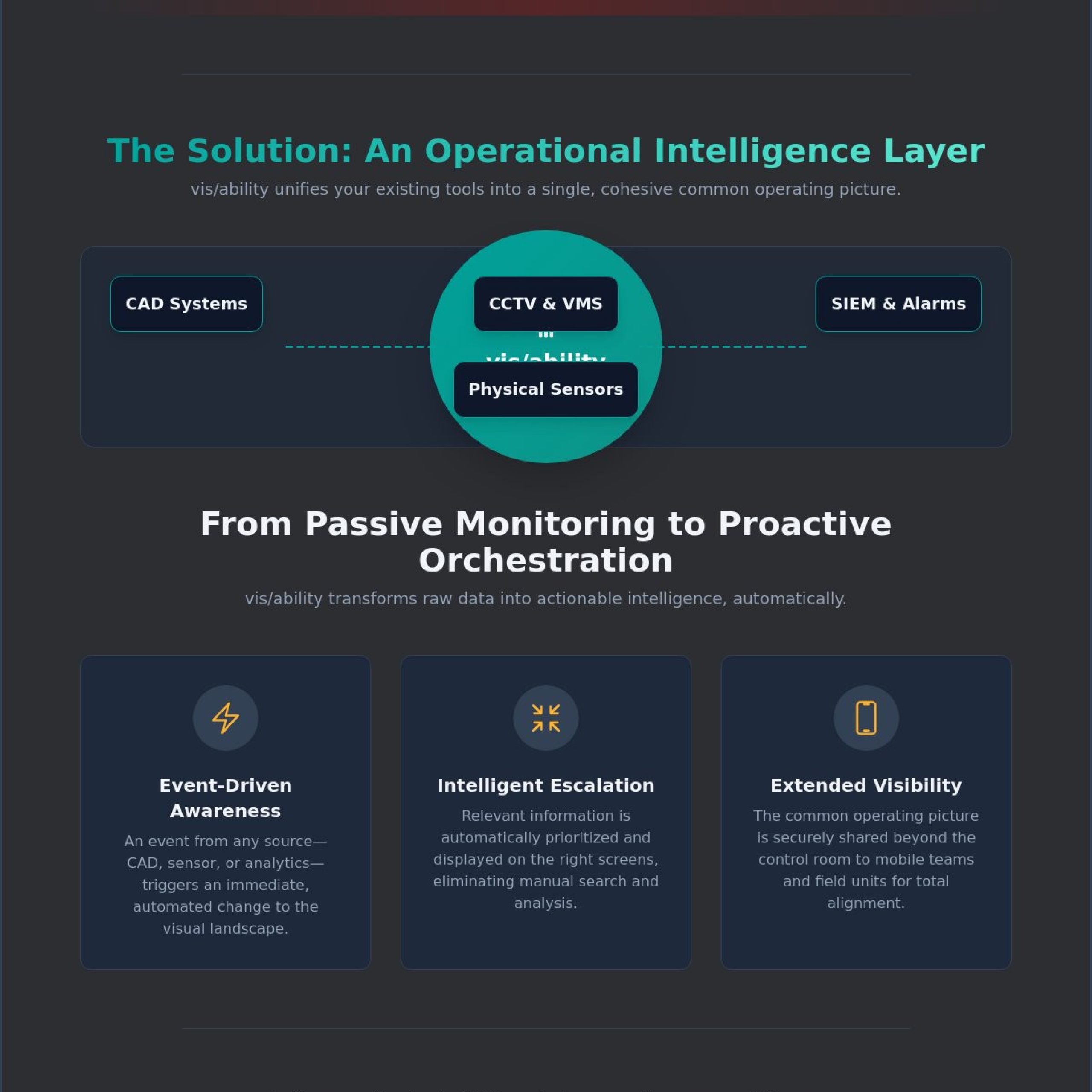
The operational intelligence layer functions as a sophisticated overlay that sits above your existing mission-critical tools. It doesn’t replace established systems like CAD or VMS. Instead, it provides the context those tools lack when used in isolation. This layer is tool-agnostic, allowing it to ingest telemetry from any source, whether it’s a legacy physical sensor or a cloud-based analytics suite. Within a collaborative crisis management platform, the operational intelligence layer is the bridge between raw data and human judgment.
Integrating SIEM, SOAR, and Physical Security Data
High-stakes environments like a GSOC require the total convergence of digital and physical security. A modern platform integrates SIEM and SOAR threat intelligence directly into the operational workspace. This integration allows teams to maintain a cybersecurity common operating picture that reflects the reality of modern threats. When a cyber incident is detected, the platform can instantly trigger physical security protocols, such as locking doors or displaying relevant CCTV feeds. This process transforms raw telemetry into actionable visual intelligence, ensuring that every stakeholder sees the same critical information at the same time. If you want to see how this convergence works in real-time, our vis/ability Platform provides the necessary integration to eliminate blind spots.
Event-driven situational awareness serves as the mechanical heart of this architecture. Systems that rely on manual checklists often fail when the pace of a crisis accelerates. An event-driven approach uses automated triggers to update displays and notify personnel the moment a threshold is breached. This ensures that the right information reaches the right person without manual intervention. It moves the command center from a reactive posture to a state of proactive orchestration, where the technology actively supports the mission and reduces the burden on human operators.
Beyond the Video Wall: Intelligent Escalation and Automated Awareness
Most control rooms already have the screens. What they’re missing is the layer that decides what goes on them; and escalates automatically when something needs attention. Static video walls often become wallpaper, failing to capture the urgency of a developing threat. A collaborative crisis management platform changes this dynamic by shifting the focus from reactive monitoring to proactive visualization. By treating hardware and software as a single, integrated entity, organizations ensure that their most valuable visual real estate is always dedicated to the highest-priority events.
Automated escalation reduces the critical time gap between incident detection and decisive action. In traditional environments, an operator might notice an anomaly on a remote feed but must then manually notify supervisors, change video wall layouts, and pull up relevant SOPs. An intelligent platform automates these steps. When a sensor or software trigger detects a breach, the system immediately reconfigures the environment to present the necessary context. This ensures that response teams aren’t wasting seconds searching for information that should already be in front of them.
Automating the Common Operating Picture
Event-driven triggers allow for instantaneous shifts in video wall layouts. Instead of operators manually switching sources during high-stress moments, the system responds to the severity of the incident. If a high-priority alert originates from a specific facility, the collaborative crisis management platform can automatically push relevant camera feeds, floor plans, and responder locations to the main display. This keeps the most critical information front and center, allowing the team to maintain a steady focus on the mission.
Escalation Logic: From Alert to Action
Effective escalation is governed by logic that distinguishes between a routine alert and a context-aware notification. Simple alerts often contribute to alarm fatigue, while context-aware notifications provide the “why” behind the signal. By leveraging incident management software, organizations can standardize their response playbooks. This ensures that every escalation follows a verified protocol, moving the operation seamlessly from initial detection to resolution. The result is a more resilient command center where technology acts as a vigilant guardian, protecting the team from information overload.
Implementing a Unified Operating Picture Across Distributed Teams
Effective crisis response is never confined to a single room. While the command center serves as the brain of an operation, the limbs are the field units and remote stakeholders who require the same level of intelligence to act with certainty. Implementing a common operating picture across distributed teams ensures that geographic distance does not become an information barrier. A modern collaborative crisis management platform must extend its reach beyond the video wall, providing a seamless flow of data to every person involved in the mission. This connectivity ensures that when a decision is made, it is based on a single, verified version of the truth.
Maintaining situational awareness outside the NOC is a primary requirement for resilient operations. Mobile vis/ability ensures that field personnel aren’t just receiving task lists; they are seeing the same real-time video feeds and geospatial data as the command center. While some organizations use basic task-management apps that only provide text-based updates, a truly unified platform replicates the full visual context for mobile users. This bidirectional flow allows teams to collaborate on the same data set in real-time. If the primary control center is compromised or requires evacuation, the platform maintains operational continuity by allowing any authorized device to become a mobile command post.
Connecting the Control Room to the Field
True collaboration requires more than one-way communication. Field units must be able to contribute live data back to the central operating picture, whether through mobile camera feeds or local sensor telemetry. Secure, reliable data transport is essential. It ensures that intelligence remains protected even when moving through public networks. This connectivity empowers responders to act as additional sensors, enriching the command center’s visibility while receiving the tactical context they need to stay safe. To explore how to extend your command center’s reach, contact our design team to discuss your distributed operational needs.
Collaborative Tools for Huddle Rooms and Remote Stakeholders
Crisis management frequently involves non-technical stakeholders and executive leadership who need a high-level view of the situation. A sophisticated platform breaks the four walls of the command center by providing simplified, curated views for huddle rooms and remote offices. This ensures cross-departmental alignment without overwhelming executives with raw telemetry. Maintaining this level of clarity is a cornerstone of mission-critical operations, where every decision-maker must have confidence in the bedrock of information provided. By providing a tailored view of complex data, the collaborative crisis management platform allows the entire organization to move with a single, purposeful rhythm.
Activating vis/ability: The Hub for Mission-Critical Collaboration
Activu vis/ability serves as the vital central hub that amplifies the effectiveness of your entire technological stack. By functioning as the operational intelligence layer, it ensures that every integrated tool, from CAD to SIEM, contributes to a cohesive objective. This orchestration is essential for a collaborative crisis management platform to deliver on its promise of absolute technical reliability. It bridges the gap between raw data streams and the human judgment required to resolve high-stakes incidents. Most control rooms already have the screens. What they’re missing is the layer that decides what goes on them; and escalates automatically when something needs attention.
Seamless integration with existing video wall systems allows organizations to leverage their current hardware investments while adding a level of intelligence previously unavailable. vis/ability is designed to scale effortlessly, supporting everything from a single local command center to a global network of interconnected operations. This flexibility ensures that as your mission expands, your situational awareness remains uncompromised. The platform values precision over rhetoric, providing a quiet, powerful engine that remains focused and analytical when stakes are highest.
The vis/ability Advantage: Event-Driven Intelligence
The core strength of vis/ability lies in its ability to automate the visualization of critical events through event-driven situational awareness. It ingests data from both legacy and modern applications, presenting them within a single, intuitive interface that eliminates the need for manual data integration. This automation ensures that your team is never distracted by irrelevant noise during a crisis. vis/ability is the bedrock for critical decision-making, providing the calm and clarity needed to navigate potential complexity with confidence.
Planning Your Operational Intelligence Strategy
Successful implementation begins with a strategic approach to your physical and digital environment. Our control room design services play a pivotal role in this rollout, ensuring that the technology aligns with the ergonomic and operational realities of your team. We recommend a comprehensive audit of your current data feeds to identify specific opportunities for automation and intelligent escalation. This methodical progression transforms your command center from a collection of screens into a state of clear, actionable intelligence.
Moving from a state of fragmentation to a state of vis/ability is a deliberate process. Whether you operate in Utilities, Transportation, or Public Safety, the requirement for a unified collaborative crisis management platform is universal. Your next step is to see this technology in action. Request a tailored demonstration to discover how an operational intelligence layer can secure your mission and empower your operators to act with greater certainty.
Securing the Mission Through Operational Intelligence
Trusted by Federal Government and Defense agencies, vis/ability reduces incident response time through automated escalation. It seamlessly integrates with SIEM, CAD, and various mission-critical telemetry systems to create the bedrock upon which critical decisions are made. It’s time to move beyond passive monitoring and embrace active orchestration. Request a vis/ability Demo to See Your Operational Intelligence Layer in Action. Your team deserves the clarity and certainty required to protect the mission with unwavering dependability.
Frequently Asked Questions
What is a collaborative crisis management platform?
A collaborative crisis management platform is a unified operational environment that orchestrates intelligence from disparate systems into a single common operating picture. It functions as the central hub where data from CAD, VMS, and SIEM flow together to inform decisive action. This platform ensures that every stakeholder, from the command center to field units, shares the same real-time visibility during high-stakes incidents.
How does an operational intelligence layer differ from standard incident software?
An operational intelligence layer sits above your existing tools to provide context and automation that standard incident software lacks. While traditional databases simply record events, this layer actively manages the flow of information. Most control rooms already have the screens. What they’re missing is the layer that decides what goes on them; and escalates automatically when something needs attention. It transforms raw telemetry into actionable visual intelligence.
Can this platform integrate with my existing video wall hardware?
Yes, the vis/ability platform is designed to integrate seamlessly with your existing video wall systems. It is a hardware-agnostic solution that overlays your current infrastructure to add a level of intelligence and automation. This allows organizations to leverage their current hardware investments while upgrading to a more proactive, event-driven posture. The platform scales from single rooms to global networks without requiring a complete hardware overhaul.
What are the benefits of event-driven situational awareness?
Event-driven situational awareness automates the visualization of critical events, ensuring that the right information reaches the right person instantly. Instead of operators manually switching screens, the system responds to predefined triggers to update displays and notify personnel. This reduces cognitive load and eliminates the noise of irrelevant data within a collaborative crisis management platform. It moves the command center from a reactive state to a state of proactive orchestration.
How does the platform support mobile and remote users during a crisis?
The platform supports mobile and remote users through Mobile vis/ability, which extends the full common operating picture to any authorized device. Field units and remote stakeholders receive the same real-time video feeds and geospatial data as the command center. This bidirectional flow allows field personnel to contribute data back to the central hub. It ensures operational continuity even if the primary control room is compromised or requires evacuation.
Is it possible to integrate cybersecurity data into a physical security operating picture?
Yes, the platform allows for the total convergence of digital and physical security data. By integrating SIEM and SOAR intelligence, teams maintain a cybersecurity common operating picture alongside physical operations. When a cyber threat is detected, the platform can automatically trigger physical protocols, such as displaying relevant CCTV feeds or locking secure areas. This integration provides a holistic view of the threat landscape for more resilient operations.
How do automated escalations improve response times?
Automated escalations improve response times by removing the manual bottlenecks between incident detection and decisive action. The platform uses logic to distinguish between routine alerts and context-aware notifications, triggering immediate changes to video wall layouts and responder alerts. This ensures that the team doesn’t waste critical seconds searching for context. Standardizing these responses through incident management software ensures every escalation follows a verified mission-critical protocol.
Does the platform work with COTS (Commercial Off-the-Shelf) hardware?
The platform is built to operate on standard COTS hardware, ensuring absolute technical reliability and ease of maintenance. It utilizes standard IT infrastructure to transport data securely across the network to any display or mobile device. This approach avoids the limitations of proprietary hardware and allows for easier scaling as your operational needs grow. It positions the brand as a flexible partner capable of integrating with the tools you already use.