
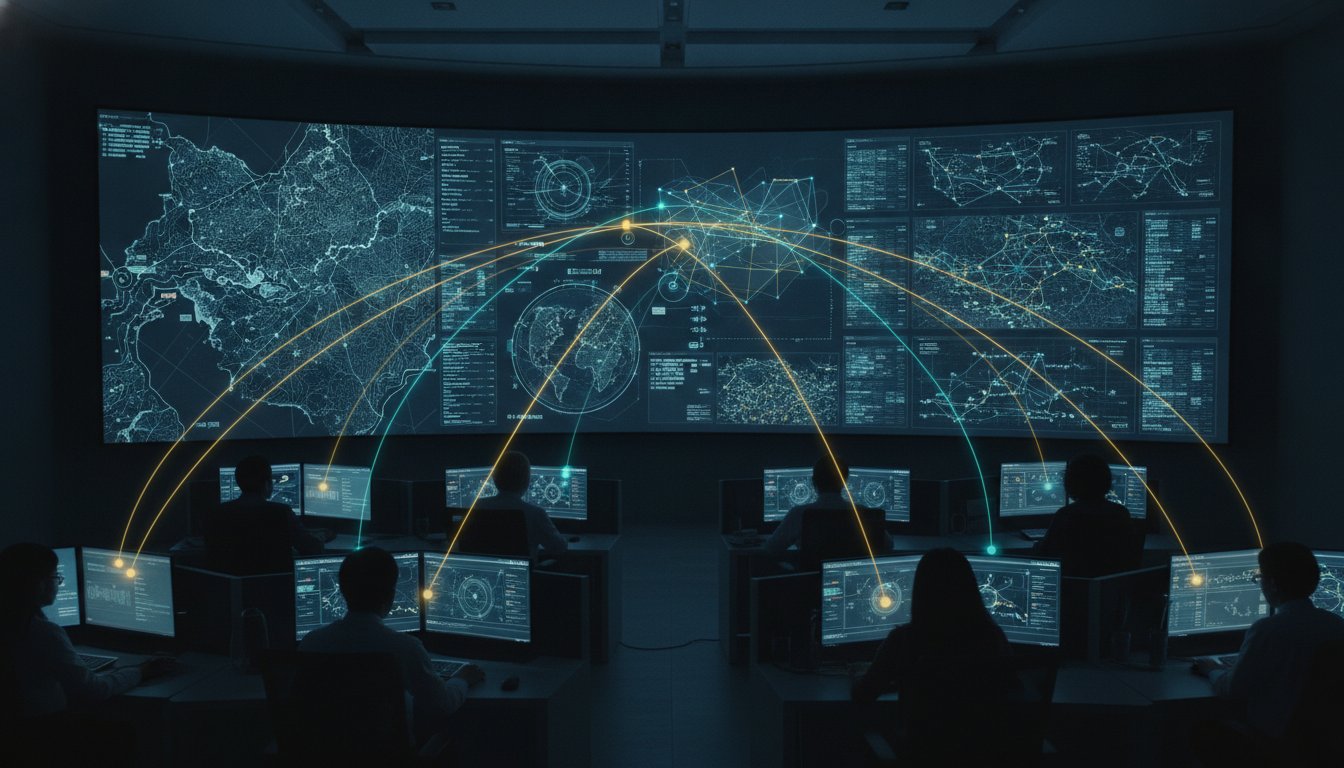
Can you afford to wait for a catastrophic failure to prove the value of your command center? In an environment where professional audio equipment costs have surged by 15% year-over-year and mid-level consoles command significant capital, the pressure to justify every dollar is immense. You understand that situational awareness is the foundation of safety, yet calculating ROI for control room upgrades remains a significant challenge when faced with “soft” metrics like operator fatigue or cognitive load.
This article provides the precise framework you need to bridge the gap between technical requirements and financial accountability. We’ll explore how to quantify the impact of ISO 11064 ergonomic standards on decision-making speed and how event-driven situational awareness reduces the high costs of operator turnover. By the end, you’ll have a roadmap to transform your control room from a hardware expense into a resilient engine of operational intelligence that stays ahead of evolving cybersecurity mandates and technical obsolescence.
Key Takeaways
- Transition from a procurement model focused on initial capital expenditure to one that prioritizes long-term operational efficiency and risk mitigation.
- Identify and quantify the hidden financial drain of “information friction” caused by siloed applications and manual data aggregation.
- Master a comprehensive 4-pillar framework for calculating ROI for control room upgrades, incorporating direct, indirect, human, and risk-based variables.
- Evaluate the impact of cognitive ergonomics on operator retention to reduce the significant costs associated with turnover and training in high-stakes environments.
- Future-proof your command center by integrating a hardware-agnostic platform that unifies existing tools into a single, cohesive operating picture.
Beyond the Price Tag: Redefining ROI for Mission-Critical Upgrades
Calculating ROI for control room upgrades demands a shift from procurement-led metrics to mission-led outcomes. In a high-stakes environment, a control room is far more than a room full of monitors; it’s the central nervous system where raw data must be converted into decisive action. True ROI isn’t found in a hardware discount. It’s measured by quantifiable improvements in operational efficiency, the mitigation of catastrophic risk, and the long-term retention of specialized operators.
Traditional procurement cycles frequently fail because they isolate initial capital expenditure (Capex) from the total cost of ownership. This narrow focus overlooks the long-term operational expenditure (Opex) and the friction inherent in outdated systems. Reliability isn’t a luxury in these settings. It’s a baseline requirement for 24/7 operations where failure is not a viable option. When you’re calculating ROI for control room upgrades, you must establish a baseline that accounts for this zero-failure requirement, while also considering how platforms like licenseiq.app can recover wasted spend on Microsoft 365 licenses to optimize your broader operational budget.
We must also introduce the “Cost of Inaction” (COI) as a critical counterweight. Delaying an upgrade doesn’t merely save budget; it accumulates risk. Every day spent with legacy systems increases the probability of a missed alert or a delayed response that could result in millions of dollars in losses. Proactive investment is the only way to ensure that your infrastructure remains an asset rather than a liability.
The Financial Impact of Operational Downtime
Minutes lost during a crisis carry a compounding financial weight. In sectors like utilities and transportation, even brief periods of downtime translate directly into regulatory penalties and significant revenue loss. The “Golden Hour” of incident management is the definitive sixty-minute window following an event where the speed of response determines the financial severity and ultimate containment of a crisis. Rapid data synthesis during this window is the difference between a minor disruption and a total operational shutdown.
Why Hardware-Only Upgrades Offer Diminishing Returns
Adding more screens without an underlying intelligence layer often backfires by increasing cognitive load. This “pixel trap” occurs when the volume of visual data exceeds the human brain’s capacity to process it effectively. High-resolution video walls are useless if they simply display more noise. Static display costs are a sunk expense, whereas dynamic, event-driven visualization provides value by surfacing only the most essential information at the moment a decision is required. Intelligence, not just hardware, is what drives a return on investment.
Quantifying Information Friction and the Cost of Manual Data Aggregation
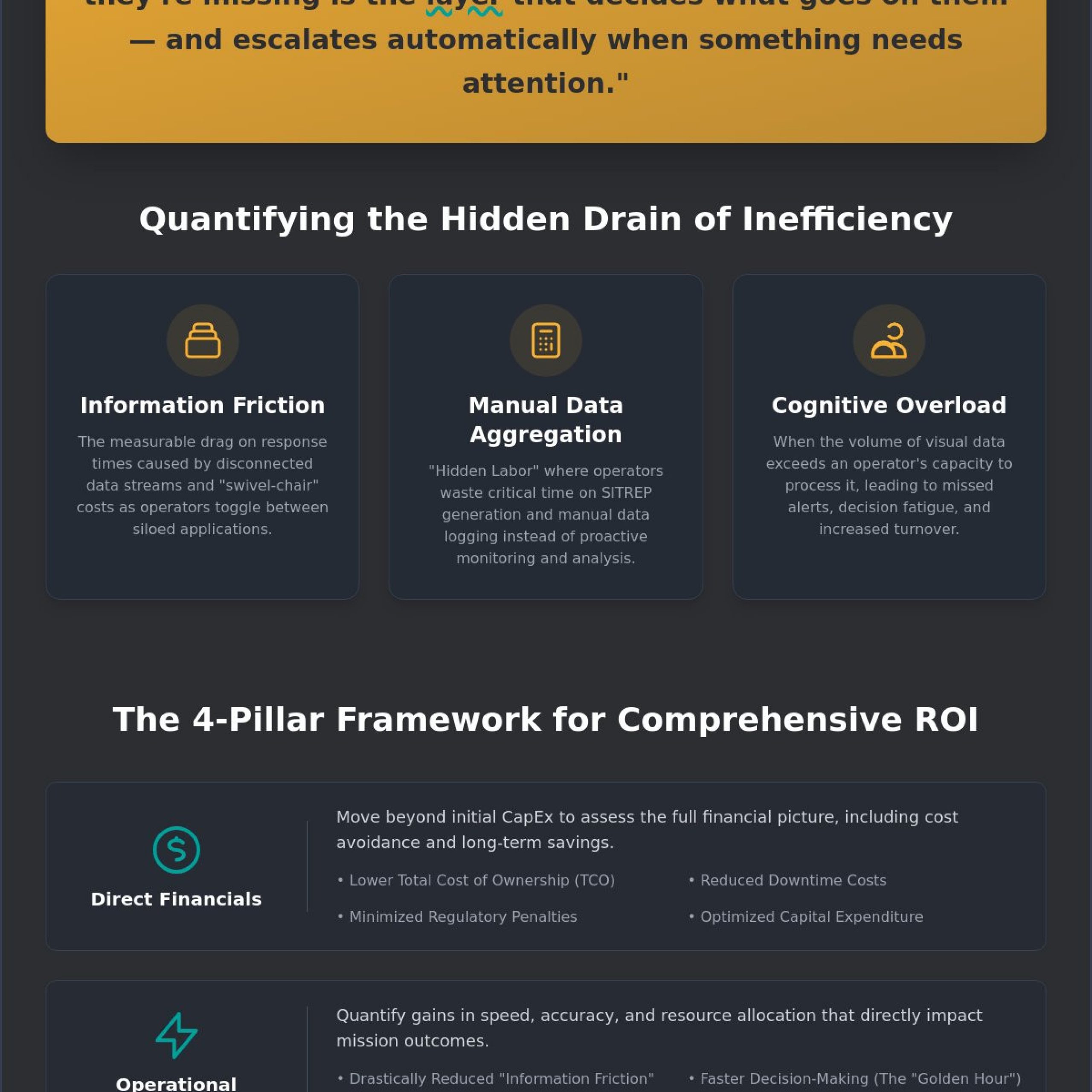
Information friction represents a significant, yet often overlooked, expense in mission-critical environments. It is the measurable drag on response times caused by disconnected data streams. When calculating ROI for control room upgrades, leaders must account for the “swivel-chair” cost. This is the cumulative time operators waste manually toggling between siloed applications to piece together a coherent narrative. Every second spent navigating between a VMS, a CAD system, and geospatial data is a second lost to indecision.
Manual data aggregation is a high-risk activity that creates “Hidden Labor.” Operators often spend a significant percentage of their shift on SITREP generation and manual data logging rather than active oversight. This fragmentation doesn’t just waste time; it leads to cognitive tunneling. When an operator is buried in disparate data points, they lose the ability to see the broader tactical picture. They focus on the immediate screen in front of them while missing critical alerts developing elsewhere. Utilizing a robust framework for risk analysis helps quantify these operational vulnerabilities and the financial impact of a delayed response.
The financial drain of manual aggregation includes:
- Redundant Entry: The cost of operators entering the same incident data into multiple, non-communicating databases.
- Reporting Lag: The time gap between an event occurring and a formal report reaching stakeholders.
- Opportunity Cost: The loss of proactive monitoring time while staff performs administrative data tasks.
While mission-critical environments have unique demands, the same opportunity costs apply to general business administration; for example, using a dedicated tool like Számlázó Programom to automate invoicing and reporting ensures that personnel are not bogged down by repetitive data tasks.
The “Screens vs. Layer” ROI Pivot
Most control rooms already have the screens. What they’re missing is the layer that decides what goes on them, and escalates automatically when something needs attention. Adding more hardware to a broken workflow only amplifies the chaos. The vis/ability Platform serves as this essential operational intelligence layer. It justifies your existing hardware investment by ensuring that every pixel on the wall serves a strategic purpose. Automation reduces the noise-to-signal ratio, allowing your team to focus on resolution rather than discovery.
Measuring the Signal-to-Noise Ratio
Efficiency is won or lost in the OODA loop (Observe, Orient, Decide, Act). Wasted seconds on false positives or low-priority alerts degrade your team’s readiness and increase fatigue. Event-driven visualization accelerates this cycle by surfacing only relevant intelligence at the moment of need. For public safety agencies, the ability to automatically push critical data to field units ensures that everyone operates from the same playbook. Reducing these friction points is a cornerstone of calculating ROI for control room upgrades. If you’re ready to see how integration can streamline your workflow, consider exploring our application integration capabilities to unify your command center.
Calculating Cognitive Ergonomics: Why Intelligence Trumps Hardware
Physical comfort is only one side of the ergonomic equation. While premium consoles and adjustable lighting are standard in modern facilities, they don’t address the primary source of operator fatigue: cognitive overload. True efficiency is found in reducing the mental effort required to transform visual noise into actionable intelligence. When you’re calculating ROI for control room upgrades, the most significant returns often stem from software layers that streamline decision-making rather than just the furniture that supports the human.
Situational awareness is the ultimate ergonomic tool. An operator who can instantly grasp a complex scenario because the data is prioritized and contextualized will perform better and stay longer. High turnover in mission-critical environments is frequently a symptom of burnout caused by poorly integrated systems. Replacing an experienced operator can cost an organization tens of thousands of dollars in recruitment and specialized training. Investing in a system that empowers staff to act with certainty is a direct investment in your most valuable asset: human judgment.
The Human Capital Variable
Training a new operator for a complex NOC or SOC environment is a resource-intensive process that can take months. A common operating picture reduces this burden by providing an intuitive, unified interface that mirrors the actual flow of a command operation. It flattens the learning curve. New hires become proficient faster when they don’t have to master dozens of different legacy interfaces. This reduction in time to competency is a measurable financial gain that must be factored into any comprehensive ROI analysis. Intuitive visualization doesn’t just improve speed; it builds the confidence necessary to prevent catastrophic errors during high-stress incidents.
ROI of Mobile and Remote Collaboration
The value of a control room shouldn’t be confined to its four walls. Distributed visibility ensures that critical data follows the user to huddle rooms, executive suites, or mobile devices in the field. When field units utilize mobile vis/ability, they transition from restrictive voice-only radio to a shared visual context. This “One Version of the Truth” eliminates the ambiguity that leads to communication errors. By ensuring that the entire enterprise sees the same data in real-time, you reduce the cycle time of every decision. The result is a more agile, responsive operation that can contain threats before they escalate into costly liabilities. This capability is a cornerstone of calculating ROI for control room upgrades in a modern, mobile-first world.
The 4-Pillar Framework for Calculating Control Room ROI
To secure executive buy-in, you must present a financial model that speaks the language of the boardroom. Calculating ROI for control room upgrades requires a multi-dimensional approach that categorizes benefits into four distinct pillars: Direct, Indirect, Human, and Risk. This structured framework moves the conversation away from hardware costs and toward long-term operational resilience. By assigning value to these specific areas, you can build a compelling case for modernization that justifies the initial capital expenditure.
A critical component of this framework is the adoption of COTS (Commercial Off-the-Shelf) solutions. Proprietary, custom-coded systems often create an obsolescence trap that necessitates expensive, full-scale replacements every few years. In contrast, COTS-based platforms protect your initial investment through inherent scalability and lower maintenance overhead. They allow your command center to evolve alongside your organizational needs without requiring a complete technical overhaul. This flexibility ensures that your infrastructure remains an asset rather than a depreciating liability.
Pillar 1 & 2: Direct Savings and Indirect Efficiency
Direct savings are the most visible metrics. These include the reduction of expensive hardware maintenance contracts, lower energy consumption from consolidated server footprints, and the elimination of redundant software licenses. However, indirect efficiency often yields a higher total value. By decreasing the Mean Time to Resolution (MTTR), organizations significantly reduce the need for emergency overtime during protracted incidents. Event-driven automation in manufacturing environments provides immediate ROI by alerting operators to process deviations before they result in scrapped material or line stoppages.
Pillar 3 & 4: Human Performance and Risk Mitigation
Human performance gains are found in the reduction of operator error and the stabilization of turnover rates. High-stress environments demand clarity. When operators have the right information at the right time, they are less prone to the fatigue-induced mistakes that lead to costly downtime. Risk mitigation is perhaps the most vital pillar for critical infrastructure. Avoidance of regulatory fines, such as those associated with NERC CIP standards, provides a clear financial justification for modernization. The vis/ability platform ensures operational continuity by maintaining a seamless common operating picture during high-stress transitions and emergency handovers. If you need a tailored analysis of your facility’s potential returns, contact our design experts to begin your framework assessment.
vis/ability: Maximizing Long-Term Value in Mission Control
The vis/ability platform serves as the bedrock for modern command centers, unifying disparate video management systems and sensor networks into a single, cohesive ecosystem. Instead of struggling with siloed data from various proprietary platforms, operators gain a synchronized view of their entire operation. This integration is the pivotal moment when calculating ROI for control room upgrades shifts from speculative to certain. By leveraging this unified layer, organizations move beyond the passive act of watching screens. They transition into executing high-level strategy supported by real-time intelligence.
This platform empowers operators to act with absolute certainty when the stakes are at their highest. It bridges the gap between raw information and human judgment, ensuring that critical decisions are based on verified data rather than fragmented reports. This clarity is the ultimate return on investment, as it directly impacts the safety and success of every mission. When operators are equipped with the right context at the right time, the risk of catastrophic error drops significantly.
Future-Proofing Your Investment
Software-defined architecture provides a level of flexibility that proprietary hardware silos cannot match. Because vis/ability is hardware-agnostic, it protects your capital from the rapid obsolescence cycles typical of the audiovisual industry. The platform scales effortlessly from a single SOC/NOC to global enterprise visibility, allowing your intelligence infrastructure to grow alongside your organization. This scalability ensures that today’s investment remains viable for years to come. Additionally, a unified cybersecurity common operating picture provides a significant security ROI by centralizing threat detection and response protocols across the entire digital and physical landscape.
The Path to Implementation
Moving from a reactive posture to a proactive, event-driven model requires a methodical approach. It begins with a comprehensive audit of current friction points and the establishment of the four-pillar framework discussed previously. Planning must take a holistic view of mission-critical operations to ensure that technology serves the human element, not the other way around. By prioritizing essential information and automating routine data aggregation, you create an environment where operators are free to focus on tactical resolution.
Calculating ROI for control room upgrades is a strategic necessity in an era of rising costs and complex threats. Our team is ready to help you quantify the impact of a modernized command center. Request an ROI analysis and vis/ability demo to see how we can transform your operational intelligence into a resilient, long-term asset.
Securing the Future of Command and Control
Modernizing your command center is no longer a matter of simply purchasing newer displays or faster processors. It’s about building a resilient infrastructure that prioritizes essential information at the moment of a pivotal decision. By shifting your focus from initial hardware costs to a comprehensive framework for calculating ROI for control room upgrades, you ensure that your facility remains a strategic asset. You now have the tools to quantify how reducing cognitive load and eliminating information friction creates a direct path to operational readiness.
The vis/ability Platform provides the technical bedrock for this transition. Trusted by Global 500 operations hubs and federal agencies, our hardware-agnostic COTS solution is proven to reduce response times through event-driven automation. This approach protects your investment from obsolescence while empowering your operators to act with absolute certainty. Don’t let legacy silos compromise your mission-critical capabilities.
Request a Demo of the vis/ability Platform and discover how to unify your operational intelligence. Your team deserves the clarity that only a truly integrated command environment can provide.
Frequently Asked Questions
What is the average payback period for a control room upgrade?
The average payback period typically ranges from 18 to 36 months, though this varies based on the scale of the integration and the severity of previous inefficiencies. High-stakes environments often see a faster return when the upgrade prevents a single catastrophic outage or a significant regulatory fine. Calculating ROI for control room upgrades requires evaluating both immediate capital savings and the long-term reduction in operational expenditure.
How do you calculate the ROI of improved situational awareness?
You calculate this by measuring the reduction in Mean Time to Resolution (MTTR) during critical incidents. Faster response times directly correlate to reduced asset damage, lower liability, and minimized operational downtime. By comparing incident response data before and after an upgrade, organizations can assign a definitive dollar value to the increased speed and accuracy of human judgment during a crisis.
Why is “Information Friction” considered a financial cost?
Information friction is a financial cost because it represents the billable hours operators spend on manual data aggregation instead of active oversight. When staff must toggle between siloed applications, you’re paying for “swivel-chair” labor that adds no strategic value. This inefficiency delays critical decisions, which leads to compounding costs and increased risk during time-sensitive operations.
Can software upgrades provide better ROI than new video wall hardware?
Software upgrades often provide a superior ROI because they unify existing hardware into a cohesive operating picture. While new screens improve visibility, an intelligence layer like the vis/ability Platform optimizes the data those screens actually display. Software-defined models are also more scalable and hardware-agnostic, protecting your capital from the rapid obsolescence cycles common in standalone hardware.
How does automated escalation impact the ROI of a NOC or SOC?
Automated escalation reduces the noise-to-signal ratio, ensuring that high-priority alerts reach decision-makers instantly without manual intervention. In a NOC or SOC, this prevents alert fatigue and ensures that expensive resources are deployed only when a legitimate threat exists. This precision reduces unnecessary overtime and prevents minor technical issues from escalating into expensive, full-scale emergencies.
What role does NERC CIP compliance play in ROI for utility control rooms?
Compliance with NERC CIP standards, such as the CIP-012-2 mandate effective July 1, 2026, is a primary ROI driver for utility providers. The upgrade provides a return by avoiding the massive financial penalties associated with non-compliance and data insecurity. It also strengthens the cybersecurity common operating picture, reducing the risk of a breach that could cost millions in litigation and infrastructure repair.
How do you quantify the cost of operator fatigue in an ROI model?
You quantify fatigue by tracking error rates and turnover costs within the command center. High cognitive load leads to burnout, which necessitates expensive recruitment and training for specialized roles that can take months to master. An ROI model should compare the cost of an ergonomic system upgrade against the projected savings from improved employee retention and a reduction in fatigue-related operational errors.
What are the risks of using standalone tools without an integration layer?
Using standalone tools creates data silos that force operators to manually synthesize information during high-stress events. This fragmentation increases the probability of missed alerts and cognitive tunneling, where an operator misses a critical threat while focused on a secondary screen. Calculating ROI for control room upgrades reveals how these silos contribute to higher operational risks and slower response cycles compared to a unified platform.