
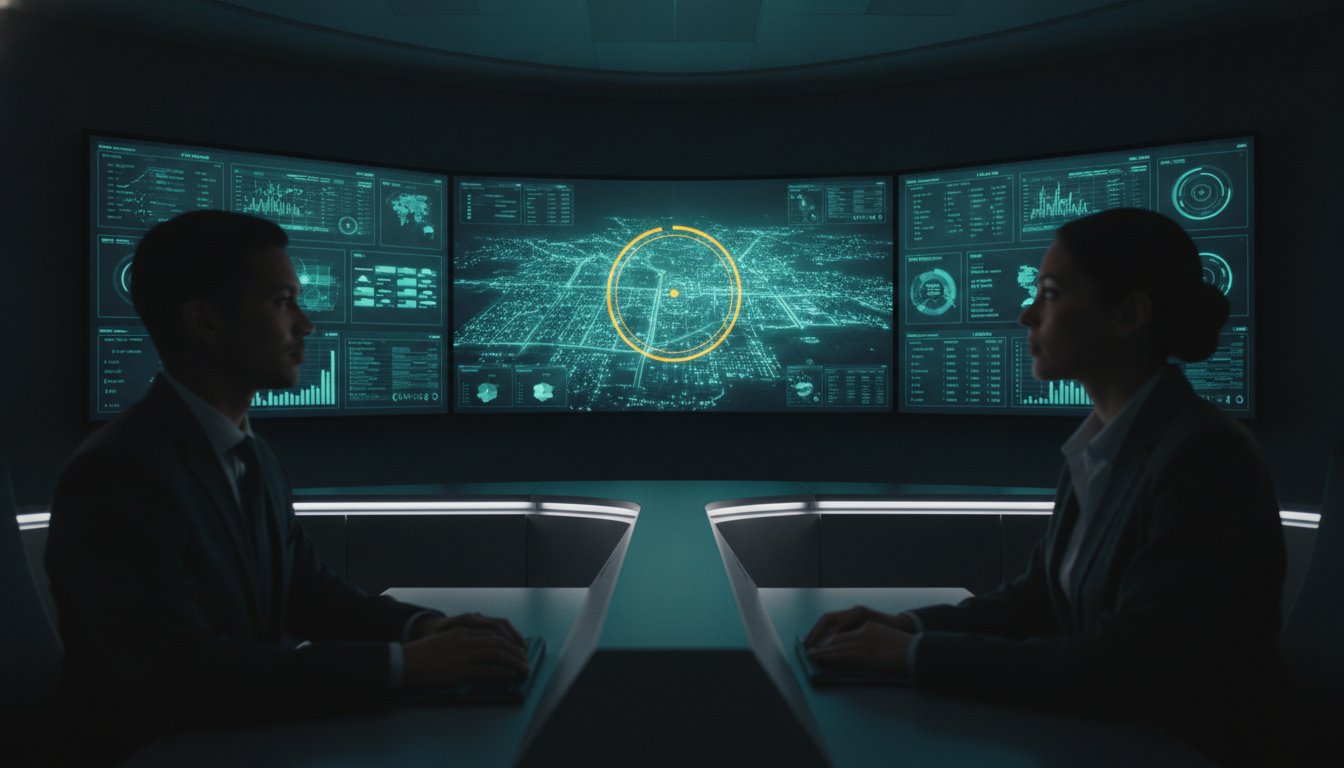
Your command center isn’t failing because it lacks data; it’s failing because it has too much of it. Operators spend hours staring at static video walls, drowning in siloed feeds from systems like Axon that don’t communicate with other critical applications. This creates a dangerous lag between a field event and control room visibility, leading to fatigue and missed incidents. Implementing effective real-time decision support tools for command centers is no longer about adding more monitors. It’s about managing the intelligence that flows through them.
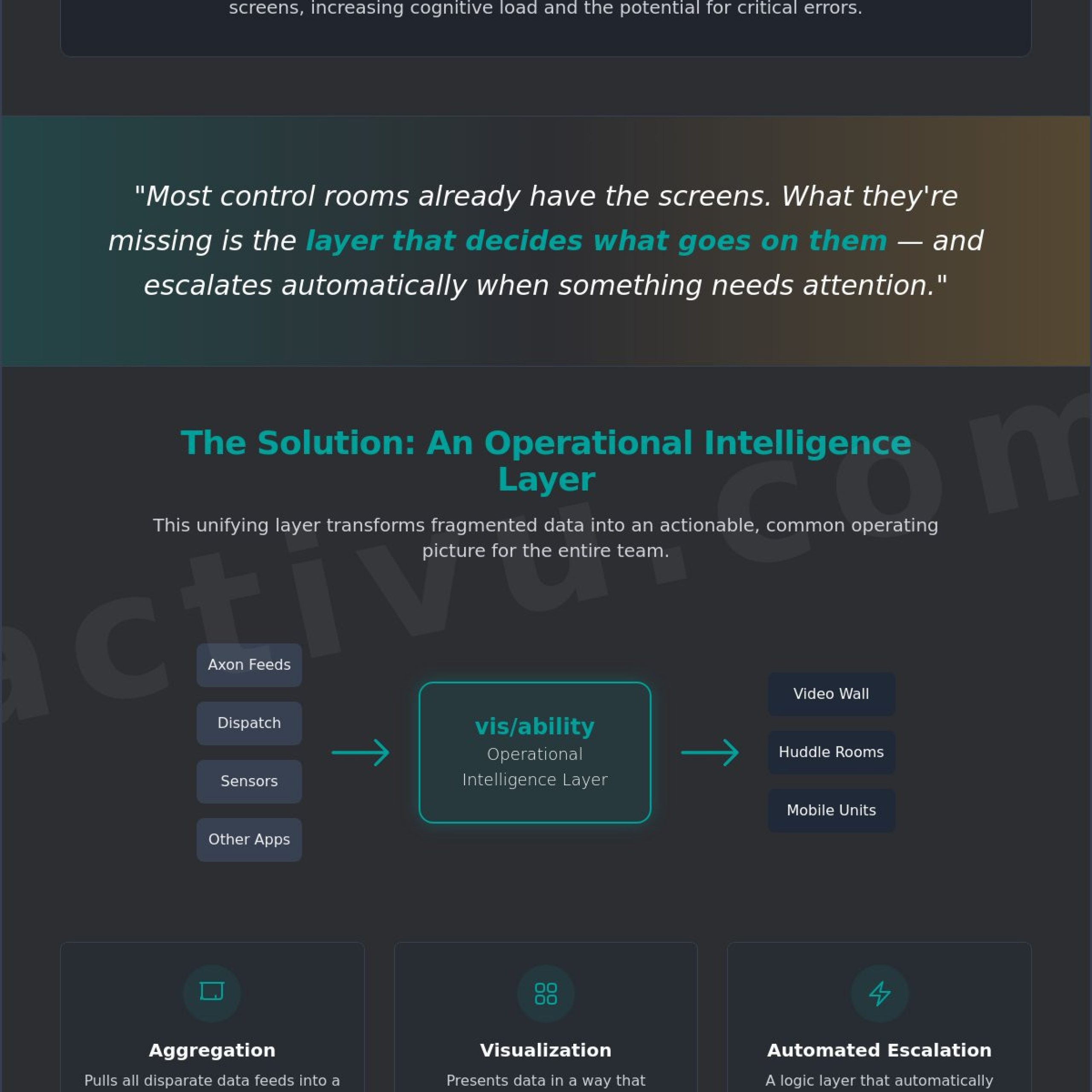
Most control rooms already have the screens. What they’re missing is the layer that decides what goes on them, and escalates automatically when something needs attention. You can transform this fragmented data into actionable intelligence with the vis/ability operational intelligence layer that automates situational awareness. This article explores how to create a unified operating picture that reduces cognitive load for 24/7 operators and ensures seamless collaboration between the control room and mobile field units.
Key Takeaways
- Identify how passive monitoring leads to operator fatigue and why human attention typically fails within 20 minutes of watching static video walls.
- Learn how real-time decision support tools for command centers bridge the gap between raw telemetry and the human judgment required for high-stakes decisions.
- Recognize the “screen-rich, data-poor” paradox and why siloed applications like Axon require a unifying operational intelligence layer to be truly effective.
- Follow a strategic framework to audit your existing data silos and establish automated escalation protocols that prioritize essential information.
- Discover how the vis/ability platform transforms fragmented data into a unified operating picture for both command center personnel and mobile field units.
The Cognitive Load Crisis: Why Operators Miss Incidents
Command centers face a silent failure rooted in human bandwidth rather than hardware limitations. Operators are frequently tasked with monitoring a wall of data that grows more complex every year. While the volume of incoming telemetry increases, the psychological limits of the human brain remain static. Research into operator performance shows that vigilance drops sharply after only 20 minutes of passive monitoring. When an operator is expected to watch dozens of live feeds for hours, the brain naturally filters out normal activity, which often includes the subtle precursors to a major incident.
The Mechanics of Information Overload
In 24/7 high-stakes environments, situational awareness is a finite resource. Alert fatigue is a primary byproduct of this reality. When systems generate constant, non-essential notifications, operators begin to subconsciously ignore them. This creates a dangerous environment where critical warnings for infrastructure failures or security breaches are lost in the noise. In the context of a Real Time Crime Center (RTCC), cognitive load represents the total mental effort required to synthesize disparate information from camera feeds, gunshot detection sensors, and officer locations into a single coherent thought. Without real-time decision support tools for command centers, this synthesis happens too slowly to affect the outcome of a field event.
Siloed Systems as Operational Roadblocks
Fragmented technology stacks contribute heavily to this cognitive tax. Many organizations utilize powerful tools like Axon for body-worn camera management or specific dispatch software, but these platforms frequently operate in isolation. The marketing promise of a single pane of glass often collapses into the reality of an operator juggling twenty open browser tabs. This fragmentation forces decision-makers to manually correlate data between systems; they must remember what they saw on one screen while looking for context on another. This manual correlation is where errors occur.
Data blindness is the inevitable result when critical alerts are buried three menus deep in a secondary application. A Decision Support System (DSS) should ideally prevent this, yet hardware-centric setups fail to provide the necessary filtration. The crisis intensifies during shift changes. When a new team takes over, the subtle context of an evolving situation is often lost because it lived only in the outgoing operator’s head, not in a unified platform. Continuity breaks down, and the lag between an event occurring and the room understanding its significance grows. Deploying real-time decision support tools for command centers is the only way to bridge this comprehension gap and ensure that critical data is never ignored.
Defining Real-Time Decision Support for Mission-Critical Operations
A robust support system rests on three pillars: Aggregation, Visualization, and Automated Escalation. Aggregation pulls disparate feeds into a single environment. Visualization ensures that data is presented in a way that respects human cognitive limits. Automated Escalation is the most critical; it acts as the logic layer that dictates priority. Most control rooms already have the screens. What they’re missing is the layer that decides what goes on them, and escalates automatically when something needs attention. For sectors like transport and utilities, “real-time” is a literal requirement. Sub-second latency is mandatory because a three-second delay in a rail operations center or a power grid huddle room can result in total system failure.
Organizations can Enhance command and control by leveraging advanced logic to filter noise and focus on mission-relevant insights. Teams looking to modernize their infrastructure often start with a vis/ability platform to unify these disparate feeds into a cohesive strategy.
Event-Driven vs. Static Visualization
Static layouts are the enemy of operational readiness. They assume a steady state that rarely exists in high-stakes environments. When a video wall remains unchanged regardless of activity, operators naturally tune out. Event-driven triggers solve this by changing the video wall state based on external data. If a NERC CIP violation occurs or a perimeter security breach is detected, the system should automatically override the current view with the relevant camera feeds and geospatial maps. This dynamic response is a core component of resilient Mission Critical Operations.
The Role of the Common Operating Picture (COP)
A Common Operating Picture (COP) ensures every stakeholder sees the same verified truth. It integrates geospatial data with live video feeds to provide context that a simple list of alerts cannot. In a Security Operations Center (SOC), this becomes a Cybersecurity Common Operating Picture, where digital threats are mapped alongside physical assets. By unifying these views, a COP eliminates the need for operators to manually correlate data between disconnected browser tabs; the system does the work for them, providing immediate clarity when stakes are highest.
The Integration Gap: Why Hardware and Siloed Apps Are Not Enough
Many command centers fall victim to the “Screen-Rich, Data-Poor” paradox. Organizations invest heavily in massive, high-resolution displays, yet operators remain starved for actionable intelligence. This occurs because hardware alone cannot synthesize information. While a video wall provides the canvas, it does not provide the context. Without a unifying operational intelligence layer, more monitors simply lead to more noise, forcing operators to hunt for critical details across dozens of disconnected feeds.
Specialized tools like Axon or Juvare serve vital roles in specific workflows, such as evidence management or crisis logging. However, these platforms often operate as islands. They provide a partial solution but fail to create a full common operating picture because they do not ingest data from the broader ecosystem of sensors, VMS, and GIS tools. Most control rooms already have the screens. What they’re missing is the layer that decides what goes on them, and escalates automatically when something needs attention. Relying on siloed applications creates a dangerous vendor lock-in, where decision support tools cannot ingest data from other essential systems, leaving the team blind to cross-platform correlations.
Implementing real-time decision support tools for command centers requires moving beyond these silos. When data is trapped in separate browser tabs, the “cognitive tax” mentioned previously becomes an operational liability. A unifying hub ensures that when a trigger occurs in one system, the relevant context is immediately surfaced across the entire platform, regardless of the original data source.
Hardware vs. Intelligence: A Critical Distinction
Video wall processors are tactical tools designed for signal routing and window management. Strategic decision support software is fundamentally different; it provides the logic and filtration necessary for high-stakes judgment. High-resolution displays are useless if they don’t show high-relevance information. This is why Commercial Off-the-Shelf (COTS) flexibility is mandatory for long-term resilience. Proprietary, closed systems prevent the integration of new telemetry, while a COTS-based approach allows the command center to evolve as new threats and technologies emerge.
Bridging the Field and the Command Center
A significant breakdown occurs when field units are disconnected from the command center’s visual intelligence. Relying on voice-only SITREPs introduces human error and slows response times. Extending the common operating picture to mobile devices ensures that distributed teams see the same verified truth as the controllers. This level of synchronization requires Incident Management Software that functions seamlessly across all hardware endpoints, ensuring the “big picture” is available to those at the tactical edge.
Implementing an Operational Intelligence Layer: A Strategic Framework
Moving from a fragmented monitoring environment to a proactive command operation requires a structured approach. Most control rooms already have the screens. What they’re missing is the layer that decides what goes on them, and escalates automatically when something needs attention. Deploying real-time decision support tools for command centers is not just a software installation; it is a strategic realignment of how information flows from the edge to the decision-maker. This framework ensures that technology serves the mission rather than overwhelming the operator.
- Step 1: Audit Data Silos. Catalog every disparate system, from VMS and CAD to IoT sensors. Identify the specific “trigger” events that require immediate human intervention.
- Step 2: Define Escalation Protocols. Establish clear logic for who needs to see specific data. Not every alert requires the full attention of the video wall; some only need to reach a specific supervisor’s mobile device or a huddle room.
- Step 3: Unify the Software Hub. Integrate these applications into a central operational intelligence layer. This ensures that when a trigger occurs, the system pulls context from all relevant sources simultaneously, providing instant clarity.
- Step 4: Extend Visibility. Ensure the common operating picture is not trapped within the four walls of the command center. Distribute high-relevance data to huddle rooms and mobile units to maintain synchronization across the entire organization.
- Step 5: Refine Through After-Action Reports. Use incident data to identify where automation succeeded and where manual intervention caused delays. Continuously update the system logic to improve response times for future events.
Designing for Operational Readiness
Physical space and digital logic must work in tandem to support the operator. Utilizing professional Control Room Design Services allows organizations to map data priority directly to screen real estate. This process optimizes operator workflows by placing mission-critical feeds in the primary field of view while relegating secondary telemetry to the periphery. The focus remains on reducing “time to glass,” ensuring that emergency alerts are seen and processed within seconds of arrival without the need for manual searching.
Automation and Escalation Logic
Modern software removes the burden of manual layout switching. When a perimeter sensor is tripped or a critical system failure is detected, the intelligence layer can automatically “pop” the relevant camera feed and geospatial map onto the main display. This transition from manual searching to logic-based visualization is fundamental to maintaining Operational Continuity. By automating the mundane tasks of data correlation, operators remain focused on high-level strategy and incident resolution. To begin optimizing your environment, contact our team for a detailed operational audit.
Transforming Command Centers with the vis/ability Platform
The transition from a data-heavy environment to an intelligence-driven operation culminates in the deployment of a central hub. Modern organizations recognize that simply adding more pixels to a wall does not solve the cognitive load crisis. Most control rooms already have the screens. What they’re missing is the layer that decides what goes on them, and escalates automatically when something needs attention. The vis/ability Platform serves as this essential operational intelligence layer, transforming fragmented telemetry into a decisive advantage.
While specialized tools like Axon or various GIS platforms provide critical data, they often exist in silos that limit their utility during a crisis. These systems provide a partial solution, but they require a unifying layer to create a full common operating picture. The vis/ability platform makes existing tools more useful for the entire team by contextualizing their data. For Utilities managing grid resilience and Public Safety agencies coordinating incident response, this integration ensures that every stakeholder acts on the same verified intelligence. By implementing real-time decision support tools for command centers, leaders can finally bridge the gap between raw data arrival and human comprehension.
Unifying Disparate Data Streams
The platform excels at aggregating diverse information sources, including live video, web applications, and desktop captures, into a single, coherent view. This aggregation is not merely visual; it’s event-driven. Version 6.7G of the platform is designed to reduce manual intervention by using logic-based triggers to surface information only when it becomes relevant to the mission. This capability is particularly vital for Federal Government and Defense sectors, where the speed of situational awareness directly impacts operational success. When the system handles the filtration, the human element is empowered to focus on high-stakes judgment rather than data management.
Actionable Intelligence Anywhere
True operational readiness requires that intelligence follows the user, regardless of their physical location. Mobile vis/ability extends the power of the command center to the tactical edge, allowing real-time collaboration between controllers and field units. This synchronization facilitates rapid decision-making in huddle rooms, remote offices, and on mobile devices, ensuring that the “big picture” is never trapped behind a single desk. By unifying the entire team under a single operating picture, the platform eliminates the communication lags that traditionally compromise high-stakes missions. To see how these real-time decision support tools for command centers can be tailored to your specific environment, contact Activu for a customized control room assessment.
Empowering Decisive Action in High-Stakes Environments
Command centers must move beyond the era of passive monitoring to meet the demands of modern operations. Operator fatigue and siloed data systems create structural gaps in situational awareness that no amount of additional hardware can fix. Solving the cognitive load crisis requires a transition toward event-driven automation that filters noise and prioritizes essential information. Implementing real-time decision support tools for command centers provides this vital bridge, ensuring that human judgment is applied where it matters most.
Most control rooms already have the screens. What they’re missing is the layer that decides what goes on them, and escalates automatically when something needs attention. The vis/ability platform provides this operational intelligence layer, proven in high-stakes environments ranging from public safety to global SOCs. By offering seamless integration with Axon, GIS, and other mission-critical applications, vis/ability ensures your team remains synchronized and proactive. Request a demo of the vis/ability platform to see your operational intelligence layer in action.
Take the first step toward operational clarity and give your team the tools they need to act with absolute certainty.
In the same way that command centers require centralized data for success, individuals can streamline their own professional journey by using specialized management platforms; visit CVernia to explore how to organize your job application process.
Frequently Asked Questions
What are real-time decision support tools for command centers?
Real-time decision support tools for command centers act as an intelligence filter that sits between raw data feeds and human operators. They synthesize information from disparate sources like VMS, CAD, and IoT sensors into actionable insights. Most control rooms already have the screens. What they’re missing is the layer that decides what goes on them, and escalates automatically when something needs attention.
How do decision support tools reduce operator fatigue?
These tools reduce fatigue by eliminating the need for constant, passive monitoring of static video walls. Instead of forcing operators to stare at dozens of unchanging feeds, the system uses event-driven logic to highlight only the data that requires intervention. This shift from manual observation to exception-based management protects mental bandwidth for high-stakes decision-making during long shifts.
Can decision support software integrate with my existing video wall hardware?
Yes, modern decision support software like vis/ability is designed to be hardware-agnostic, allowing it to leverage your current displays and processors. It functions as the operational intelligence layer that unifies your existing technology stack. This approach prevents vendor lock-in and ensures that your investment in hardware remains useful while adding the strategic logic necessary for modern, high-stakes operations.
What is the difference between a video wall processor and an operational intelligence layer?
A video wall processor is a tactical tool focused on signal routing, window management, and pixel resolution. In contrast, an operational intelligence layer is a strategic platform that manages the logic, filtration, and escalation of data. While the processor controls how a feed looks, the intelligence layer determines which feed is critical and when it must be displayed to the team.
How does event-driven visualization improve incident response times?
Event-driven visualization improves response times by removing the lag associated with manual layout switching. When a sensor is tripped or an alert is triggered in a system like Axon, the platform automatically “pops” the relevant camera feeds and geospatial context onto the screens. This automation ensures that operators see the incident immediately without having to search through menus or disconnected browser tabs.
Is it possible to extend a command center common operating picture to mobile users?
It is entirely possible to extend the common operating picture to mobile devices and remote huddle rooms. Using Mobile vis/ability, field units can access the same live video and data visualizations as the command center. This synchronization ensures that everyone from the dispatcher to the first responder acts on the same verified intelligence, eliminating the errors common in voice-only reports.
Why do operators often miss critical incidents on traditional video walls?
Operators miss incidents because human vigilance naturally declines after approximately 20 minutes of monitoring static information. Traditional video walls often present too much irrelevant data, leading to cognitive overload and alert fatigue. When critical information is buried in siloed applications that don’t communicate, the human brain cannot correlate the data fast enough to catch every developing threat.
How do decision support tools help with NERC CIP compliance in utility control rooms?
Decision support tools facilitate NERC CIP compliance by providing automated visibility and logging for security violations. In a utility environment, the system can be configured to trigger immediate visual alerts and escalation protocols the moment a compliance threshold is breached. This creates a reliable audit trail and ensures that potential threats to the power grid are addressed with sub-second latency.