

A shipment delay appears in one system, inventory risk in another, and the people who need to respond are spread across locations. A supply chain command center can help teams detect disruptions and coordinate a response. But fragmented data, information silos, and a lack of automatic escalation can leave operators assembling updates while the situation develops.
More feeds do not automatically create a shared operational picture. Teams need to know which events matter, who should act, and how a response could affect other locations. The key is to connect operational information to decisions and clear responsibilities, so teams can identify priority issues and coordinate their next steps.
Most control rooms already have the screens. What they’re missing is the layer that decides what goes on them and escalates automatically when something needs attention. Activu’s vis/ability platform serves as the central hub for applications and data streams. It is an operational intelligence layer that surfaces through the video wall, while extending shared visibility to remote teams, meeting spaces, and mobile users. This creates a clearer path from incoming signals to informed action.
Key Takeaways
- A supply chain command center can turn disconnected operational data into a shared picture that supports better-coordinated decisions.
- Map the decisions teams need to make before choosing the feeds and workflows that support them.
- Evaluate how a solution integrates data, provides context, prioritizes events, routes escalations, and keeps distributed teams aligned.
- Event-driven visibility can surface relevant developments while leaving response decisions with the people responsible for acting.
- Activu vis/ability is an operational intelligence layer that surfaces through the video wall and connects teams across locations.
Why Supply Chain Command Centers Struggle with Fragmented Operational Data
A shipment delay can affect inventory, facility schedules, and downstream deliveries. Yet the relevant updates may sit in separate applications, pass through different teams, or reach decision-makers at different times. When information stays siloed and escalation depends on manual handoffs, teams can spend valuable time piecing together the situation before they respond.
A supply chain command center is a coordinated environment for monitoring operations and supporting decisions across teams and locations. The supply chain control tower concept similarly brings supply chain information together to support oversight and coordination. The value comes from shared operational awareness: A command center gives teams a common view of developing conditions so they can coordinate a response.
How data silos obscure supply chain disruptions
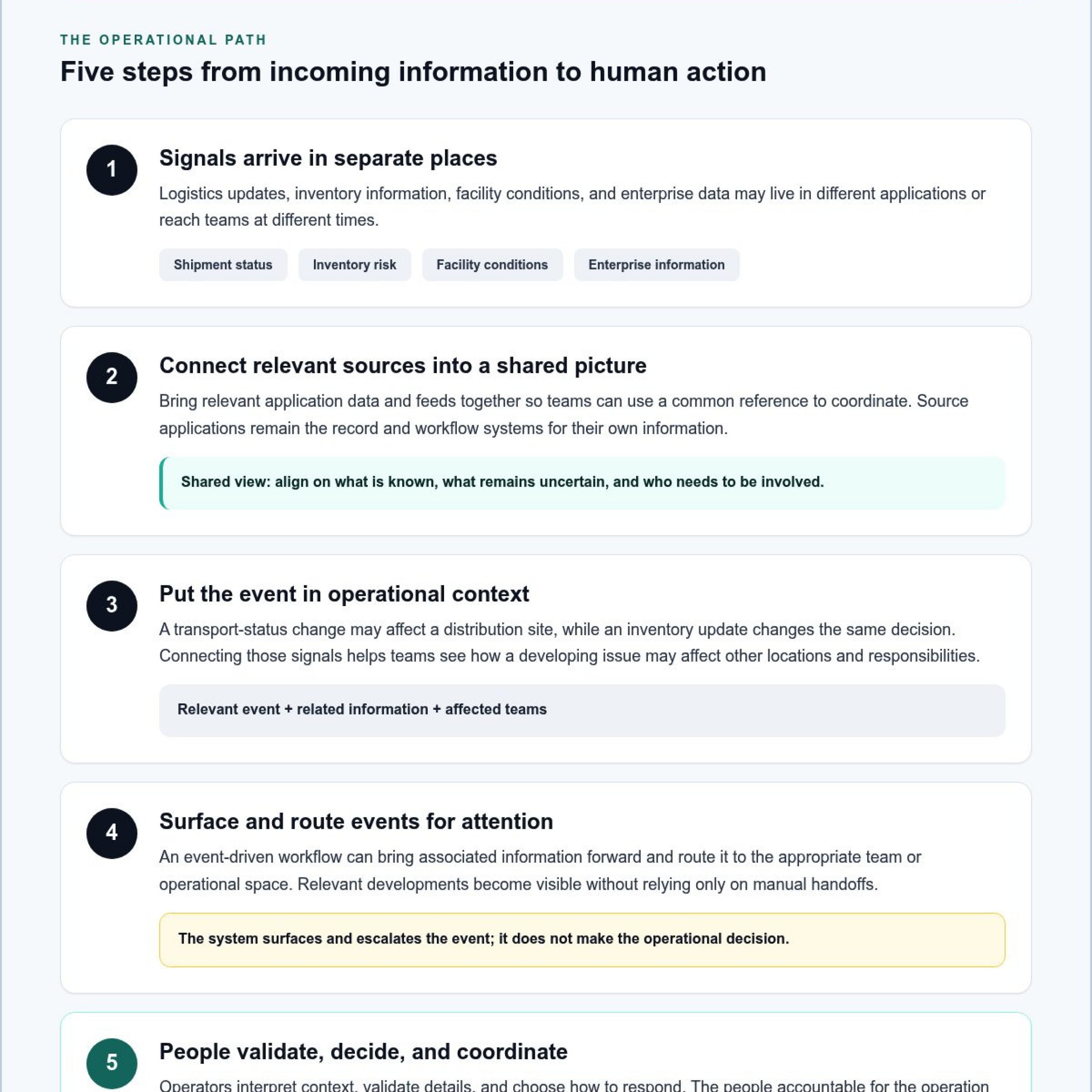
Logistics updates, facility conditions, and enterprise information may live in different applications. A change in transport status could affect a distribution site, while a separate inventory update changes the same decision. If these signals remain disconnected, each team sees only part of the developing issue.
The result can be uneven awareness. One location may identify a constraint while another continues working from an earlier update. To find the gaps, trace a representative disruption through the operation: note where each relevant update originates, who sees it, and where a handoff relies on someone manually passing information along. The coordination challenge is to get relevant information to the people who share responsibility for the outcome.
Why more screens do not automatically create situational awareness
More dashboards and data feeds can increase the amount of information available without clarifying what deserves attention first. Operators may face competing alerts, repeated updates, or changing conditions without a clear path for prioritization and escalation. A useful operational view connects an event to its context and helps teams identify who needs to act.
Most control rooms already have the screens. What they’re missing is the layer that decides what goes on them and escalates automatically when something needs attention.
That layer should support human judgment by bringing relevant information forward and routing events for attention, not make every operational decision. Activu’s vis/ability is an operational intelligence layer that surfaces through the video wall, connecting applications and data streams to provide event-driven situational awareness. The wall becomes the place where the operational answer appears because vis/ability brings the relevant information together.
For a deeper look at the role of the display environment, see The Video Wall: A Strategic Guide to Mission-Critical Situational Awareness. The central design question is operational: can teams recognize the same issue, understand its context, and coordinate the next step?
How a Supply Chain Command Center Turns Live Feeds into Operational Awareness
Operational awareness depends on a clear path from incoming information to a decision. A supply chain command center can bring relevant application data into a shared operational picture, helping teams understand how a developing event may affect other locations and responsibilities.
From applications and data feeds to a common operating picture
Relevant systems can contribute information to a unified view. A logistics update, facility status, or enterprise application may each show part of an operational situation. Integrating those sources gives teams a shared reference for coordination, while the original systems remain the source for their own records and workflows.
A common operating picture helps teams align on what is known, what remains uncertain, and who needs to be involved. It supports coordination, but it does not replace source applications or the need to validate information. For a fuller explanation of the concept, see What Is a Common Operating Picture (COP)?. IBM describes how supply chain control towers support end-to-end visibility by connecting information across operations.
Event-driven escalation keeps essential information visible
From fragmented feed to visible event to human action, each step should give the next decision-maker useful context. Prioritizing information supports judgment, while the people accountable for the operation remain responsible for decisions.
Activu’s vis/ability is an operational intelligence layer that surfaces through the video wall. It serves as the central hub for applications and data streams, bringing relevant information forward so the operational answer appears where teams can act on it. Shared visibility can extend across control rooms, remote locations, meeting spaces, and mobile users. Explore vis/ability’s operational awareness platform to see how it connects data and teams.
What to Evaluate in Supply Chain Command Center Solutions
Evaluate a supply chain command center by how well it helps people move from incoming information to coordinated action. A platform that displays data may improve access, but teams also need context, event prioritization, clear escalation paths, and shared visibility. Use real operational scenarios to test those capabilities. Follow an emerging issue from the first signal through to the people responsible for assessing it.
| Criterion | Evaluation question | Operational implication |
|---|---|---|
| Integration | Can relevant applications and data streams contribute to a unified view? | Teams can consider related information together instead of switching between isolated feeds. |
| Event prioritization | Can the platform surface information that warrants attention? | Operators have a clearer basis for deciding what to review first. |
| Escalation | Can an event reach the team or operational space responsible for it? | Defined routing supports handoffs while leaving response decisions with accountable people. |
| Shared visibility | Can relevant teams refer to a common operational picture? | Teams coordinate from shared information and can identify gaps or differing views. |
| Distributed collaboration | Can control rooms, remote locations, and mobile users access relevant updates? | Coordination can extend beyond a single operations room. |
Integration and operational context across existing systems
Assess integration against actual decisions. For example, consider whether logistics, facility, and enterprise information can appear together when teams evaluate a disruption. A unified view should help operators interpret information in context, while source applications continue to support their own records and workflows. The Supply Chain Movement checklist discusses improving supply chain visibility and agility, including the role of command centers in addressing data silos.
Escalation and collaboration across teams
Walk through a representative event from detection to response. Identify who receives the information, where it becomes visible, and who validates details before deciding what to do. Check whether the escalation route is clear and whether the next team receives enough context to act without reconstructing the event from separate feeds.
Activu’s vis/ability is an operational intelligence layer that surfaces through the video wall, bringing applications and data streams into event-driven situational awareness. Use this workflow to assess whether a platform supports human judgment across teams. For broader continuity planning, connect these evaluation criteria with Operational Continuity: Ensuring Mission-Critical Resilience in 2026.
How to Plan a Supply Chain Command Center Around Real Workflows
Plan around the decisions teams must make, not the displays they may use. A supply chain command center should reflect how information moves, where handoffs fail, and which people are accountable for each response. That gives the design a practical foundation before teams select feeds or arrange shared views.
Map decisions, roles, and the information each team needs
Start by documenting recurring operational decisions. For each one, identify the responsible role, the information needed, and where that information currently comes from. A team assessing a facility disruption, for example, may need facility status alongside logistics updates. The exact sources and responsibilities depend on the operation.
Then distinguish time-sensitive information from routine monitoring. This helps teams decide what warrants prominent visibility and what can remain available for reference. It also exposes coordination gaps, such as a feed reaching one role but not the next, or an event with no clear owner.
Design escalation and shared views for distributed operations
Define the route from event to action. Specify what should make an event visible, which team should receive it, and who validates the information and decides how to respond. Build shared views around those workflows, with relevant context available to teams in command centers, remote locations, conference rooms, and on mobile devices.
Activu’s vis/ability is an operational intelligence layer that surfaces through the video wall. It acts as a central hub for applications and data streams, bringing relevant information forward so the operational answer appears where teams can use it. For utility operations, explore Activu’s utilities and energy solutions. Transport operations offer another useful workflow context: consider how updates reach the teams coordinating activity across locations.
Before finalizing the design, walk through representative workflows with the people who perform them. Check whether essential information reaches the right roles, whether escalations are clear, and whether distributed teams can work from a shared view. Revisit the process when responsibilities or information needs change.
These planning principles provide a starting point for discussing command center workflows with Activu.
How Activu vis/ability Supports a Supply Chain Command Center
Supply chain teams need relevant updates to reach the people responsible for interpreting them, whether they are coordinating from a central operations space or working elsewhere. When applications and data streams remain separate, teams can lack shared context when they need to assess an event. The operational priority is to bring information together in a way that supports human judgment and coordinated response.
It serves as a central hub for applications and data streams, using event-driven situational awareness to bring relevant information forward. Operators interpret events, validate context, and determine the response. The video wall becomes the place where the operational answer appears because vis/ability brings the information together for the people coordinating action.
Make the operational answer visible where teams coordinate
By aggregating applications and video streams into a unified operational view, vis/ability can help teams examine an event alongside the information needed to understand its significance. That view supports coordination across roles without replacing source systems or the people accountable for decisions.
This approach connects naturally with incident response workflows. For a broader look at coordinated response in high-stakes settings, see Incident Management Software for Mission-Critical Environments. In a supply chain command center, the goal is to make relevant information visible to the appropriate operators so they can assess what is happening and coordinate the next step.
Extend shared awareness beyond the control room
Operational coordination often reaches beyond one room. vis/ability supports shared visibility for users in command centers, remote locations, conference rooms, breakout rooms, huddle rooms, and on mobile devices. Mobile vis/ability extends access to relevant operational context for users outside the central operations space, helping distributed teams stay aligned as events develop.
The value comes from giving each team a useful shared reference while keeping response decisions with the people responsible for acting. Integrated information, event awareness, and human judgment can help a supply chain command center support coordinated work across locations.
Explore the vis/ability platform to see how it supports shared operational awareness.
Bring Supply Chain Decisions into Clearer View
A supply chain command center delivers value when it gives teams a shared operational picture, surfaces developing events, and supports coordinated decisions. Planning around real workflows helps identify which information matters, who needs to see it, and how teams across locations can respond together.
Fragmented feeds and delayed escalation can leave operators without the context they need. Activu integrates applications and data streams for event-driven situational awareness, helping teams focus on relevant information while people validate events and decide how to act. Activu also provides control room design and video wall system engineering to support the operational environment.
vis/ability is an operational intelligence layer that surfaces through the video wall, where the operational answer appears for teams coordinating action.
Discuss your command-center requirements with Activu and take the next step toward clearer, more coordinated operations.
Frequently Asked Questions
What is a supply chain command center?
A supply chain command center is a coordinated environment where teams monitor operational information and support decisions across supply chain activities. Its purpose is to help relevant people understand developing events, share context, and coordinate a response. Collecting data alone does not create shared operational awareness. Teams need a common view that connects relevant updates to responsibilities, so people can assess what matters and decide what action to take.
How does a supply chain command center improve situational awareness?
It can improve situational awareness by bringing relevant information into a shared view and helping teams identify events that warrant attention. Event-driven visibility can surface important updates for operator review rather than leaving teams to scan disconnected feeds. Operators interpret context, validate information, and make response decisions; the platform supports their judgment.
How can teams manage multiple data feeds in a supply chain command center?
Teams can integrate relevant applications and data streams into a shared operational view organized around key decisions and roles. For example, logistics and facility updates may need to be considered together during an operational review. Keep source context available so operators can understand where information came from and return to the original system for its records or workflow. Integration supports coordinated awareness without replacing source applications.
What information should a supply chain command center display?
Display information that supports defined team responsibilities and operational decisions. Depending on the organization’s workflows, this may include application data, video streams, and events that warrant attention. Separate time-sensitive updates from routine monitoring content, and make clear which team needs to review each event. A useful shared view gives operators enough context to assess the situation without treating every available feed as equally urgent.
Can a supply chain command center support teams in multiple locations?
Yes. A shared operational view can support coordination across command centers, remote locations, meeting spaces, and mobile users. Access to relevant updates helps distributed teams work from common context while operators validate information and decide how to respond. The operational intelligence layer should determine what information appears and escalate events that need attention.
What is the difference between a supply chain control tower and a command center?
The terms can overlap, and their scope varies by organization. A control tower often refers to visibility and coordination across supply chain activity, while a command center may describe the operational environment where teams monitor events and coordinate decisions. Neither term implies one universal model. Focus on the work: what information teams share, which events they monitor, and how they organize a response.
How do you evaluate supply chain command center solutions?
Evaluate how a solution integrates relevant applications and data streams, provides context for interpreting information, and surfaces events for attention. Check how escalation reaches the responsible team and whether control room, remote, and mobile users can share an operational view. Then compare those capabilities with actual workflows: who validates an event, who makes the decision, and how teams coordinate. Workflow fit matters as much as data presentation.