
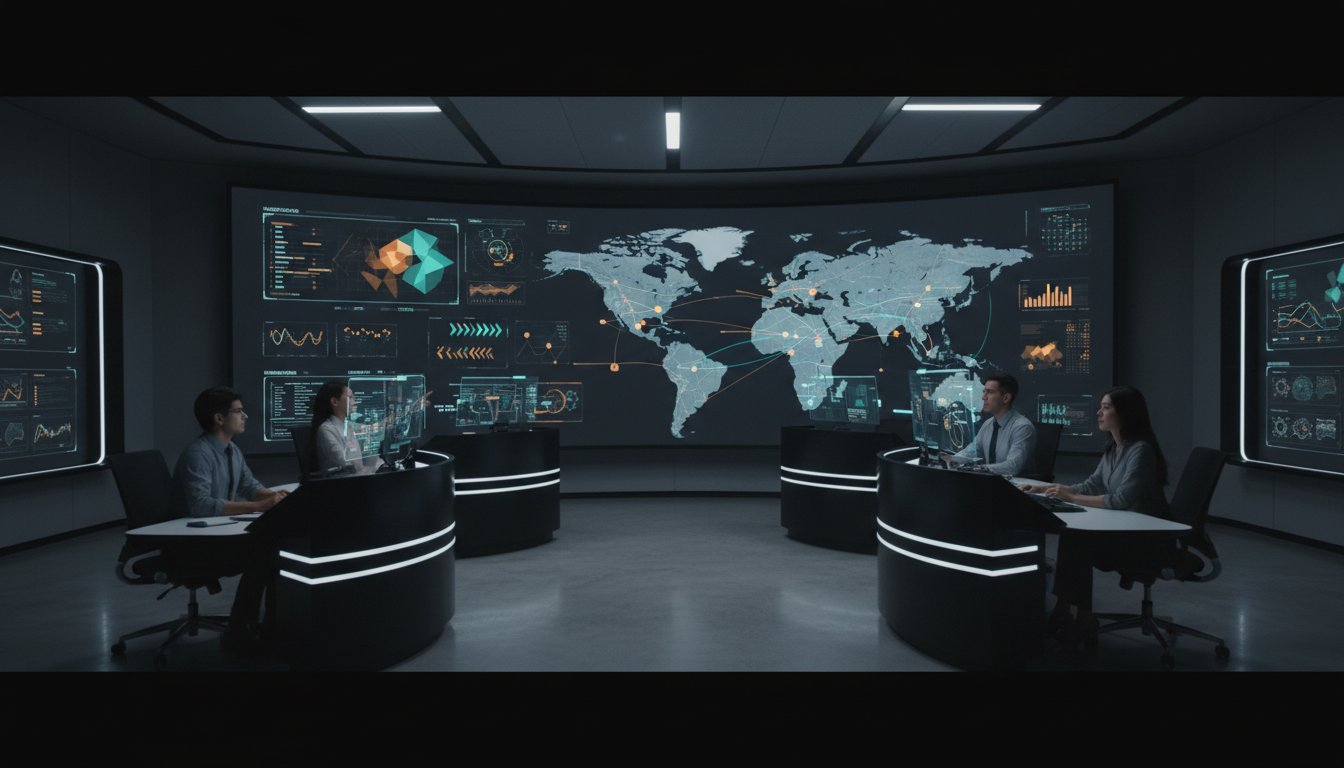
A traditional global security operations center setup often fails not because of a lack of data, but because of an inability to prioritize it. In 2026, automated systems handle over 90% of routine security alerts, yet many organizations still struggle with fragmented communication and analyst fatigue from monitoring static video feeds. You recognize the high stakes of managing infrastructure-critical decisions when disconnected tools delay your response. Most control rooms already have the screens. What they’re missing is the layer that decides what goes on them, and escalates automatically when something needs attention.
Partial solutions like Axon provide valuable data, but they lack the unifying intelligence layer required for a complete common operating picture. This article outlines how to architect a GSOC that delivers visibility into what matters most. You’ll learn how to implement an operational intelligence layer that automates threat escalation and ensures seamless collaboration between headquarters and local responders. We’ll examine the necessary transition from manual triage to strategic oversight, moving your team from a state of information overload to one of clear, actionable intelligence.
Key Takeaways
- Shift from reactive monitoring to a proactive, event-driven strategy that centralizes enterprise-wide risk management.
- Architect a high-performance global security operations center setup by implementing an operational intelligence layer to automate escalation and reduce analyst fatigue.
- Unify fragmented tools and siloed data feeds into a single platform that makes specialized software useful for the entire operational team.
- Design a scalable governance framework that establishes clear standard operating procedures for seamless collaboration between headquarters and local responders.
- Empower distributed teams by extending real-time situational awareness to mobile devices, ensuring every stakeholder has the same intelligence at the moment of decision.
The Evolution of Global Security Operations: Moving Beyond the Video Wall
A strategic global security operations center setup is the heartbeat of modern enterprise risk management. It functions as a centralized hub designed to ingest, analyze, and act upon data from across the globe. We’ve seen a decisive shift from reactive monitoring to proactive, event-driven situational awareness. In 2026, the traditional model of watching a wall of video feeds is obsolete. Analysts no longer have the luxury of waiting for incidents to appear on screen. They need a system that identifies threats before they escalate. Most control rooms already have the screens. What they’re missing is the layer that decides what goes on them, and escalates automatically when something needs attention.
Traditional regional security offices often operate as islands. This fragmented structure creates a silo effect where critical data from a local site never reaches the global command center. When global headquarters lacks a unified command structure, they lose the ability to coordinate a rapid response. Without an operational intelligence layer, a video wall is just a collection of expensive glass that fails to provide visibility into what matters.
Why Traditional Security Models Fail
Regional silos cause operational blindness. When a supply chain disruption or a security breach occurs, the cost of delayed intelligence is measured in millions of dollars. According to 2026 data, organizations using AI-augmented security services save an average of $1.8 million per incident compared to those relying on manual processes. Manual SITREP reporting in a 24/7 environment is too slow. By the time a report is typed and sent, the situation has already changed. This delay prevents leadership from making the infrastructure-critical decisions required to maintain continuity.
Defining the GSOC Mission: People, Assets, and Reputation
The GSOC mission has evolved to protect more than just physical buildings. It now encompasses executive protection, travel safety for employees in high-risk zones, and real-time brand reputation monitoring. This expanded scope requires a Common Operating Picture (COP) that remains consistent across multiple time zones and data types. Partial solutions like Axon offer visibility into specific field activities, but they don’t provide the total context needed for global decision-making. They require a unifying layer to be truly effective. Achieving this level of resilience is a core component of building mission-critical operations that empower people to act with certainty when stakes are at their highest.
Core Components of a High-Performance GSOC Architecture
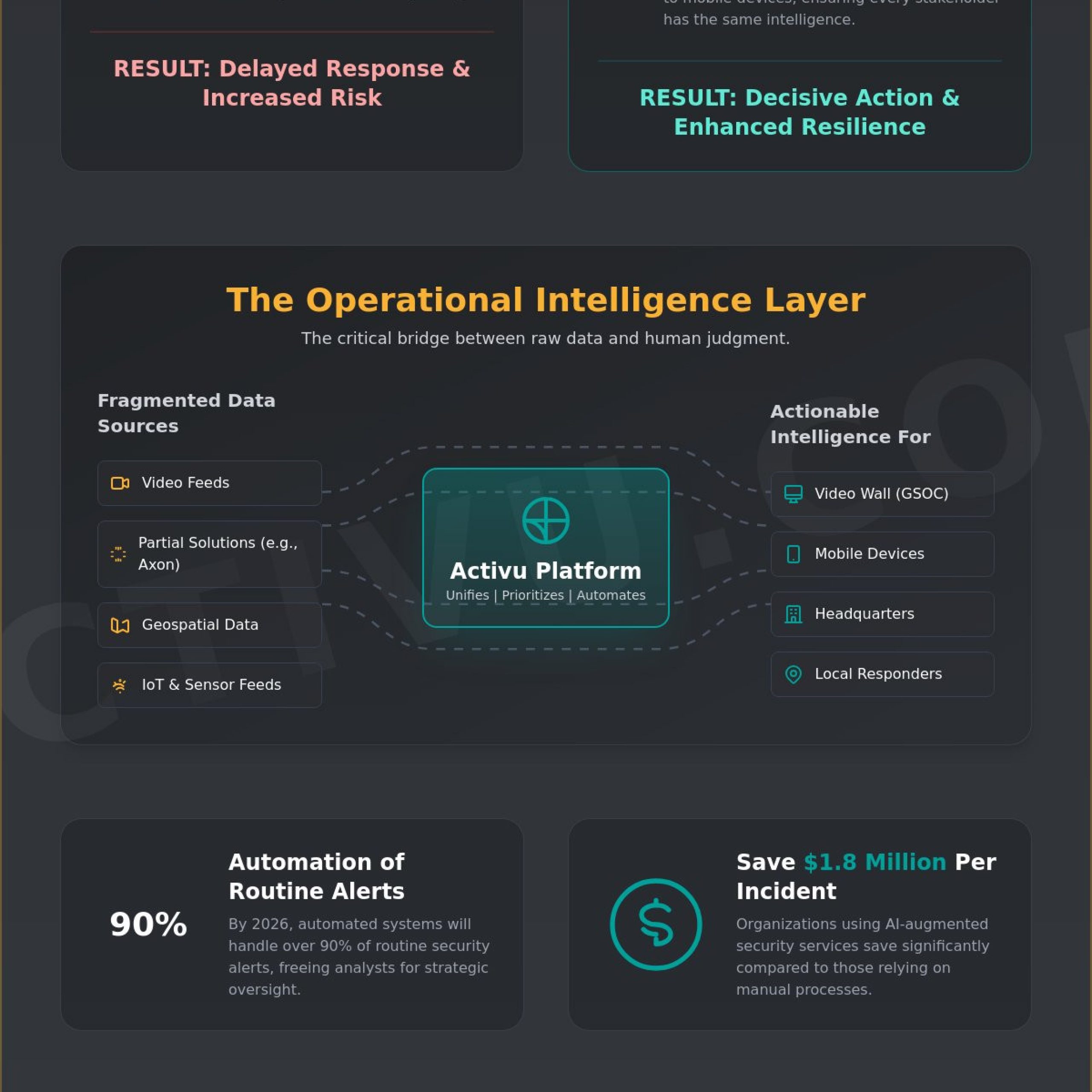
A high-performance global security operations center setup is not merely a collection of high-definition displays. It is a sophisticated ecosystem built upon three essential pillars: human intelligence, robust processes, and integrated technology. While many organizations focus on the physical layout, the true value of a GSOC lies in its ability to function as a collaborative hub rather than a static data repository. Most control rooms already have the screens. What they’re missing is the layer that decides what goes on them, and escalates automatically when something needs attention. This operational intelligence layer serves as the critical bridge between raw data feeds and human judgment.
The physical environment must support this mission. Ergonomic console furniture and strategic video wall placement are not about aesthetics; they are about reducing analyst fatigue. In a 24/7 environment, every design choice must facilitate long-term focus and rapid communication. When the stakes involve life-safety or infrastructure-critical decisions, the architecture must ensure that the right person sees the right information at the exact moment it matters. This requires a transition from manual monitoring to a system that prioritizes visibility into what matters most.
The Role of the Common Operating Picture (COP)
A Common Operating Picture (COP) provides a unified view of security, IT, and environmental data. By integrating geospatial analysis with real-time video feeds, the COP reduces the cognitive load on analysts during high-stress incidents. Instead of toggling between disconnected windows, your team sees a single, prioritized visualization. This clarity allows them to move from a state of complex data overload to a state of actionable intelligence. You can learn more about how to unify your operational visibility through an integrated intelligence layer.
Designing for Collaboration: Inside and Outside the Control Room
Effective GSOC architecture extends beyond the main command floor. It requires seamless data sharing between the center, local huddle rooms, and mobile responders. Visualization tools must support both macro-level global views for leadership and micro-level incident details for field agents. This ensures that everyone from the headquarters to the local responder is operating from the same set of facts. Hardware selected for these environments must meet the highest standards for 24/7 reliability, serving as the bedrock for successful critical operations. By focusing on these core components, you create a system that empowers people to act with greater certainty.
Solving the Problem of Tool Sprawl and Information Silos
A significant hurdle in any global security operations center setup is the management of tool sprawl. Organizations frequently deploy a Video Management System (VMS), a Security Information and Event Management (SIEM) platform, and various social media monitoring tools in isolation. While each tool provides data, they often exist as disconnected silos. This fragmentation forces analysts to manually correlate information across multiple interfaces, which increases the risk of human error during critical incidents. Most control rooms already have the screens. What they’re missing is the layer that decides what goes on them, and escalates automatically when something needs attention.
Some organizations attempt to use platforms like Axon to manage field assets, but these tools only provide a specialized slice of the total security picture. They lack the context of the broader enterprise environment. Similarly, while a SIEM is effective for log analysis and data retention, it does not solve the visual orchestration problem inherent in a command center. You need a unifying intelligence layer that acts as the central hub, making your existing tools more effective for the entire team. This layer transforms raw data into a cohesive narrative, allowing for a proactive response rather than constant fire-fighting.
The Limitations of Specialized Security Platforms
Specialized platforms create blind spots. When tools operate in isolation, an analyst must perform what is known as the “swivel-chair” correlation. This involves jumping between different screens to verify an alert from a threat intelligence platform against a live video feed. This manual process introduces unacceptable delays. In a mission-critical environment, the goal is to eliminate these gaps. Integrating these disparate feeds into a single interface ensures that the analyst spends less time searching for data and more time making informed decisions. By removing the friction of siloed information, you enable your team to act with greater certainty.
Automating Escalation: From Data to Decision
Event-driven visualization is the solution to information overload. Instead of showing every available data stream, the system should only display what is relevant to the current threat or operational status. This is achieved through an orchestration layer that handles automatic escalation when specific thresholds or triggers are met. For example, a breach detected by a perimeter sensor should automatically trigger the relevant camera feeds and local floor plans on the main display. Implementing the vis/ability platform provides this essential orchestration. It serves as the operational intelligence layer that bridges the gap between raw data and human judgment, ensuring that visibility into what matters is never lost.
Step-by-Step Guide to a Global Security Operations Center Setup
A successful global security operations center setup requires a methodical, five-phase approach to ensure technical reliability and human clarity. Most control rooms already have the screens. What they’re missing is the layer that decides what goes on them, and escalates automatically when something needs attention. By following a structured blueprint, organizations can transition from fragmented monitoring to a unified operating picture that supports infrastructure-critical decisions. This progression ensures that your technology remains a tool for empowerment rather than a source of fatigue.
Phase 1 & 2: Establishing the Foundation
Phase 1 begins with a comprehensive operational audit. You must identify every data source, from regional VMS feeds to global threat intelligence, and pinpoint where communication breaks down. It’s vital to conduct a thorough pain-point analysis to determine exactly where delays in incident response occur. Phase 2 focuses on governance and process design. Establishing standard operating procedures (SOPs) for global incidents ensures that responders act with certainty. You need a clear Responsibility Assignment Matrix (RACI) to define who manages a local event versus a global crisis. Tracking key performance indicators like Mean Time to Detect (MTTD) and Mean Time to Respond (MTTR) provides the data necessary to justify operational shifts and measure success.
Phase 3 & 4: Engineering the Visual Intelligence Hub
Phase 3 involves selecting the technology that serves as your operational intelligence layer. This platform must be vendor-agnostic to integrate with existing COTS hardware and avoid costly lock-in. Phase 4 is the engineering of the physical space. The layout of the video wall and operator consoles must account for ergonomic sightlines and room density. Incorporating professional Control Room Design Services ensures that human factors are balanced with technical requirements. This balance creates an environment that supports long-term focus and rapid collaboration during high-stakes events.
The final phase is implementation and training. Deployment isn’t complete until your team has undergone simulated ‘red team’ exercises. These drills test the automated escalation protocols and the seamlessness of the collaboration between the GSOC and local responders. This steady progression from audit to execution builds a resilient foundation for your security operations. Ready to begin your transformation? Contact our experts to start your operational audit today.
Extending GSOC Visibility to Mobile and Distributed Teams
A comprehensive global security operations center setup must extend beyond the physical confines of the command floor. Its true effectiveness is measured by its ability to communicate with field assets and distributed teams. If critical data remains trapped within the center, the person at the scene cannot act with certainty. Most control rooms already have the screens. What they’re missing is the layer that decides what goes on them, and escalates automatically when something needs attention. Extending this intelligence to mobile devices ensures that field responders possess the same Common Operating Picture as the analysts at headquarters.
This bi-directional flow of information is essential for modern operations. We call this the ‘reverse visibility’ model. Field users provide live video feeds directly from their mobile devices to the GSOC video wall, offering a perspective that fixed cameras cannot capture. For high-stakes environments such as executive protection or government use, this data sharing must be secure and encrypted. When every second counts, having a visual link between the command center and the field eliminates the ambiguity of verbal reports. It transforms the field agent from a passive recipient of orders into an active contributor to the operational intelligence layer.
Closing the Loop Between the Command Center and the Field
The ‘last mile’ of security is often the most vulnerable. It represents the gap between a decision made in the GSOC and the action taken on the ground. By providing mobile situational awareness, organizations significantly reduce radio traffic and improve response accuracy. Instead of describing a threat over a voice channel, analysts can push the relevant visual data directly to a responder’s device. Utilizing vis/ability mobile tools serves as the bridge for these distributed teams, ensuring that visibility into what matters is available anywhere, at any time. This connection ensures that the transition from fragmented data to actionable intelligence is complete.
Future-Proofing the GSOC: Scalability and AI Integration
As organizations expand into new global markets, the GSOC must scale without becoming overwhelmed by data. In 2026, AI plays a vital role in filtering the ‘noise’ from global threat data, allowing humans to focus on judgment rather than triage. Modern systems are designed to identify patterns across thousands of feeds and only alert the team when a threshold is met. This scalability ensures that your global security operations center setup remains a proactive engine of clarity, regardless of how many assets you manage. To design a GSOC that empowers your team with this level of intelligence, contact Activu today to speak with an operational expert.
Securing the Future of Global Operations
A resilient global security operations center setup requires moving beyond the limitations of fragmented data and siloed tools. You’ve seen how a unified common operating picture transforms reactive monitoring into proactive situational awareness. By implementing an operational intelligence layer, you bridge the gap between complex data and human judgment. Most control rooms already have the screens. What they’re missing is the layer that decides what goes on them, and escalates automatically when something needs attention.
Activu brings over 40 years of control room engineering experience to your mission. Our solutions serve as the bedrock for major utilities, transportation hubs, and federal agencies. We reduce incident response times by unifying fragmented data feeds into a single, actionable interface. This technical reliability provides the calm and clarity required to act when stakes are at their highest. Design your Global Security Operations Center with Activu’s vis/ability platform and achieve the operational intelligence required to protect your people and assets with absolute certainty.
Frequently Asked Questions
What is the primary difference between a SOC and a GSOC?
A Security Operations Center (SOC) typically focuses on digital infrastructure and cyber threats, whereas a Global Security Operations Center (GSOC) manages enterprise-wide risk. This includes physical assets, personnel safety, and brand reputation across multiple geographies. A global security operations center setup integrates physical security systems with digital intelligence to provide a holistic view of the organization’s risk profile.
How many analysts are typically required for a 24/7 GSOC setup?
A standard 24/7 GSOC requires approximately 10 to 12 full-time analysts to maintain coverage across five shifts. This staffing level accounts for 24/7/365 operations, including scheduled time off, training, and emergency surge capacity. Organizations can optimize these costs by utilizing an operational intelligence layer that automates over 90% of routine alerts, allowing analysts to focus on strategic oversight.
Can we build a GSOC using our existing security hardware?
You can build a high-performance GSOC using existing COTS (Commercial Off-The-Shelf) hardware if you implement a vendor-agnostic orchestration layer. Most control rooms already have the screens. What they’re missing is the layer that decides what goes on them, and escalates automatically when something needs attention. This software-centric approach prevents hardware lock-in and ensures your current investments remain useful.
What are the most common mistakes in GSOC design?
The most frequent mistake in global security operations center setup is prioritizing the video wall hardware over the data orchestration software. This leads to “wall of windows” syndrome, where operators are overwhelmed by static, non-prioritized feeds. Another common error is failing to design for the human element, such as ignoring ergonomic sightlines or neglecting the communication needs of mobile responders.
How does a GSOC handle data privacy and GDPR compliance across different regions?
A GSOC manages regional compliance through granular, role-based access controls and localized data masking. This ensures that while the global headquarters maintains situational awareness, specific PII (Personally Identifiable Information) remains restricted according to GDPR or CCPA requirements. The intelligence layer must be configured to respect these regional boundaries automatically without degrading the common operating picture.
What is the average timeline for a full GSOC implementation?
A full GSOC implementation typically follows a timeline of 6 to 12 months from the initial audit to final red-team exercises. This duration allows for the five phases of development, including governance design and technical integration of disparate tools like VMS and SIEM. Complex global deployments involving multiple regional hubs may extend toward the 12-month mark to ensure seamless cross-border collaboration.
How do we justify the ROI of a Global Security Operations Center to the board?
What role does a video wall play in a modern, software-driven GSOC?
In a software-driven GSOC, the video wall serves as the shared visual anchor that ensures every analyst sees the same prioritized intelligence. It is no longer a static display of every camera feed, but a dynamic canvas that only shows what matters during a critical event. This shared visibility empowers the team to act with collective certainty during high-stakes decisions.