
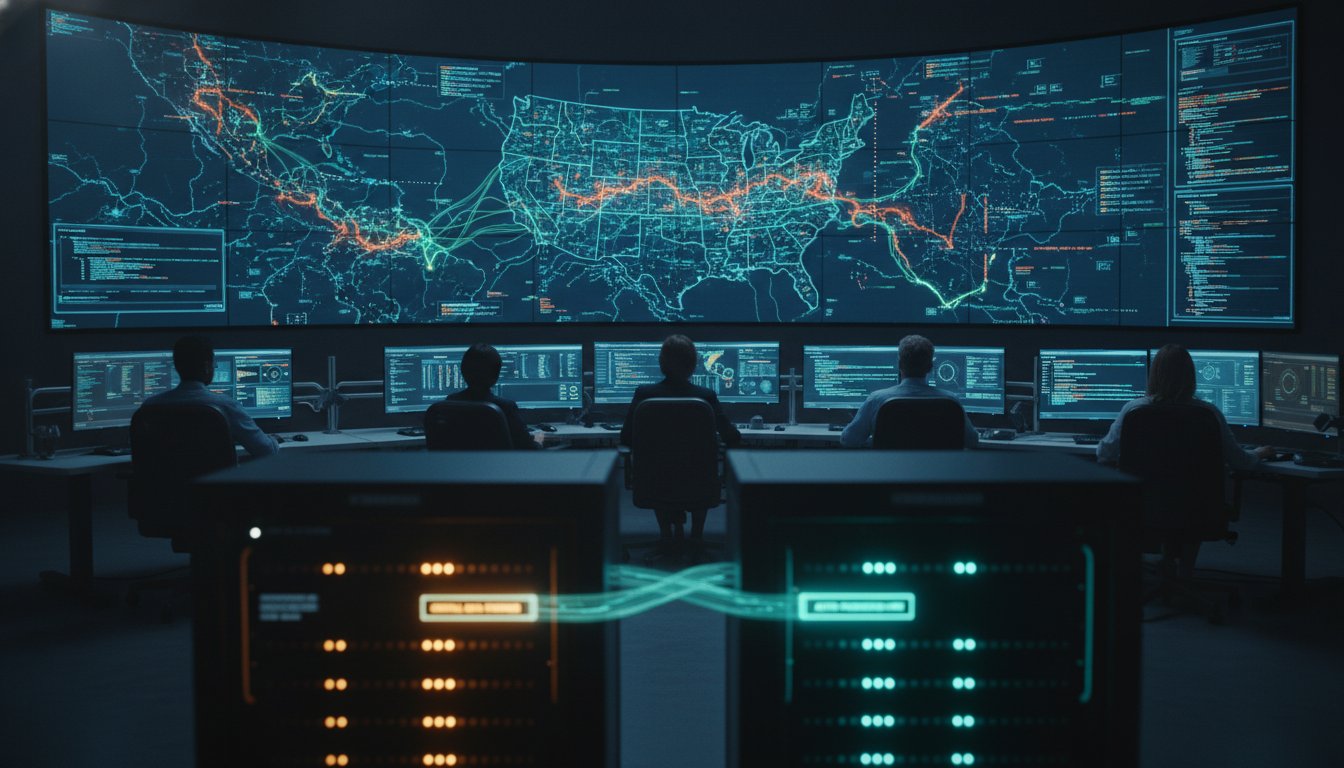
A single second of black screens during a high-stakes emergency isn’t just a technical glitch; it’s a failure of command that puts lives and infrastructure at risk. Operators often face the stress of fragmented data feeds and hardware configurations that are too complex to manage when every moment counts. Most control rooms already have the screens. What they’re missing is the layer that decides what goes on them, and escalates automatically when something needs attention. Without robust redundant video wall processor solutions, your situational awareness remains vulnerable to a single point of failure.
You understand that keeping your common operating picture live is non-negotiable, especially as updated NERC CIP reliability standards and CMMC 2.0 requirements demand absolute operational readiness. This article demonstrates how to eliminate downtime by implementing a fail-safe visualization architecture. We will explore how the vis/ability operational intelligence layer creates a unified hub for all data streams, ensuring your team maintains total visibility even if a primary hardware component fails.
Key Takeaways
- Identify the hidden vulnerabilities in command center architectures that cause operators to miss critical incidents during hardware failures.
- Implement redundant video wall processor solutions using the N+1 model to eliminate single points of failure across processing nodes and power supplies.
- Establish clear Recovery Time Objectives to ensure your visualization systems meet the strict uptime requirements of public safety and utility sectors.
- Move beyond basic hardware failover by integrating an operational intelligence layer that automatically prioritizes essential data when it matters most.
The Vulnerability of Single-Point Failure in Command Centers
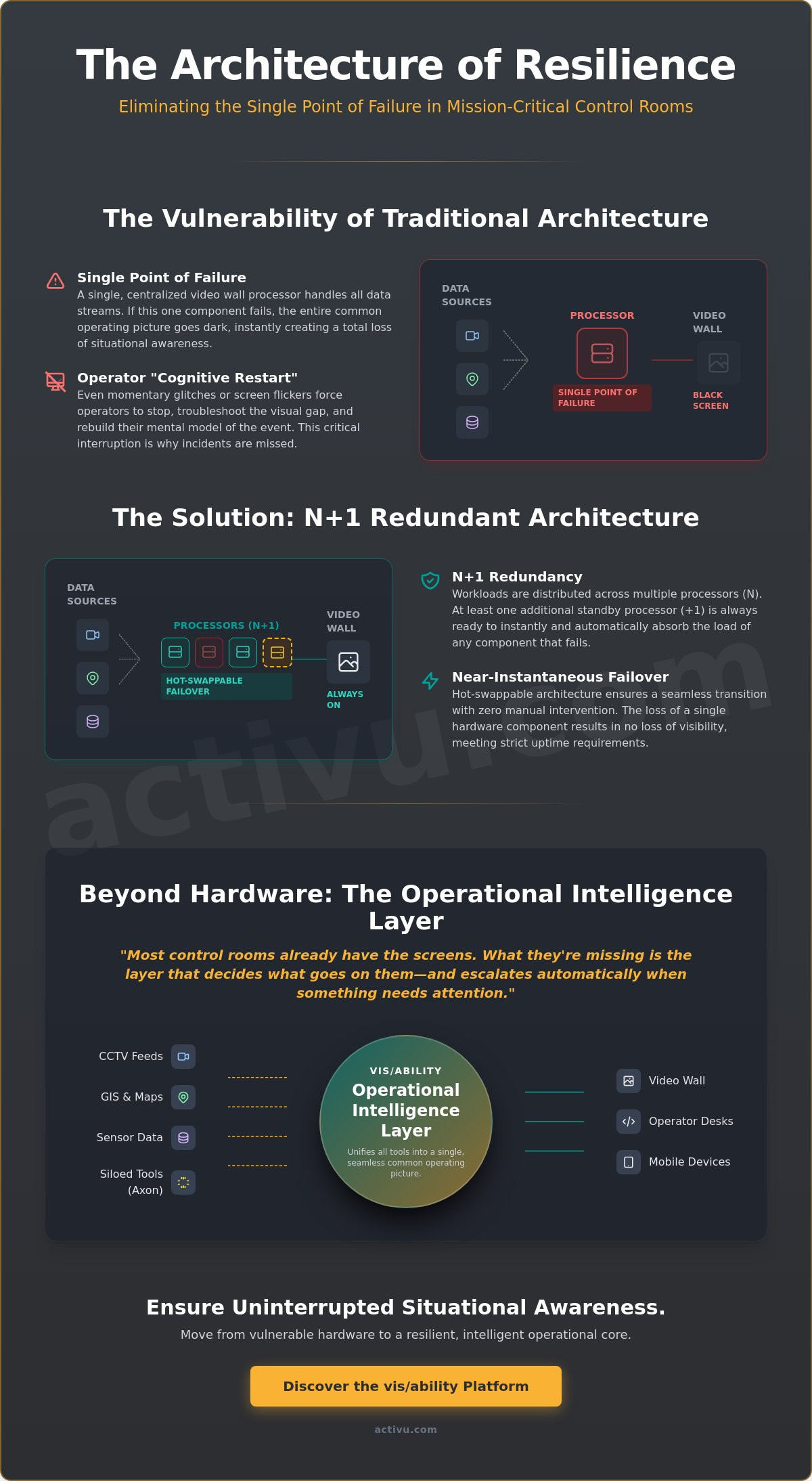
In high-stakes environments like 24/7 dispatch centers or utility grids, the video wall is the heartbeat of the operation. When this system fails, the result is more than a black screen. It’s a total loss of situational awareness that can lead to catastrophic delays in emergency response or grid management. Traditional video wall architectures often rely on a single central controller. If that controller fails, every data feed, map, and camera stream disappears. This vulnerability creates dangerous blind spots that prevent teams from acting with the speed and certainty required for public safety operations.
System instability does more than just hide data; it actively degrades operator performance. When a screen flickers or a feed lags, the human brain experiences a “cognitive restart.” Operators must stop their current analysis, troubleshoot the visual gap, and then attempt to re-establish their mental model of the event. This interruption is a primary reason why incidents are missed during critical windows. Most control rooms already have the screens. What they’re missing is the layer that decides what goes on them; and escalates automatically when something needs attention. Without redundant video wall processor solutions, the technical infrastructure becomes a liability rather than an asset.
Why Operators Miss Incidents During System Gaps
Momentary interruptions in data visualization are often dismissed as minor glitches, but they represent significant risks in mission-critical environments. If an operator is tracking a suspect or monitoring a fluctuating power load, even a three-second lag can result in a lost trail or a missed warning sign. Tools like Axon provide vital data, but they often remain siloed within their own interfaces. When these disparate tools aren’t unified by a central platform, operators are forced to toggle between screens. This fragmentation, combined with the lack of hardware failover, ensures that critical information remains hidden when it’s needed most.
The True Cost of Control Room Downtime
The financial and safety implications of a command center going dark are immense. In the energy sector, system reliability is directly linked to high availability standards and NERC CIP compliance. Relying on office-grade hardware in these settings is a recipe for failure. These consumer-level components aren’t designed for the thermal loads or continuous processing demands of a 24/7 NOC or SOC. True organizational continuity requires redundant video wall processor solutions that eliminate single points of failure. This shift from basic hardware to a multi-layered resilience strategy is the only way to guarantee that the operational intelligence layer remains active, regardless of individual component failures.
Architectural Layers of Redundant Video Wall Processor Solutions
Engineering a resilient command center requires a departure from traditional, centralized hardware. True reliability is achieved through a holistic system of hardware and software failovers that operate in unison. Redundant video wall processor solutions must address every potential failure point, from the incoming data signal to the final pixel on the display. This level of protection is often built on an N+1 redundancy model. In this configuration, at least one additional processing node stands ready to absorb the workload of any active node that fails. This ensures that the loss of a single component does not result in a loss of visibility.
The distinction between failover mechanisms is critical for mission-critical uptime. A “cold standby” system requires manual intervention or a reboot, leading to minutes of visual blackout. In contrast, hot-swappable architectures provide near-instantaneous transitions. The requirement for this level of resilience is increasingly documented in strategic planning for major infrastructure. For example, a government agency board report from the Los Angeles County Metropolitan Transportation Authority recently highlighted the necessity of a fully redundant processor to eliminate single points of failure in their security operations. By adopting network-distributed architectures, organizations prevent the catastrophic “all-or-nothing” failures common in aging matrix switcher setups.
Hardware Redundancy: Beyond Power Supplies
Network and Data Path Resilience
IP-based distribution has changed system uptime by allowing for diverse network routing. If one network path becomes congested or fails, the data stream finds an alternate route to the display. This decentralized approach ensures that a single cable break or switch failure doesn’t disable the entire video wall. Most control rooms already have the screens. What they’re missing is the layer that decides what goes on them, and escalates automatically when something needs attention. As the operational intelligence layer, vis/ability unifies these distributed streams, providing a resilient common operating picture for teams in the command center or those using mobile devices in the field.
Hardware Redundancy vs. Operational Intelligence
Reliability in a command center is often measured by uptime, yet hardware uptime alone is an incomplete metric for mission success. A screen that remains powered on but displays stale data or a frozen video feed is just as dangerous as a total blackout. While redundant video wall processor solutions provide the necessary physical failover, they must be paired with an intelligence layer that ensures the information remains relevant. True operational resilience requires a system that understands the context of the data it’s processing, moving beyond the capabilities of traditional “dumb” hardware controllers.
Most control rooms already have the screens. What they’re missing is the layer that decides what goes on them, and escalates automatically when something needs attention. This operational intelligence layer serves as the central hub into which all other tools flow. It transforms the video wall from a static display into a dynamic asset that prioritizes essential information during a crisis. Without this layer, even the most robust hardware remains a collection of disconnected silos that can lead to confusion when multiple incidents occur simultaneously.
The Myth of the ‘Industry Standard’ Standalone Processor
Some organizations continue to rely on basic standalone processors, viewing them as a safe choice for hardware procurement. These legacy systems often create significant bottlenecks because they lack the ability to scale or integrate with modern software-defined workflows. A standalone processor treats every input as equal, failing to distinguish between a routine security camera feed and a high-priority alert from a utility grid sensor. This lack of discernment forces operators to manually manage layouts during high-stress events, increasing the risk of human error. Modern redundant video wall processor solutions must do more than just mirror hardware; they must support a distributed architecture that allows for seamless content management across the entire enterprise.
Unifying Siloed Tools for Global Visibility
Managing disparate data sources is a primary challenge in any fusion center or high-stakes monitoring environment. Specialized tools like Axon provide critical evidence and real-time feeds, but they typically function as partial solutions. They lack the unifying display layer required to create a full common operating picture for the entire team. This fragmentation forces operators to jump between different interfaces, losing precious seconds during an emergency. The vis/ability platform fills these gaps by acting as the unifying operational intelligence layer. It integrates these siloed streams into a cohesive view, ensuring that critical data is accessible to teams in SOC, NOC, and GSOC environments. By aggregating real-time data and video into a single hub, the platform empowers decision-makers to act with greater certainty, regardless of where they’re located.
Designing for Resilience: A Framework for Redundant Processing
Step 1: Auditing the Operational Reality
The first step in designing for resilience is identifying where technical gaps currently compromise your team’s reaction time. Many command centers suffer from fragmented systems where data is siloed in separate applications. This fragmentation forces operators to act as the “integration layer,” manually piecing together information during a crisis. Analyzing the flow from raw data to human judgment reveals the true single points of failure in your operation. For utilities and energy operations, the criticality of specific feeds, such as grid stability maps or weather overlays, cannot be overstated. A failure in these visualizations directly impacts the ability to prevent widespread outages.
Step 2: Implementing Automated Escalation
True resilience isn’t just about keeping the equipment running; it’s about ensuring the most relevant data reaches the right person at the right time. Most control rooms already have the screens. What they’re missing is the layer that decides what goes on them, and escalates automatically when something needs attention. This is where event-driven situational awareness becomes a game-changer. By setting up automated triggers, the system can detect an anomaly and immediately push the corresponding camera feeds or data charts to the video wall. This “automated redundancy” removes the burden from the operator, ensuring that situational awareness is maintained even if the primary workflow is disrupted.
Extending this intelligence beyond the physical walls of the command center is equally important. Field-based teams require the same level of situational awareness as those in the NOC. Mobile extension of the vis/ability platform ensures that data continuity is maintained across the entire organization. When you integrate these mobile capabilities with redundant video wall processor solutions, you create an ecosystem where information remains actionable regardless of where the decision-maker is standing. If you’re ready to audit your current system for these critical gaps, contact our design experts to begin building a more resilient operation.
vis/ability: The Operational Intelligence Layer for Fail-Safe Visibility
The hardware failovers discussed previously provide the physical foundation for uptime. However, true mission success depends on the intelligence driving those pixels. Most control rooms already have the screens. What they’re missing is the layer that decides what goes on them; and escalates automatically when something needs attention. As the operational intelligence layer, vis/ability serves as the central hub where all data streams converge. It transforms redundant video wall processor solutions from passive hardware into active participants in incident response. This platform ensures that even during a hardware failover, the team’s visual context remains unbroken and actionable.
Operational readiness requires a platform that remains focused and analytical when stakes are at their highest. By serving as the unifying engine behind your displays, vis/ability removes the complexity of managing multiple data feeds. It provides the steady reassurance that your common operating picture is always accurate. This shift from manual management to automated intelligence allows your team to focus on pivotal decisions rather than troubleshooting technical gaps.
Beyond the Video Wall: Distributed Collaboration
Situational awareness cannot be confined to a single room. In complex public safety and emergency response scenarios, the ability to share a common operating picture with remote stakeholders is vital. The vis/ability platform extends this visibility to huddle rooms and mobile devices, ensuring that field commanders see exactly what dispatchers see. This distributed collaboration model provides a second layer of redundancy. If a primary facility faces an outage, the mission continues through mobile vis/ability and remote access points. This continuity empowers individuals to act with certainty, knowing their data is consistent across the entire enterprise.
Securing the Mission with a Cybersecurity COP
Modern operations are inseparable from the networks that support them. A comprehensive strategy for redundant video wall processor solutions must include a Cybersecurity Common Operating Picture. By integrating network health and threat intelligence directly into the display, vis/ability allows teams to visualize their cybersecurity posture in real time. This visibility prevents operational disruptions by highlighting potential vulnerabilities before they impact the mission. It bridges the gap between raw technical data and strategic human judgment, positioning the technology as an essential guardian of your operations. To ensure your command center is built on a foundation of absolute reliability, we invite you to contact Activu for a tailored redundancy strategy.
Securing the Future of Mission-Critical Operations
Operational continuity in high-stakes environments depends on more than just hardware uptime. It requires a strategic shift from monitoring static displays to leveraging a dynamic intelligence layer. True resilience is achieved when redundant video wall processor solutions are integrated into a framework that prioritizes essential data automatically. This approach eliminates single points of failure and ensures that your common operating picture remains live, regardless of component degradation. Most control rooms already have the screens. What they’re missing is the layer that decides what goes on them, and escalates automatically when something needs attention.
With 40 years of mission-critical experience and patented event-driven automation technology, Activu provides the bedrock upon which critical decisions are made. Our systems are trusted by Federal Government and Defense agencies to maintain situational awareness when every second counts. You can move from a state of technical complexity to one of clear, actionable intelligence by auditing your current visualization gaps today. Take the next step toward a fail-safe architecture and Request a Demo of the vis/ability Operational Intelligence Layer. Your mission deserves the unwavering dependability of a partner focused on your operational success.
Frequently Asked Questions
What is the difference between N+1 and 2N redundancy in video wall processors?
N+1 redundancy utilizes a single spare component to back up a group of active units, whereas 2N redundancy provides a complete mirror of the entire system. While N+1 is an efficient way to protect multiple processing nodes, 2N architectures offer the highest degree of reliability by ensuring every primary component has a dedicated secondary. This choice depends on your specific recovery time objectives and the criticality of each visual stream in your command environment.
How does an IP-based video wall processor improve system redundancy?
IP-based architectures improve redundancy by distributing the processing load across a decentralized network rather than relying on a central matrix switcher. These redundant video wall processor solutions utilize diverse network routing to ensure that data packets find an alternate path if a specific switch or cable fails. This approach prevents the “all-or-nothing” failure scenarios common in legacy hardware setups, maintaining visibility across the entire video wall even during partial network disruptions.
Can redundant video wall solutions prevent operator fatigue?
Redundant visualization systems prevent operator fatigue by eliminating the cognitive load associated with system instability and technical troubleshooting. When a system is prone to flickering or lag, operators must constantly re-evaluate their visual context, which leads to rapid mental exhaustion. A fail-safe architecture provides the steady reassurance that critical information will remain visible, allowing the team to focus entirely on decision-making and incident response during high-stress operations.
Why is software-level redundancy more important than hardware-only backups?
Software-level redundancy is critical because it ensures the operational intelligence layer remains active even if physical components are compromised. Hardware backups only keep the screens powered; they don’t manage the logic of data prioritization or automated escalation. Without a resilient software layer, your team might be left looking at a powered screen that displays stale or irrelevant information, which is a significant risk in mission-critical environments.
How do I integrate disparate data feeds into a redundant common operating picture?
Disparate data feeds are integrated by using a unifying operational intelligence layer that serves as the central hub for all incoming streams. This platform aggregates video, geospatial data, and real-time alerts into a single common operating picture. By using a platform like vis/ability, organizations can bridge the gap between siloed tools, ensuring that every member of the team has access to the same prioritized information regardless of their location.
What happens to the video wall if the primary control room network fails?
A resilient video wall system utilizes secondary, redundant network paths to maintain operations if the primary control room network fails. This failover happens automatically, rerouting mission-critical video and data streams through diverse infrastructure to prevent any loss of situational awareness. This level of network resilience is a core requirement for organizations that must comply with strict uptime standards like NERC CIP or maintain 24/7 readiness in public safety.
Are redundant video wall processors compatible with existing legacy displays?
Modern redundant video wall processor solutions are compatible with legacy displays through the use of standard interface protocols and adaptable output configurations. This allows organizations to modernize their processing and intelligence layers while continuing to utilize their existing screen infrastructure. By focusing the upgrade on the processing engine and software layer, you can achieve mission-critical reliability without the massive capital expenditure required for a total hardware replacement.
How does event-driven visualization contribute to system resilience?
Event-driven visualization enhances resilience by automating the delivery of critical data to the video wall based on pre-defined triggers. Most control rooms already have the screens. What they’re missing is the layer that decides what goes on them, and escalates automatically when something needs attention. By removing the need for manual layout changes during a crisis, this technology ensures that the most important information is always prioritized, reducing human error and accelerating response times.