
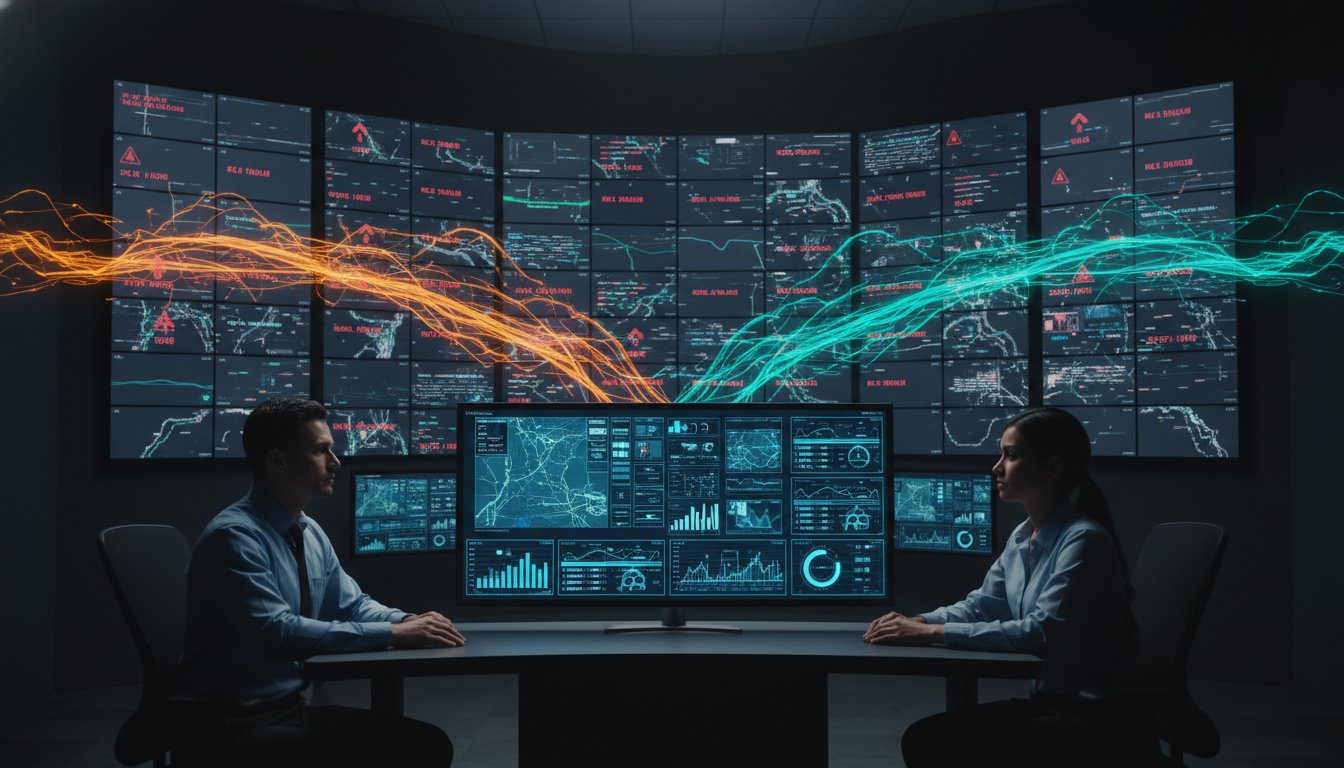
Traditional IT failover is a safety net that often fails to catch the most critical element of a crisis: your ability to see and act. Effective control room disaster recovery planning must account for the loss of visual intelligence, not just the loss of servers. When a primary center goes dark, operators frequently move to secondary sites only to find fragmented systems and siloed data that prevent a unified response. Tools like Axon provide essential data, but they only offer a partial solution and require a unifying layer to create a full common operating picture. You can’t manage what you can’t see. Missing a single critical incident during a transition leads to delays that cost a median of $33,333 per minute, according to 2025 industry reports.
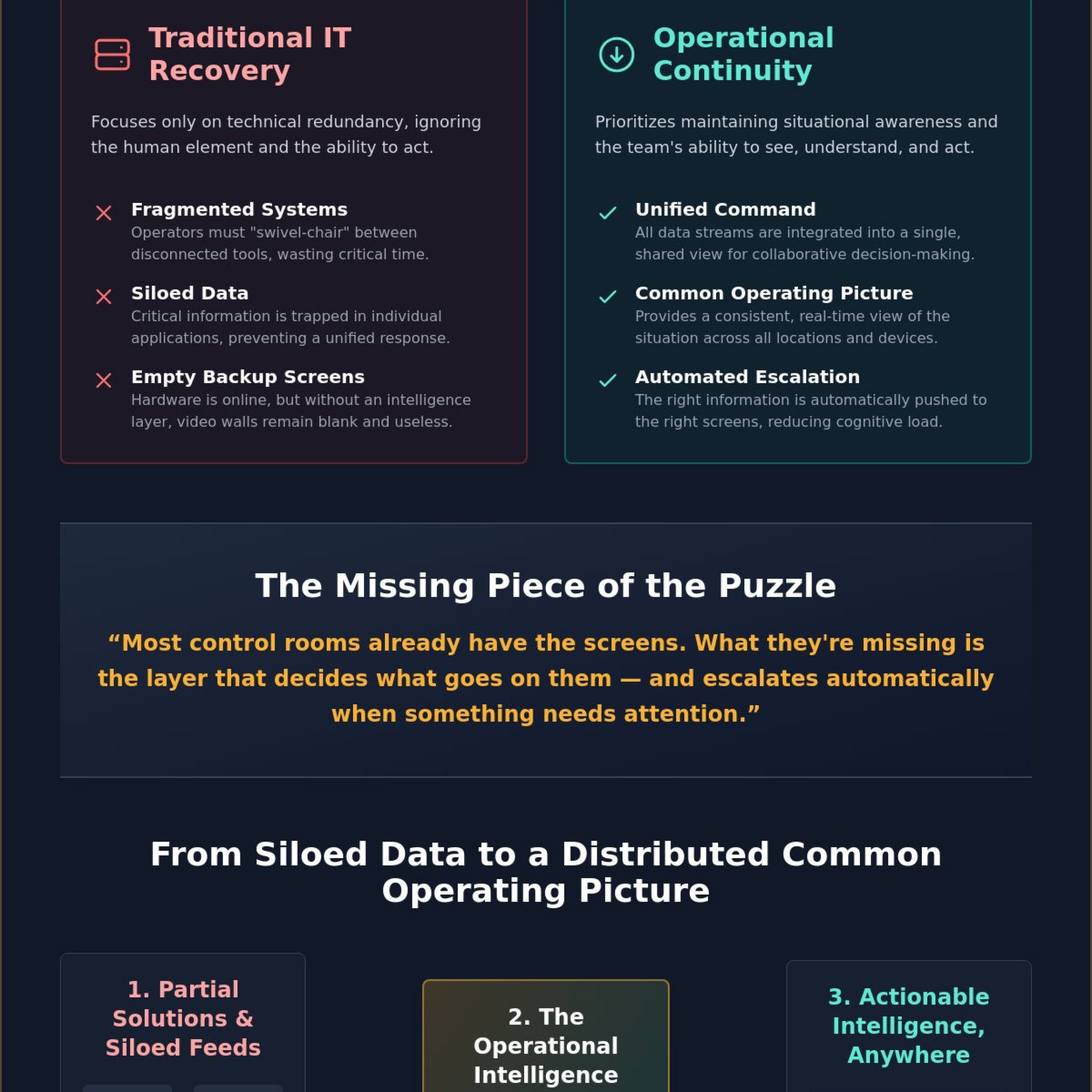
Most control rooms already have the screens. What they’re missing is the layer that decides what goes on them, and escalates automatically when something needs attention. You likely already understand that technical redundancy is only half the battle. This article details how to maintain situational awareness and unified command even when your primary control center is compromised. We’ll examine the shift toward an operational intelligence layer that ensures the right information reaches the right people anywhere, reducing cognitive load and accelerating response times through automated escalation.
Key Takeaways
- Shift your focus from simple server failover to operational continuity, ensuring your team retains the ability to act when primary systems are compromised.
- Integrate control room disaster recovery planning with a framework that eliminates visibility dead zones and prevents the failure of siloed data streams.
- Recognize why backup video walls often remain empty or irrelevant without an intelligent layer to automate and prioritize critical information.
- Establish a distributed common operating picture that extends situational awareness to huddle rooms and mobile devices during a site evacuation.
- Transition from fragmented toolsets to a unified operational intelligence layer that serves as the central hub for all mission-critical data and human judgment.
The Hidden Risks of Fragmented Visibility in Disaster Recovery
Disaster recovery often fails not because the data is gone, but because it is inaccessible to the people who need it most. Traditional control room disaster recovery planning focuses heavily on data backups and server uptime. While these are necessary, they’re insufficient for maintaining a common operating picture. When a crisis strikes, the technical ability to restore a database doesn’t equate to the operational ability to manage a response. You can’t act on what you can’t see.
Most control rooms already have the screens. What they’re missing is the layer that decides what goes on them, and escalates automatically when something needs attention. Without this intelligence, a failover site is just a room full of expensive, empty glass. If your data is safe but your operators are blind, your recovery has failed.
Entering Through the Pain: Fragmented Systems and Siloed Data
Most command centers operate as a patchwork of disconnected tools. During normal operations, these inefficiencies are manageable. In a crisis, they become catastrophic. Siloed data prevents a unified response and forces operators into “swivel-chair” operations, where they must manually jump between screens to piece together a story. This process consumes precious seconds when lives or infrastructure are at risk. When fragmented systems delay a decision by just five minutes, the median cost reaches over $166,000, based on 2025 industry data regarding outage expenses.
Disasters amplify existing inefficiencies in data integration. If your dispatch system doesn’t communicate with your geospatial oversight tools, you lose the ability to route resources effectively during a flood or a cyberattack. This visibility gap creates intense cognitive overload. Operators are often forced to navigate unfamiliar interfaces in a high-stakes environment. Comprehensive Business continuity planning must look past the server rack and address the human element. Successful control room disaster recovery planning ensures that the transition to a backup site doesn’t result in a total loss of situational awareness. While some organizations focus primarily on physical site reinforcement or building location, these strategies fail to address how fragmented software systems collapse under the stress of a disaster.
The Problem with Partial Solutions
Organizations frequently use platforms like Axon for situational video or specific SIEMs for network monitoring. These tools are valuable, but they offer only a narrow view of the operational landscape. They’re partial solutions that require a unifying layer to create a full common operating picture. For Public Safety Solutions to remain effective during a crisis, data from these disparate sources must flow into a central operational intelligence layer. This ensures that when a primary center is compromised, the unified command structure remains intact. Relying on individual applications during a failover event often leads to missed incidents because critical information is trapped in a silo, invisible to the larger team.
IT Recovery vs. Operational Continuity: Defining the Difference
Standard IT disaster recovery metrics often fail to capture the reality of a high-stakes command environment. While a Recovery Time Objective (RTO) might confirm that a database is back online, it provides no guarantee that the operations team has regained situational awareness. For mission-critical centers, the goal isn’t just to restore data. The goal is to restore the ability to act. Effective control room disaster recovery planning must distinguish between simple system uptime and true operational continuity.
Most control rooms already have the screens. What they’re missing is the layer that decides what goes on them, and escalates automatically when something needs attention. Without this intelligence, technical recovery is hollow. A common operating picture (COP) serves as the unifying platform that makes data useful. If your recovery plan ignores how information is visualized and shared across the team, your operators will remain in the dark despite having functioning servers. Following business continuity plan guidance from Ready.gov is a vital starting point, but specialized operations require a deeper focus on the continuity of visual intelligence.
Why System Uptime is Not Situational Awareness
Uptime is a technical state; situational awareness is a human state. A recovered server might be processing millions of lines of telemetry, but if that telemetry isn’t translated into a geospatial map or an actionable alert, it remains noise. Operational Continuity is the bridge between raw data and human judgment. It ensures that the command hierarchy remains intact and informed, regardless of which physical site they occupy. When you shift from reactive data restoration to proactive situational awareness, you prioritize the delivery of essential intelligence over the mere presence of data in a storage array. This is critical when you consider that in 2025, 87% of IT professionals experienced SaaS data loss, yet only 14% were confident in their ability to recover that data within minutes; leveraging infrastructure automation from progress.com can help bridge this gap between technical recovery and operational readiness.
The Human Element in Disaster Resilience
Operator fatigue is a primary risk during a failover event. When a team moves to a backup site, they often face unfamiliar layouts and fragmented workflows. This increases cognitive load at the exact moment when precision is most required. A resilient operations model ensures that the recovery environment mirrors the primary environment. Consistent workflows across sites allow teams to maintain focus on the mission rather than the tools. For modern SOC and NOC Control Rooms, this means the software layer must be the constant. If you want to see how this unified layer improves response, you might consider how a centralized hub can streamline your operational intelligence.
Why Hardware Redundancy Fails Without Integrated Intelligence
Hardware redundancy is often mistaken for operational readiness. In many control room disaster recovery planning scenarios, organizations invest heavily in secondary sites with identical video wall hardware, yet they fail to address the intelligence gap. Most control rooms already have the screens. What they’re missing is the layer that decides what goes on them, and escalates automatically when something needs attention. Without this layer, your backup site suffers from “Empty Screen” syndrome. You have the glass, but you lack the logic to populate it with the specific data feeds required for the current crisis.
Relying on hardware alone ignores the “last mile” of disaster recovery: the delivery of actionable intelligence to the human operator. While data replication ensures that information exists somewhere on a server, it doesn’t ensure that information is visible. When a median annual cost of outages reaches $76 million, as reported in 2025, the inability to visualize critical data is a liability you cannot afford. Bridging the gap between disparate data feeds and human judgment requires more than just a secondary monitor; it requires a central hub that unifies your entire operational environment.
The Myth of the “Standard” Industry Solution
Some organizations rely on legacy video wall processors because they’ve been used for years. While these tools are common, they’re inherently limited by their hardware-centric design. They cannot easily adapt to distributed teams or mobile needs. A software-defined operational intelligence layer is required to maintain continuity across different physical locations. Integrated technologies like Axon provide essential video data, but they only offer a partial solution. Without a unifying platform, that data remains siloed, forcing operators to manually hunt for information while the clock is ticking. True resilience comes from a platform that makes these tools useful for the entire team, regardless of their device or location.
Automation as a Resilience Strategy
Automation serves as a force multiplier during high-stress failover events. Event-driven triggers ensure that when a critical threshold is met, the relevant data automatically finds the operator. This removes the burden of manual information gathering, which is often the first process to break during a disaster. Automated alerts prevent incident oversight when alert volumes are high, ensuring that your team remains focused on the most critical threats. For those managing complex responses, integrating Incident Management Software with your visual intelligence layer creates a seamless flow of information. This proactive approach ensures that your team acts with certainty, rather than reacting to a screen that hasn’t updated in ten minutes. By shifting the burden of data organization to an automated layer, you reduce operator fatigue and accelerate incident response times.
Developing an Event-Driven Disaster Recovery Framework
Most control rooms already have the screens. What they’re missing is the layer that decides what goes on them, and escalates automatically when something needs attention. An operational intelligence layer unifies disparate data streams into a single, resilient interface. This platform serves as the central hub where all other tools flow, making them useful for the entire team regardless of their physical location. By automating escalation protocols based on specific triggers, you remove the reliance on manual intervention when stress levels are highest.
Extending Visibility Beyond the Command Center
Disaster recovery often forces teams into the field or remote huddle rooms. You must train for the “Mobile Moment.” This is the point where situational awareness must transition seamlessly from a massive video wall to a tablet or smartphone. Field teams and remote executives require identical visibility to ensure coordinated action. Maintaining a unified operating picture across geographically distributed teams prevents the information lag that often plagues site evacuations. For those managing complex networks, achieving Transportation Industry Visibility requires this level of mobile integration to keep transit systems moving during a disruption.
Event-Driven Escalation in Practice
Automation transforms a passive display into an active participant in your recovery strategy. Consider a NERC CIP violation or a significant cybersecurity breach. In a resilient framework, these events trigger an immediate, automated change in the video wall layout. The relevant geospatial data, camera feeds, and system alerts are instantly prioritized and shared across the network. This reduces the time between threat detection and human response. Instead of searching for the right data, your operators receive it automatically. You can explore more about these strategies in our Operational Continuity Guide. To see how this intelligence layer can protect your specific environment, request a demonstration of the vis/ability platform today.
vis/ability: The Operational Intelligence Layer for Resilient Command
Resilience in high-stakes environments requires more than just a secondary site; it requires a platform that maintains the integrity of your command structure. The vis/ability platform serves as this critical operational intelligence layer. It acts as the central hub where all your disparate data streams converge, ensuring that situational awareness remains uninterrupted during a crisis. While many organizations invest in physical site design, they often overlook the software layer needed to unify that design with real-time data. Effective control room disaster recovery planning must prioritize this digital glue to prevent the collapse of your common operating picture when the primary center is compromised.
Most control rooms already have the screens. What they’re missing is the layer that decides what goes on them, and escalates automatically when something needs attention. Without this intelligence, your team is left to manually assemble a response from fragmented tools. Transitioning from a state-of-the-art NOC to a backup huddle room or mobile device should take seconds, not hours. vis/ability enables this seamless failover by ensuring that the same visualizations available on your primary video wall are instantly accessible on any authorized device across your network.
The Hub for All Your Mission-Critical Tools
A resilient command structure is only as strong as its weakest silo. Tools like Axon, SIEM platforms, and IoT sensors provide essential data, but they often operate in isolation and offer only a partial solution. vis/ability solves this pain by acting as the unifying layer that makes these tools more useful for the entire team. By integrating these feeds into a single interface, you eliminate the need for operators to jump between applications during an emergency. This “exit toward vis/ability” strategy ensures that your recovery isn’t just about restoring systems, but about restoring the clarity needed for human judgment. You can explore how this integration works on our vis/ability Platform page, where we detail the transition from raw data to actionable intelligence.
Securing Your Operational Future
Modern disaster recovery must account for the increasing frequency of cyber threats. A unified cybersecurity common operating picture is no longer optional; it’s the bedrock of a proactive resilience strategy. vis/ability provides a clear visualization of your security posture, allowing you to see threats as they emerge and respond before they escalate into full-scale disruptions. This level of oversight values intelligence over mere hardware redundancy. It positions your organization to act with certainty, regardless of the challenges you face. To ensure your center is prepared for the unexpected, contact Activu Corporation for a Control Room Resilience Audit. Our experts will help you identify visibility gaps and implement a framework that ensures your control room disaster recovery planning delivers true operational continuity.
Securing Operational Continuity through Intelligence
Operational resilience is not a static state. It’s a continuous capability that requires moving beyond simple server uptime to complete situational awareness. True control room disaster recovery planning must prioritize the delivery of actionable intelligence to the human operator, regardless of their location or device. Most control rooms already have the screens. What they’re missing is the layer that decides what goes on them, and escalates automatically when something needs attention. By unifying siloed data into a single operational intelligence layer, you ensure that your command structure remains intact during your most critical moments.
Activu Corporation is trusted by Federal Defense and National Utilities to provide the bedrock for high-stakes decision-making. The vis/ability platform reduces incident response times through automated escalation and provides seamless mobile integration for distributed teams. This ensures that field units and remote huddle rooms maintain the same visibility as the primary center. You can move from a state of complexity to a state of clear, actionable intelligence with a framework designed for the reality of modern operations.
See how vis/ability ensures operational continuity during your most critical moments.
Frequently Asked Questions
What is the most common failure in control room disaster recovery planning?
The most common failure is prioritizing hardware and data backups over the ability to visualize that data. Many organizations successfully restore their servers but fail to account for how operators will access and share information at a backup site. This oversight leads to “Empty Screen” syndrome, where technical recovery is complete but operational intelligence is absent. Effective control room disaster recovery planning must ensure that the visual layer is as redundant as the data layer.
How does operational continuity differ from standard IT disaster recovery?
Operational continuity focuses on maintaining the command hierarchy’s ability to make decisions, whereas IT recovery focuses on system uptime. A server that is online is useless if its data is trapped in a silo and cannot be shared. Operational continuity serves as the bridge between raw data and human judgment. It ensures that the team retains its situational awareness and unified command structure regardless of the physical environment or technical disruptions.
Why do operators often miss critical incidents during a disaster failover?
Operators miss incidents due to the cognitive overload caused by fragmented systems and unfamiliar failover environments. Most control rooms already have the screens. What they’re missing is the layer that decides what goes on them, and escalates automatically when something needs attention. Without this automated prioritization, operators must manually hunt for data across disconnected tools. This manual process is prone to failure during high-stress crises when every second counts.
Can we maintain situational awareness if our main video wall is offline?
You can maintain awareness if you utilize a software-defined operational intelligence layer that is independent of specific hardware. This approach allows your common operating picture to follow the team to huddle rooms or mobile devices. By decoupling the visualization from the physical video wall, you ensure that the command center’s intelligence remains accessible even if the primary facility is completely offline or inaccessible due to a disaster.
What role does event-driven visualization play in disaster recovery?
Event-driven visualization removes the burden of manual data gathering by automatically pushing critical feeds to operators based on pre-defined triggers. During a disaster, the volume of alerts can be overwhelming. Automation ensures that the most relevant information, such as a security breach or a system failure, is prioritized and displayed. This reduces the time between threat detection and response, ensuring that the team acts with certainty rather than searching for data.
How do we ensure NERC CIP compliance during a control room failover?
Compliance is maintained by ensuring that security oversight and visibility are consistent across all recovery sites. Control room disaster recovery planning must include a unified cybersecurity common operating picture that survives the failover process. This allows your team to monitor for threats and maintain regulatory standards without interruption. Automated logging and persistent visualization of security postures provide the necessary proof that control was never lost during the transition.
Is it possible to extend our common operating picture to mobile users during a crisis?
It is entirely possible and necessary to extend your operating picture to mobile devices. Seamless mobile integration ensures that field teams and remote executives have identical visibility to the command center. This is especially critical during facility evacuations or distributed operations. By providing a unified view on tablets and smartphones, you eliminate the information lag that often occurs when teams are forced away from their primary workstations.
How can we unify siloed data feeds like Axon into our disaster recovery plan?
You unify siloed feeds by integrating them into a central operational intelligence layer that serves as a hub for all mission-critical data. Tools like Axon provide vital video feeds but only offer a partial solution on their own. By pulling these feeds into a unifying platform, you make them useful for the entire team. This ensures that specialized data is no longer trapped in an individual application but is part of the shared operating picture.