
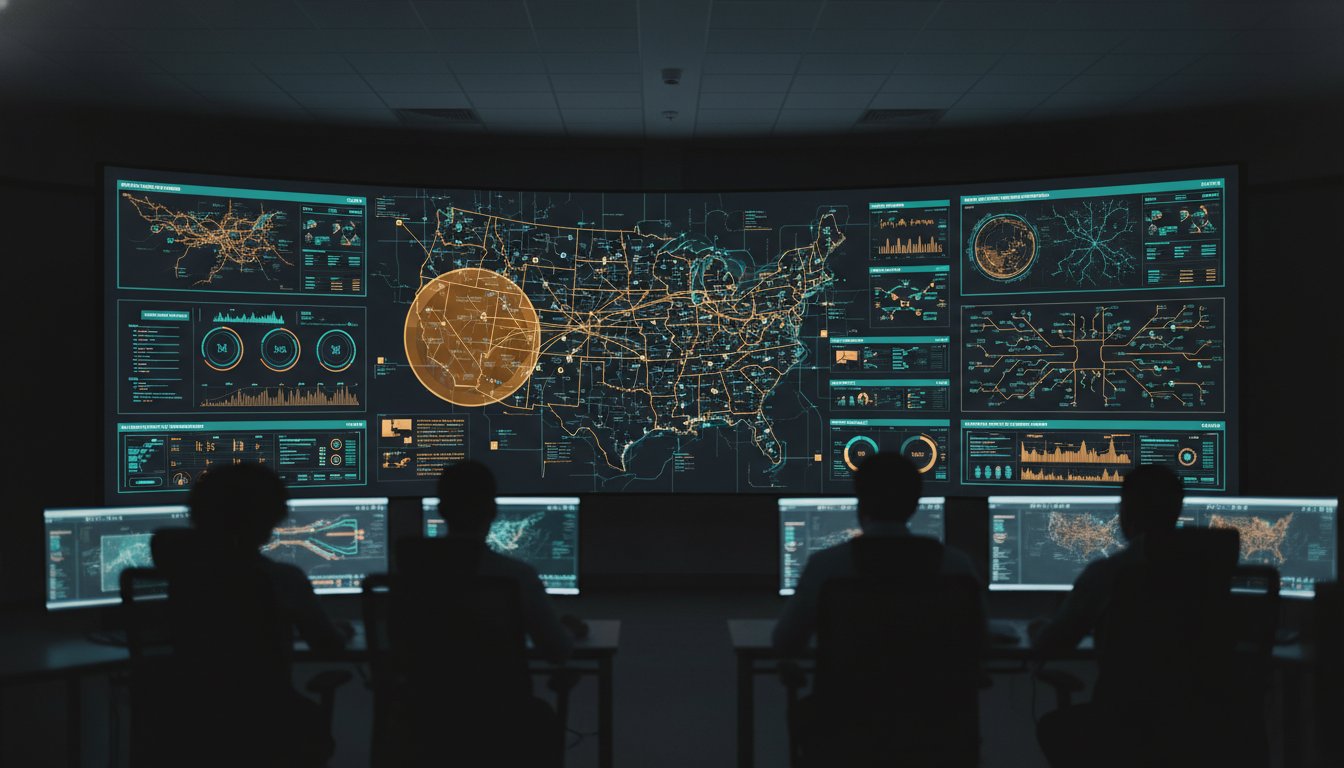
A command center that stays powered on but fails to update its data during a crisis is effectively dark. As the global security control room market reaches $12.1 billion in 2026, organizations are realizing that traditional hardware redundancy is no longer enough to manage modern complexity. You likely already feel the strain of siloed data feeds that refuse to communicate, or the risk of system downtime during peak crisis moments. Implementing high-availability control room systems must now account for more than just power supplies and server clusters. It requires a resilient architecture that keeps operators focused on the mission rather than managing disconnected screens.
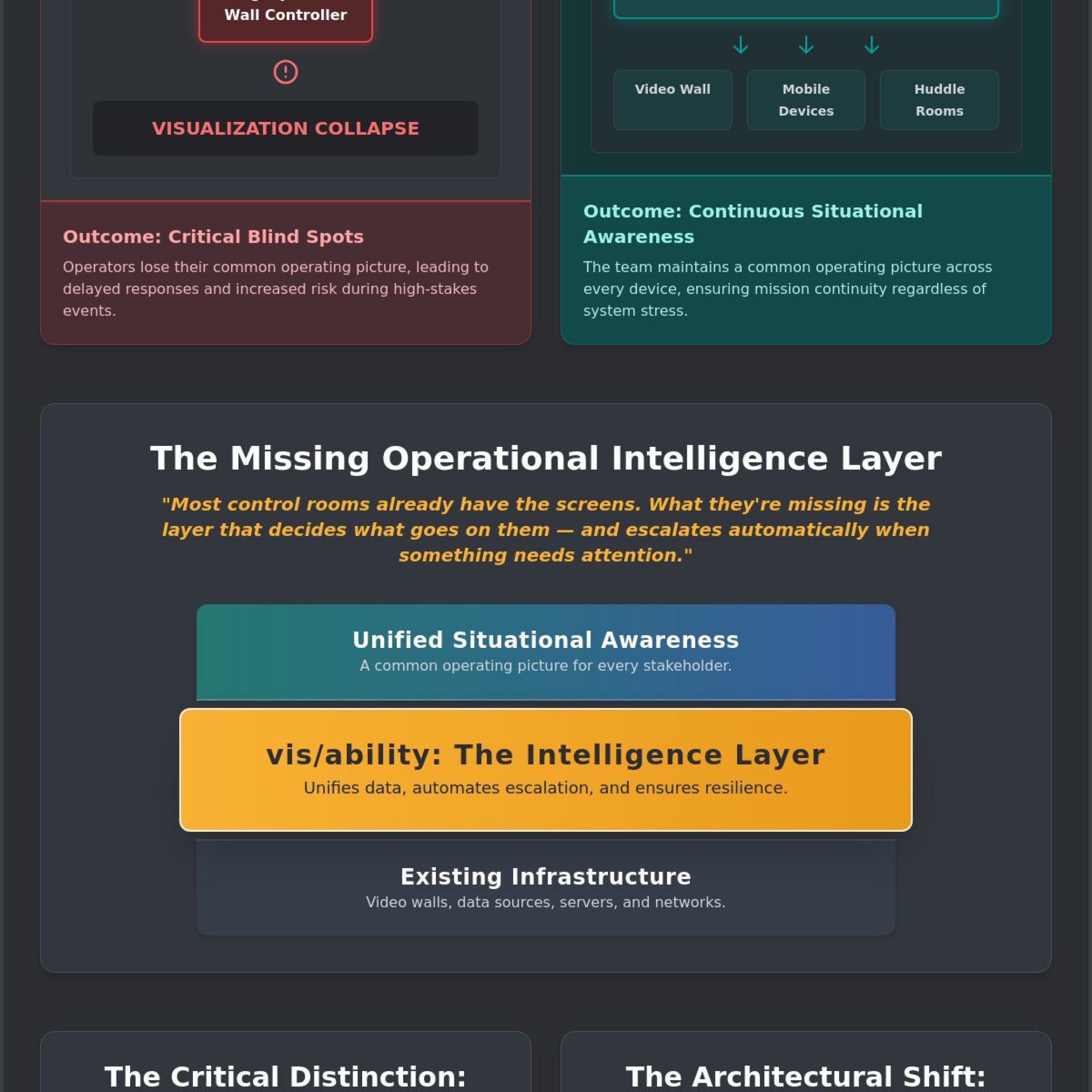
Most control rooms already have the screens. What they’re missing is the layer that decides what goes on them, and escalates automatically when something needs attention. You understand that true operational readiness depends on the human element having the right information at the right second. This article provides a roadmap to architecting a fail-safe visualization ecosystem that moves beyond simple uptime to deliver continuous situational awareness. We will examine how vis/ability, acting as your operational intelligence layer, unifies fragmented tools and ensures your team maintains a common operating picture across every device in the network.
Key Takeaways
- Transition from simple hardware uptime to a zero-fail environment that prioritizes continuous situational awareness over basic power redundancy.
- Architect high-availability control room systems using distributed processing and resilient design to ensure visibility remains intact during peak operational stress.
- Identify and eliminate the silo trap by unifying fragmented data feeds into a single, cohesive operating picture for your entire team.
- Implement sector-specific strategies to meet the evolving compliance and security standards required for national infrastructure and defense operations.
- Deploy an operational intelligence layer that automates data escalation, ensuring your screens display the most critical information precisely when it is needed.
Defining High-Availability for Mission-Critical Control Rooms
High-availability isn’t just a technical metric for a server rack. It’s a promise of continuity for the people responsible for life safety and grid stability. In a mission-critical environment, high-availability ensures that situational awareness remains unbroken, even when underlying hardware components fail. There’s a vital distinction between simple uptime and true operational readiness. Uptime means the power is on; operational readiness means the right data is visible and actionable at the moment of a pivotal decision.
Standard IT failover protocols often focus exclusively on the backend database. While these protocols keep records safe, they frequently leave control room operators in the dark during the transition. If a server switches to a backup but the video wall lags or data feeds desync, the team loses its common operating picture. Effective high-availability control room systems must account for the entire visualization ecosystem, from the data source to the operator’s eyes. Most control rooms already have the screens. What they’re missing is the layer that decides what goes on them, and escalates automatically when something needs attention.
The Five Nines of Operational Intelligence
In sectors like public safety or utilities, a dark minute represents a period of total risk. Achieving 99.999% uptime is a baseline requirement, but this availability must extend to the data integration layers. Proactive monitoring identifies potential failures before they disrupt the flow of information. By moving from reactive maintenance to a state of constant intelligence, organizations ensure that the vis/ability platform continues to serve as the bedrock for critical decisions, regardless of system stress.
Common Fail Points in Traditional Command Centers
Legacy video wall controllers are often the weakest link in a command center. These proprietary hardware boxes represent single points of failure; if the processor hangs, the entire visual ecosystem collapses. Network bottlenecks also pose a significant threat during high-traffic incidents. When data feeds flood the network, unoptimized systems can throttle bandwidth, leading to dropped frames or delayed alerts. Relying on manual switching during these failures is a liability. Human error increases during a crisis, which is why the system must manage its own resilience through automated, event-driven protocols.
The Architecture of a Fail-Safe Visualization Ecosystem
Building a resilient operation requires a shift from simple redundancy to a broader philosophy of resiliency. While redundancy involves having a spare part ready, resiliency is the ability of the system to absorb a shock and continue functioning without human intervention. In high-availability control room systems, this means that even if a primary network node fails, the visualization of critical data must remain uninterrupted. This is achieved through a distributed architecture that removes the reliance on a single central processor. When a system is truly resilient, it doesn’t just survive a failure; it maintains the flow of intelligence without the operators ever noticing a flicker on their screens.
Technical implementation of a redundancy control system often relies on high-speed industrial protocols that manage data flow across multiple nodes. By distributing the processing load, the system ensures that data integrity is maintained across the vis/ability platform and all integrated applications. If one node goes offline, the rest of the ecosystem compensates instantly. This prevents the blackout scenario where a single hardware failure blinds the entire command staff. Unlike basic data replication solutions that only focus on backend storage, a fail-safe visualization ecosystem ensures that the replicated data is actually visible to those who need it most.
Hardware Redundancy: Beyond Power Supplies
Effective hardware strategies utilize N+1 or 2N redundancy for video wall processors. This ensures that if one unit fails, a secondary unit is already synchronized and ready to take over. Automatic failover mechanisms are essential for mission-critical display arrays to prevent manual switching delays. For organizations looking to modernize their physical space, expert Control Room Design Services can help map these technical requirements to the physical layout of the center, ensuring no single cable or switch becomes a point of failure.
Software-Defined Availability: The Intelligence Layer
Most control rooms already have the screens. What they’re missing is the layer that decides what goes on them, and escalates automatically when something needs attention. The vis/ability platform serves as this operational intelligence layer. It manages load balancing for real-time video streams and complex application data, ensuring that the most vital information is always prioritized. This software-defined approach allows for seamless mobile vis/ability. If the central command center is physically compromised, the same common operating picture is instantly available to distributed teams on their mobile devices. If you are evaluating your current resiliency, you can speak with our specialists to audit your existing architecture.
Fragmented Intelligence: The Risk of Siloed High-Availability Tools
Many organizations invest heavily in specialized software, assuming that high uptime for individual applications guarantees a successful mission. This is the silo trap. If you have five different tools with high uptime but your operators must manually correlate data between them, your operation remains fragile. During a crisis, this fragmentation leads to information blindness. Operators miss critical incidents because they are staring at disconnected video walls or searching through separate tabs, losing precious seconds as they try to piece together a coherent story from disparate sources.
A truly resilient operation requires more than just keeping individual servers running. It demands a unified platform that prevents data from becoming trapped in a single interface. High-availability control room systems must act as a central hub where security logs, geospatial data, and live video converge. Most control rooms already have the screens. What they’re missing is the layer that decides what goes on them, and escalates automatically when something needs attention. Without this unifying intelligence, the risk of human error increases as the volume of incoming data overwhelms the staff.
Why Axon and SIEM Tools are Only Partial Solutions
Some organizations rely on platforms like Axon for body-cam feeds or SIEM tools for threat detection. While these are robust for their specific functions, they are only partial solutions in a command center environment. They provide raw data but lack the visualization layer needed to create a full common operating picture. For data to be actionable, it must be visible to the entire team, not just the individual operator logged into a specific terminal. The vis/ability platform bridges this gap by pulling these siloed feeds into a central, high-availability ecosystem where they can be analyzed and shared instantly.
Eliminating Cognitive Overload During System Stress
Fragmented systems force operators to act as human integration layers. This constant context-switching causes cognitive overload and fatigue, particularly during high-traffic incidents. The vis/ability Platform addresses this pain by using event-driven logic to filter out noise. Instead of monitoring dozens of disconnected screens, the team sees exactly what matters based on pre-defined triggers. This automated escalation ensures that critical information is never buried under a mountain of low-priority alerts, allowing the command staff to act with absolute certainty when the stakes are at their highest.
Implementing High-Availability in Specialized Sectors
High-availability isn’t a one-size-fits-all solution. A utility grid facing a coordinated cyberattack has fundamentally different requirements than a transit agency managing a city-wide emergency. Tailoring high-availability control room systems for national infrastructure requires a deep understanding of both the physical and digital threats unique to each sector. While a standard corporate office might tolerate a brief lag, mission-critical environments in defense and energy demand zero-fail performance. Achieving this level of reliability involves more than just buying the latest hardware; it requires a specialized architecture that aligns with strict federal mandates and operational realities.
Most control rooms already have the screens. What they’re missing is the layer that decides what goes on them, and escalates automatically when something needs attention. This gap is particularly dangerous in federal government and defense operations, where the volume of incoming intelligence can easily overwhelm human operators. By implementing an operational intelligence layer, these organizations can ensure that critical data moves seamlessly between command centers, huddle rooms, and mobile devices without losing integrity or security. This unified approach is essential for maintaining a Cybersecurity Common Operating Picture across distributed global networks.
Utilities and Energy: NERC CIP and Beyond
The regulatory landscape for the energy sector shifted significantly in early 2026. With FERC’s approval of updated CIP Reliability Standards for virtualization, utility providers now have more flexibility to deploy software-based tools. However, the revised NERC CIP-002-8 definition of control centers has reclassified many distributed architectures as high-impact environments. Meeting these strict standards requires a Cybersecurity Common Operating Picture that visualizes both grid stability and network threats in real-time. Our Utilities & Energy Solutions help bridge the gap between complex data and human judgment, ensuring compliance and operational uptime during peak demand or system stress.
Public Safety and Transportation: Real-Time Resilience
In Real-Time Crime Centers (RTCCs) and Emergency Operations Centers (EOCs), resilience is measured by the speed of the response. Integrating telematics, CAD data, and live video into a high-availability video wall allows dispatchers to act with greater certainty. If a primary network node fails during a crisis, the system must automatically re-route data to maintain situational awareness. This level of integration ensures that responders on the ground and commanders in the center are looking at the same information simultaneously. To ensure your center is equipped for these demands, explore our Public Safety Solutions to see how we unify disparate data feeds into a single, fail-safe ecosystem.
Managing distributed collaboration in a Global Security Operations Center (GSOC) presents its own set of challenges. When teams are spread across different time zones and continents, maintaining a unified operating picture is vital. High-availability systems must support seamless data sharing that transcends physical boundaries, allowing a supervisor in New York to see exactly what an analyst in London is viewing. This level of connectivity ensures that the organization remains proactive, identifying and neutralizing threats before they can escalate into full-blown crises.
vis/ability: The Operational Intelligence Layer for 2026
True high-availability in 2026 is no longer defined by the persistence of a hardware signal. It is defined by the persistence of intelligence. The vis/ability platform serves as the central hub where mission-critical data streams converge, ensuring that the flow of information remains uninterrupted even under extreme system stress. By moving away from reactive screen management, organizations can establish a proactive, automated operating environment. This shift allows the command staff to move beyond monitoring status lights to managing the actual mission. When high-availability control room systems are built on this operational intelligence layer, the technology becomes a transparent extension of human judgment.
Most control rooms already have the screens. What they’re missing is the layer that decides what goes on them, and escalates automatically when something needs attention. This is the core value of the vis/ability Platform. It integrates seamlessly with existing COTS hardware and specialized sensors, acting as the unifying platform that makes every other tool more effective for the entire team. Whether data is flowing from a cybersecurity sensor or a geospatial feed, vis/ability ensures it reaches the right person at the right time. This automated decision layer removes the burden of manual correlation, allowing operators to focus on resolution rather than navigation.
Extending Visibility Beyond the Video Wall
Visibility must extend beyond the physical boundaries of the command center. Collaboration in huddle rooms or via mobile devices ensures that field units and remote commanders maintain the same common operating picture as the central staff. Activu’s engineering ensures this decision layer remains resilient, removing the risk of information blindness when primary sites are compromised. By providing a secure, high-availability stream to any device, the system maintains a steady cadence of intelligence across the entire organization. This connectivity ensures that decisions made in the field are supported by the same data available to the Chief of Operations.
The Future of Event-Driven Situational Awareness
The future of situational awareness is event-driven. By integrating AI-driven alerts into the visualization workflow, the system can filter through noise to find the signal. Automated escalation reduces the critical window between threat detection and response, ensuring that vital alerts are never buried under a mountain of low-priority data. This technology serves as the essential bridge between raw data and human judgment. It empowers individuals to act with greater certainty when stakes are at their highest. Ultimately, the bedrock of any successful operation is the confidence of its people, and vis/ability provides the absolute technical reliability required to maintain that confidence in any crisis.
Achieving Operational Certainty through Resilient Intelligence
Maintaining operational readiness in 2026 requires a departure from traditional, hardware-centric redundancy. True resilience comes from an architecture that unifies fragmented data and automates the delivery of critical insights. Most control rooms already have the screens. What they’re missing is the layer that decides what goes on them, and escalates automatically when something needs attention. By implementing high-availability control room systems that prioritize event-driven situational awareness, you ensure that your team remains focused on the mission during the most high-stakes moments.
Since 1983, Activu has supported the most demanding mission-critical environments. Our Red Dot recognized visualization technology is trusted by federal defense agencies and national utility providers to serve as the bedrock of their operations. We provide the operational intelligence layer that bridges the gap between raw data and decisive action. Secure your command center against the risks of information blindness and system downtime. We invite you to Request a Demo of the vis/ability Operational Intelligence Layer to see how we can transform your control room into a fail-safe ecosystem. Build your operation on a foundation of absolute technical reliability and clarity.
Frequently Asked Questions
What is the difference between high availability and disaster recovery in a control room?
High availability focuses on maintaining operational continuity during localized failures, while disaster recovery addresses the restoration of systems after a total site loss. In a mission-critical center, high availability ensures that a server or processor failure doesn’t interrupt the video wall or data streams. Disaster recovery involves moving operations to a secondary location. Effective high-availability control room systems prioritize immediate, automated failover to keep situational awareness intact without human intervention.
Why is N+1 redundancy important for video wall systems?
N+1 redundancy provides an additional component beyond the minimum required to support the operational load, ensuring that a single failure doesn’t cause a system-wide blackout. For video wall systems, this means having a spare processor or power supply that’s active and ready to take over instantly. This configuration eliminates single points of failure, allowing the command center to maintain full visibility during maintenance or unexpected hardware malfunctions.
Can vis/ability integrate with my existing COTS hardware?
How does event-driven situational awareness reduce operator fatigue?
Event-driven situational awareness reduces operator fatigue by filtering out non-essential data and only displaying information that requires immediate action. Instead of monitoring dozens of static screens, operators receive automated escalations based on pre-defined triggers. This approach prevents cognitive overload, ensuring that the team remains focused on resolving incidents rather than searching through a flood of irrelevant data feeds during a crisis.
What are the common causes of downtime in mission-critical operations centers?
Downtime in mission-critical centers is often caused by single points of failure in proprietary hardware, network congestion during high-traffic incidents, and human error during manual system switching. Software crashes and unpatched security vulnerabilities also contribute to unplanned outages. Modern high-availability control room systems mitigate these risks by using distributed processing and automated failover protocols that remove the reliance on manual intervention during peak stress.
How do high-availability systems handle cybersecurity threats in real-time?
High-availability systems handle cybersecurity threats by enabling rapid, low-risk patching and providing a Cybersecurity Common Operating Picture. Because the system is redundant, security updates can be applied to one node while others remain operational, ensuring zero downtime for the visualization layer. This proactive approach allows teams to identify network intrusions or anomalies instantly, maintaining the integrity of the data streams used for critical decision-making.
Is a common operating picture (COP) necessary for small-scale control rooms?
A common operating picture is essential for any control room, regardless of size, to ensure all team members are acting on the same information. Even in a small-scale huddle room or dispatch center, fragmented data leads to delayed responses and missed incidents. Implementing a unified visualization layer ensures that small teams can collaborate with the same level of certainty and speed as a large-scale emergency operations center.
How does mobile vis/ability maintain high availability for field operators?
Mobile vis/ability extends high availability to field units by providing a secure, real-time stream of the common operating picture to any mobile device. If the central command center is compromised or if operators need to move, the intelligence layer remains accessible via the cloud or private network. This ensures that situational awareness isn’t tethered to a physical desk, allowing for seamless collaboration between distributed teams during an active incident.