
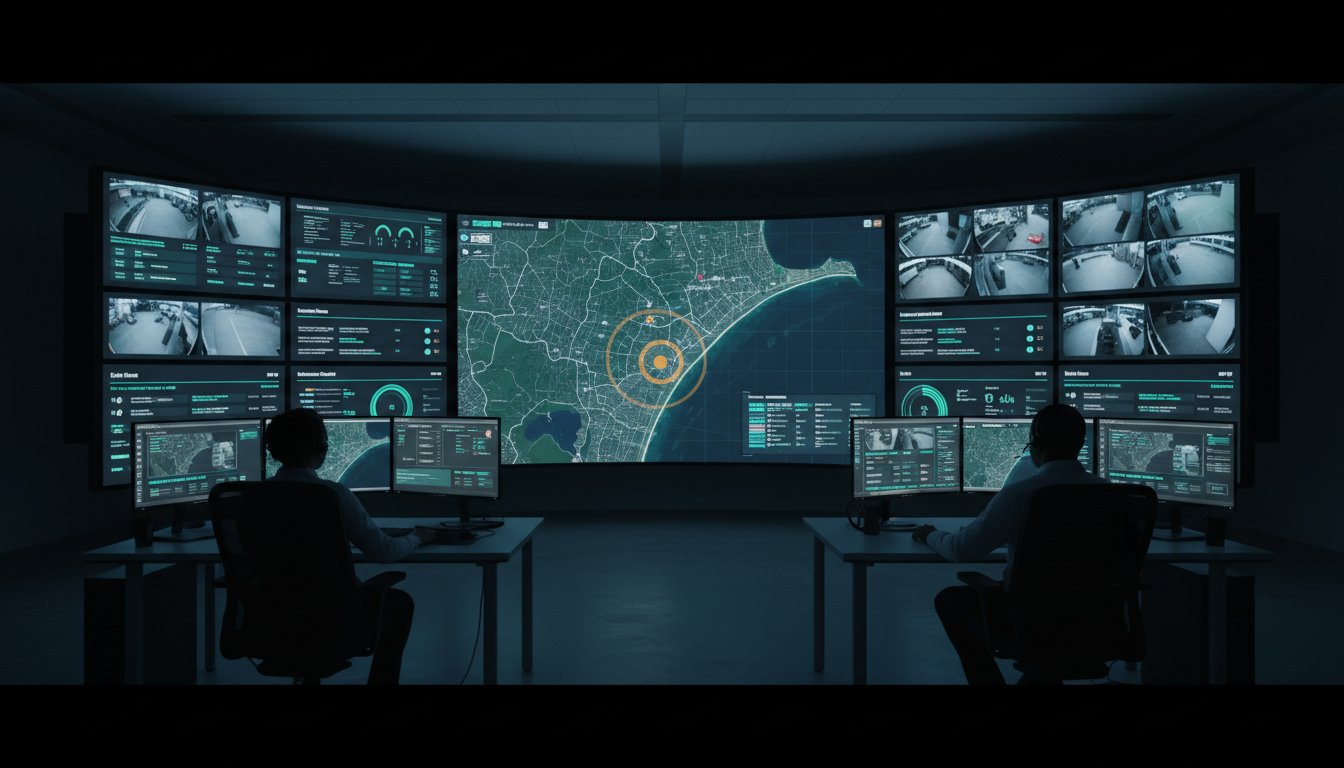
In 2023, research into emergency dispatch environments revealed that operators often juggle 12 or more disparate software interfaces during a single high-priority incident. This fragmentation isn’t just a technical hurdle; it’s a direct threat to response times. You’ve likely seen how information silos between CAD systems and field units create dangerous delays when every second counts. Managing a modern PSAP requires more than just answering calls. It’s about synthesizing a flood of data from sensors and video feeds without drowning your team in cognitive overload.
Most control rooms already have the screens. What they’re missing is the layer that decides what goes on them, and escalates automatically when something needs attention. This article demonstrates how to evolve your operations to achieve total situational awareness through an operational intelligence layer known as vis/ability, which surfaces critical data directly through the video wall. By the end of this guide, you’ll understand how to unify fragmented feeds into a single operating picture that empowers your team to act with absolute certainty. We’ll examine the shift from manual monitoring to automated incident escalation and seamless multi-agency collaboration.
Key Takeaways
- Understand how the modern PSAP must evolve beyond legacy voice systems to manage a complex deluge of data from Text-to-911, real-time video, and IoT sensors.
- Identify why simply adding more monitors fails to improve situational awareness and how to bridge the gap between having screens and having actionable intelligence.
- Discover how vis/ability serves as a central unifying hub, transforming fragmented data streams into a proactive command environment through automatic escalation.
- Learn strategies for designing a resilient operational environment that optimizes human-machine interaction and ensures clarity during mission-critical events.
- Explore how an intelligence layer empowers operators to act with greater certainty by surfacing the right information on the video wall at the exact moment it matters.
What is a PSAP? Defining the Core of Emergency Response
A Public Safety Answering Point (PSAP) is the mission-critical facility responsible for receiving 911 calls and dispatching emergency services. It acts as the frontline of public safety, bridging the gap between a citizen in distress and the necessary police, fire, or medical response. While the administrative definition focuses on call intake, modern operations require much more than just answering a phone. Operators must manage a complex Emergency Services IP network (ESInet) that carries voice, photos, and video data. Fragmented systems and data silos often leave dispatchers overwhelmed by information they can’t see or verify quickly.
Most control rooms already have the screens. What they’re missing is the layer that decides what goes on them, and escalates automatically when something needs attention. This is where vis/ability transforms raw data into actionable intelligence, serving as an operational intelligence layer that surfaces directly through the video wall. This visibility ensures that the most relevant data reaches the right person at the exact moment it’s needed, preventing critical details from being lost in the noise of a high-stress environment.
Primary vs. Secondary PSAP Functions
Primary PSAPs are the initial point of contact, receiving calls directly from the 911 Control Office selective router. Secondary PSAPs handle calls transferred from a primary point, such as a specialized air-medical or poison control center. Seamless data transfer is essential here. If an operator transfers a call but the caller’s location data or incident notes don’t follow, the response slows down. Organizations often use tools like Axon for evidence management, but these are only partial solutions. They don’t provide the unified visual hub required to manage an entire team’s situational awareness or ensure that every stakeholder sees the same operational picture simultaneously.
The Regulatory Landscape: FCC and NENA Standards
The FCC Master PSAP Registry tracks over 6,000 facilities to ensure accurate call routing across the country. Compliance isn’t just about following rules; it’s about future-proofing. The NENA i3 standard defines the architecture for Next Generation 911 (NG911), moving PSAPs from legacy copper lines to high-speed IP networks. This shift allows for rich data integration, but it also increases the risk of data overload. Maintaining compliance in this shifting environment requires a system that can aggregate these new data streams into a single, coherent view. Without a central unifying hub, the influx of NG911 data can become a liability rather than an asset for the dispatch team.
The Evolution to NG911: Managing the Data Deluge
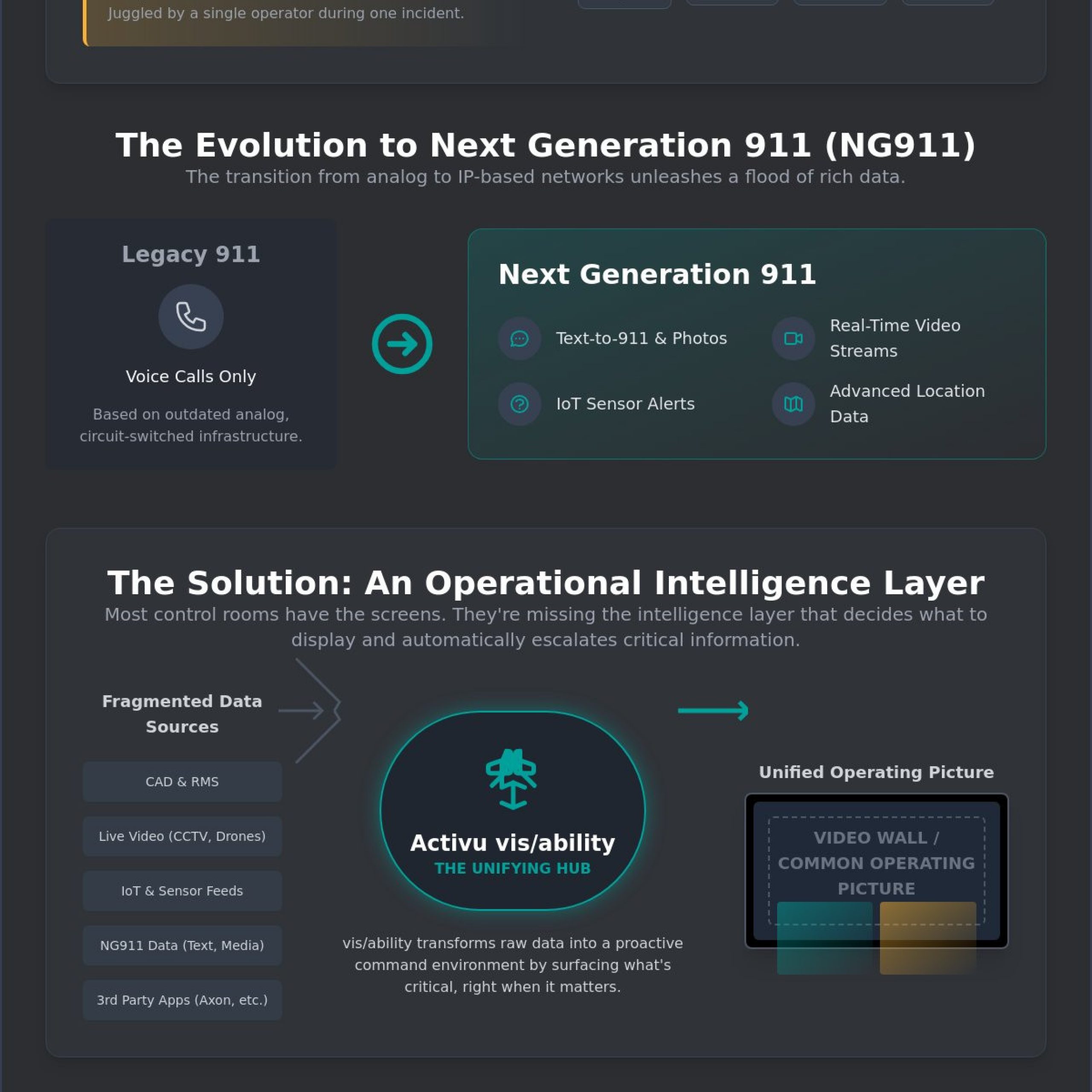
The legacy PSAP environment relied almost exclusively on circuit-switched voice calls for decades. This architecture provided a stable foundation for analog communication but cannot support the demands of a modern, mobile-first society. The transition to Next Generation 911 replaces this outdated infrastructure with an IP-based system designed to handle high-bandwidth data. Dispatchers are no longer just listeners; they’re now the recipients of Text-to-911, live video streams, and automated IoT sensor alerts from smart buildings and vehicles. While this data provides deeper context, it often arrives through proprietary channels. Tools like Axon body-worn cameras or third-party gunshot detection telemetry offer valuable snapshots, but they frequently remain isolated from the primary dispatch workflow. These platforms are only partial solutions. Without a central hub, they exist as silos that force dispatchers to synthesize complex information manually during life-or-death seconds.
The Problem with Fragmented Systems
Silos are the primary obstacle to achieving a Common Operating Picture (COP). When critical data lives in disparate applications, operators resort to “swivel-chair” operations. They must physically turn between monitors or toggle through browser tabs to move data from a map to a reporting tool. This manual process creates a dangerous visibility gap. Raw data collection isn’t the same as intelligence. A PSAP might have access to 1,000 traffic cameras and hundreds of sensor feeds, but that data is useless if it isn’t surfaced at the exact moment it becomes relevant to an active incident. The gap between receiving data and understanding it determines the success of the response.
Operator Fatigue and Cognitive Overload
Monitoring dozens of disconnected feeds takes a heavy psychological toll on dispatch staff. Cognitive load increases as operators try to filter through background noise to find a single critical signal. Research into human factors shows that attention spans drop significantly when staff must monitor static video or repetitive data streams for extended periods. Critical incidents get missed because the system expects the human to be the primary filter. Most control rooms already have the screens. What they’re missing is the layer that decides what goes on them, and escalates automatically when something needs attention.
Event-driven escalation is mandatory to reduce this mental burden. By implementing vis/ability, agencies transform their video wall from a passive display into an active operational intelligence layer. This ensures that only mission-critical alerts break through the noise, allowing the team to act with absolute certainty. To see how these layers integrate into a live environment, you can explore our solutions for public safety command centers. This approach moves the PSAP from a reactive state to a proactive posture, where the technology handles the noise so the humans can handle the crisis.
The Visibility Crisis: Why Screens Aren’t Enough
The standard response to increasing data complexity in a command center is often to install more hardware. This approach assumes that more pixels lead to better decisions. In reality, adding monitors without an intelligence layer only increases the cognitive load on operators. When a dispatcher manages 7 to 12 disparate systems simultaneously, fragmented data becomes a liability. Most control rooms already have the screens. What they’re missing is the layer that decides what goes on them; it escalates automatically when something needs attention.
This intelligence layer is vis/ability. It’s not just a software suite; it’s the operational intelligence that surfaces through the video wall to provide a single point of truth. Without it, the Public Safety Answering Point (PSAP) remains in a reactive state, forced to manually hunt for information across isolated silos. Organizations that rely on manual switching often see a 20% increase in response lag during the first five minutes of an event. Vis/ability eliminates this friction by moving the operation from passive monitoring to proactive, event-driven awareness.
Automated Escalation in the PSAP
Manual data retrieval is a significant failure point in high-stakes environments. When a critical incident occurs, every second spent navigating menus or dragging windows is a second lost. Vis/ability uses logic-based triggers to identify anomalies and surface relevant data instantly. If a ShotSpotter alert or a CAD entry meets specific criteria, the system automatically pushes the nearest camera feeds and GIS data to the center of the wall. This event-driven visualization ensures the right information reaches the right person without human intervention, potentially shaving 30 to 45 seconds off the initial assessment phase.
Extending Visibility Beyond the Control Room
Operational intelligence loses its value if it’s trapped inside the command center. Field supervisors and remote stakeholders require the same level of clarity as the dispatch team. Through mobile tools and unified operating pictures, vis/ability extends the reach of the PSAP to huddle rooms and handheld devices. This level of integration was vital during the 2023 wildfire responses, where remote incident commanders needed real-time visuals to coordinate air and ground assets. By maintaining a consistent view across all locations, agencies ensure continuity of operations even when the primary center is bypassed or remote collaboration is required.
- Reduces operator fatigue by filtering out irrelevant data.
- Creates a unified operating picture across mobile and desktop platforms.
- Automates visual workflows based on real-time sensor inputs.
- Eliminates the “silo effect” of disconnected software tools.
Designing a Modern PSAP for Operational Resilience
Modern PSAP environments struggle with a fundamental gap between data acquisition and actionable intelligence. Dispatchers and supervisors often navigate a fragmented landscape of siloed applications, including Computer-Aided Dispatch (CAD), Geographic Information Systems (GIS), and diverse video management feeds. While tools like Axon provide valuable evidence and real-time streaming, they remain partial solutions. They lack the native ability to aggregate disparate data into a single, cohesive view for the entire team. This fragmentation is why operators miss incidents; the critical information is buried under technical friction and disconnected monitors.
Effective Control Room Design Services focus on bridging this gap by prioritizing human-machine interaction. Design isn’t just about ergonomic furniture or lighting; it’s about creating a unified operating environment that supports 24/7/365 mission-critical demands. Most control rooms already have the screens. What they’re missing is the layer that decides what goes on them, and escalates automatically when something needs attention.
The Unified Operating Picture
True operational resilience requires a unifying hub that aggregates CAD, GIS, and video management systems into one interface. Commercial Off-The-Shelf (COTS) solutions often fail to meet mission-critical standards because they function as isolated islands. Vis/ability serves as the essential operational intelligence layer that surfaces through the video wall to provide a common operating picture. By integrating these complex applications into a single stream, the PSAP eliminates the need for manual context-switching. When a high-priority event occurs, vis/ability ensures the relevant data is pushed to the forefront immediately, allowing the team to act with absolute certainty.
Future-Proofing Through Technical Reliability
A modern PSAP must be built for operational continuity. This requires hardware and software synergy that supports 99.999% uptime and scales as jurisdictions grow. Scalable visualization allows a dispatch center to expand its reach without overhauling its core infrastructure. Cybersecurity is also paramount; the common operating picture must remain secure against external threats while maintaining internal transparency. By leveraging event-driven situational awareness, agencies can manage future tech integrations without increasing the cognitive load on operators. Vis/ability ensures that as new sensors and data streams enter the ecosystem, they are filtered and presented only when they matter most.
Activu: The Intelligence Hub for Public Safety
Modern PSAP environments often struggle with fragmented systems that do not communicate. Dispatchers and supervisors frequently toggle between standalone VMS feeds, CAD displays, and radio traffic, losing precious seconds during high-stakes incidents. While tools like Axon provide valuable data, they remain partial solutions. They lack the ability to provide a unified, automated response across the entire command center. This fragmentation creates a visibility gap where critical incidents can be missed because the data stayed trapped in a silo. Most control rooms already have the screens. What they’re missing is the layer that decides what goes on them, and escalates automatically when something needs attention.
Activu transforms the PSAP by deploying vis/ability as the central unifying hub. It’s an operational intelligence layer that surfaces through the video wall, aggregating data from every source, including geospatial analysis and real-time sensor feeds, to create a single, actionable operating picture. By positioning vis/ability at the core of the operation, agencies move beyond simply viewing video to actively managing intelligence. This platform ensures that public safety teams don’t just see more data; they see the data that matters most.
The vis/ability Advantage
Operational certainty requires more than just additional monitors. It requires automated intelligence that surfaces what matters, when it matters. In a 2023 industry survey, 65% of dispatchers noted that screen fatigue contributed to delayed response times. The vis/ability platform solves this by monitoring backend data and automatically pushing critical alerts to the video wall the moment a threshold is crossed. This allows operators to act with absolute certainty rather than searching for information across dozens of windows. The system is built for the high-stakes reality of emergency management, where technical reliability is the bedrock of every decision.
- Automated event triggering can reduce manual monitoring tasks by up to 40%, allowing staff to focus on incident resolution.
- The platform provides a commitment to technical reliability with architectures designed for 24/7 mission-critical uptime.
- It empowers operators to move from a reactive posture to a proactive command center by providing the right information at the exact moment of need.
Next Steps for PSAP Leadership
Transitioning from a reactive environment to an intelligent operating picture begins with identifying your current visibility gap. If your team spends more time managing screens than managing incidents, your operational intelligence is at risk. Leaders must assess their silos and move toward a common operating picture that extends from the main command center to remote setups, conference rooms, and mobile devices. This ensures that every stakeholder, whether in the room or in the field, has access to the same critical data.
You can see this operational intelligence layer in action by contacting Activu for a specialized control room engineering assessment. Our experts help bridge the gap between raw data and life-saving decisions, ensuring your PSAP remains a vigilant guardian of the community.
Strengthening Operational Resilience Through Intelligent Visibility
Modernizing your PSAP requires more than just adding more monitors. The shift to NG911 brings a flood of data that often leads to situational awareness problems and missed incidents. While tools like Axon provide valuable data points, they remain isolated silos without a unifying platform to provide a common operating picture. Most control rooms already have the screens. What they’re missing is the layer that decides what goes on them, and escalates automatically when something needs attention.
Activu provides this essential operational intelligence layer through vis/ability. This event-driven platform serves as the bridge between raw data and decisive action. It’s built on 40 plus years of mission critical control room experience and is currently trusted by federal and state agencies to manage complex data feeds. Our comprehensive design to deployment engineering services ensure that your team sees exactly what matters when the stakes are highest. You can transform your command center from a collection of fragmented tools into a resilient, unified hub that extends to remote setups and mobile devices.
Request a vis/ability Demo to Modernize Your PSAP
Your team deserves the confidence that comes with absolute clarity during every critical incident.
Frequently Asked Questions
What is the difference between a primary and secondary PSAP?
A primary PSAP receives 911 calls directly from the control office, while a secondary PSAP receives transferred calls from the primary point. Both facilities require 99.999% technical reliability to ensure no data is lost during the handoff. Most control rooms already have the screens. What they’re missing is the layer that decides what goes on them, and escalates automatically when something needs attention. This ensures critical data flows between agencies without interruption or loss of context.
How does NG911 change PSAP operations?
NG911 shifts the focus from traditional voice calls to data-rich inputs like video, text, and sensor data. This transition can increase incoming data volume by 10 times compared to legacy systems. This requires an operational intelligence layer like vis/ability to prevent operators from becoming overwhelmed. Without this layer, the sheer volume of information creates a gap where critical details are lost in the noise of fragmented systems, hindering the speed of the emergency response.
Why do operators miss incidents on a video wall?
Operators miss incidents because they’re forced to manually filter noise across fragmented systems, leading to cognitive overload. Research indicates that after 20 minutes, an operator’s attention to a video monitor can drop by 95%. This is a primary reason why operators miss incidents on a video wall when relying on manual observation. vis/ability acts as the unifying hub that identifies critical events and brings them to the forefront, ensuring nothing is overlooked during high-stress shifts.
Can vis/ability integrate with my existing CAD and video management systems?
Yes, vis/ability is designed as a unifying hub that aggregates data from disparate sources into a single operating picture. While tools like Axon or Milestone provide essential data, they’re only partial solutions on their own. vis/ability integrates these feeds to bridge the gap between silos. Most control rooms already have the screens. What they’re missing is the layer that decides what goes on them, and escalates automatically when something needs attention.
Is a PSAP the same as a dispatch center?
A PSAP refers to the facility that answers the 911 call, while a dispatch center focuses on the deployment of resources. Since the first 911 call in 1968, many facilities have evolved to perform both functions simultaneously. Managing multiple data feeds in a dispatch center requires a platform that surfaces the right information at the right time. vis/ability provides this mission-critical visibility, turning raw data into actionable intelligence for the whole team across any device or room.
What are the benefits of an event-driven situational awareness platform?
An event-driven platform ensures that critical data is surfaced automatically based on pre-defined triggers. This approach addresses common control room situational awareness problems by reducing the time spent searching for information. Studies indicate that automated alerting can reduce response times by 30% or more. Operators can focus on decision-making while vis/ability manages the information flow. It transforms the video wall into a proactive tool rather than a passive display of cluttered data.