
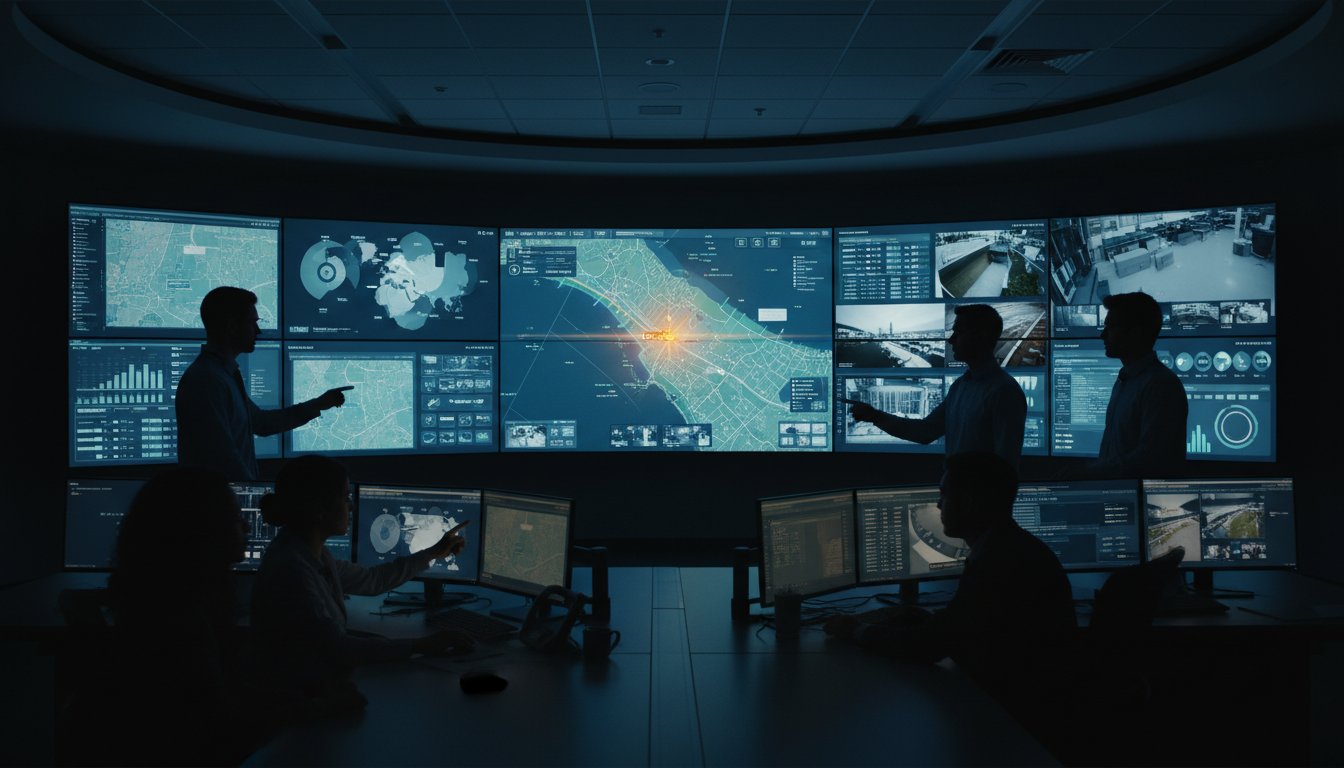
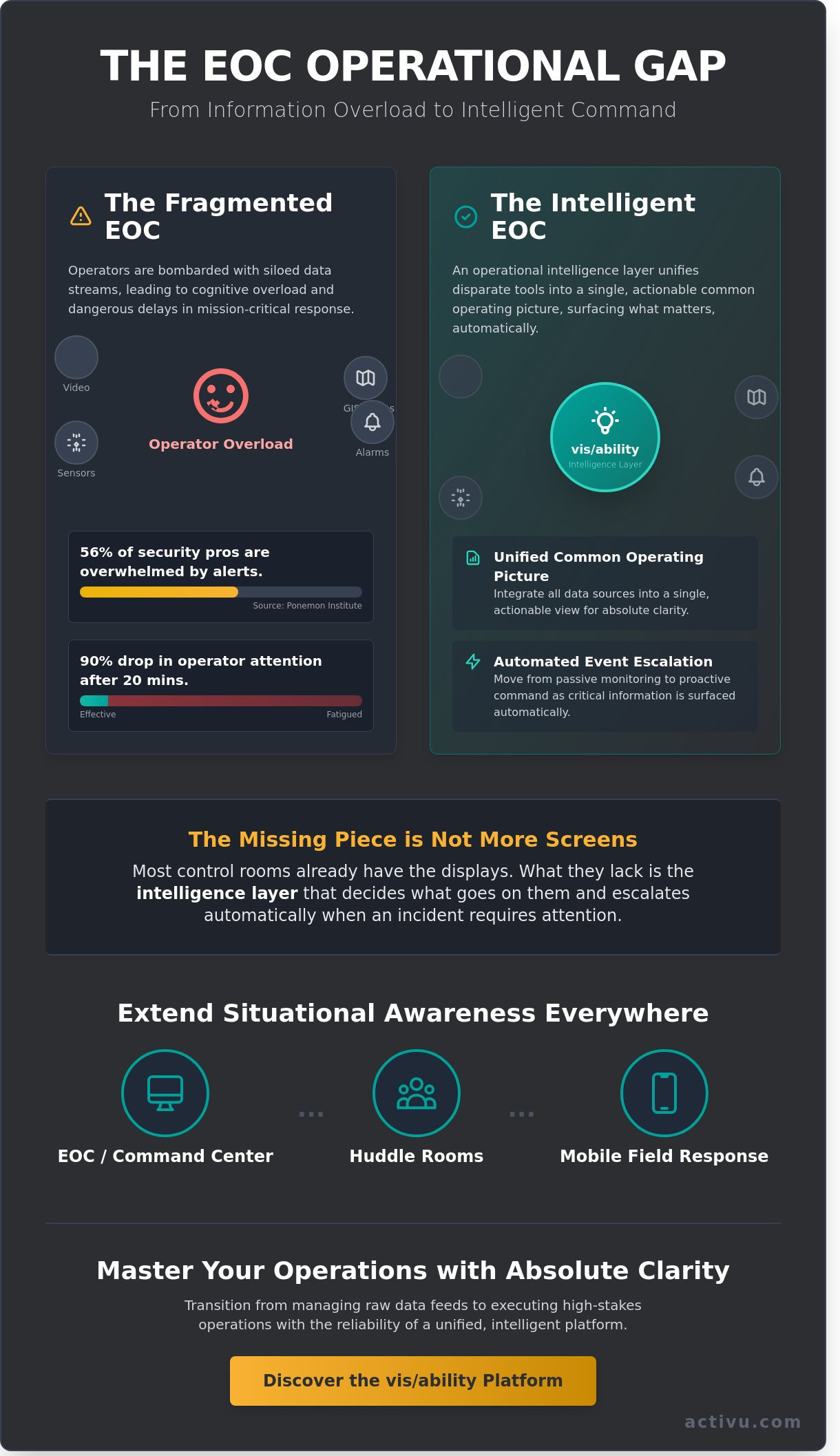
What if the massive influx of data in your EOC is actually making your team less effective during a mission-critical event? It’s a reality for command centers where operators face constant information overload from siloed data streams. Research from the Ponemon Institute shows that 56% of security professionals feel overwhelmed by the volume of alerts they receive. This noise creates significant control room situational awareness problems, leading to screen fatigue where critical incidents go unnoticed. While organizations often rely on tools like Axon to manage video evidence, these platforms remain a partial solution because they function as disconnected silos. When you’re trying to figure out how to manage multiple data feeds in a dispatch center, the lack of coordination with field units often leads to delayed response times.
You understand that having more data isn’t the same as having more clarity. Most control rooms already have the screens. What they’re missing is the layer that decides what goes on them, and escalates automatically when something needs attention. This guide will show you how to master the complexities of EOC operations and implement an intelligent common operating picture. We’ll explore how vis/ability serves as the essential operational intelligence layer that surfaces through the video wall to provide EOC common operating picture solutions and solve why operators miss incidents on the video wall. By the end of this article, you’ll see how to achieve a unified operating picture and seamless collaboration across your entire distributed team.
Key Takeaways
- Identify the critical operational gap where fragmented systems and data silos create dangerous delays in mission-critical decision-making.
- Understand why your EOC requires more than just screens, requiring an intelligence layer that automatically escalates the most relevant data when incidents occur.
- Learn to implement vis/ability as the central hub that unifies disparate tools into a single, actionable common operating picture.
- Discover how to design for resilience by extending situational awareness from the main command center to huddle rooms and mobile field response units.
- Master the transition from managing raw data feeds to executing high-stakes operations with absolute clarity and technical reliability.
The Operational Gap in Modern Emergency Operations Centers (EOC)
An Emergency Operations Center (EOC) functions as the central command and control facility responsible for strategic management during disasters and large scale incidents. These centers act as the brain of an organization’s response, yet a dangerous operational gap persists in most modern facilities. This gap is defined by fragmented systems, data silos, and a manual struggle to correlate information across disparate platforms. When a crisis unfolds, traditional EOCs fail because they rely on human operators to monitor every feed, sensor, and communication channel simultaneously. This reactive posture creates cognitive overload, making it impossible to identify the signal within the noise. Event-driven situational awareness provides the necessary solution, shifting the burden from human observation to intelligent, automated detection.
Control Room Situational Awareness Problems
Siloed data is the primary driver of delayed response times in mission-critical environments. When information remains trapped in isolated applications, the team’s common operating picture breaks down. Some organizations attempt to solve this with tools like Axon. While these products manage specific data types like digital evidence or body camera feeds, they often operate without a central hub, leaving operators to piece together the narrative manually. This fragmentation leads to “tunnel vision,” where an operator focuses exclusively on a single source of data and misses critical developments occurring elsewhere. Most control rooms already have the screens. What they’re missing is the layer that decides what goes on them, and escalates automatically when something needs attention.
Why Operators Miss Incidents on the Video Wall
Operator fatigue is a primary failure point in 24/7 EOC environments. Human attention is a finite resource. Passive monitoring of video walls leads to a phenomenon where critical signals are missed simply because the brain can no longer process static or repetitive visual data. Research in the security industry has shown that after just 20 minutes, an operator’s attention span for monitoring video feeds degrades by over 90 percent. This creates an environment where the very tools meant to provide clarity instead contribute to the chaos. Vis/ability is the operational intelligence layer that surfaces through the video wall to prevent these misses. It ensures that the right information reaches the right person at the exact moment it becomes relevant, moving the EOC from a state of passive observation to proactive command.
Core Functions of an EOC: Beyond Physical Infrastructure
The EOC serves as the nerve center where communication, resource allocation, and strategic coordination converge. While many visualize a room filled with monitors, the modern EOC mission has evolved beyond physical walls. Organizations now require the agility to transition between permanent command centers and mobile or hybrid configurations. This shift became a necessity for 85 percent of emergency management agencies following the operational shifts of 2020. The facility must function as the single source of truth for the entire organization, regardless of where the individual team members are located.
The primary challenge in high-stakes environments isn’t a lack of information; it’s the fragmentation of that information across silos. Dispatchers might see CAD data while field units rely on radio and GIS teams work in separate applications. This disconnect creates a dangerous visibility gap. Most control rooms already have the screens. What they’re missing is the layer that decides what goes on them, and escalates automatically when something needs attention. We define this operational intelligence layer as vis/ability. It ensures the EOC acts as the definitive anchor for decision-making by pulling critical data from Public Safety solutions into a unified environment.
The Role of the Common Operating Picture (COP)
A COP is a single display of relevant information shared by more than one organization. It facilitates collaborative planning and assists at all levels of incident management by ensuring every stakeholder sees the same reality. Without a robust COP, agencies risk conflicting responses. Effective EOC common operating picture solutions must provide resilience and visibility. When a 15 percent deviation in resource arrival occurs, the system must flag it immediately for the commander. This clarity allows for proactive adjustments rather than reactive troubleshooting.
Inter-Agency Coordination and Data Integration
Learning how to manage multiple data feeds in a dispatch center or EOC environment is a significant hurdle for many operators. Integrating GIS, telematics, and real-time video into a unified view is essential for situational awareness. Many organizations attempt to use commercial off-the-shelf (COTS) software for this task. While COTS tools are accessible, they lack the integration layer necessary to synthesize disparate feeds. They often leave operators overwhelmed by data noise. vis/ability fills this gap by acting as the central hub where raw data transforms into actionable intelligence. This ensures that when a critical event triggers, the answer appears on the wall exactly when it’s needed. To see this technology in action, you can schedule a technical briefing with our specialists.
EOC Common Operating Picture Solutions: The Intelligence Layer
Emergency Operations Centers often face a critical disconnect between the volume of data they collect and the speed at which they can act. Data arrives from dozens of disparate sources, yet it frequently remains trapped in silos, requiring operators to manually toggle between screens to find relevant information. This manual process introduces a dangerous lag in response. According to a 2023 analysis of mission-critical environments, manual data aggregation can delay incident recognition by as much as 15 minutes during high-stress events. Most control rooms already have the screens. What they’re missing is the layer that decides what goes on them, and escalates automatically when something needs attention.
The vis/ability platform serves as this essential operational intelligence layer. It functions as the bridge between raw data feeds and human judgment, surfacing critical information through the video wall only when it becomes relevant. Instead of forcing operators to stare at static, unchanging feeds, vis/ability ensures that the most vital data points move to the forefront. This approach transforms the EOC from a reactive monitoring station into a proactive command hub where intelligence drives every decision.
Automating the Escalation Workflow
Traditional monitoring setups rely on manual input to change views or update layouts. If an incident occurs, an operator must recognize the threat and manually push the relevant data to the video wall. This creates a bottleneck that limits situational awareness. vis/ability eliminates this friction through event-driven visualization. When a specific trigger occurs, such as a perimeter breach or a 911 call spike, the system automatically changes the video wall layout to display the most pertinent cameras, maps, and data streams. This shift from reactive to proactive management ensures that the team spends less time searching for information and more time coordinating the response. Organizations using automated escalation workflows have seen a 30% reduction in the time elapsed between an initial event trigger and the execution of a response plan.
Integrating Fragmented Systems into vis/ability
Effective EOC management requires a unified view of both physical and digital threats. Many organizations utilize tools like Axon or specialized CAD software, but these often act as partial solutions that don’t communicate with the rest of the center. vis/ability acts as the central unifying hub that pulls these fragmented systems into a single common operating picture. It integrates cybersecurity feeds with physical security assets to provide holistic awareness across the entire organization. By leveraging a centralized incident management framework, vis/ability ensures that every stakeholder, whether in the main command center or on a mobile device, sees the same verified intelligence. This integration removes the guesswork from complex operations, allowing the EOC to maintain absolute technical reliability when stakes are at their highest.
Designing for Resilience: From Huddle Rooms to Mobile Field Response
Traditional emergency management often fails because critical information remains trapped within the four walls of a central command center. Fragmented data feeds and siloed communication channels create a gap between decision makers and the tactical reality on the ground. When operators are forced to manually toggle between disparate systems, they miss the subtle cues that signal an escalating incident. This disconnect is a primary driver behind control room situational awareness problems.
Most control rooms already have the screens. What they’re missing is the layer that decides what goes on them; and escalates automatically when something needs attention. Activu defines this layer as vis/ability. It is the operational intelligence layer that surfaces through the video wall to provide clarity when it is needed most. By automating the visual hierarchy, vis/ability ensures that the most relevant data reaches the right person at the right time.
Resilience requires intelligence that travels. Modern EOC management demands that visibility extends to huddle rooms, breakout spaces, and remote executive suites. In high-stakes Federal Government and Defense operations, distributed command structures ensure that if a primary site is compromised, the mission continues from secondary locations without losing situational awareness. This setup empowers people to act with certainty because the intelligence follows the person, not the room.
Mobile vis/ability and Field Collaboration
Field units are the eyes and ears of any response. However, tools like Axon body cameras provide only a partial view of the theater. Without a central hub, field data becomes just another noise source. Mobile vis/ability ensures that field personnel contribute to and benefit from the EOC common operating picture. Using mobile devices for real-time visualization allows responders to see exactly what the commander sees. This creates a unified feedback loop that maintains operational continuity during the most volatile phases of a crisis.
Control Room Design for Maximum Efficiency
Physical layout must complement the digital intelligence layer to be effective. Efficient control room design prioritizes reducing cognitive load. When a team must manage multiple data feeds in a dispatch center, operators can suffer from information fatigue. This is a common reason why operators miss incidents on the video wall. Smart visualization filters the noise, showing only what matters. Protecting this infrastructure is equally vital. A Cybersecurity Common Operating Picture integrates threat detection directly into the workflow, ensuring the systems that manage the crisis aren’t the ones causing it.
Implementing vis/ability: The Future of EOC Operations
Modern emergency management often suffers from a paradox of information. While agencies have access to more data than ever before, this volume frequently creates “screen fatigue” rather than clarity. Many organizations struggle with why operators miss incidents on the video wall; the human brain simply cannot process dozens of simultaneous, static feeds for hours on end. Transitioning from a screen-heavy room to an intelligence-driven center requires a shift in how data is consumed. Most control rooms already have the screens. What they’re missing is the layer that decides what goes on them, and escalates automatically when something needs attention.
Implementing vis/ability transforms the EOC from a reactive environment into a proactive command hub. This operational intelligence layer integrates fragmented systems, such as CAD, GIS, and sensor networks, into a unified stream. The process moves through three distinct phases: integration of silos, configuration of automated triggers, and the deployment of a dynamic common operating picture. In this model, the video wall is no longer a storage space for raw data. It is the place where the answer appears. When a sensor detects a breach or a CAD entry reaches a specific threshold, vis/ability automatically surfaces the relevant cameras and maps, providing the team with immediate situational awareness.
Measuring EOC Success and Impact
Success in a mission-critical environment is measured by response time, data accuracy, and the effectiveness of coordination. vis/ability provides the digital bedrock for these metrics by maintaining a precise audit trail of every data point surfaced during an incident. This functionality is essential for post-incident SITREPs, as it allows leaders to review the exact timeline of information flow and decision-making. A unified operating picture ensures that every stakeholder sees the same reality at the same time, which reduces the window for error during life-saving decisions. By cutting the time required to aggregate data from minutes to seconds, agencies can focus entirely on the tactical response.
Next Steps for Emergency Management Leaders
Leaders must first identify their situational awareness gaps. If your operators are manually toggling between software windows or if information is siloed in specific departments, your response capability is compromised. Addressing these control room situational awareness problems starts with a professional design audit. This assessment evaluates how your current infrastructure handles multiple data feeds and identifies where automatic escalation can replace manual monitoring. To move your operations toward a more resilient, intelligence-driven future, Contact Activu for a mission-critical assessment of your current environment.
Mastering the Modern Intelligence Layer
Effective management of an EOC requires more than just physical infrastructure and high-definition screens. True operational success depends on closing the gap between fragmented data silos and actionable intelligence. Most control rooms already have the screens. What they’re missing is the layer that decides what goes on them, and escalates automatically when something needs attention. By implementing vis/ability as your central hub, you ensure that critical information moves seamlessly from the command center to huddle rooms and mobile devices in the field.
Activu brings over 40 years of mission-critical experience to every deployment. As pioneers of event-driven situational awareness, we’re trusted by Federal Agencies and Global Fortune 500s to maintain clarity when stakes are highest. Our technology serves as the essential bridge between raw data and human judgment, empowering your team to act with absolute certainty. You don’t have to manage the chaos alone when you have a partner dedicated to technical reliability and proactive visibility.
See how vis/ability transforms EOC operations; Request a Demo
Your team is ready to move from reactive data monitoring to proactive mission success.
Frequently Asked Questions
What is the primary purpose of an EOC?
An EOC serves as the central command and control facility responsible for carrying out the principles of emergency preparedness and disaster management. It acts as the strategic hub where multi agency leaders coordinate their response to high stakes incidents like the 2023 regional floods. Most control rooms already have the screens. What they’re missing is the layer that decides what goes on them, and escalates automatically when something needs attention.
How does an EOC differ from a NOC or SOC?
While a NOC or SOC monitors technical infrastructure and digital threats 24 hours a day, an EOC activates specifically for physical crises and large scale public emergencies. The EOC focuses on inter agency coordination and resource allocation rather than purely technical uptime. It functions as a mission critical environment where leaders use real time data to protect physical assets and human lives during active disruptions.
What are the main components of a common operating picture for EOCs?
Effective EOC common operating picture solutions integrate live GIS mapping, incident management software, and real time weather telemetry into a single pane of glass. A 2022 industry analysis showed that organizations using a unified COP reduced their decision making cycle by 30 percent. By surfacing this data through vis/ability, the operational intelligence layer ensures that every stakeholder sees the same critical information simultaneously.
Why is situational awareness often a problem in emergency operations?
Control room situational awareness problems typically arise from fragmented systems that trap data in isolated silos. When an operator must manually toggle between 12 different applications, they lose the ability to see the broader context of an escalating event. This lack of integration is precisely why operators miss incidents video wall displays should have highlighted, as the relevant information remains buried under a mountain of noise.
Can an EOC operate remotely or on mobile devices?
Modern emergency management requires the ability to maintain visibility from any location, including mobile command units and remote laptops. Our vis/ability platform extends the intelligence of the main command center to any authorized device, ensuring field commanders have the same clarity as those in the hub. During the 2023 emergency response drills, agencies using mobile integration reported a 40 percent increase in coordination efficiency between remote teams.
How does vis/ability improve EOC response times?
Vis/ability improves response times by serving as the operational intelligence layer that surfaces critical data through the video wall the moment a threshold is breached. It removes the manual burden of searching for information, allowing teams to focus on the decision rather than the data collection. By automating the escalation process, the system cuts minutes off the initial response, which is vital when every second impacts public safety.
What data feeds should be integrated into a modern EOC?
A modern EOC must integrate Computer Aided Dispatch (CAD), Video Management Systems (VMS), and geospatial layers to provide a complete tactical view. Learning how to manage multiple data feeds dispatch center staff use daily is often a challenge because tools like Axon only provide a partial solution. Vis/ability acts as the central unifying hub where these disparate feeds flow together to create a single, actionable narrative for the entire team.
Is a video wall necessary for an effective EOC?
A video wall provides the essential canvas for shared situational awareness, but it’s only as effective as the software driving it. Most control rooms already have the screens. What they’re missing is the layer that decides what goes on them, and escalates automatically when something needs attention. Without vis/ability, a video wall can become a distraction, contributing to the reasons why operators miss incidents video wall layouts were originally intended to prevent.