
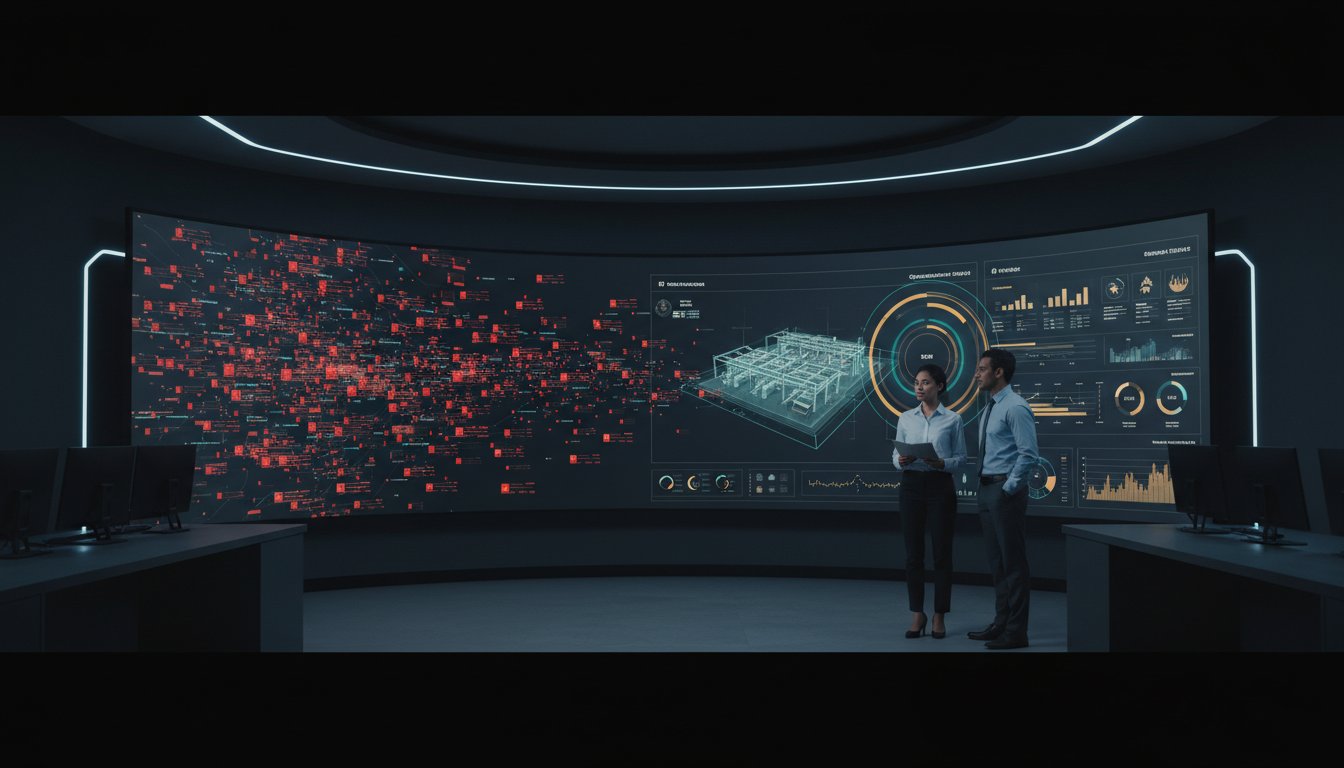
Every minute of unplanned downtime in a high-volume manufacturing plant costs an average of $22,000; yet most facilities still rely on operators to manually catch critical failures across a dozen disconnected screens. You’ve likely invested millions in MES, SCADA, and ERP systems, only to find your team buried under a mountain of alarm fatigue and cognitive overload. It’s a common struggle to maintain a unified view when these fragmented systems don’t talk to each other, leaving a dangerous gap between the factory floor and the decision makers who need to see the full picture.
Most control rooms already have the screens. What they’re missing is the layer that decides what goes on them, and escalates automatically when something needs attention. True manufacturing optimization isn’t about collecting more data; it’s about making that data visible to the right person before a minor glitch becomes a catastrophic shutdown. We call this operational intelligence layer vis/ability. It’s the software that ensures the right answer appears on the video wall exactly when it’s needed, scaling from the control room to mobile devices. In this article, you’ll learn how to transform fragmented data into actionable intelligence. We’ll explore how a common operating picture reduces Mean Time to Repair (MTTR) and ensures your team acts with absolute certainty.
Key Takeaways
- Identify the critical visibility gap between high-speed data generation and human judgment that often stalls Manufacturing Optimization initiatives.
- Understand why specialized tools provide only partial solutions and how to bridge these silos using a unifying hub for operational intelligence.
- Learn to implement an event-driven layer that automatically surfaces mission-critical data and escalates priority incidents to the right personnel.
- Discover how to scale situational awareness beyond the control room to huddle rooms and mobile devices for enterprise-wide clarity.
- Transform your video wall from a passive display into a strategic asset that minimizes downtime and eliminates production waste through vis/ability.
The Visibility Gap: Why Traditional Manufacturing Optimization Stalls
Manufacturing optimization is the precise alignment of real-time data with rapid human decision-making. It’s not merely about increasing machine speed or reducing waste; it’s about the bridge between automated sensors and the people who manage them. When this bridge fails, a visibility gap emerges. This gap is the space between high-speed data generation and actionable human judgment. It represents the moments where critical information exists within a system but remains invisible to the people who need to act on it. In mission-critical production, this delay is the primary barrier to operational continuity.
True manufacturing optimization requires a unified intelligence layer. Without it, data remains a liability rather than an asset. Most organizations collect vast amounts of telemetry, yet they lack the mechanism to surface the specific insights that prevent downtime. The visibility gap is the primary barrier to operational continuity.
The Problem with Fragmented Systems
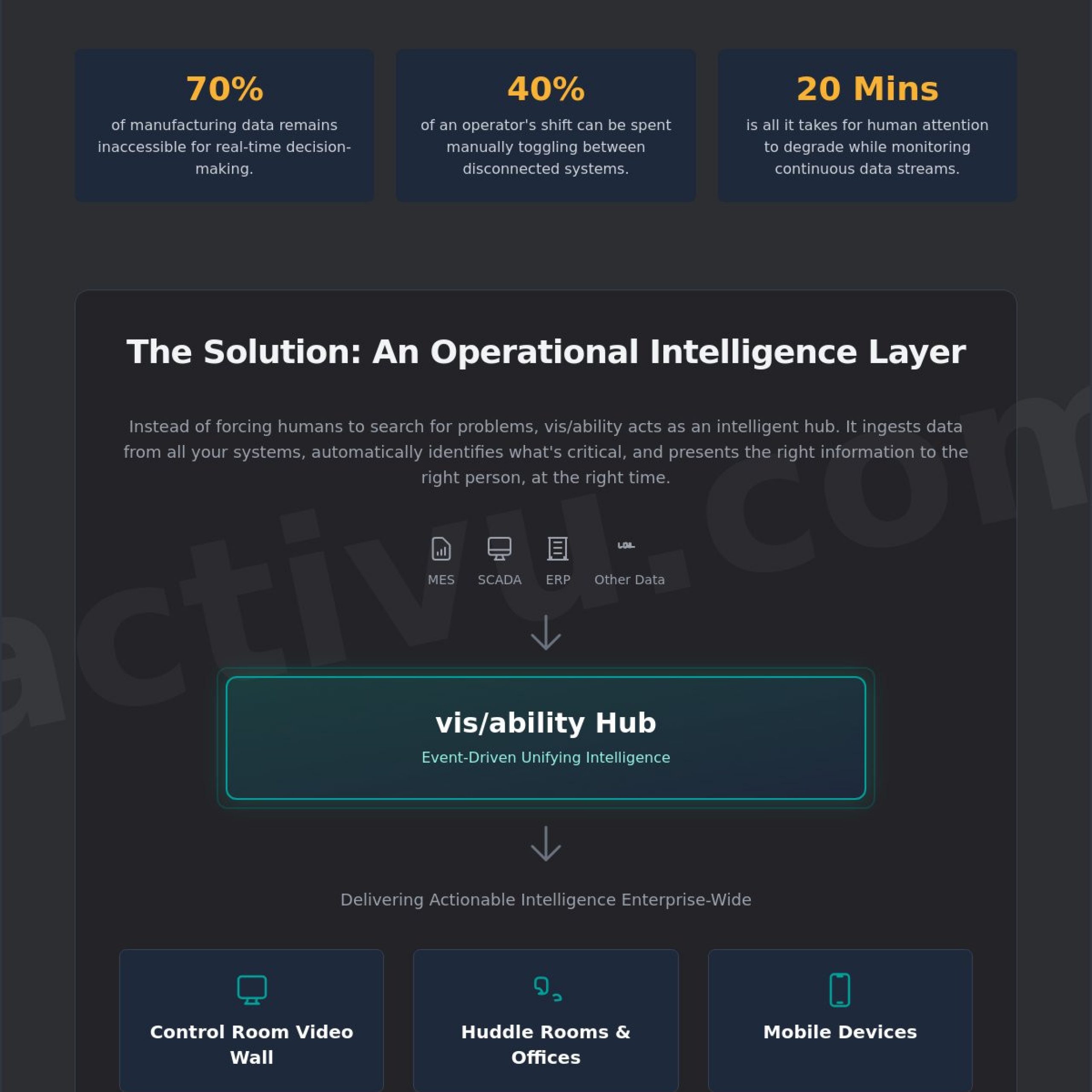
Disconnected feeds from SCADA, MES, and ERP systems create dangerous blind spots. These tools are designed for specialized tasks, but they often trap critical information in silos. A 2023 industry report found that nearly 70 percent of manufacturing data remains inaccessible for real-time decision-making because it’s locked within isolated platforms. When a pressure spike occurs in a SCADA feed, but the corresponding maintenance history is stuck in an ERP, operators lose the context needed for a swift response. This silo trap forces teams to jump between screens, wasting precious seconds during an escalating incident.
Organizations often rely on Process optimization frameworks to improve efficiency, but these strategies stall when data isn’t centralized. While some teams use basic monitoring tools, they’re only a partial solution. They lack the overarching intelligence to unify the entire operation. Most control rooms already have the screens. What they’re missing is the layer that decides what goes on them, and escalates automatically when something needs attention.
Why Operators Miss Incidents on the Factory Floor
Operators face immense cognitive overload while monitoring dozens of static dashboards. This leads to a paradox where the facility has too much data but too little insight. Research indicates that human attention begins to degrade after only 20 minutes of monitoring continuous data streams. This explains why operators miss incidents on the video wall; the human brain isn’t built to find a single anomaly among thousands of normal readings. Manual escalation processes fail under pressure because they depend on an operator’s ability to spot a needle in a digital haystack.
This challenge highlights why organizations struggle with control room situational awareness problems. They need a way to manage multiple data feeds in a dispatch center or EOC common operating picture solutions that do more than just display numbers. This is where vis/ability becomes essential. It’s the operational intelligence layer that surfaces through the video wall, acting as the central hub for all visual information. When a threat is detected, vis/ability ensures the answer appears exactly where it’s needed, transforming raw data into certain action.
Beyond Monitoring: The Role of Operational Intelligence
Traditional monitoring creates a paradox where more data leads to less clarity. In high-stakes production environments, operators often spend 40% of their shift manually toggling between SCADA systems, ERP dashboards, and security feeds to find the source of a disruption. This manual search for information is the primary obstacle to true Manufacturing Optimization. While hardware provides the eyes, it doesn’t provide the brain. Most control rooms already have the screens. What they’re missing is the layer that decides what goes on them, and escalates automatically when something needs attention.
This is where vis/ability transforms the environment. It functions as an operational intelligence layer that sits above existing hardware and software silos. Instead of passive monitoring, where a human must notice a red light among hundreds of green ones, vis/ability provides proactive situational awareness. It ensures that the right information reaches the right person at the right time, regardless of the device or location. This intelligence layer bridges the gap between raw data and the moment of a critical decision.
Defining the vis/ability Platform
The vis/ability platform aggregates disparate real-time data streams into a unified operating picture. It breaks down the silos between IT and OT by pulling information from every corner of the facility. Operators no longer need to hunt for answers across multiple workstations. Instead, the platform surfaces the answer automatically on the video wall or a mobile device. This shift from manual data retrieval to intelligent delivery is essential for scaling complex manufacturing processes without increasing headcount or cognitive load.
- Aggregates SCADA, VMS, and IoT feeds into a single pane of glass.
- Reduces the time spent searching for data by 35% in mission-critical scenarios.
- Empowers teams to act with certainty during a 15-minute response window.
Event-Driven Escalation: Turning Data into Action
True situational awareness requires more than just a view; it requires a mechanism for action. vis/ability uses event-driven escalation to monitor specific thresholds, such as a 5% drop in line speed or a critical temperature spike in a process reactor. When these conditions are met, the system automatically triggers a visual alert. This removes the burden from the operator to be everywhere at once. By surfacing only what matters, the platform ensures that minor anomalies don’t escalate into site-wide outages. This level of precision is the foundation for maintaining resilience across the entire enterprise. To see how this applies to your facility, explore our solutions for manufacturing process control.
Escaping the Silo Trap: Why Specialized Tools Are Only Partial Solutions
Modern production environments rely on a patchwork of specialized software to maintain operations. You likely utilize tools like Axon for facility security or generic SCADA interfaces for line monitoring. While these tools perform their specific functions well, they often exist in isolation. This fragmentation creates a dangerous visibility gap. When a critical failure occurs, the necessary data stays trapped within its respective silo, invisible to the people who need it most. Manufacturing optimization requires more than just collecting better data; it requires unified intelligence.
We position vis/ability as the central hub where all other visual information flows. It is not another point solution to be managed. It is the operational intelligence layer that surfaces through the video wall to provide a single source of truth. Most control rooms already have the screens. What they’re missing is the layer that decides what goes on them, and escalates automatically when something needs attention.
The Limitation of Point Solutions
A top-tier Manufacturing Execution System (MES) is ineffective if the logistics team cannot see its output during a crisis. Point solutions focus on narrow data sets and lack the context needed for true situational awareness. To evaluate your current tools, consider this framework: does your data reach the right person automatically without manual intervention? Can different departments see the same reality simultaneously? Does the system filter out noise during an incident? If your current setup fails these tests, your specialized tools are only providing a partial view of the mission.
Integrating Physical and Cybersecurity in Production
The convergence of Information Technology (IT) and Operational Technology (OT) is a reality that defines modern manufacturing optimization. In 2023, industry data showed that cyberattacks on industrial assets rose by nearly 50 percent compared to the previous year. A physical disruption on the floor is often the result of a digital intrusion. You cannot manage these risks in separate departments. vis/ability creates a cybersecurity common operating picture by linking network alerts with physical security feeds. This unified view ensures that a server room temperature spike or an unauthorized gate entry is recognized as a single, coordinated threat, allowing for immediate response across the entire facility.
Implementing Situational Awareness Across the Enterprise
Fragmented systems and data silos represent the primary obstacle to true Manufacturing Optimization. When information remains trapped within specific departments, the organization suffers from a visibility gap that delays response times and obscures the root cause of production bottlenecks. Most control rooms already have the screens; what they’re missing is the layer that decides what goes on them and escalates automatically when something needs attention. This layer is vis/ability, an operational intelligence layer that surfaces through the video wall to transform raw data into actionable insights.
Scaling from the Control Room to the Field
Operational intelligence cannot stop at the control room door. To eliminate control room situational awareness problems, the common operating picture must extend to every corner of the facility. Managers on the move require mobile vis/ability to maintain oversight without being tethered to a desk. This ensures that when a critical threshold is met, the alert reaches the floor supervisor’s mobile device with the same visual context seen by the dispatcher.
Breakout and huddle rooms play a vital role in incident resolution by providing a dedicated space for deep-dive analysis. When a process deviation occurs, vis/ability allows teams to push the relevant data feeds from the main display to these smaller collaborative spaces. This seamless transition is essential for effective Manufacturing Process Control, as it allows specialists to troubleshoot without disrupting the primary workflow of the main command center. In a 2023 analysis of high-output facilities, organizations that extended visual intelligence to mobile users saw a 22% reduction in mean time to resolution for Tier 1 incidents.
Collaborative Decision Making in Remote Setups
Remote experts often struggle to provide guidance because they lack a “unified operating picture.” They’re frequently forced to rely on verbal descriptions or static screenshots, which is why operators miss incidents video wall alerts when the full context isn’t shared. Vis/ability solves this by integrating distributed teams into a single collaborative environment. It doesn’t matter if an engineer is in a different time zone; they see the same real-time data as the on-site team.
While some organizations attempt to use standard video conferencing or basic screen sharing, these tools lack the mission-critical reliability required for Manufacturing Optimization. They don’t handle how to manage multiple data feeds dispatch center requirements effectively, often lagging or failing to sync diverse data sources. Vis/ability acts as the central hub, pulling in SCADA, CCTV, and ERP data into one view. To ensure operational resilience, teams should follow this checklist:
- Verify that remote experts have sub-90-millisecond latency for real-time data feeds.
- Confirm that mobile alerts include direct links to the relevant visual evidence.
- Ensure huddle room displays can instantly pull “states” from the main control room wall.
- Audit the automated escalation triggers once every quarter to match shifting production goals.
By bridging the gap between the control room and the field, vis/ability ensures that no critical event goes unnoticed. It provides the steady reassurance that your team is acting on the most accurate, up-to-date information available.
vis/ability: The Unifying Hub for Manufacturing Excellence
Fragmented systems and data silos create a dangerous visibility gap in high-stakes production. When a PLC fails or a production line exceeds temperature thresholds, operators often find themselves hunting through multiple disconnected screens to identify the source. This delay directly contributes to downtime and waste. True Manufacturing Optimization requires more than just faster machinery; it requires a way to unify these disparate feeds into a single, actionable source of truth. Activu provides this through vis/ability, an operational intelligence layer designed for the most demanding environments.
Most control rooms already have the screens. What they’re missing is the layer that decides what goes on them, and escalates automatically when something needs attention. By focusing on event-driven visualization, vis/ability ensures that critical alerts are never buried under routine data. This approach transforms the control room from a passive monitoring station into a proactive command center. It provides a steady reassurance that when a mission-critical event occurs, the system will respond with clarity and precision.
The Video Wall as the Place Where Answers Appear
A high-performance Video Wall System is often the most visible part of a facility, but its true power lies in the software layer driving it. Without vis/ability, a wall is just a collection of monitors showing static feeds that operators eventually stop seeing. With it, the wall becomes the location where answers appear. The software monitors backend data and surfaces the exact camera feed or telemetry report needed the moment a threshold is breached. This directly solves the problem of why operators miss incidents on a video wall by removing the need for constant manual scanning. The absolute technical reliability of this platform provides the peace of mind necessary to manage complex, multi-site operations without hesitation.
Next Steps for Your Manufacturing Control Room
Transitioning from reactive to proactive operations starts with identifying current situational awareness problems. Many facilities rely on fragmented tools that offer only a partial solution. These systems often fail to communicate with each other, leaving the human operator to bridge the gap during a crisis. Manufacturing Optimization is only possible when these tools flow into a central hub. Utilizing Control Room Design Services allows you to architect a space where data is filtered and prioritized automatically.
- Identify the specific silos causing delays in your current workflow.
- Evaluate how automatic escalation can reduce your mean time to resolution.
- Determine how to extend visibility to mobile devices and remote stakeholders.
To see how vis/ability can resolve your specific operational challenges and provide a common operating picture, contact Activu for a tailored demo and operational assessment.
Command Your Production Reality
True Manufacturing Optimization fails when critical data remains trapped in fragmented silos. Monitoring tools provide data, but they don’t provide clarity. Relying on manual oversight leads to missed incidents and increased cognitive load for your team. Most control rooms already have the screens. What they’re missing is the layer that decides what goes on them, and escalates automatically when something needs attention.
The vis/ability platform serves as this essential operational intelligence layer. It transforms your video wall into a proactive hub by surfacing the exact information needed at the moment of decision. Activu brings over 40 years of experience in mission-critical environments to your facility. Our event-driven automation is trusted by federal agencies and Fortune 500 manufacturers to reduce noise and ensure situational awareness across the entire enterprise. It’s time to move beyond partial solutions and establish a unified common operating picture.
Request a demo of the vis/ability platform to see how we unify your manufacturing operations.
Your team deserves the clarity required to act with absolute certainty.
Frequently Asked Questions
What is the biggest challenge in manufacturing optimization today?
The primary obstacle to manufacturing optimization is the fragmentation of data across disconnected silos. Operators manage an average of 12 to 15 different software interfaces, which creates a critical visibility gap during high-stakes production cycles. Most control rooms already have the screens. What they’re missing is the layer that decides what goes on them, and escalates automatically when something needs attention. Without this unifying layer, 40% of operational inefficiencies stem from delayed responses to localized line failures.
Why do operators often miss critical incidents on standard video walls?
Operators miss incidents on standard video walls because passive displays rely on human vigilance to spot anomalies across hundreds of data points. Research indicates that after 20 minutes of monitoring, a human’s ability to detect a deviation drops by over 50%. Standard systems present a static grid of information that lacks the intelligence to highlight urgent threats. vis/ability solves this by transforming the wall into an event-driven display that prioritizes critical alerts automatically, ensuring nothing is overlooked.
How does vis/ability integrate with existing MES and SCADA systems?
vis/ability functions as a central unifying hub that ingests real-time data from existing MES and SCADA systems without requiring a total infrastructure overhaul. While SCADA systems provide raw data, they lack the cross-platform context needed for site-wide situational awareness. The platform bridges these silos, ensuring that a pressure drop in a SCADA feed triggers an immediate visual escalation across the entire command center. It turns isolated metrics into actionable intelligence for the whole team.
Can situational awareness solutions be extended to mobile devices for floor managers?
Floor managers can access the common operating picture directly on mobile devices to maintain situational awareness while moving through the facility. This extension ensures that the same mission-critical data visible in the control room is available to personnel at the point of impact. Most control rooms already have the screens. What they’re missing is the layer that decides what goes on them, and escalates automatically when something needs attention, whether that screen is a 20 foot wall or a 6 inch tablet.
What is the difference between a standard video wall and an event-driven visualization system?
A standard video wall is a passive display of fixed feeds, whereas an event-driven system like vis/ability is a proactive intelligence layer. Standard setups require manual intervention to change layouts or zoom in on problems. In contrast, an event-driven system uses pre-defined triggers to automatically surface relevant data the moment a threshold is crossed. This shift from manual monitoring to automated escalation reduces the time to identify production bottlenecks by up to 30%.
How does a common operating picture improve manufacturing ROI?
A common operating picture improves manufacturing optimization by reducing Mean Time to Repair (MTTR) and minimizing unplanned downtime. When every department sees the same real-time data, decision-making becomes faster and more accurate. Studies show that unified visibility can reduce operational costs by 15% through better resource allocation. vis/ability provides the clarity needed to act decisively, ensuring that minor technical glitches don’t escalate into multi-million dollar production halts.
Is vis/ability suitable for smaller huddle rooms or only large control rooms?
The platform is engineered to scale across all environments, from massive global security operations centers to localized huddle rooms and breakout spaces. Small teams benefit from the same automated escalation and data integration as large-scale command centers. By providing a consistent interface across different room sizes, vis/ability ensures that a unified strategy is maintained throughout the organization. It transforms any space with a screen into a high-functioning node of operational intelligence.
How does the platform handle cybersecurity threats in a manufacturing context?
vis/ability protects mission-critical operations through a secure architecture designed to meet stringent industrial cybersecurity requirements. The system operates as a secure overlay that doesn’t compromise the integrity of underlying SCADA or MES networks. It provides administrators with granular control over data access and distribution. This ensures that sensitive production data is only visible to authorized personnel, maintaining a secure perimeter while delivering the transparency required for operational excellence.