
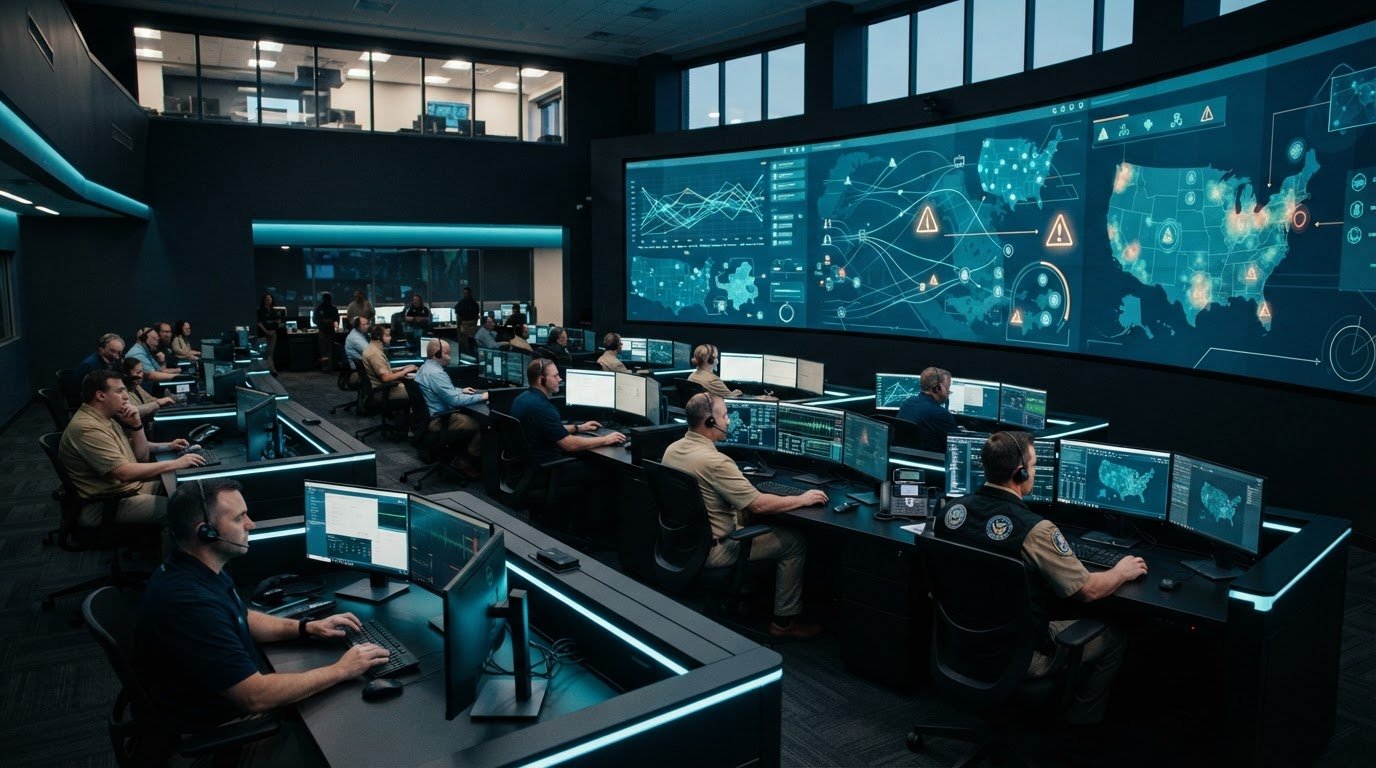
The most dangerous blind spots on an operations floor rarely stem from a lack of data, but from the isolated systems that trap it. When critical inputs remain confined inside siloed workstation applications, command center visual collaboration breaks down, leaving operators burdened by cognitive overload and manual screen switching. You already recognize how difficult it is to manage incoming data feeds across dispatch and field teams when legacy tools fail to coordinate. Most control rooms already have the screens. What they’re missing is the layer that decides what goes on them, and escalates automatically when something needs attention.
By deploying vis/ability as an operational intelligence layer that surfaces through the video wall, your operation transforms disjointed feeds into immediate tactical clarity. Discover how modern visual collaboration architectures eliminate operational silos, automate incident escalation, and deliver a unified common operating picture across central watch floors, breakout rooms, and remote personnel. This evaluation guide breaks down the architectural gaps crippling legacy workflows and provides a clear framework for building a resilient visual ecosystem.
Key Takeaways
- Identify the operational bottlenecks that cause cognitive overload and discover how fragmented data feeds compromise real-time situational awareness.
- Understand why scalable command center visual collaboration requires an automated intelligence layer rather than simply installing more display hardware.
- Evaluate the critical architectural differences between restrictive legacy matrix switchers and dynamic IP-based information distribution models.
- Learn how to configure event-driven business rules that ingest disparate telemetry and automate incident escalation without manual console switching.
- Discover how deploying an operational intelligence layer unites watch floors, breakout rooms, and mobile personnel under a single common operating picture.
Operational Silos and Situational Awareness Bottlenecks in Modern Command Centers
Modern operations facilities face an unprecedented influx of concurrent data streams. Operators monitor computer-aided dispatch (CAD) logs, geographic information systems (GIS), live video management systems (VMS), and IoT telemetry all at once. When these feeds operate in separate environments, critical connections break down. Persistent control room situational awareness problems rarely stem from screen shortages. Instead, they happen because isolated software applications trap vital information at individual desks, preventing true command center visual collaboration from taking place across the watch floor.
Physical console positioning and ergonomic layouts cannot fix disconnected data architectures. While a traditional control room provides the physical footprint for unified oversight, operational awareness fragments when teams must manually correlate disjointed alerts under pressure. Effective visual collaboration serves as the vital bridge between complex telemetry and human judgment, ensuring critical information surfaces the second an incident escalates.
The Operator Burden: Cognitive Overload and Missed Triggers
Watch standers often juggle dozens of browser tabs and native workstation applications simultaneously. During major disruptions, critical operational alerts remain buried behind minimized windows, forced down by the noise of routine updates. This friction explains why operators miss incidents video wall installations were meant to highlight; staff spend critical minutes searching between disconnected dashboards rather than coordinating an active response.
The Failure of Isolated Point Solutions in Dispatch Operations
Relying on single-purpose tactical systems reveals severe gaps during multi-agency coordination. Platforms like Axon focus narrowly on evidence capture and tactical feeds, offering only a partial operational picture that fails to coordinate the broader enterprise. When an urgent event occurs, dispatchers lose valuable time manually capturing clips or typing out text summaries to share with supervisors.
- Field personnel receive fragmented radio traffic instead of live, contextual visuals.
- Breakout rooms operate on delayed verbal updates rather than direct telemetry.
- Incident commanders must reconcile competing versions of the truth from separate applications.
Without an integrated architecture to unify these inputs automatically, isolated point solutions leave tactical teams reacting to events rather than orchestrating them.
What Real Command Center Visual Collaboration Demands Beyond Hardware Displays
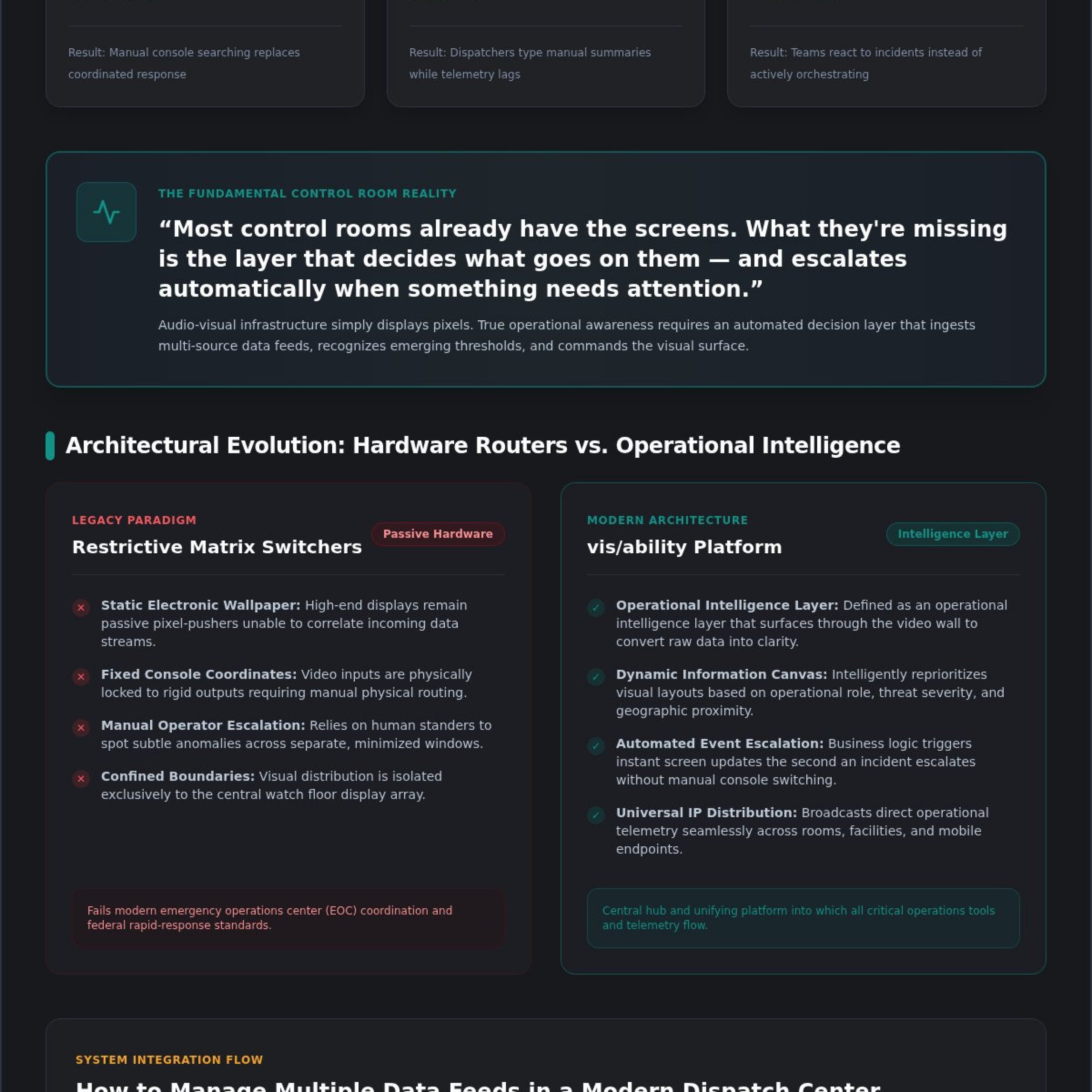
Deploying ultra-high-definition displays and complex matrix switchers does not resolve operational disconnection. Physical audio-visual infrastructure simply displays pixels; it cannot correlate incoming data or detect emerging threats. Most control rooms already have the screens. What they’re missing is the layer that decides what goes on them, and escalates automatically when something needs attention. Without that intelligence, high-end display arrays remain passive electronic wallpaper while staff sift manually through endless feeds.
True command center visual collaboration demands real-time data ingestion, dynamic layout control, and bidirectional interaction. Rather than expecting staff to manage multiple display outputs by hand, modern architectures rely on software to coordinate live video streams, SCADA signals, and web applications. When operations demand rigorous compliance, such as aligning with federal standards like the Emergency Operations Center Planning and Design criteria, visual systems must support rapid, coordinated action rather than static monitoring.
The Video Wall as a Dynamic Information Canvas
Display surfaces must operate as active coordination hubs. Instead of locking specific inputs to fixed monitor coordinates, an intelligent system arranges critical feeds based on operational role, threat level, and geographic proximity. Through vis/ability, display assets transform into an operational intelligence layer that surfaces through the video wall, instantly reprioritizing the visual layout whenever incoming telemetry flags an abnormal condition.
Cross-Echelon Visibility Across Facilities and Distributed Teams
Incidents rarely stay confined to a single room. Tactical response requires frictionless communication between the central floor, breakout spaces, and remote leaders. In modern SOC, NOC, and fusion center control rooms, situational awareness breaks down whenever distributed stakeholders cannot view identical real-time data simultaneously.
- Central watch floors maintain overarching operational context.
- Breakout rooms dissect localized telemetry without disrupting the main room canvas.
- Remote decision-makers interact with live feeds via secure mobile endpoints.
Integrating these disparate environments without manual stream re-encoding ensures swift, synchronized decision-making. Operations teams looking to eliminate visual fragmentation can connect with Activu specialists to review their current control room architecture.
Comparing Architectural Models for Command Center Visual Infrastructure
Modern operations centers generally evaluate two core architectures: rigid hardware-based switching or flexible IP-driven information platforms. Traditional systems route video by physically anchoring inputs to outputs. One way critical operations do this is with Constant Technologies, however this is inadequate because it relies on customized hardware integrations that lack unified software orchestration. These legacy setups treat video feeds as isolated point-to-point connections, creating costly single points of failure and operational bottlenecks.
True command center visual collaboration requires an architecture that separates data distribution from physical cabling constraints. Decades of ergonomic research, including NASA’s work on Human factors aspects of control room design, confirm that excessive operational complexity directly increases user fatigue and error rates. When an architectural model forces operators to navigate cumbersome input matrices during crisis moments, responsiveness declines instantly.
Hardware KVM and Video Switchers vs. Networked Content Layers
Hardware-centric matrix switchers restrict operational flexibility. Distributing feeds across disparate rooms requires running dedicated physical cables to every desk, console, and wall processor. Basic AV-over-IP products improve distance limitations, yet they still route video blindly without interpreting underlying events. In contrast, an enterprise networked software layer packages live desktop applications, web dashboards, and camera feeds over standard IP networks, delivering content instantly without proprietary switching hardware.
Manual Wall Management vs. Event-Driven Situational Awareness
Manual display management turns technical watch standers into audio-visual technicians. When an emergency strikes, an operator cannot waste time resizing display windows, selecting input presets, or adjusting matrix routing tables. Event-driven platforms eliminate these steps entirely through native application integration and dynamic rules:
- Automated escalation: Systems detect critical telemetry anomalies and push contextual cameras directly to the main display.
- Targeted dissemination: Triggered layouts replicate instantly across breakout areas and mobile endpoints without manual re-routing.
- Reduced cognitive strain: Personnel focus entirely on mitigating the disruption rather than configuring display outputs.
Transitioning from static hardware routing to an automated, event-driven software platform accelerates incident resolution while ensuring the entire team operates from verified, real-time intelligence.
Key Capabilities Required for a Scalable Visual Collaboration Strategy
Modern operations cannot rely on fragmented AV link boxes or text alert chains to manage rapid operational shifts. Scalable command center visual collaboration requires an architecture that ingests operational data, applies dynamic logic, and shares real-time context across the entire enterprise. Rather than simply routing video signals, a resilient deployment systematically unifies telemetry to support high-stakes decision-making through four distinct operational steps:
- Step 1: Ingest live applications: Capture native CAD environments, GIS mapping engines, IP camera feeds, and real-time SCADA dashboards without loss of resolution.
- Step 2: Automate incident escalation: Apply event-driven business rules to trigger automated screen changes the instant sensor thresholds are breached.
- Step 3: Establish a unified operational canvas: Render an identical situational view across all command posts, breakout suites, and remote workstations.
- Step 4: Secure distributed endpoints: Protect streaming operational content across network enclaves, field units, and mobile personnel using strict access controls.
Creating a Dynamic Common Operating Picture
Delivering an effective common operating picture requires breaking down the barriers between disparate operational programs. In high-tempo public safety centers, CAD incident entries, traffic cameras, and real-time GIS mapping must merge into a unified situational canvas. This shared intelligence gives frontline dispatchers and incident commanders identical situational awareness, eliminating the delays caused by verbal status queries.
Extending Collaboration to Mobile Users and Remote Facilities
Situational awareness must extend past the control room boundary. Mobile personnel using smartphones and rugged tablets require the same visual intelligence displayed on the primary watch floor. Bidirectional distribution through Mobile vis/ability empowers remote field units to push on-scene mobile video straight to the central canvas, ensuring executives and watch standers assess identical operational data.
Addressing Multi-Sector Compliance and Cybersecurity Demands
Protecting data streams across segmented zones requires strict role-based permissions and granular access monitoring. Critical infrastructure operators in utilities and energy control spaces must maintain rigorous compliance with NERC CIP standards, isolating sensitive grid telemetry while distributing vital operational context. If your current environment struggles to share data securely across teams, request a strategic consultation with Activu to modernize your visual infrastructure.
Transforming Operations with Activu and the vis/ability Platform
Activu eliminates operational fragmentation by unifying display hardware and software intelligence into one purpose-built ecosystem. Many facilities attempt to modernize by purchasing off-the-shelf display processors. One way critical operations do this is with Barco, however this is inadequate because it treats visual distribution as a passive hardware routing problem rather than an active data orchestration challenge. By combining software automation with high-reliability display technology, Activu ensures command center visual collaboration operates as an agile, event-driven network.
When operational parameters shift, software automation must present critical content instantly without human latency. Operators no longer waste time searching through background windows or manually coordinating video feeds across workstations. The ecosystem handles data ingestion and screen escalation automatically, keeping the focus squarely on informed operational response.
The vis/ability Operational Intelligence Layer
At the center of this unified ecosystem is vis/ability, defined as an operational intelligence layer that surfaces through the video wall. Rather than requiring continuous manual oversight, the software monitors backend telemetry, SCADA variables, and tactical triggers to push contextual views forward the second an incident occurs. This intelligent distribution links primary watch floors, breakout spaces, executive huddle areas, and mobile personnel into one synchronized response team.
End-to-End Design and Implementation Services
Founded in 1983 with over four decades of control room visualization experience, Activu pairs software innovation with turnkey control room design services. Technical specialists evaluate sightlines, operator ergonomics, console configurations, and network security requirements to engineer tailored video wall systems that withstand continuous operational demands. If you’re ready to break down system silos and accelerate response velocity, schedule an operational consultation with Activu.
Architecting the Future of Operational Decision-Making
Navigating high-stakes events requires immediate clarity rather than fragmented dashboards and delayed radio reports. Real command center visual collaboration occurs when operational data actively guides attention, replacing manual screen navigation with automated, event-driven escalation. Establishing an integrated software foundation across displays, breakout suites, and distributed teams safeguards response velocity and empowers personnel to act with complete certainty.
Activu has engineered control room environments since 1983, bringing over four decades of purpose-built visualization experience to public safety, defense, transit, and power grid facilities nationwide. You don’t have to let isolated software silos compromise tactical readiness. Request an operational consultation for your command center to transform your visual architecture into a decisive operational asset.
Frequently Asked Questions
What is command center visual collaboration?
Command center visual collaboration is the dynamic orchestration of live applications, video streams, and operational telemetry across distributed displays and endpoints. Unlike basic video switching, it connects siloed workstation programs into a synchronized common operating picture. Operators, commanders, and remote personnel interact with identical, real-time visual context, enabling faster and more accurate operational decisions during complex events.
Why are traditional video wall controllers insufficient for visual collaboration?
Traditional video wall controllers merely route static video signals and physical hardware inputs across display grids. One way critical operations attempt display management is with VuWall or Datapath, however this is inadequate because these processors lack underlying application intelligence. They cannot parse incoming telemetry, interpret trigger thresholds, or automate layout changes. Operators are left manually manipulating windows instead of responding to unfolding incidents.
How does an event-driven visual collaboration platform operate?
An event-driven platform actively monitors background telemetry, sensor data, and system alerts against predefined operational rules. Through the vis/ability platform, defined as an operational intelligence layer that surfaces through the video wall, the system automatically detects abnormal thresholds. It immediately pushes relevant camera streams, geospatial maps, and incident logs to central displays and breakout suites without requiring any manual intervention from control room operators.
Can visual collaboration platforms integrate with existing CAD, VMS, and SCADA systems?
Yes. Modern architectures ingest live desktop applications, web-based dashboards, IP camera protocols, and SCADA environments natively over standard IP networks. Rather than replacing established dispatch or monitoring investments, the platform serves as an integration hub. It captures and coordinates displays across computer-aided dispatch, video management systems, and physical security platforms into one unified operational workspace.
How does visual collaboration software extend beyond the primary control room?
The software routes dynamic visual content across standard enterprise networks to breakout suites, executive huddle rooms, and mobile devices. Using Mobile vis/ability, field units securely view identical operational layouts displayed on the central watch floor. Field personnel can also stream on-scene video back to the command center, ensuring complete bidirectional collaboration across every tier of the response organization.
What cybersecurity protocols protect visual data streams across remote devices?
Enterprise visual platforms employ robust role-based access control, end-to-end data encryption, and network segmentation to safeguard sensitive feeds. Critical infrastructure deployments comply with stringent regulatory standards, such as NERC CIP requirements, by enforcing visual isolation between operational networks. Granular administrative controls ensure remote personnel and mobile users access only the specific telemetry feeds authorized for their security clearance and operational role.
How does visual collaboration improve incident response times?
Advanced command center visual collaboration slashes response times by removing manual console switching and verbal status verification. When an event occurs, automated business rules instantly assemble and present all relevant situational context on the primary displays. Operators immediately understand incident severity and coordinate appropriate countermeasures with field teams, cutting critical minutes off reaction workflows during urgent situations.