

What if a fast response time hides a missed handoff or an escalation that never needed to happen? Operator performance metrics can show how effectively a control room detects, escalates, and resolves incidents, but only when leaders read them in context. When data is scattered across tools and workflows, a single speed measure can miss the conditions that shaped an operator’s decision.
Fragmented systems, information silos, and gaps in automatic escalation can make it harder to see what is happening and act on it. Screens alone do not provide a shared operational view. Teams also need a way to bring relevant information together and make changes in incident status visible.
vis/ability brings applications and data streams into a unified operational view that can be shared through the video wall. It supports command centers, remote locations, conference rooms, breakout rooms, huddle rooms, and mobile devices.
This guide explains how to choose a balanced, role-relevant set of metrics, interpret them alongside incident conditions and workload, and use shared operational visibility to support timely decisions and practical improvement.
Key Takeaways
- Define operator performance metrics around actions, outcomes, and the conditions that shape them.
- Assess detection, acknowledgment, escalation, resolution, handoffs, and workload to identify where operations need attention.
- Compare leading indicators, lagging outcomes, process adherence, and system-level measures in context instead of relying on a single score.
- Build a useful measurement framework by linking each metric to an operational question, reliable data, and an accountable review owner.
- Use vis/ability to bring tools and data into a shared operational view that supports coordinated decisions across locations.
Why operator performance metrics fail when control room information is fragmented
Operators often make decisions using signals spread across separate applications, workflows, and team channels. Information silos and gaps in automatic escalation can obscure who owns an event, whether it has been acknowledged, and what context informed the next action. These situational awareness challenges make it difficult to judge performance from an isolated timestamp or activity count.
Operator performance metrics measure operational actions, outcomes, and the conditions that enable the work. Their value depends on clear definitions and reliable context. A count of acknowledgments, for example, shows activity. It does not tell leaders whether an alert was visible, understood, or routed to the right person.
Consider the question behind “how to manage multiple data feeds dispatch center” searches: how can operators make sense of related signals when they appear in different tools? In an emergency operations center, EOC common operating picture solutions also need to help teams establish shared incident context and ownership. Without that connection, one developing situation can appear to be several unrelated tasks.
What do operator performance metrics measure?
A useful Key Performance Indicator (KPI) evaluates whether an activity or process is achieving its objectives. In a control room, measures can cover:
- Individual actions: whether an operator acknowledged an alert or recorded an update.
- Team coordination: whether information reached the people responsible for the next step.
- Process performance: whether an incident followed the defined workflow, including escalation and handoff.
- System availability: whether necessary applications and data sources were accessible.
Give every measure a plain-language definition. A delay deserves review, but the metric alone cannot show whether the cause was unclear ownership, missing information, or a process that made the next action difficult.
How do silos affect situational awareness?
Separate applications can obscure an incident’s timeline, status, and ownership. An alert may be acknowledged in one system while relevant updates remain elsewhere. If a handoff is not recorded consistently, the measured response interval may include time when responsibility was unclear. Leaders could then mistake a workflow gap for an individual performance problem.
This context also helps answer “why operators miss incidents video wall” searches: important signals can be easy to overlook when operators must reconcile disconnected information. For more on incident workflow context, see Activu’s SOC, NOC, and fusion center control rooms.
A shared operational view can help teams see relevant applications and data streams together. vis/ability brings this information together through the video wall, giving teams a way to review incident details without treating the display itself as the source of the operational picture.
Which operator performance metrics reveal detection, response, and coordination?
A useful metric follows an incident through the work that matters: recognizing a signal, acknowledging it, escalating when needed, resolving the issue, and transferring responsibility clearly. Treat these measures as candidates to tailor to local workflows, not universal benchmarks. Define the start and end points consistently before comparing results over time.
Which measures track incident response?
Detection-to-acknowledgment time measures the interval between an event becoming detectable and an operator acknowledging it. Mean time to acknowledge (MTTA) is the average time from a defined alert or event trigger to acknowledgment. It can indicate whether signals are being recognized promptly, provided the trigger and acknowledgment are recorded reliably.
Mean time to resolve (MTTR) is the average time from a consistently defined incident start to resolution. Because MTTR can refer to different endpoints in different organizations, specify whether “resolved” means contained, restored, or otherwise closed under the team’s workflow. Interpret the result alongside incident complexity, dependencies, and operational impact. A complex event involving several teams should not be treated as equivalent to a straightforward alert.
Teams can also track escalation timeliness, the time from a defined escalation condition to notification of the next responsible party, and escalation completion, whether the required transfer or action was completed. A response-time result is meaningful only when leaders know what happened, how severe it was, and what work the response required.
For an additional reference on response measurement, consult standard industry operational response frameworks and control room guidelines.
Which measures show coordination and operator workload?
Response depends on coordinated work, so assess handoff quality as well as individual tasks. Candidate measures include whether a handoff records incident status and next steps, whether ownership is clear, and whether teams followed the defined escalation path. These indicators can reveal workflow friction that an individual response-time figure misses.
Alert volume and concurrent workload add useful context. Review them alongside incident type, staffing conditions, and the tasks underway. Neither is a standalone score of operator effectiveness. Team-level measures matter because one person’s acknowledgment may depend on another team’s information or action. To explore how integrated operational information can support shared awareness, see the vis/ability platform by Activu Corporation.
How should leaders compare operator performance metrics fairly?
Fair comparison starts by asking what each measure can actually show. Operator performance metrics should guide operational improvement, not reduce people to a ranking. A longer resolution time, for example, may reflect a complex incident, delayed information, or a dependency outside an operator’s control. Review the action an operator could take separately from the conditions that shaped the outcome.
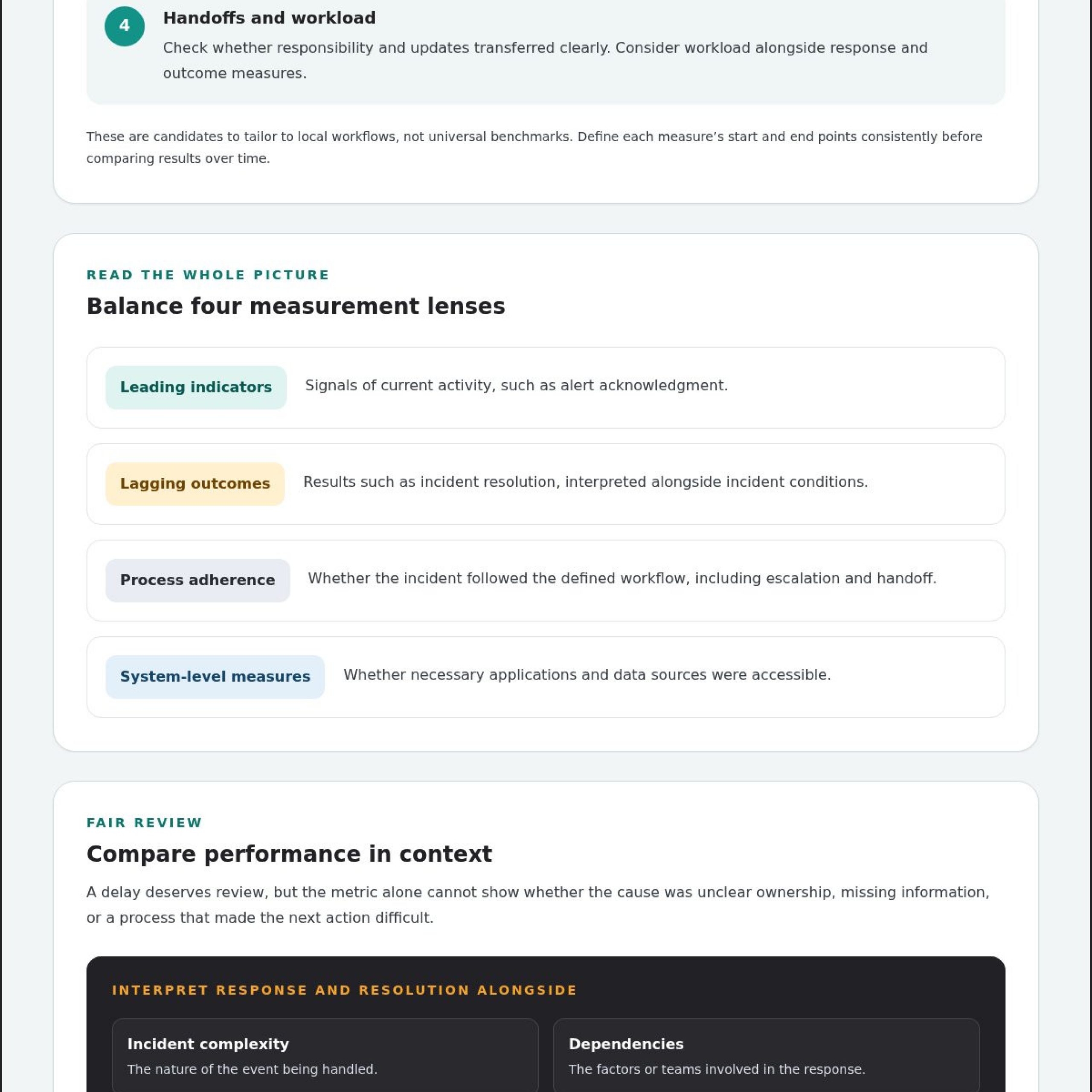
Use several categories together. Each provides a different view of performance, and each has limits.
| Measure category | What it reveals | What it misses | How to interpret it |
|---|---|---|---|
| Leading indicators | Whether alerts are acknowledged and escalation is initiated in time to support action. | Whether the incident was ultimately resolved or the response achieved its intended outcome. | Look for emerging workflow friction, then check alert visibility, ownership, and escalation conditions. |
| Lagging outcomes | Whether incidents were resolved, contained, or otherwise closed under the team’s definition. | How much complexity, external dependency, or operational impact influenced the result. | Compare similar incidents and examine the timeline behind the outcome. |
| Process adherence | Whether teams followed defined steps, including escalation and handoff procedures. | Whether the process itself was clear, practical, or suited to the incident. | Use exceptions to identify where workflows need review, rather than assuming every deviation signals poor performance. |
| System-level measures | Whether data sources, applications, and workflows supported timely action. | Which individual decision or system condition caused a delay. | Review system availability and information flow alongside operator actions. |
Read indicators and outcomes together
Acknowledgment and escalation readiness can flag an emerging issue before it appears in resolution results. Yet a quick acknowledgment alone does not confirm that the team understood the event or chose the right next step. Resolution outcomes provide another signal, though they may depend on incident complexity, external teams, or other operational conditions. Read both categories together to see where action was timely and where the broader response encountered friction.
Make comparisons that support improvement
Compare like-for-like incidents and roles when the available context supports it. Before drawing conclusions, confirm that teams use the same metric definitions, data sources, and measurement periods. A difference may come from inconsistent timestamps or incident classification rather than a real performance gap.
Avoid unsupported targets and league tables. One number cannot prove operator quality. Use results to ask what made an action easier or harder, which conditions were within the operator’s control, and what the team can improve in its processes or systems. This keeps measurement focused on learning and sound decisions.
How to build a useful operator performance measurement framework
A practical framework starts with the decisions leaders need to improve, then traces the operational work behind them. The goal is to select a small set of operator performance metrics that answers clear questions, such as whether an escalation path is working or whether a handoff leaves the next team ready to act.
Use this sequence:
- Define the decision. Identify what leaders need to understand or change, such as how incidents move from detection to escalation.
- Map the workflow. Document the steps, roles, handoffs, and dependencies involved. Metrics should reflect how work actually moves across teams.
- Select measures. Choose only measures that answer the operational question. Avoid collecting every available data point without a clear use.
- Validate the data. Check that source systems capture events and timestamps consistently, and confirm what each timestamp represents.
- Review and refine. Examine results with operators, investigate workload and process causes, and adjust measures when they no longer support a useful decision.
Define, validate, and assign ownership
Document each measure’s plain-language definition, data source, accountable review owner, review cadence, and limitations. For example, a measure of escalation delay needs a consistent start event and a clear definition of completed escalation. If one source records alert creation and another records operator visibility, their timestamps may not support a fair comparison.
Pilot the framework before relying on it. Ask operators and reviewers to interpret the measures independently, then resolve differences in definitions. Operational settings vary, so metrics should reflect the workflows and responsibilities of each environment. Activu’s overview of control room environments and use cases offers context for that variation.
Use shared context to interpret results
A common operating picture can help teams review an incident timeline, see how information moved, and understand where ownership changed. That shared visibility supports analysis of the operational sequence. It does not, by itself, prove whether an individual performed well or poorly. Leaders still need to review incident conditions, assigned responsibilities, and operator input before deciding what a result means.
vis/ability brings applications and data streams into a unified operational view through the video wall, helping teams share incident context across control room and distributed work settings. Explore the vis/ability platform to learn how shared operational information can support coordination and metric review.
How vis/ability supports operator performance visibility across teams
Fragmented systems and information silos can leave teams working from different parts of an incident picture. Operators may have to reconcile updates across applications before confirming what happened, who owns the next step, or whether attention is needed. That makes it harder to interpret performance measures against the decisions and handoffs behind them.
A video wall alone does not resolve these information gaps. Teams also need a way to bring relevant applications and data streams into a shared view.
vis/ability provides that operational intelligence layer through the video wall. It acts as a central hub for applications and data streams, helping bring relevant operational information together. The video wall can display the shared picture, while the integrated information provides context for the operational story.
How can unified operational information support decisions?
When incident-related feeds are brought into shared context, teams can review relevant information alongside status and updates. Event-driven visibility can help focus attention on changing conditions and support coordination around escalation. This context can inform a review of operator performance metrics, such as whether a handoff or escalation followed the defined workflow.
Visibility alone does not establish what an individual did or prove why an outcome occurred. Metrics still depend on clearly defined workflows and reliable source data, including consistent event records and timestamps. Leaders should use the shared view to understand operational context, then validate conclusions against the underlying records and team responsibilities.
The vis/ability platform integrates applications and data streams to support a unified operational view.
How does visibility extend beyond the control room?
Operational coordination can involve people in command centers, remote locations, and on mobile devices. vis/ability also supports collaboration in conference rooms, breakout rooms, and huddle rooms, helping distributed teams work from shared operational information. That broader visibility can help teams coordinate decisions while keeping performance review grounded in each role’s workflow.
To discuss your operational requirements, contact Activu through its contact page.
Turn performance insight into stronger operational decisions
Useful operator performance metrics connect actions and outcomes to the conditions surrounding an incident. Compare leading indicators with resolution outcomes, account for workload and handoffs, and use consistent definitions and reliable timestamps. This gives leaders a fairer basis for spotting process or system issues without reducing operators to a single score.
Fragmented systems and information silos can make it harder to understand what happened and who had the context to act. vis/ability integrates complex applications and data streams into a unified operational view through the video wall. Mobile vis/ability also supports collaboration beyond the control room, helping distributed teams stay connected to shared information.
With clearer context, teams can review performance findings with operators and focus improvement efforts where they can make a difference. A fair framework and shared operational information can help teams make more informed decisions.
Frequently Asked Questions
What are operator performance metrics in a control room?
Operator performance metrics measure operational actions, outcomes, and the conditions that enable control room work. They can cover individual actions, such as acknowledging an alert, as well as team coordination, workflow execution, and system availability. A useful metric has a clear definition and supports a specific operational question. For example, acknowledgment time can help identify delays, but it needs incident context to explain what influenced them.
Which metrics best measure control room operator performance?
No single measure captures performance across every role or incident. Consider detection-to-acknowledgment time, escalation timeliness, incident resolution time, handoff completeness, adherence to defined processes, and workload context. Together, these measures can show where an event moved smoothly or where a workflow needs review. Select measures that match actual responsibilities, and interpret individual actions alongside team coordination, incident complexity, and the availability of relevant information.
How do you measure incident response time fairly?
Define the start and end events before calculating response time. For example, specify whether timing begins when an alert is generated or becomes visible to the responsible team, and whether it ends at acknowledgment, escalation, or resolution. Use consistent timestamps and compare incidents with similar types, severity, and dependencies. Review workload and handoffs too. Without these controls, a time difference may reflect inconsistent data or incident conditions rather than response quality.
Can response-time metrics measure operator effectiveness on their own?
No. Response time shows how long a defined stage took, but it cannot establish whether an operator had the right context, followed an appropriate process, or made an effective decision. A quick acknowledgment may not mean the incident was understood, while a longer resolution may involve external dependencies or greater complexity. Pair timing measures with outcome, escalation, handoff, and workload information to identify what happened and where improvement may help.
How can control room leaders measure handoff quality?
Assess whether each handoff clearly records the incident status, relevant updates, next steps, and the team or person accepting responsibility. Review whether the receiving party acknowledged ownership and whether the escalation path was followed when required. Use consistent criteria across comparable workflows, then examine incomplete transfers to find process or information gaps. A missed handoff can affect apparent response time, so interpret timing alongside the transfer record and incident timeline.
What is the difference between mean time to acknowledge and mean time to resolve?
Mean time to acknowledge (MTTA) is the average interval from a defined alert or event trigger to acknowledgment by the responsible operator or team. Mean time to resolve (MTTR) is the average time from a defined incident start to its resolution. Organizations should document the start and end points for both. MTTR can refer to different endpoints, so clarify whether resolution means containment, restoration, or formal closure.
How can teams use performance metrics without encouraging operator surveillance?
Set a clear improvement purpose, explain what each measure captures, and avoid using isolated numbers as individual rankings. Review results with operators to understand workload, incident context, process friction, and system conditions. Focus on patterns that point to changes in workflows or information access, while distinguishing operator-controlled actions from factors outside their control. Transparent definitions and shared review help build trust and keep measurement tied to better operational decisions.
Explore how Activu supports operational visibility for mission-critical teams.