

When a crisis unfolds, the sheer volume of telemetry can become overwhelming. You likely manage dozens of disconnected streams, from geospatial overlays to specialized sensor feeds, yet your operators still face fatigue and delayed response times. While these tools provide valuable information, they only offer a partial view of the mission. Effective multi-domain command and control software must do more than just aggregate feeds; it has to synthesize them into a single, actionable truth that empowers your team to act with absolute certainty.
Most control rooms already have the screens. What they’re missing is the layer that decides what goes on them, and escalates automatically when something needs attention. You’ll learn how to integrate these fragmented data silos into a unified operational intelligence layer for faster, more accurate decision-making. We will examine how a central hub like vis/ability creates a common operating picture across distributed teams, ensuring that critical events are prioritized and human judgment is never buried under information overload.
Key Takeaways
- Identify the operational gaps created by fragmented data silos and the cognitive load of monitoring disconnected systems.
- Understand how multi-domain command and control software integrates sensors across land, cyber, and physical domains into one common operating picture.
- Recognize the limitations of domain-specific tools, which require a unifying hub to provide actionable intelligence for the whole team.
- Implement an event-driven strategy that moves beyond continuous monitoring to focus on automated escalation of critical incidents.
- Learn why the vis/ability platform is the bedrock for mission-critical decision-making, turning raw data into a proactive operational intelligence layer.
The Cognitive Load of Fragmented Command Domains
Operators in modern command centers often find themselves trapped in a swivel-chair environment. They must manually correlate data from a dozen different screens, each running a proprietary application that doesn’t communicate with the others. This fragmentation is more than a technical nuisance; it’s a fundamental threat to mission success. When information exists in isolation, critical patterns remain invisible. In high-stakes sectors like public safety or national defense, these visibility gaps lead directly to delayed responses and missed incidents. Effective multi-domain command and control software is designed to solve this by providing a single point of truth.
The stakes of this fragmentation are immense. For example, the Department of Defense requested over $2 billion for Joint All-Domain Command and Control (JADC2) technology licenses for fiscal year 2027. This massive investment highlights a universal truth: manual data correlation is no longer viable. Whether in a battlefield or a metropolitan emergency operations center, the speed of modern threats outpaces the ability of humans to navigate siloed systems. Without a unified intelligence layer, situational awareness is always reactive. The goal is to move beyond simply seeing data to actually understanding its implications in real time.
The Problem with Siloed Data Streams
Disparate systems in Security Operations Centers (SOCs) and Network Operations Centers (NOCs) create dangerous information gaps. A cyber threat detected in a NOC might have physical consequences for infrastructure monitored by a SOC, yet the two teams often operate in total isolation. By 2026, the volume of data from satellite imagery, IoT sensors, and mobile devices has made manual oversight impossible. When domains remain siloed, the organization loses the ability to see the full scope of a multi-domain emergency. This lack of integration forces operators to spend precious seconds jumping between interfaces rather than making decisions. The mission demands a platform that absorbs these feeds into a cohesive narrative.
This demand for a cohesive narrative is equally prevalent in the haulage and freight industry; to learn how AI integrates diverse logistics data streams, you can visit Logivo.ai.
Why Operators Miss Critical Incidents
Human operators have finite cognitive limits. In traditional monitoring environments, the sheer volume of noise from non-critical alerts creates a state of perpetual fatigue. When an operator is forced to monitor fifty camera feeds and three separate data dashboards, the brain naturally begins to filter out information. This is where incidents are missed. The high cost of this noise is felt when a critical event is buried under a mountain of routine data. Organizations require robust incident management software to filter out the irrelevant and highlight the essential. Modern multi-domain command and control software addresses this by prioritizing information based on its mission impact. This ensures that the human element remains focused on judgment rather than data entry. Clarity replaces complexity, allowing teams to act with absolute certainty when it matters most.
What is Multi-Domain Command and Control (MDC2) Software?
MDC2 software represents a fundamental shift in how organizations manage complex environments. It integrates disparate sensors and data streams across land, cyber, and physical domains into a single, unified interface. Traditional command structures were built around silos; a dispatcher monitored radios, a security team watched cameras, and IT analysts tracked network health. Modern requirements demand that these domains interact. When a physical perimeter is breached, the cyber domain should immediately assess the risk to local server rooms. This shift from reactive monitoring to proactive, event-driven intelligence is the cornerstone of a true Common Operating Picture (COP).
A unified COP ensures that every stakeholder, regardless of their location or device, sees the same critical information at the same time. This synchronization is essential for maintaining operational tempo during complex incidents. By integrating sensors and data streams into a single interface, multi-domain command and control software eliminates the need for manual data correlation. It transforms raw information into actionable intelligence, allowing leaders to focus on strategic outcomes rather than technical troubleshooting.
MDC2 in Civilian Infrastructure
While the concept originated in military strategy, its application is vital for civilian resilience. In utility and energy control rooms, MDC2 principles allow operators to correlate weather patterns with grid load and physical asset security. For transportation hubs, it means managing passenger flow alongside cyber-threat detection for signaling systems. The intersection of physical security and cybersecurity isn’t just a theoretical concern; it’s a daily operational reality. Protecting these assets requires a platform that can bridge the gap between physical sensors and digital networks.
This requirement for specialized, sensor-driven oversight is also critical in the equestrian sector, where professional breeders can discover BovEquine for advanced horse health monitoring and foaling surveillance systems that prioritize animal welfare through precise telemetry.
Core Capabilities of MDC2 Software
Most control rooms already have the screens. What they’re missing is the layer that decides what goes on them, and escalates automatically when something needs attention. High-performance multi-domain command and control software provides real-time aggregation and geospatial overlays that bridge the gap between legacy hardware and modern analytics. This capability ensures that data from disparate sources, whether a decades-old SCADA system or a new AI-driven sensor, flows into a central hub. Essential features of a robust MDC2 platform include:
- Real-time Data Aggregation: Consolidating disparate feeds into a single, manageable stream.
- Geospatial Overlay: Mapping data points to physical locations for immediate context.
- Cross-Platform Sharing: Distributing the operating picture to mobile devices and remote huddle rooms.
- Automated Escalation: Triggering visual alerts based on predefined event criteria.
Effective software must integrate with your existing tech stack while providing a path for future expansion. For a deeper dive into these requirements, see our Mission Critical Operations Guide. If you’re ready to move beyond fragmented monitoring, you can speak with our design team to see how these capabilities fit your specific environment.
The Limitations of Domain-Specific Tools
High-stakes organizations often invest heavily in specialized software to manage specific facets of their operations, such as video management systems or network security monitoring platforms. While these applications provide depth within their specific domain, they are inherently limited by their narrow scope. They generate deep pools of data that often remain inaccessible to the rest of the infrastructure. This isolation creates a significant blind spot when an incident crosses multiple domains, leaving teams to piece together a fragmented puzzle during a crisis.
Relying on these tools in isolation results in a partial understanding of the mission. One team might observe a network anomaly while another monitors a physical security breach, yet neither realizes these events are linked. True multi-domain command and control software bridges these gaps by synthesizing isolated data points into a cohesive operational narrative. Without this integration, your organization remains reactive, dependent on manual coordination that is too slow for the speed of modern threats.
Why Specialized Tools Aren’t Enough
Specialized tools provide a narrow view that can hinder situational awareness during a complex crisis. A platform focused solely on video evidence lacks the broader operational context of physical assets or network health. If a power failure impacts a specific sector, a tool focused only on camera feeds won’t correlate the outage with the loss of visibility or the increased risk to nearby facilities. Similarly, cybersecurity alerts are frequently siloed within technical departments, leaving physical security teams unaware of digital threats that could compromise building access. Manual correlation in these moments is prone to error and consumes precious time that operators simply don’t have.
The Operational Intelligence Layer
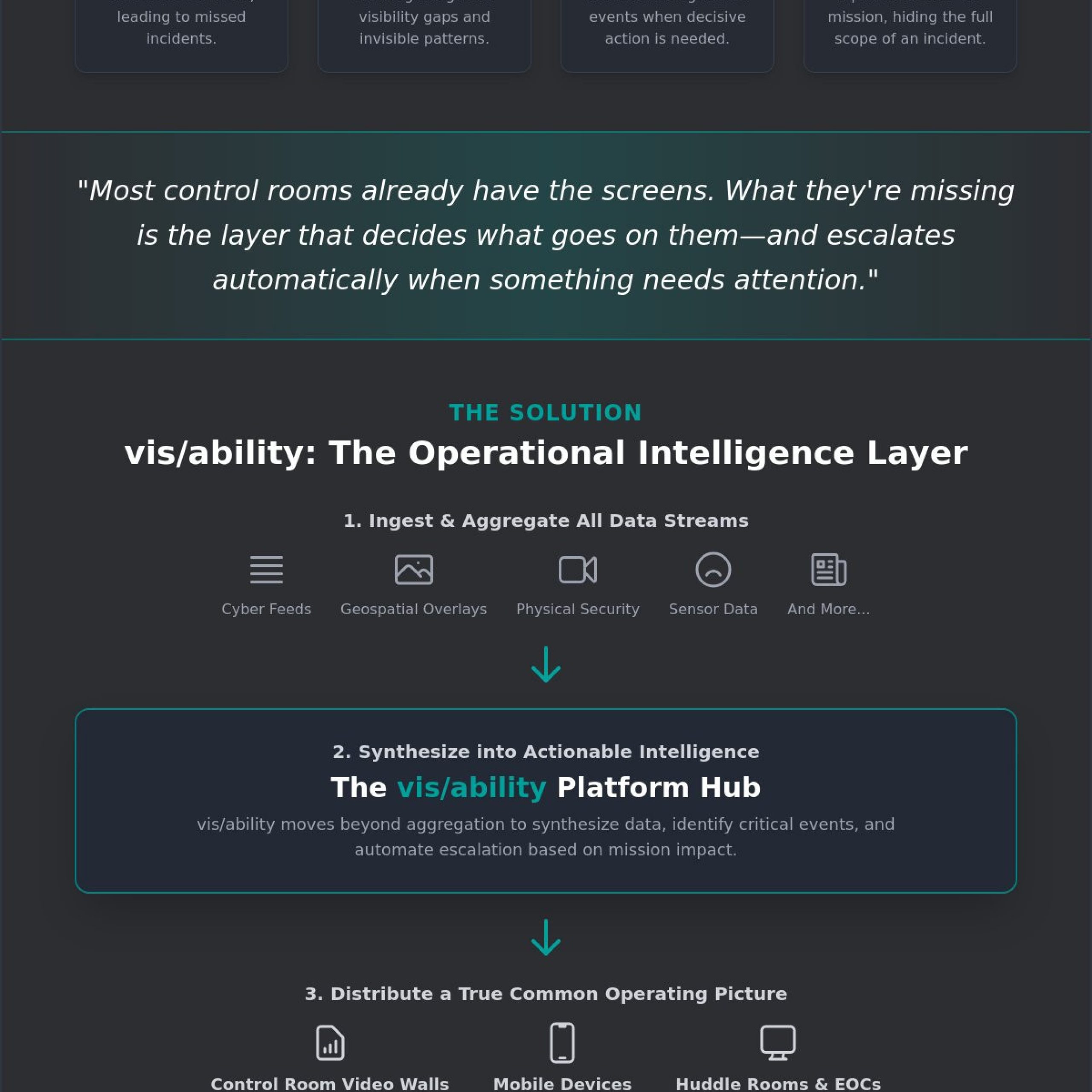
A robust mission-critical strategy requires an operational intelligence layer that bridges the gap between raw data and human judgment. vis/ability serves as this central hub, integrating your existing tools into a unified operating picture. It transforms multi-domain command and control software from a theoretical concept into a functional reality for your entire team, ensuring that every tool becomes more valuable when connected to a central hub.
Most control rooms already have the screens. What they’re missing is the layer that decides what goes on them, and escalates automatically when something needs attention. By centralizing these feeds, vis/ability ensures that operators remain focused on high-value tasks. It prioritizes the most critical information and pushes it to the forefront, whether on a massive video wall, in a huddle room, or on a supervisor’s mobile device. This approach empowers individuals to act with greater certainty, knowing they have a complete view of the operational landscape.
Implementing an Event-Driven MDC2 Strategy
Traditional monitoring is a recipe for failure; it relies on the hope that an exhausted operator won’t blink at the wrong moment. Transitioning to an event-driven model removes this vulnerability by shifting the burden of detection from the human to the intelligence layer. Most control rooms already have the screens. What they’re missing is the layer that decides what goes on them, and escalates automatically when something needs attention. This strategy builds a robust cybersecurity common operating picture, where digital alerts are mapped to physical assets. It ensures that multi-domain command and control software works as a filter rather than just a funnel for raw data.
Adopting an exception-based approach means your team only engages when a situation requires unique human judgment. This mindset change is essential for organizations managing complex, distributed infrastructure. By focusing on events rather than streams, you reduce the noise that leads to missed incidents on the video wall. The goal is a proactive stance where the system identifies the threat and prepares the response environment before the operator even reaches for the keyboard.
Automating the Escalation Workflow
Automation handles the routine so humans can handle the crisis. When an alert meets specific criteria, the software triggers a workflow that immediately updates video walls and notifies stakeholders. It pushes relevant data to the forefront, which is critical for maintaining the Operational Continuity Pillars. This automated escalation ensures that the right information reaches the right people without the delays inherent in manual reporting. It transforms the command center from a passive observation room into an active response hub.
Enhancing Situational Awareness Across Teams
Modern missions are inherently distributed, requiring situational awareness that travels from the command center to the field. Activu Corporation provides the tools to maintain a common operating picture across mobile devices and remote huddle rooms. This ensures every team member, regardless of their location, acts on the same intelligence layer. Geospatial data provides the physical context necessary for a synchronized response. To see how this intelligence layer transforms high-stakes environments, you can explore the vis/ability platform and its integration capabilities.
vis/ability: The Core of Your Multi-Domain Strategy
Selecting multi-domain command and control software determines whether your team stays ahead of a threat or spends its time catching up. Vis/ability serves as the bedrock for mission-critical decision-making, providing the steady hand needed to navigate complex data environments. Most control rooms already have the screens. What they’re missing is the layer that decides what goes on them, and escalates automatically when something needs attention. Activu Corporation provides this intelligence layer to bridge the gap between raw sensor data and strategic judgment, unifying federal and defense operations into a single truth.
A Unified Platform for All Domains
The vis/ability platform utilizes an event-driven architecture to ensure it remains a silent guardian until specific criteria are met. This approach creates a sense of calm and clarity by prioritizing essential information over routine telemetry. It scales from local emergency operations centers to national-level defense assets, connecting the command center to huddle rooms and mobile devices. This seamless flow of intelligence defines modern multi-domain command and control software, turning a fragmented network into a quiet, powerful engine for success.
Take Control of Your Operational Picture
The transition from fragmented data to actionable intelligence is a strategic necessity for any mission-critical organization. Strategic leaders must evaluate their current visualization gaps to identify where siloed systems delay response times. Professional control room design, when combined with this operational intelligence layer, ensures your physical environment and digital tools work in concert. We invite you to contact Activu Corporation for a demonstration of how vis/ability can secure your mission and unify your operational picture.
Securing the Future of Mission-Critical Visibility
Fragmented data and siloed domains represent a significant hurdle to operational readiness. By shifting to an event-driven model, your organization can move past the limitations of standalone tools and refocus on strategic decision-making. High-performance multi-domain command and control software is the essential engine that turns complex telemetry into clear, actionable intelligence. It ensures that human judgment remains the centerpiece of every critical response.
Activu has pioneered control room visualization since 1983, providing the technical foundation for federal agencies and global utilities. Our vis/ability platform utilizes event-driven automation to reduce cognitive load, ensuring that your operators only engage with the information that truly matters. Most control rooms already have the screens. What they’re missing is the layer that decides what goes on them, and escalates automatically when something needs attention. This intelligent layer provides the bedrock upon which successful operations are built.
See how vis/ability unifies your mission-critical domains.
Your team deserves a platform that matches the gravity of their mission. Take the next step toward absolute operational clarity and ensure your command center remains a source of strength and certainty.
Frequently Asked Questions
What is the primary difference between MDC2 and traditional command and control?
MDC2 unifies sensors and data across land, air, sea, cyber, and space domains into a single, cohesive interface. Traditional command and control often relies on domain-specific silos where operators must manually correlate information between different screens. This software automates that process, providing a holistic view that allows for faster decision-making. It ensures that critical patterns are recognized immediately, even when they span multiple operational areas.
How does multi-domain software reduce operator fatigue in high-stress environments?
Multi-domain command and control software reduces fatigue by filtering out non-essential alerts and presenting only the most critical data to the team. Instead of forcing operators to monitor dozens of static feeds, the software utilizes an event-driven interface. This proactive approach prevents cognitive overload by ensuring that the human element is only engaged when a specific, predefined threshold is met, maintaining clarity during high-stress incidents.
Can MDC2 software integrate with legacy SCADA and SIEM systems?
Yes, modern MDC2 platforms act as an integration layer that connects legacy hardware with modern data analytics. Most control rooms already have the screens. What they’re missing is the layer that decides what goes on them, and escalates automatically when something needs attention. This functionality ensures that data from older SCADA systems flows seamlessly alongside modern SIEM alerts, providing a complete picture of the operational environment.
Why is event-driven visualization superior to constant manual monitoring?
Event-driven visualization is superior because it eliminates the noise that often leads to missed incidents in traditional monitoring. Manual monitoring assumes an operator can maintain focus across hundreds of feeds indefinitely, which isn’t realistic. Event-driven systems proactively push relevant information to the forefront only when an incident occurs. This allows for an immediate, focused response rather than constant, passive observation of routine telemetry.
What industries benefit most from multi-domain command and control software?
Sectors with high-stakes, distributed operations benefit most, including federal defense, public safety, transportation hubs, and global utilities. These industries manage complex infrastructure where physical and cyber threats often overlap. Any environment requiring rapid coordination across different teams and geographical locations needs multi-domain command and control software. It provides the necessary platform to maintain operational continuity and ensure mission success when stakes are at their highest.
How does a common operating picture improve cross-departmental collaboration?
A common operating picture ensures that every department, from IT security to physical response teams, sees the exact same data in real time. This synchronization removes the delays caused by verbal status updates or conflicting reports. When everyone shares a single truth, coordination becomes faster and more precise. This is particularly vital during multi-domain emergencies that require a synchronized, joint response across various specialized teams.
Is vis/ability compatible with mobile devices for field operations?
Yes, the vis/ability platform is designed to extend situational awareness beyond the command center to huddle rooms and mobile devices. This capability allows field operators and remote supervisors to access the same unified operating picture as those in the central SOC. Maintaining this connection ensures that decision-makers have the intelligence they need to act with certainty, regardless of their physical location or the device they are using.
What role does cybersecurity play in a multi-domain command center?
Cybersecurity is a fundamental domain that must be integrated directly into the physical security posture. A breach in the network can compromise physical access controls, signaling systems, or surveillance networks. A multi-domain approach maps these digital threats alongside physical assets. This creates a cybersecurity common operating picture that protects the organization from coordinated attacks that might otherwise be missed by siloed security teams.