
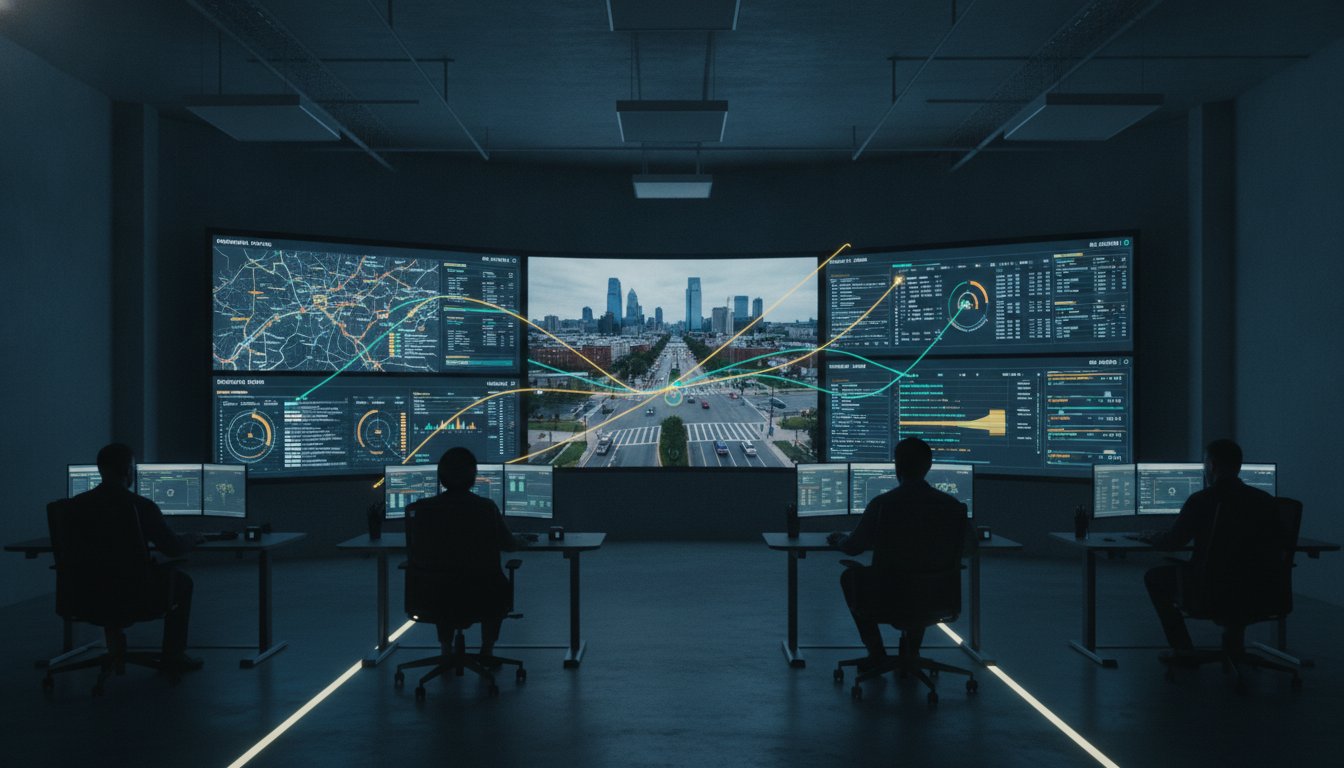
In a mission-critical environment, a five-second delay isn’t just a technical glitch; it’s an operational failure that can compromise public safety or critical infrastructure. Achieving low latency video streaming for control rooms is the difference between proactive intervention and reactive cleanup. You’re likely already dealing with the frustration of fragmented systems where manual switching delays and siloed data between GIS and SIEM feeds create a persistent fog of war. It’s exhausting for operators to filter through low-value streams while waiting for the one feed that actually matters to load. While tools like Axon provide a piece of the puzzle, they often remain siloed, offering only a partial view of the field.
Most control rooms already have the screens. What they’re missing is the layer that decides what goes on them, and escalates automatically when something needs attention. This article demonstrates how to eliminate visual lag and transform raw video streams into actionable situational awareness for your entire command center. We’ll explore technical protocols like WebRTC and SRT, which now deliver sub-500 millisecond latency to ensure real-time response. You’ll also learn how vis/ability acts as the operational intelligence layer to unify your NOC with mobile field units, ensuring every second counts when the stakes are highest.
Key Takeaways
- Define latency as the critical interval between a field event and an operator’s decision, where standard streaming delays can lead to catastrophic operational failures.
- Learn how to optimize low latency video streaming for control rooms by addressing the four stages of lag, from initial encoding to final display.
- Identify why standalone video tools provide only a partial solution when they remain siloed from essential data sources like GIS or SIEM.
- Shift from monitoring overwhelming volumes of raw data to managing actionable intelligence by implementing event-driven triggers that automate feed escalation.
- Discover how vis/ability serves as the operational intelligence layer, unifying fragmented systems into a single common operating picture for the entire team.
The Operational Cost of Latency in Mission-Critical Environments
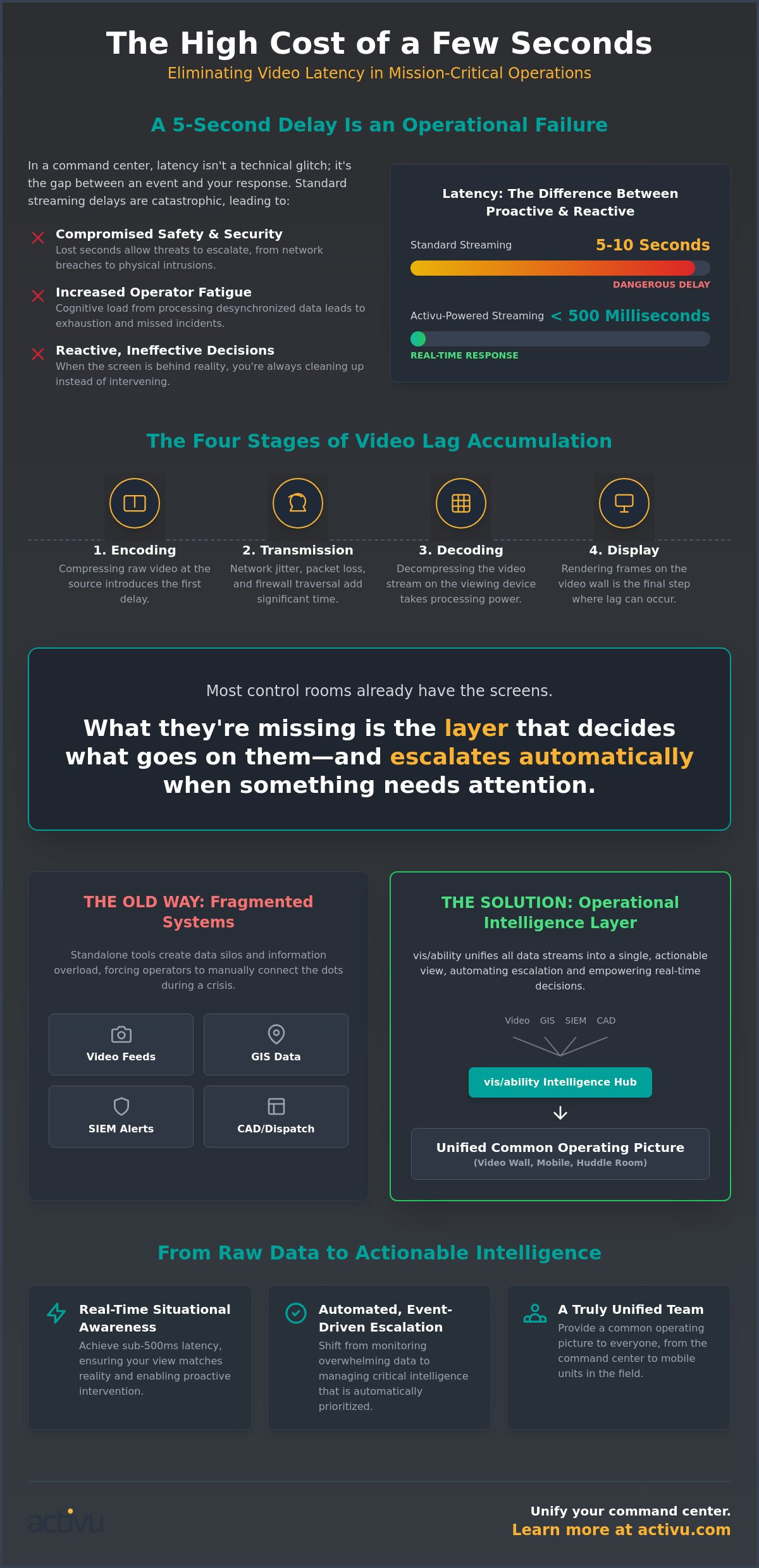
Latency in a command center is more than a technical lag in pixels. It is the critical interval between a field event occurring and an operator making a decisive action. When managing mission-critical operations, standard streaming delays of five to ten seconds are not merely inconvenient; they are catastrophic. In a Security Operations Center (SOC) or Network Operations Center (NOC), those lost seconds allow an intruder to move deeper into a facility or a network fault to cascade into a widespread outage. High-performance low latency video streaming for control rooms ensures that the visual representation of an event matches its physical reality, providing the foundation for immediate response.
Visual lag contributes significantly to operator fatigue in 24/7 environments. When video frames stutter or desync from associated data feeds, the human brain must work harder to process fragmented information. This cognitive load accelerates exhaustion, especially during peak activity periods when the volume of incoming data is highest. This is precisely when operators are most likely to miss critical incidents. The failure to see a threat in real time often stems from a lack of synchronization between the video wall and the underlying operational data. Without a unified stream, the operator remains a step behind the unfolding crisis.
Control Room Situational Awareness Problems
Fragmented data sources often compound the impact of video lag. When Geographic Information Systems (GIS), Computer-Aided Dispatch (CAD), and Security Information and Event Management (SIEM) platforms exist in silos, operators must manually correlate disparate timestamps. This manual process is prone to error and delay. Technical foundations like the Real-Time Streaming Protocol (RTSP) provide a starting point for media control, but they cannot solve the problem of information overload on their own. A Common Operating Picture (COP) requires more than just raw video; it requires visual clarity that allows an operator to distinguish a critical alarm from background noise instantly. Information overload happens when too much irrelevant data hides the critical feed, causing a paralysis of analysis during urgent moments.
The Impact on Public Safety and Utility Resilience
For transportation networks and energy distribution, real-time visibility is a matter of public safety and regulatory necessity. In the energy sector, maintaining NERC CIP compliance requires strict oversight of physical and digital assets. Any delay in visual verification of a sensor trip or a perimeter breach can result in significant fines or infrastructure damage. Most control rooms already have the screens. What they’re missing is the layer that decides what goes on them, and escalates automatically when something needs attention. Achieving this level of operational readiness is explored in depth within the Strategic Guide to Mission-Critical Situational Awareness, which outlines how to bridge the gap between raw data and human judgment through intelligent integration.
Technical Drivers of Video Streaming Lag in Command Centers
Achieving low latency video streaming for control rooms requires a surgical understanding of the four stages where lag accumulates: encoding, transmission, decoding, and display. Each stage introduces milliseconds that, if left unmanaged, aggregate into seconds of delay. High Efficiency Video Coding (HEVC or H.265) serves as a foundational tool in this process. By reducing bitrate requirements without sacrificing the forensic detail needed for mission-critical oversight, HEVC allows high-resolution streams to traverse bandwidth-constrained environments more efficiently than legacy codecs.
Transmission hurdles like network jitter and packet loss are particularly prevalent in high-security or air-gapped environments. Standard streaming solutions often struggle when faced with the strict firewall rules and limited throughput of these networks. While Commercial Off-the-Shelf (COTS) hardware provides the physical infrastructure, it lacks the specialized software orchestration required to prioritize critical packets during a crisis. Without this intelligence, a sudden surge in data can cause the very lag that blinds an operator at the most critical moment. Managing these technical variables is essential for maintaining a clear and responsive operating environment.
Protocols for Secure, High-Performance Streaming
Secure Reliable Transport (SRT) has become essential for maintaining stability over unpredictable networks. Unlike standard commercial hardware that prioritizes smooth playback through heavy buffering, SRT allows for precise tuning of latency versus reliability. Low-latency IPTV encoders, specifically designed for command environments, outperform generic streaming devices by minimizing the delay between capture and packetization. However, a balance must be struck; pushing for ultra-low latency can sometimes degrade visual fidelity, making forensic analysis difficult if the stream becomes pixelated or compressed beyond recognition. Selecting the right protocol ensures that the visual data remains both timely and actionable.
Hardware vs. Software Decoding on the Video Wall
The final bottleneck often occurs at the video wall itself. Standard PC-based decoding frequently fails when tasked with rendering multiple simultaneous 4K streams, leading to dropped frames and increased heat. Dedicated video wall processors utilize hardware-accelerated decoding to maintain a fluid Common Operating Picture across dozens of displays. This level of technical resilience is a core component of Operational Continuity, ensuring that the visual interface remains responsive even under maximum load. To see how these systems integrate into a broader strategy, you can consult with our design experts to evaluate your current infrastructure.
Beyond Speed: Why Raw Streaming Protocols are a Partial Solution
While the technical protocols discussed previously ensure that pixels move quickly, raw speed is only half the battle. High-performance low latency video streaming for control rooms loses its value if the operator has to spend precious seconds finding the right feed among hundreds of options. Many organizations rely on partial solutions like Axon, which effectively capture field video but leave it siloed from the rest of the operational environment. Similarly, while some organizations use standard IPTV systems to distribute content, these tools lack the event-driven logic required to prioritize information during an emergency. Most control rooms already have the screens. What they’re missing is the layer that decides what goes on them, and escalates automatically when something needs attention.
Passive monitoring is a luxury mission-critical environments can’t afford. True active situational awareness requires that the video stream be part of a broader, intelligent ecosystem. Without this, the video wall remains a wall of noise rather than a tool for judgment. The goal is to move beyond simply seeing data to understanding it within the context of a live operation. This requires a shift from manual oversight to automated intelligence.
The Limitations of Standalone Video Management Systems (VMS)
Standalone VMS tools are designed for storage and retrieval, not for real-time team collaboration. They often fail to provide a unified operating picture because they don’t integrate with the non-video data that drives decisions. This creates a “swivel-chair” effect, where an operator must constantly switch between the VMS, a GIS map, and threat intelligence platforms. This fragmentation increases cognitive load and slows down the response. To overcome this, teams need a platform that integrates these disparate applications into a single, cohesive view. The vis/ability platform serves as this unifying layer, ensuring that the right data reaches the right person at the right time.
How to Manage Multiple Data Feeds in a Dispatch Center
In a dispatch center or EOC, the challenge is correlating 911 dispatch data with live traffic or security camera feeds. When an incident occurs, an operator shouldn’t have to manually search for nearby cameras or reconfigure video wall layouts. These manual changes consume time and increase decision latency. An operational intelligence layer automates this visualization by using external data triggers to move relevant feeds to the foreground. This automation ensures that when a sensor trips or a 911 call is placed, the corresponding low-latency video appears instantly, allowing for a seamless transition from detection to action. For agencies looking to improve their response, understanding EOC common operating picture solutions is the first step toward eliminating these manual bottlenecks.
Designing an Intelligence-Driven Streaming Architecture
High-volume data becomes an operational liability when it lacks prioritization. In a mission-critical environment, the goal of low latency video streaming for control rooms is to provide clarity, not just more imagery. To prevent operator burnout, the architecture must distinguish between baseline monitoring and emergency escalation. Most control rooms already have the screens. What they’re missing is the layer that decides what goes on them; and escalates automatically when something needs attention. By implementing event-driven triggers, the system can instantly move relevant video feeds to the foreground based on external data, such as a sensor trip, a door alarm, or a sudden change in network traffic.
A resilient architecture also requires N+1 redundancy to ensure that visibility remains constant even during hardware or network failures. This intelligence must extend beyond the main video wall to huddle rooms and mobile devices, enabling distributed collaboration. Unlike commercial solutions that rely on global CDNs, which are often prohibited in secure, air-gapped networks, a mission-oriented streaming architecture is built for private, high-security infrastructure. This ensures that situational awareness is maintained across all levels of the command structure without compromising security protocols.
EOC Common Operating Picture Solutions
In an Emergency Operations Center (EOC), building a Common Operating Picture requires a systematic approach to data aggregation. First, the system ingests disparate feeds from weather services, power grid sensors, and emergency response databases. Second, these feeds are correlated with geospatial oversight tools to provide a map-based view of the incident area. Finally, this unified view is shared with field units. Linking the command center to field users via Mobile vis/ability ensures that the person on the ground sees the same critical information as the commander in the EOC, eliminating the confusion of verbal-only reports during a disaster.
Cybersecurity and Network Health Visualization
Modern threats are rarely just physical or just digital. Integrating SIEM and SOAR data directly into the visual stream allows for a faster SOC response by showing the cybersecurity posture alongside physical security feeds. When a digital breach is detected, the system can automatically display the physical location of the server rack or the nearest security camera. This holistic approach to visualization is a hallmark of effective SOC/NOC/GSOC solutions. To learn how to integrate your existing security tools into a unified intelligence layer, schedule a technical consultation with our team.
vis/ability: The Operational Intelligence Layer for Real-Time Response
The vis/ability platform serves as the definitive operational intelligence layer, functioning as the central hub where all mission-critical tools converge. While the technical protocols established in previous sections ensure the speed of data, vis/ability provides the logic that makes that speed useful. It automates the escalation of low latency video streaming for control rooms by monitoring real-time data from integrated applications. When specific operational criteria are met, the platform instantly populates the video wall with the necessary visual data. This transition happens without manual intervention, ensuring that the team sees the incident before they even hear the alarm.
By providing a unified view across video walls, operator desktops, and mobile devices, the platform eliminates the silos that typically hinder a common operating picture. This consistency is vital for the human element of command. When an operator knows the information on their screen is current, accurate, and prioritized by an intelligent system, they act with absolute certainty. The technology acts as a bedrock, allowing individuals to focus on judgment and decision-making rather than data management. Most control rooms already have the screens. What they’re missing is the layer that decides what goes on them, and escalates automatically when something needs attention.
Unified Visibility for Utilities and Transportation
In high-stakes sectors, the consequences of visual lag are measured in grid stability and public safety. Energy and Utility providers utilize vis/ability to maintain oversight of distributed assets, ensuring that power grid fluctuations are visualized and addressed instantly. Similarly, Transportation hubs have successfully reduced incident response times by automating the display of traffic incidents and platform security feeds. Achieving this level of coordination often starts with professional Control Room Design Services, which ensure that the physical environment supports the digital flow of intelligence.
Future-Proofing the Command Center for 2026
The evolution of the command center is a shift from reactive monitoring to proactive, event-driven operations. Traditional video wall processors often act as passive display drivers, leaving the burden of information filtering on the operator. vis/ability fills these gaps by transforming the video wall into an active participant in the response process. This forward-looking approach ensures that as data volumes grow, the command center remains agile and focused. To begin your transition toward a more resilient operation, contact Activu for a comprehensive situational awareness assessment.
Advancing Toward Unified Operational Intelligence
Operational readiness depends on the seamless integration of technical performance and automated logic. We’ve established that while protocols like SRT and HEVC are essential for achieving low latency video streaming for control rooms, they’re only the foundation. True resilience comes from eliminating the manual bottlenecks that cause decision lag. Most control rooms already have the screens. What they’re missing is the layer that decides what goes on them, and escalates automatically when something needs attention.
By prioritizing essential information over raw data, you empower your team to act with certainty during high-stakes incidents. Activu brings over 40 years of control room engineering expertise to this challenge, providing solutions trusted by Global 500 companies and federal agencies. Our event-driven automation ensures that your common operating picture remains focused and responsive, reducing time-to-incident and enhancing safety across the entire organization. This shift from reactive monitoring to proactive intelligence is the key to maintaining a decisive advantage.
Take the next step toward a more responsive command center. Request a demo of the vis/ability operational intelligence layer to see how we transform raw streams into clear, actionable intelligence. Your team deserves the clarity that only a unified, automated platform can provide.
Frequently Asked Questions
What is considered “low latency” for a mission-critical control room?
Low latency in mission-critical environments is defined as sub-500 milliseconds. This threshold ensures that the visual data on the video wall matches the physical reality in the field. Interactive operations require this near-real-time performance to prevent decision lag. Standard commercial streaming delays of five to ten seconds are unacceptable in high-stakes scenarios where every second impacts public safety or grid stability.
How does an event-driven video wall reduce operator response time?
Event-driven video walls reduce response time by eliminating the need for manual feed switching. When an external sensor or alarm trips, the system automatically pulls the relevant video to the foreground. This automation ensures the most critical information is always prioritized. It removes the stress of navigating complex menus during a crisis, allowing operators to focus entirely on the resolution of the incident.
Can I stream low-latency video to mobile devices outside the NOC?
Yes, low latency video streaming for control rooms can be extended to mobile devices and remote huddle rooms. The vis/ability platform ensures that mobile users receive the same high-priority feeds as the command center. This creates a unified common operating picture across the entire response team. It allows field supervisors and executives to make informed decisions from any location without the typical lag associated with mobile data, often relying on APEX VPN to secure these remote connections without compromising on speed.
Why do operators miss incidents even when they have a low-latency video wall?
Operators often miss incidents due to cognitive fatigue and information overload. Even with a high-performance video wall, monitoring dozens of low-value feeds causes the brain to overlook subtle changes. Most control rooms already have the screens; what they’re missing is the layer that decides what goes on them and escalates automatically when something needs attention. This intelligent filtering prevents critical events from being lost in the noise of standard operations.
What is the difference between a VMS and an operational intelligence layer?
A Video Management System (VMS) is primarily a tool for recording and retrieving historical footage. In contrast, an operational intelligence layer like vis/ability unifies video with GIS, SIEM, and CAD data. It transforms raw video into a collaborative tool for real-time judgment. This integration ensures that video isn’t just a siloed asset but a functional part of the broader mission-critical workflow.
How does vis/ability integrate with existing cybersecurity tools like SIEM?
vis/ability integrates with SIEM platforms by ingesting digital threat alerts and correlating them with physical security assets. When a cyber threat is detected, the platform can automatically display the physical rack location or associated camera feeds. This integration allows for a faster, more holistic SOC response. It bridges the gap between digital forensic data and physical security oversight within a single, unified interface.
Is it possible to achieve low latency over a standard wide-area network (WAN)?
Achieving low latency video streaming for control rooms over a WAN is possible through specialized protocols like Secure Reliable Transport (SRT). These protocols manage network jitter and packet loss more effectively than standard commercial methods. Using HEVC encoding also helps by reducing the bitrate required for high-resolution streams. This combination ensures that remote sites and distributed teams maintain the same level of situational awareness as the main NOC.
How do you ensure NERC CIP compliance when streaming utility data?
NERC CIP compliance is maintained through secure, private network architectures that enforce strict access controls and audit trails. By centralizing utility data into a secure operational intelligence layer, organizations ensure that only authorized personnel have visibility into critical infrastructure. This approach provides the necessary oversight while adhering to federal security standards. It allows utilities to maintain grid stability without compromising the integrity of their most sensitive data.