

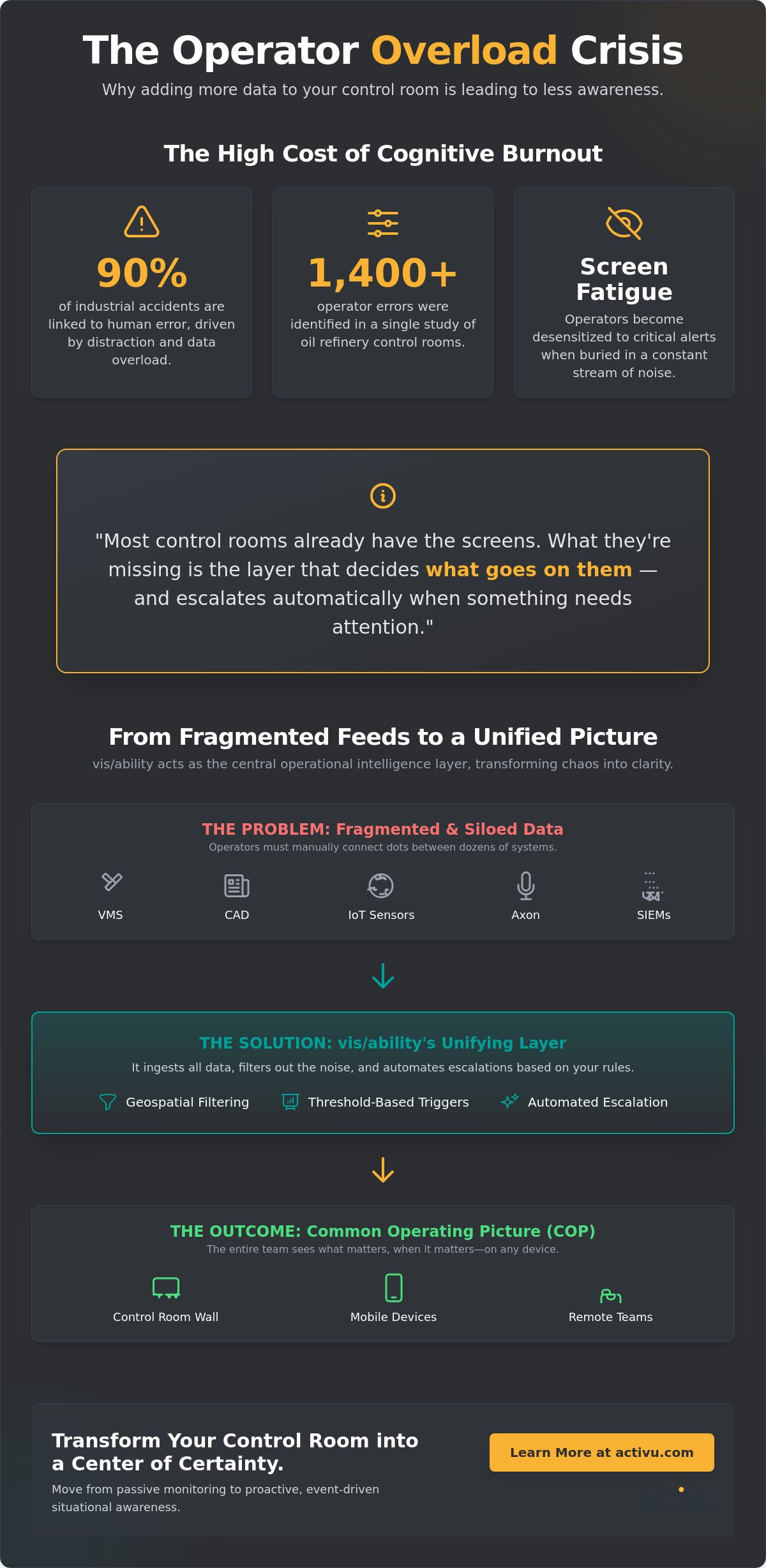
A 2026 study of oil refinery control rooms identified over 1,400 operator errors in a single sector, with distraction and communication gaps cited as the primary causes. When 90% of industrial accidents are linked to human error, the question of how to prevent information overload for operators becomes a matter of mission success rather than just convenience. You likely see the symptoms every day: screen fatigue, fragmented data feeds, and the constant stress of missing a critical event in a sea of noise.
Most control rooms already have the screens. What they’re missing is the layer that decides what goes on them — and escalates automatically when something needs attention. While tools like Axon provide valuable data, they often function as silos that require a unifying force to be truly effective. You’ll learn how to transform these overwhelming streams into actionable intelligence to ensure operator focus and operational readiness. We’ll examine the path from fragmented complexity to a calm, unified operating environment where your team acts with absolute certainty.
Key Takeaways
- Identify the specific threshold where data volume exceeds human processing capacity to mitigate the risks of missed alerts and delayed responses.
- Learn how to prevent information overload for operators by deploying an automated layer that prioritizes essential data over routine noise.
- Integrate disparate systems like VMS, CAD, and IoT into a single interface to create a cohesive common operating picture.
- Reduce screen fatigue through geospatial filtering and threshold-based triggers that only escalate information when it requires immediate attention.
- Transform your command center into a proactive environment by using vis/ability as the central operational intelligence layer for your entire team.
The Cognitive Burden of High-Stakes Operations Centers
In high-stakes environments, the human brain is the ultimate processing unit. Information overload occurs at the precise moment when data input exceeds human processing capacity. In a command center, this isn’t a minor inconvenience; it’s a systemic risk. Operators tasked with monitoring critical infrastructure or public safety feeds face a relentless stream of telemetry. When the brain reaches saturation, the ability to distinguish between a routine notification and a life-threatening emergency evaporates. This leads to missed alerts and delayed responses that jeopardize mission success.
The primary metric for operational health is the noise-to-signal ratio. High noise levels force operators to hunt for relevant data, leading to screen fatigue and cognitive burnout. This psychological strain is cumulative. Constant, unprioritized notifications create a state of hyper-vigilance that is unsustainable, eventually resulting in the very errors the center was built to prevent. Operators don’t just get tired; they become desensitized to the alerts that matter most.
Commanders often attempt to solve this by adding hardware. They install larger video walls or more desktop monitors, assuming visibility scales with screen real estate. This is a tactical error. More hardware without an intelligence layer only increases the surface area for distraction. Solving the crisis of cognitive fatigue requires a shift in strategy, focusing on how data is filtered before it ever reaches the human eye.
Why Traditional Monitoring Models Fail
The belief that more screens equal more awareness is a dangerous fallacy. Traditional models rely on the operator to perform “mental integration,” manually connecting the dots between fragmented applications. When a CAD alert triggers, the operator must look at a separate VMS window, then check a geospatial map. This manual process is the root of alarm fatigue. When every system screams for attention, nothing is treated as urgent. Determining how to prevent information overload for operators starts with recognizing that human-led data correlation is too slow for modern threats.
The Cost of Delayed Situational Awareness
In sectors like transportation hubs, a 30-second delay in identifying a platform incident or a track obstruction can have catastrophic results. Information silos are the primary culprit. If the cybersecurity team sees a network breach but the physical security team is blind to it, the response remains fractured. Establishing a Common Operating Picture (COP) is impossible when data is trapped in separate feeds. Understanding how to prevent information overload for operators requires moving beyond data collection toward true data orchestration. Without a unified view, the cost of data saturation is measured in lost time and compromised safety.
Why More Data Often Leads to Less Awareness
Awareness isn’t a byproduct of volume. Many command centers operate under the assumption that collecting every possible data point ensures safety. This creates the “Data vs. Intelligence” paradox. You have the facts, but you lack the context to act on them. Raw data streams are static and indifferent; intelligence is dynamic and purposeful. When an operator is buried under thousands of data points, the sheer mass of information obscures the very incidents it’s meant to highlight.
Most control rooms already have the screens. What they’re missing is the layer that decides what goes on them, and escalates automatically when something needs attention. This is the fundamental answer to how to prevent information overload for operators. Without this layer, the video wall becomes a wall of noise that demands constant, exhausting attention. This “passive monitoring” model creates a false sense of security. It assumes that if an incident occurs, a human will naturally spot it. In reality, it hides risks behind a veil of normalcy.
Contrast this with event-driven situational awareness. In this model, the system doesn’t wait for a human to find a needle in a haystack. It identifies the needle and presents it clearly. The goal isn’t to see everything; it’s to see what matters now. Determining how to prevent information overload for operators requires a move toward this event-driven logic. It ensures that the transition from data to decision is instantaneous and accurate.
The Limitations of Current Monitoring Tools
Organizations often rely on specialized tools like Axon for video or various SIEMs for network security. While powerful, these platforms only provide a partial view of the operational reality. They exist in silos, forcing “swivel-chair” operations where users jump between disconnected dashboards to piece together a story. This fragmentation is where critical details slip through the cracks. Specialized software fails when it lacks a unifying visualization hub to correlate these disparate feeds into a single, understandable narrative.
Defining the Operational Intelligence Layer
An operational intelligence layer acts as a gatekeeper for the mission-critical operations center. It filters the noise before it ever reaches the operator’s eyes. Instead of a person manually managing displays, software uses pre-defined logic to visualize only what’s necessary for the current mission. This shift from manual display management to automated, logic-based visualization ensures that the most relevant data is always front and center. If you’re struggling with fragmented feeds, you can speak with a specialist about unifying your operational view.
Moving from Fragmented Feeds to a Unified Operating Picture
A true Common Operating Picture (COP) is more than a collection of video feeds on a wall. It is a unified architectural framework that synthesizes data from disparate sources, including Video Management Systems (VMS), Computer-Aided Dispatch (CAD), IoT sensors, and cybersecurity telemetry. Strategic leaders often ask how to prevent information overload for operators when their current infrastructure is a patchwork of legacy systems. The answer lies in moving away from fragmented feeds and toward a single, cohesive interface that provides context alongside raw data.
Mental switching between applications is the primary cause of operator error in high-pressure environments. When an operator must manually correlate an alert from a CAD system with a specific camera feed in a separate VMS, the cognitive load spikes. This manual integration is slow and prone to failure. Most control rooms already have the screens. What they’re missing is the layer that decides what goes on them, and escalates automatically when something needs attention. By automating this correlation, the video wall transforms from a static display into a collaborative tool that drives the entire team toward the same objective.
Breaking Down Information Silos
The technical challenge of creating a COP involves integrating legacy COTS systems with modern, high-velocity data feeds. Effective application integration is the foundation of cognitive relief. It allows the system to aggregate data behind the scenes, presenting only the relevant conclusions to the human operator. This allows the operations floor to move beyond static presets. Instead, they use dynamic, context-aware screen layouts that change based on the severity and location of an unfolding event. This ensures the team stays focused on the mission rather than the technology.
Extending Visibility Beyond the Control Room
Visibility must not be confined to the four walls of the command center. To truly understand how to prevent information overload for operators, organizations must consider the reporting burden. When field units and remote stakeholders lack access to the same prioritized data, the operator becomes a manual information dispatcher. Leveraging mobile vis/ability ensures that field-to-base collaboration is seamless. When decision-makers in huddle rooms or on mobile devices see the exact same operating picture as the floor operators, information bottlenecks disappear. This synchronization ensures that every action taken is based on a single, verified version of the truth.
Tactical Methods to Reduce Operator Fatigue and Noise
Achieving operational clarity requires a shift from reactive monitoring to proactive filtration. Strategizing how to prevent information overload for operators involves setting technical boundaries on what data earns a place on the screen. Organizations must implement automated escalation where telemetry only reaches the primary display when specific, mission-critical thresholds are met. If a sensor reports routine values, it remains in the background. When it hits a critical level, the intelligence layer pushes it front and center. This ensures the operations floor remains calm until action is required.
Geospatial filtering adds another layer of precision by providing immediate context. Alerts shouldn’t exist as isolated text strings; they must be mapped to their physical location to allow for rapid assessment. Standardizing visualization layouts is equally vital. When an operator knows exactly where to look for a specific metric, they don’t waste cognitive energy searching for it. Most control rooms already have the screens. What they’re missing is the layer that decides what goes on them, and escalates automatically when something needs attention. Routine audits of alert configurations are necessary to prune noisy triggers that don’t lead to actionable outcomes.
Designing for the Human Element
Visual design is a technical requirement, not an aesthetic choice. Using standardized color-coding and iconography allows for rapid recognition without increasing fatigue. White space is essential in high-density data environments to prevent visual saturation. When an incident occurs, operators shouldn’t have to navigate through menus to find their primary incident management tools. These assets must be one click away, ensuring the transition from monitoring to response is instantaneous. This disciplined approach to design protects the operator’s cognitive bandwidth for high-level decision-making.
The Role of Event-Driven Automation
Event-driven automation uses “if-this-then-that” logic to manage the command center environment. This logic can trigger an entire video wall to switch from a routine monitoring layout to an emergency response configuration the moment a crisis is detected. It reduces the manual burden of launching applications and arranging windows during the first few minutes of an incident. By automating these repetitive tasks, the system empowers the human element to focus entirely on the resolution. You can explore the vis/ability platform to see how event-driven logic transforms operational readiness.
vis/ability: Orchestrating the Operational Intelligence Layer
The vis/ability platform serves as the central hub for mission-critical situational awareness. It acts as the operational intelligence layer that unifies fragmented data streams into a single, actionable view. While organizations often implement powerful tools like Axon for specific video needs, these tools only provide a partial solution. They require a unifying platform to create a full common operating picture. vis/ability provides this essential bridge, ensuring that every integrated tool becomes useful for the entire team, whether they are in a command center, a huddle room, or using mobile devices.
Most control rooms already have the screens. What they’re missing is the layer that decides what goes on them, and escalates automatically when something needs attention. This automated escalation is the definitive answer to how to prevent information overload for operators. By removing the need for manual monitoring, the platform allows personnel to remain focused on high-level analysis and response. This is particularly critical in SOC environments, where cybersecurity threats demand an immediate, unified response. A unified operating picture ensures that digital threats are visualized alongside physical security data, closing the gap between detection and action.
A Platform Built for Reliability
Reliability is the bedrock of any high-stakes operation. vis/ability is designed to be the trusted partner during pivotal moments of decision-making. The platform’s architecture is built to scale, supporting everything from a single command center to a sprawling national network. Beyond the software, Activu design services ensure that your physical hardware and digital workflows are perfectly aligned. This holistic approach guarantees that the technology remains a powerful engine behind your operations rather than a source of technical friction.
Taking the Next Step Toward Clarity
Transitioning to an event-driven mindset is the most effective way to improve operational readiness. It requires moving away from the chaos of raw data toward a state of clear, actionable intelligence. Understanding how to prevent information overload for operators is about more than just software; it’s about a fundamental shift in how you prioritize the human element. A professional assessment of your current control room gaps is the first step in this journey. By identifying where silos exist and where information bottlenecks occur, you can begin to implement the technical tools that empower your team to act with greater certainty. We invite you to contact us for a demonstration of how the vis/ability platform can transform your command center into a model of efficiency and clarity.
Secure Your Mission with Actionable Intelligence
Transforming a command center from a source of noise into an engine of clarity is a strategic necessity. You now understand the cognitive risks of data saturation and the tactical benefits of a unified operating picture. Success in high-stakes environments depends on your ability to prioritize essential information before it reaches the floor. Implementing an event-driven architecture is the most reliable method for how to prevent information overload for operators. It’s time to move beyond the limitations of legacy monitoring and fragmented data silos.
Most control rooms already have the screens. What they’re missing is the layer that decides what goes on them, and escalates automatically when something needs attention. Activu leverages decades of expertise in mission-critical control room design to deliver this clarity. Our platform is trusted by federal agencies and global utilities to reduce incident response times through robust, event-driven automation. We invite you to request a demo of the vis/ability platform to see how we filter noise for your team.
Frequently Asked Questions
What are the first signs of information overload in a control room?
The earliest indicators include a measurable increase in incident response times and the onset of alarm fatigue, where operators begin to ignore or silence notifications without investigation. You’ll often notice operators struggling with screen fatigue or appearing overwhelmed by the volume of fragmented data. These signs suggest that the brain’s processing capacity has been exceeded, leading to a state of hyper-vigilance that is both exhausting and prone to error.
How does an operational intelligence layer differ from a standard video wall?
A standard video wall is a hardware display, while an operational intelligence layer is the software that manages and prioritizes the content shown on it. Most control rooms already have the screens. What they’re missing is the layer that decides what goes on them, and escalates automatically when something needs attention. This layer acts as a gatekeeper, ensuring that only mission-critical information reaches the operator’s field of view.
Can I integrate my existing software tools into a unified operating picture?
Yes, modern situational awareness platforms are designed to aggregate data from disparate COTS systems, including VMS, CAD, and IoT feeds. Through deep application integration, these tools are synthesized into a single, cohesive interface. This removes the need for operators to jump between disconnected dashboards, which is a primary cause of cognitive friction and delayed decision-making during high-stakes events.
How do you identify which data feeds are causing the most operator fatigue?
Identifying fatigue-inducing feeds requires an audit of your noise-to-signal ratio. Focus on data streams that generate a high volume of notifications but result in few actionable outcomes. By quantifying which alerts are consistently ignored or cleared without action, you can prune non-essential triggers. This process ensures that the remaining signals on the operations floor are meaningful and demand immediate professional attention.
What is the best way to manage multiple data feeds in a dispatch center?
The most effective strategy for how to prevent information overload for operators is to implement event-driven situational awareness. This methodology uses pre-defined logic to ensure that data feeds only appear on the primary display when specific operational thresholds are met. Instead of forcing operators to monitor static feeds, the system pushes relevant information to the forefront only when an incident requires human judgment or intervention.
Why do operators often miss critical incidents even with a large video wall?
Operators miss incidents because large video walls often lack a prioritization layer, resulting in a “wall of noise” that obscures critical signals. Human cognitive capacity is finite. When dozens of screens display unprioritized data, the brain cannot effectively distinguish a threat from routine background activity. Without automated escalation, the sheer volume of data creates a state of saturation where important alerts are simply lost in the clutter.
How can mobile tools help reduce the burden on control room operators?
Mobile tools reduce the reporting burden by providing field stakeholders with direct access to the common operating picture. When remote teams can see the same prioritized data as the command center, the operator no longer needs to act as a manual information relay. This field-to-base collaboration prevents information bottlenecks and allows the control room staff to focus on high-level orchestration rather than basic communication tasks.
What role does geospatial visualization play in preventing information overload?
Geospatial visualization provides immediate physical context, allowing operators to understand the “where” and “why” of an alert instantly. Mapping data feeds to their precise location removes the cognitive step of manually correlating an alert with a map. This visual clarity helps operators assess the proximity and potential impact of multiple incidents simultaneously, leading to faster and more accurate resource deployment during a crisis.