

What if the most critical data in your command center never actually reaches the person who needs it most? In high-stakes environments, the gap between centralized intelligence and field execution is often where operations fail. Field teams frequently struggle with fragmented communication and disconnected monitoring tools, leading to hesitation when stakes are at their highest. True control room application integration must extend beyond the facility walls to ensure the tactical edge remains synchronized with the core mission.
Many control rooms are well-equipped with visual displays, yet they often lack the crucial intelligence layer needed to dynamically manage what appears on those screens and automatically escalate critical events. Relying on partial data feeds or manual updates leaves your personnel vulnerable to information lag. This article explores how a unified operational intelligence layer delivers real-time situational awareness to any mobile device. We’ll examine how to bridge the gap between command and the field, replacing cognitive overload with absolute clarity and technical reliability.
Key Takeaways
- Identify the limitations of voice-only communication and how fragmented data creates dangerous operational blind spots during complex multi-agency responses.
- Discover how to leverage control room application integration to extend mission-critical data beyond the command center, ensuring field teams have the same situational awareness as operators.
- Recognize why standalone monitoring tools offer only a partial solution and how an operational intelligence layer unifies these feeds into a single source of truth.
- Learn the methodology for auditing field-to-base gaps and selecting high-reliability video standards that prevent cognitive overload for distributed teams.
- Establish a foundation for operational resilience by deploying a secure, event-driven platform that prioritizes essential information when stakes are highest.
The Crisis of the Operational Blind Spot
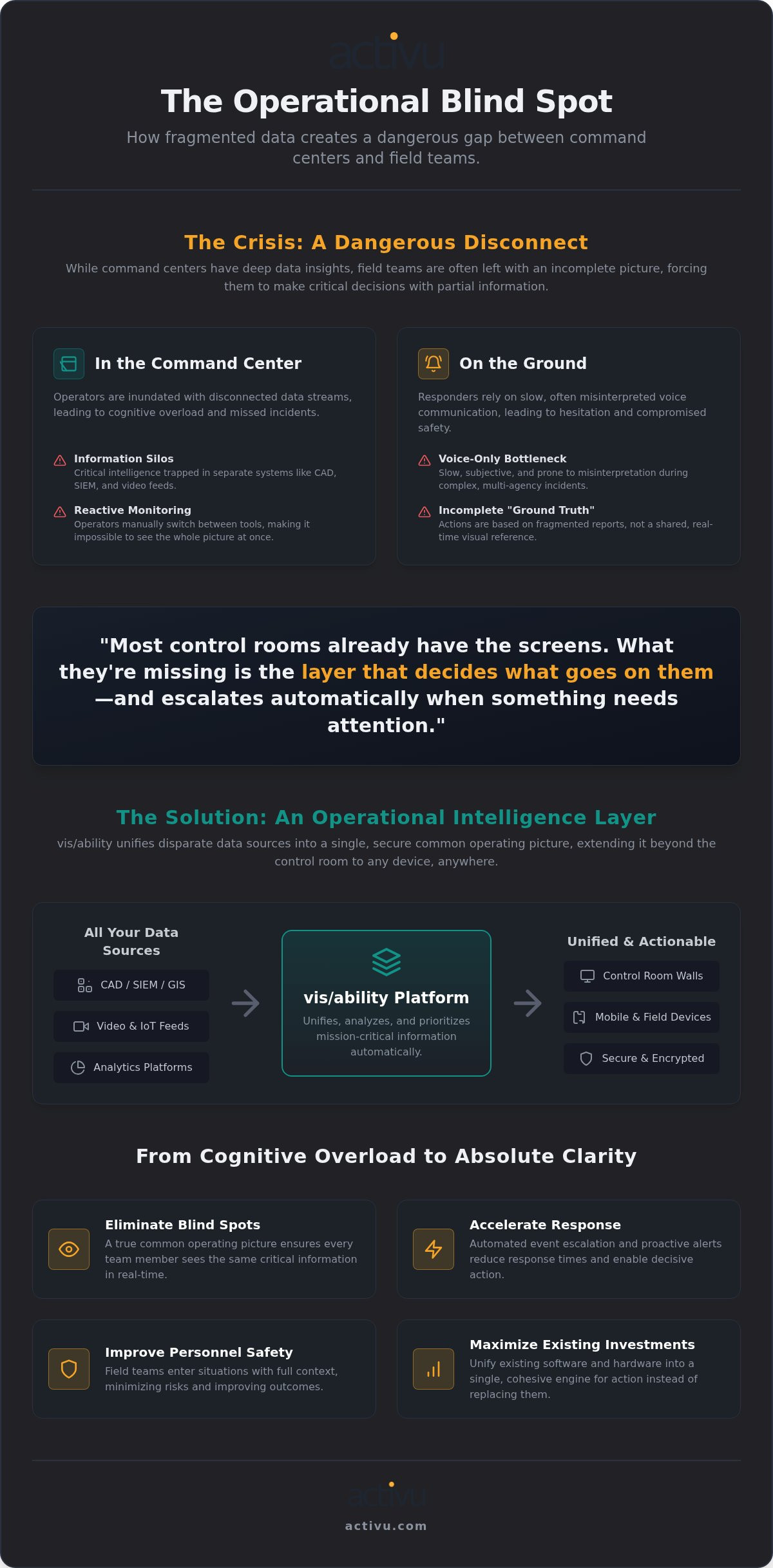
The operational blind spot is a silent threat in high-stakes environments. It occurs when centralized command centers possess deep data insights that never reach the personnel on the ground. This information asymmetry creates a dangerous disconnect. While a commander might see a developing threat on a digital map, the field team often relies on verbal descriptions over a radio. Voice-only communication remains a bottleneck during complex, multi-agency incidents. It is slow, subjective, and prone to misinterpretation. When multiple agencies respond to a single event, the lack of a shared visual reference leads to conflicting reports. Waiting for a verbal update introduces an unacceptable lag that can compromise the entire mission.
Effective control room application integration is the only way to eliminate this gap. Without it, critical data remains siloed within specific software environments at headquarters. This fragmented situational awareness forces field personnel to make pivotal decisions based on incomplete snapshots. Hesitation or incorrect action is the inevitable result when the “ground truth” seen by the operator doesn’t match the reality of the responder. Most control rooms already have the screens. What they’re missing is the layer that decides what goes on them, and escalates automatically when something needs attention. Relying on manual data sharing is no longer a viable strategy for modern operations.
Why Operators and Field Teams Miss Critical Incidents
Operators frequently face cognitive overload. Monitoring disconnected data streams such as Computer-Aided Dispatch (CAD) or Security Information and Event Management (SIEM) requires constant manual switching. This reactive approach ensures that some incidents will be missed. Intelligence stays trapped in silos because there is no unifying platform to surface what matters. Field intelligence also stays trapped in the field. When data from the tactical edge cannot flow back into the central hub, the command center operates with an incomplete picture. This failure to integrate field and base intelligence creates a cycle of reactive monitoring rather than proactive response.
The Cost of Fragmented Situational Awareness
Fragmented awareness leads to increased response times and cascading system failures. In sectors like transportation and public safety, these delays have real-world consequences. Personnel safety is compromised when responders enter a scene without a full common operating picture. Operational efficiency suffers when teams must manage multiple disconnected apps instead of focusing on the mission. Achieving true control room application integration transforms these disparate tools into a single, cohesive engine for action, ensuring that every individual has the clarity required to act with certainty.
Defining Mobile vis/ability as an Operational Intelligence Layer
Mobile capability in high-stakes environments often suffers from a limited perspective. Many organizations treat mobile devices as simple remote viewers, offering a static window into the command center. This approach fails to provide the dynamic intelligence required for the Strategic Deployment of Mobile Situational Awareness. True operational intelligence requires an extension of the control room application integration layer directly to the palm of the hand. It transforms a standard mobile device into a proactive participant in the mission, rather than a passive observer of distant data.
Security remains the bedrock of this extension. For distributed mission-critical teams, especially in federal and defense sectors, data must be encrypted and delivered through a secure architecture. This ensures that sensitive operational data flows safely between the field and the primary video wall system. By unifying field data with centralized monitoring, supervisors can convert raw inputs into actionable visual intelligence. This process eliminates the guesswork that often plagues field operations during rapid escalations. You can explore how this architecture functions by reviewing the vis/ability platform features.
The Layer That Decides What Matters
Most control rooms already have the screens. What they’re missing is the layer that decides what goes on them, and escalates automatically when something needs attention. vis/ability provides this essential intelligence. It acts as the central hub for disparate monitoring tools and CAD systems, ensuring that only the most relevant information reaches the user. This represents a strategic shift away from proprietary hardware. By utilizing flexible, COTS-based mobile solutions, organizations gain the agility to scale their response without being tethered to specific vendor hardware or static workstations.
Key Features for Field-to-Base Collaboration
Effective collaboration relies on shared context. vis/ability enables the real-time sharing of “Spaces” between the NOC or SOC and mobile users. This means an operator can push a specific visual layout to a field supervisor’s tablet instantly. For multi-agency events, secure, password-protected links allow external stakeholders to view critical feeds without compromising the core network. Integrated tools like live whiteboarding further enhance coordination. These features ensure that whether a team member is in a huddle room or on the tactical edge, they are working from the same intelligence bedrock.
Overcoming Fragmented Monitoring: Unifying Field and Command Intelligence
Standalone monitoring tools often promise clarity but deliver fragmentation. While organizations frequently deploy specialized software for evidence collection or specific asset tracking, these tools provide only a partial operating picture. They lack the context of the broader environment. When field teams are forced to juggle multiple disconnected applications, they face “tool fatigue.” This exhaustion leads to missed alerts and delayed responses. A field agent shouldn’t have to navigate three different interfaces to understand a single event. True control room application integration solves this by aggregating SIEM, SOAR, and geospatial data into a single, unified mobile view.
Most control rooms already have the screens. What they’re missing is the layer that decides what goes on them, and escalates automatically when something needs attention. Without this intelligence layer, the command center is just a collection of monitors. By extending the cybersecurity common operating picture to field personnel, organizations ensure that the tactical edge has the same situational intelligence as the headquarters. This connection is vital for Building Operational Resilience and maintaining a cohesive response across all domains.
Integrating Disparate Monitoring Platforms
Connecting vis/ability to existing IT, cyber, and physical security tools creates a hub where all data flows. The platform filters the signal from the noise, preventing mobile users from being distracted by irrelevant pings. It automates the visualization of critical alerts, pushing specific “Spaces” to remote devices the moment a threshold is crossed. This ensures that control room application integration isn’t just about connecting software. It’s about delivering the right visual context at the right moment.
The Human Element in a Digital Context
Technology must empower individuals to act with certainty. In high-stress federal government and defense operations, reducing cognitive burden is a matter of mission success. Prioritized data allows field agents to focus on the objective rather than the tool. This clarity ensures that critical infrastructure sectors maintain continuity even when stakes are at their highest. When the system handles the data processing, the human can focus on judgment and action.
Strategic Deployment of Mobile Situational Awareness
Deploying mobile situational awareness requires more than just distributing hardware. It demands a rigorous audit of current field-to-base communication gaps and the data silos that impede rapid response. Identifying where information halts is the first step toward building a resilient architecture. Organizations must move beyond the limitations of verbal-only updates and static reports. Success depends on control room application integration that prioritizes mobile-ready AVoIP standards. These standards ensure low-latency, high-reliability video delivery, which is essential when every second influences the outcome of a mission.
Establishing permissions-based access is equally critical, especially for distributed and multi-agency teams. Security protocols must allow for the seamless addition of agency partners without compromising the core network. Training field teams on real-time situational reporting and bi-directional sharing ensures that intelligence flows both ways. This creates a feedback loop where the command center and the tactical edge operate as a single, synchronized unit. You can begin this transformation by reviewing our control room design services to ensure your infrastructure supports this level of integration.
Deploying Across Distributed Networks
Rapid, national-scale deployment is now achievable through vis/ability Cloud. This approach allows organizations to scale their operations quickly while maintaining network integrity and cybersecurity for all mobile feeds. By ensuring interoperability with commercial off-the-shelf hardware, agencies avoid being locked into proprietary ecosystems. This flexibility is vital for maintaining a modern, agile response capability that can adapt to evolving threats across any distance.
Event-Driven Escalation Workflows
Schedule a consultation to eliminate your operational blind spots and unify your command.
Building Operational Resilience through Distributed Visualization
Resilience is not a static state. It is a dynamic capability built on the flow of accurate, prioritized information that reaches the right person at the moment of decision. Activu serves as the bedrock for this process across federal, defense, and industrial sectors. For an organization to achieve true operational resilience, it must move beyond fragmented data and embrace a unified platform. This unity ensures that the mission continues regardless of the complexity of the environment or the distance between team members.
Most control rooms already have the screens. What they’re missing is the layer that decides what goes on them, and escalates automatically when something needs attention. In the utilities and energy sectors, this capability is a requirement for safety and continuity. Field crews managing high-voltage repairs or infrastructure grid management cannot afford to wait for radio updates or static reports. Mobile vis/ability delivers a common operating picture directly to their devices, closing the most dangerous operational gaps by ensuring that intelligence is never trapped in a headquarters silo. Effective control room application integration transforms these disparate data points into a cohesive engine for action.
The Activu Difference: Precision, Security, and Reliability
Activu brings over 40 years of experience to mission-critical visualization and design. We provide the only solution built specifically for the highest-stakes command environments, where technical reliability is a matter of national security or public safety. Our approach prioritizes direct engineering support for complex control room application integration, ensuring that your specific software ecosystem works as a unified whole. We don’t just provide software. We provide the technical certainty that your team can act with confidence when stakes are at their highest.
Extend Your Operating Picture to the Field
The first step toward building a more resilient operation is evaluating your current incident management software and identifying the data silos that slow your response. Are your field teams operating with the same intelligence as your command center? If not, you have an operational gap that requires immediate attention. We invite you to request a technical walkthrough of the vis/ability operational intelligence layer to see how it can unify your existing tools into a single source of truth. Contact Activu today to bridge your operational gaps and secure your command.
Unifying the Command and Tactical Edge
High-stakes operations demand a seamless flow of intelligence from the command center to the tactical edge. We’ve established how eliminating data silos and prioritizing essential information transforms a reactive environment into a proactive one. Achieving true control room application integration ensures that every team member, regardless of their location, operates from a shared bedrock of visual truth. By treating mobile devices as active intelligence extensions rather than passive viewers, organizations can finally close the gap between centralized command and field reality.
Activu provides the only operational intelligence layer certified for high-security US government environments. Our platform aggregates all mission-critical data into a single hub, reducing incident response times through event-driven automated intelligence. Most control rooms already have the screens. What they’re missing is the layer that decides what goes on them, and escalates automatically when something needs attention. It’s time to replace cognitive overload with absolute clarity and act with certainty.
Request a vis/ability Demo to Unify Your Field and Command Operations
You have the tools to secure your mission. We provide the reliable platform to ensure they work as one.
Frequently Asked Questions
What is mobile vis/ability and how does it differ from a standard remote desktop app?
Mobile vis/ability is a proactive operational intelligence layer designed for high-stakes decision-making. Unlike standard remote desktop applications that merely mirror a single workstation screen, vis/ability allows users to interact with curated “Spaces” containing multiple integrated data feeds. It provides a dynamic, bi-directional link between the field and the command center. This ensures that responders see exactly what is relevant to their specific role rather than navigating a cluttered desktop interface.
How does mobile vis/ability integrate with existing control room video walls?
The platform unifies your mobile fleet with your primary video wall by serving as a central hub for all visual data. Through control room application integration, an operator can push any layout or specific application view from the video wall directly to a field supervisor’s device. This synchronization ensures that the common operating picture remains consistent across the entire organization. It eliminates the communication lag typically caused by describing visual data over voice-only channels.
Is the vis/ability platform secure enough for federal government and defense use?
Security is a foundational element of the platform’s architecture. Activu Corporation provides the only on-premise solution certified for high-security US government environments. It maintains network integrity through encrypted data distribution and strict permissions-based access. This level of security is essential for federal and defense sectors where mission-critical data must be protected from unauthorized access while remaining accessible to authorized personnel on the tactical edge.
Can I share real-time data feeds with stakeholders outside my immediate network?
You can securely share real-time intelligence with external stakeholders using password-protected links. This feature allows agency partners or temporary stakeholders to view specific visual context without requiring full access to your internal network. It facilitates multi-agency coordination during large-scale incidents while maintaining the cybersecurity of your core systems. This controlled visibility ensures that everyone involved in a response is working from the same intelligence bedrock.
What types of control room applications can be integrated and pushed to field teams?
The platform integrates with a wide variety of mission-critical applications including CAD, SIEM, SOAR, and geospatial oversight tools. It also unifies video management systems and IoT sensor data into a single operational intelligence layer. By aggregating these disparate feeds, vis/ability makes all integrated tools more useful for the entire team. Field responders receive a consolidated view of the situation rather than having to manage multiple disconnected apps during an escalation.
How does event-driven visualization reduce operator fatigue for field supervisors?
Event-driven visualization reduces fatigue by automating the delivery of critical information. Most control rooms already have the screens; what they’re missing is the layer that decides what goes on them and escalates automatically when something needs attention. By filtering the signal from the noise, the system only pushes data to field supervisors when specific triggers are met. This prevents cognitive overload and allows personnel to focus on the mission rather than monitoring screens.
Does mobile vis/ability require proprietary hardware or work on COTS devices?
Mobile vis/ability is a software-centric solution that operates on standard Commercial Off-The-Shelf (COTS) hardware. It doesn’t require proprietary mobile devices, allowing organizations to leverage their existing fleet of smartphones, tablets, and laptops. This flexibility simplifies the control room application integration process and avoids the high costs and logistical challenges of specialized hardware. It ensures that your operational intelligence layer can scale rapidly across any distributed network.
How can I request a demo of the vis/ability operational intelligence layer?
You can request a technical walkthrough of the vis/ability platform by contacting Activu Corporation directly through our website. Our engineers will demonstrate how the operational intelligence layer unifies your existing tools and extends your common operating picture to the field. This demo provides a clear view of how the system closes operational gaps and enhances situational awareness. Scheduling a session is the first step toward achieving absolute clarity in your command environment.