
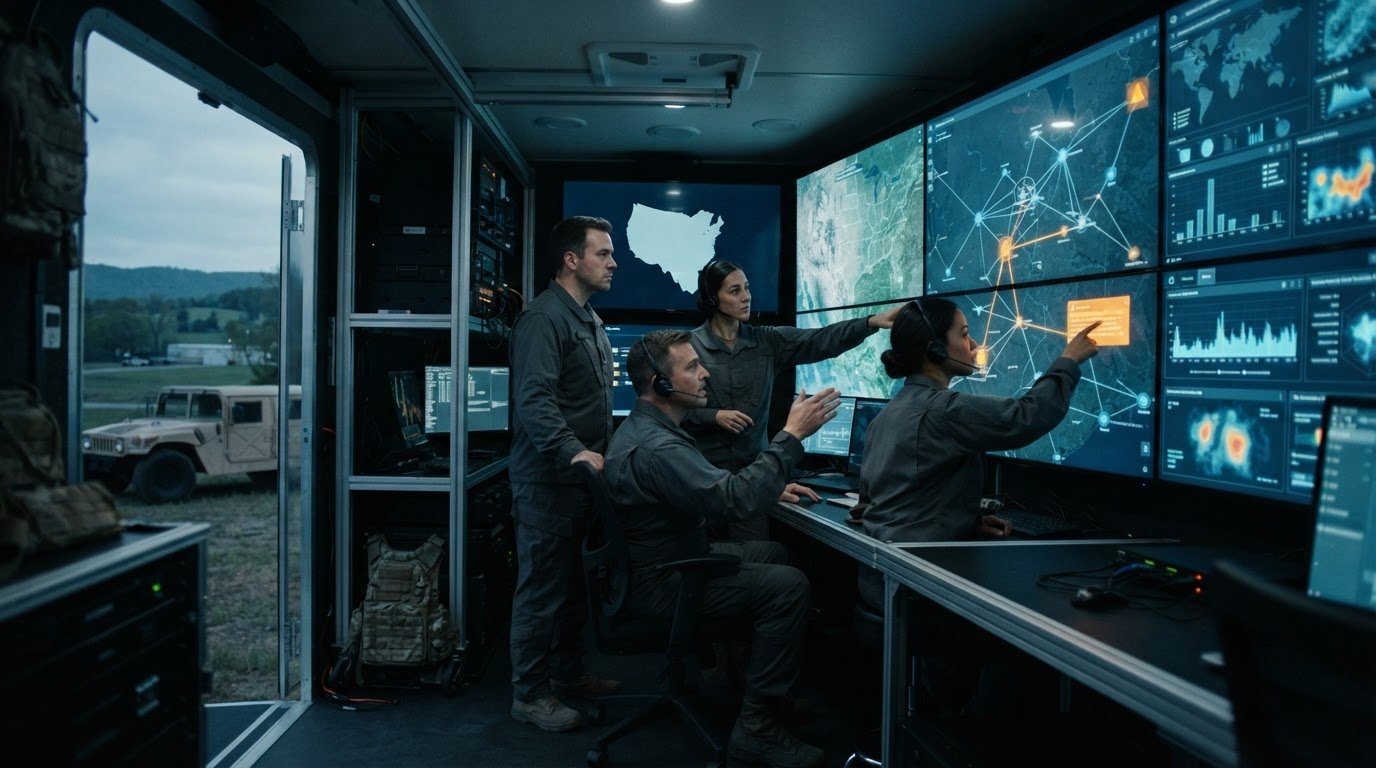
Mobility alone doesn’t make a command post effective. Military command post technology must help teams maintain a shared operational picture as people, platforms, and communications networks shift. The decisive capability is turning fragmented information into clear, timely decisions.
Command teams know that connected operations depend on more than collecting data. Fragmented systems, information silos, and missing escalation workflows can leave operators sorting through feeds instead of responding to emerging events. Many control rooms already have displays; the challenge is organizing what appears on them and making sure critical information reaches the right people.
This article explains how mobility and distributed nodes shape command-post operations, why network interoperability matters, and how AI can help manage cognitive burden. It also looks at how an operational intelligence layer can bring relevant information together on shared displays, helping teams focus on essential signals and apply human judgment with greater clarity.
Key Takeaways
- Identify how fragmented systems, information silos, and missing automatic escalation can weaken a shared operational picture.
- Evaluate command-post mobility by how well teams can maintain connectivity and coordinate as operations shift between locations.
- Explore how AI and machine learning can help prioritize information while keeping people responsible for judgment and decisions.
- Consider how network interoperability and distributed nodes affect coordination, resilience, and the ability to sustain operations when conditions change.
- See how Activu Corporation’s vis/ability serves as an operational intelligence layer that surfaces through the video wall, bringing relevant applications and information into view.
Tactical command-post mobility and footprint
U.S. Army planning treats mobility, connectivity, camouflage, ergonomics, power management, and shelter as linked design demands. A command post’s footprint affects how quickly teams can relocate while maintaining coordination.
Mobile and Survivable Command Posts
A mobile command post combines transportable shelter, communications, power, and operator workspaces in a configuration built to move. Its smaller footprint can help teams disperse and reduce their exposure while maintaining command functions. U.S. Army leaders say command posts below division level must move and disperse to improve survivability. Army CPI2 combines trucks, communication nodes, and off-the-shelf commercial technologies to support this direction.
At the program level, the U.S. Army’s CPI2 initiative and modular command-post kits are identifiable approaches; vendor selection depends on the specific procurement. The planned modular approach uses a family of kits mounted in a family of vehicles, rather than one fixed configuration for every mission.
Command-Post Setup and Deployment
Deployment means selecting a site, configuring the vehicle and shelter, restoring communications, and checking operational systems. These steps matter because a mobile command post must regain useful connectivity after each move. A soldier described setup or teardown in about 30 minutes at most, showing how transportability and a repeatable layout can support relocation.
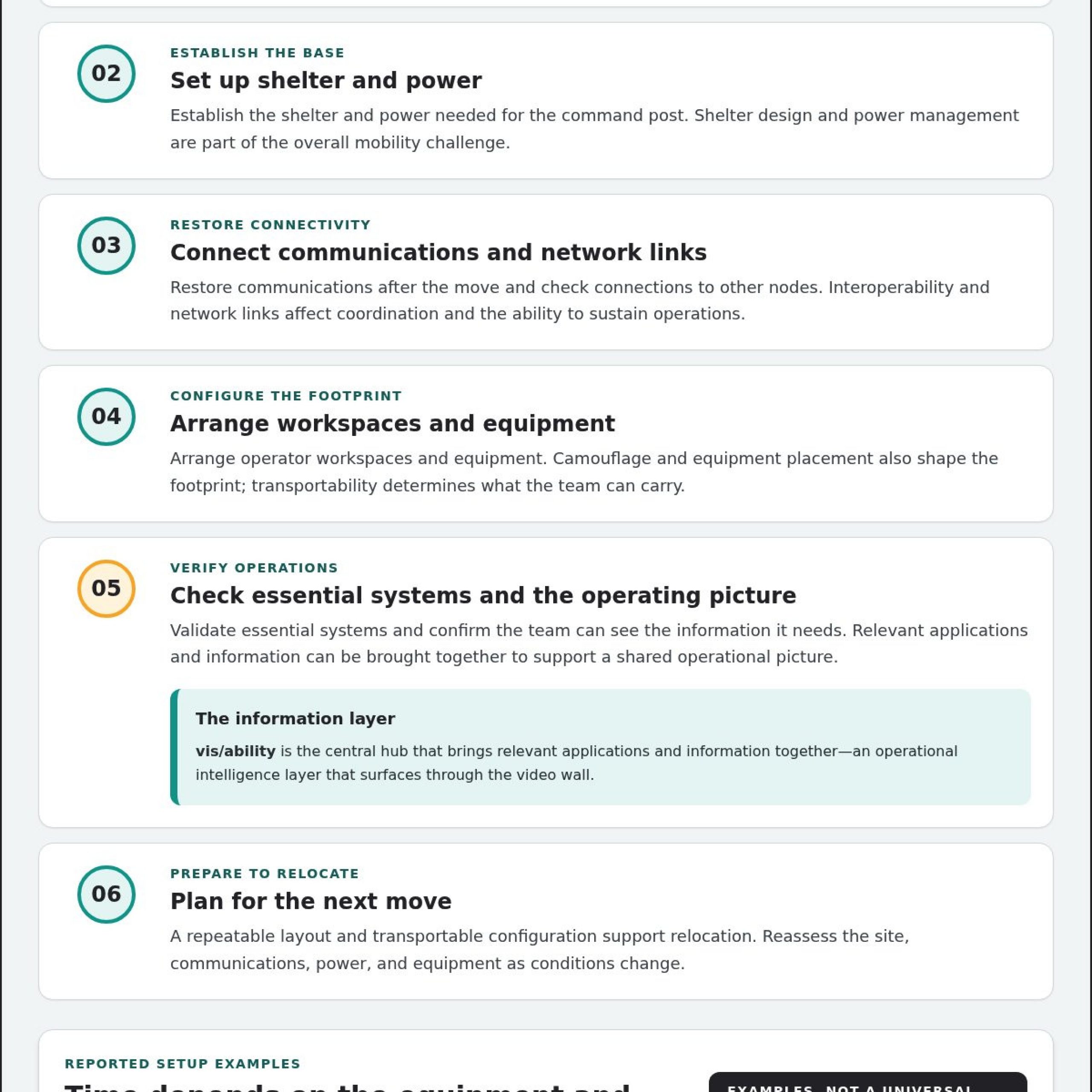
Teams begin by selecting a position that fits the mission and supports required communications. They establish shelter, power, and network connections, arrange workspaces, and verify essential systems. Camouflage and equipment placement also shape the footprint. Commercial satellite dishes can be set up and taken down in minutes, helping units disperse quickly to avoid enemy fire.
For planners considering deployment, the sequence is practical: select the site, establish shelter and power, connect communications, validate the operating picture, and prepare to move again. Vehicle choice, equipment design, and connections to other nodes determine what the team can carry.
Standards, Costs, and Security Risks
U.S. requirements depend on a command post’s acquisition, network, and intended operating environment. Assess interoperability, security, transportability, and power against those needs. Costs depend on the vehicle, shelter, communications, power, integration, and support included in the configuration, so one figure cannot describe every system.
Cybersecurity and electronic warfare risks include unauthorized access, disrupted communications, and interference with network links. A dispersed layout can complicate coordination, while concentrated equipment may increase exposure. Account for these risks in system design, communications planning, and relocation procedures, alongside camouflage and power management.
The proposed Mobile Command Post is sized for a squad to a platoon and mounted on a single light tactical vehicle. The Russia New Generation Warfare study in 2017 prompted modernization efforts to improve signature management and command post survivability. Certain Army command post shelter variants can be erected and brought online in half an hour. Together, these details connect vehicle footprint, shelter readiness, and survivability in mobile command-post planning.
AI/ML-enabled command and control
Artificial intelligence, machine learning, edge computing, and automated data analysis are changing command posts. These tools can help staff sort incoming reports, identify patterns, and prioritize information for human review. In April 2024, a report described an airspace deconfliction tool that could debut within the next year, illustrating demand for faster coordination.
AI can support command and control by reducing the time between data arrival and useful assessment. A system can combine reports from sensors, maps, and operational databases, then flag items that meet defined criteria. Machine learning can identify patterns in historical and current data. Commanders still assess context, validate information, and decide what action to take. A military command post technology stack can support analysis with these tools without transferring decision authority from people.
The practical value depends on the quality and relevance of the inputs. Delayed, incomplete, or differently formatted feeds can lead an algorithm to surface an inaccurate picture. Test AI outputs against known scenarios, define which alerts require human review, and make source information visible. These steps help operators distinguish a machine-generated cue from a confirmed event.
For military command post technology to support sound decisions, AI outputs should be traceable and show relevant source information. AI can assist with several decision-support tasks:
- Prioritization: Rank incoming reports by configured urgency, location, or operational relevance.
- Pattern detection: Flag changes across repeated observations or separate data sources.
- Information retrieval: Help staff locate relevant reports, map layers, or operational records.
- Coordination support: Present related information together for human assessment.
Each task needs an accountable workflow. An alert, for example, should show its source, timestamp, and reason for escalation so staff can judge its reliability. A designated operator can verify the information, resolve conflicting reports, and pass validated findings to the command team. Clear ownership reduces the risk of treating an algorithmic recommendation as an order.
Edge processing can matter when a command post has limited or interrupted connectivity. Processing selected data near its source may help preserve local analysis, while network links carry essential updates between nodes. The design must balance computing needs, power, communications capacity, and information security. No single model removes these operational constraints.
Adoption requires more than installing software. Command teams need to define the decisions AI may support, train personnel to interpret outputs, and review performance during exercises. Control room design can help align information displays, operator roles, and escalation paths with those workflows. Teams developing defense command environments can explore federal defense command-post considerations.
Mark Kitz took over leadership of the U.S. Army Program Executive Office Command, Control and Communications-Tactical in June, providing relevant leadership context.
Interoperability across joint networks
Joint operations depend on command posts exchanging usable information across military, civilian, and partner networks. A connection alone does not ensure interoperability: systems must route, display, and interpret information consistently. When an Army unit and a local agency use different network generations, their teams may struggle to share updates when coordination matters.
A Joint Readiness Training Center exercise in Louisiana illustrated this challenge. An Army unit used a 4G cell tower while civilian infrastructure used 3G towers. The mismatch shows why planners must account for network capability at the point of coordination. If one organization cannot access a shared service, teams need an alternate path for essential information.
The U.S. Army planned a contract in 2025 for a pilot command post with technology to switch between communications networks. Network switching can help a unit change its connection as conditions or access change. It does not, by itself, make different systems exchange information. Commanders also need common data handling, clear routing, and operating procedures that keep reports understandable across networks.
Interoperability planning should examine the full path from source to decision. A field report, for example, may originate in one system, pass through a partner network, and appear at a command post. Each transition can affect availability, format, timing, or context. Establish what information must cross boundaries, who receives it, and how operators can identify its origin.
Practical design questions include:
- Connection options: Which networks can the unit use, and how does it switch when a link becomes unavailable?
- Information compatibility: Can receiving systems interpret the report’s location, time, and status?
- Access and control: Which users can view or share each category of operational information?
- Fallback procedures: How do teams pass essential updates when a preferred connection fails?
These questions turn interoperability from a technical label into an operational capability. A joint exercise can reveal whether a local agency receives the same update as an Army command post and whether both teams understand its meaning. Test degraded connections and changes in network access, not just routine data exchange.
A unified operational view can help personnel compare information from separate systems without requiring every organization to replace its network. The key is preserving context as data moves between sources and users. Command teams should know where a report came from, whether it is current, and which network carries the next update.
For U.S. forces working alongside civilian partners, the Louisiana 4G-to-3G example makes planning concrete: identify network differences early, map alternate communication paths, and rehearse information exchange together. That preparation helps teams sustain coordination when separate systems and infrastructures meet in the field.
C2 technology overload and cognitive burden
A company-level commander may need to manage four or more communications systems. Each can require separate monitoring, navigation, and message handling. That divided attention competes with assessing the operational picture and directing personnel. The challenge increases when an outage forces workarounds across disconnected tools.
When systems fail, a commander may be left managing 15 or more systems. That load can include communications, status reports, maps, sensor feeds, and coordination tools. Operators must move between interfaces, compare details, and determine which information remains current. Every extra handoff adds another chance to miss context or delay escalation.
The burden comes from task switching as much as from the number of screens. A report may arrive in one application while its location appears on a separate map. The operator must remember the first detail, open another system, and check whether both records describe the same event. Under pressure, this sequence consumes attention needed for judgment.
Consider a command post receiving a radio update while tracking a map and reviewing a separate incident feed. The operator must identify the report, match its location, assess its relevance, and notify the right role. If each tool signals activity differently, staff must interpret the interface before they can interpret the event. Clear priorities and consistent escalation paths reduce that friction.
Command teams can reduce avoidable cognitive load by designing around decisions rather than individual applications. They can:
- Assign ownership: Specify which role monitors each system and handles its alerts.
- Set priority rules: Distinguish urgent events from routine updates using operational criteria.
- Reduce duplicate review: Identify where the same report appears across separate tools.
- Standardize escalation: Define who receives a validated alert and what information accompanies it.
- Rehearse failure conditions: Practice maintaining the operating picture when a system becomes unavailable.
These measures support human judgment; they do not replace it. An alert can identify a possible issue, but an operator still needs to consider the source, timing, and operational context. Make that review visible in procedures so staff know which signals require confirmation and which actions require authorization.
During exercises, observe how operators handle a realistic sequence of reports across their assigned systems. Note where staff repeat searches, switch interfaces, or ask colleagues to confirm details. These steps reveal where information design or role clarity can improve. The goal is to keep essential information accessible without asking one person to reconcile every feed alone.
Technology choices matter most when they simplify the work surrounding a decision. A command post should present relevant information in context, clarify responsibility, and support escalation without obscuring the source. Reducing interface friction gives operators more attention to assess events and coordinate action.
Distributed command nodes and redundancy
Distributed command nodes divide command functions across connected locations instead of concentrating every capability at one site. The proposed Mobile Command Post structure recommends one MCP per company in brigade combat teams. That arrangement can place coordination closer to units while preserving links to higher headquarters. Its value depends on clear authority, reliable information exchange, and defined roles at each node.
The U.S. Army anticipates that future battlefield command post hubs may need to be dispersed across hundreds of miles. This separation changes how teams share updates, maintain a common operational picture, and coordinate decisions. Each node needs enough local information and capability to keep operating when links weaken. Commanders also need procedures for transferring responsibilities as the operational picture changes.
In contested or disconnected environments, command networks are designed to preserve essential local functions, use available alternate communication paths, and synchronize information when connections return. Teams need clear rules for what each node can decide independently and how it reports significant changes.
The U.S. Army’s CPI2 effort combines trucks, communication nodes, and off-the-shelf commercial technologies. This approach reflects a broader shift toward adaptable networks that can distribute capability across mobile platforms. A node’s usefulness comes from its role in the wider system, not simply its physical location. Planners must define what information it receives, what decisions it supports, and what happens if its primary link is unavailable.
Redundancy means providing alternatives for functions that cannot stop when a node or connection fails. It can involve different communication paths, backup power arrangements, or another designated node able to assume specific responsibilities. The aim is continuity, not duplicating every tool at every location. Identify essential functions first, then assign a fallback for each one.
For example, a company-level node might continue local coordination during a network interruption while higher headquarters retains broader planning responsibilities. Teams need agreed procedures for marking potentially delayed information, communicating urgent updates through available channels, and reconciling records after connectivity returns. These procedures help reduce conflicting instructions and stale operational data.
Distributed operations also require deliberate information discipline. Each node should know which reports it owns, which updates it must forward, and who can authorize a change in responsibilities. Exercises can test these handoffs by simulating a disconnected link and asking teams to maintain coordination with available resources. The review should identify unclear authority, missed updates, and dependencies on a single node.
Planning a distributed defense environment means aligning node roles, communication paths, and operator workflows. Explore defense command-post planning to assess how distributed teams can maintain a shared operating picture.
Activu Corporation: Video Wall Systems
Activu Corporation’s vis/ability Platform serves as the central hub where connected applications and data feeds come together. It is an operational intelligence layer that surfaces through the video wall, so the wall becomes the place where answers appear through vis/ability. Teams can share the operating picture across command centers, remote locations, conference rooms, breakout rooms, huddle rooms, and mobile devices.
Application Integration and Event-Driven Situational Awareness help teams bring relevant information into that shared view. Activu’s Video Wall Systems provide the display environment, while vis/ability brings together the tools and information operators use to coordinate decisions.
To discuss how Activu can support your command-post operations, contact Activu Corporation.
Shape the Next Command-Post Decision
The next step is to assess how information reaches the people responsible for acting on it. Map where critical updates originate, who must interpret them, and how teams maintain shared awareness as operations shift across locations. This review can reveal gaps between collecting data and supporting timely decisions.
Use those findings to shape requirements for military command post technology around operational workflows, not isolated equipment. Define what commanders need to see, how teams coordinate across nodes, and where human review remains essential. A focused design process gives technical decisions a clear mission purpose and helps teams evaluate whether their operating picture supports real decisions.
Activu Corporation can help teams consider how integrated information supports command-post operations. Contact Activu Corporation to discuss your operational priorities and next steps. With a clear view of the requirements, your team can move forward with greater confidence.
Frequently Asked Questions
What technologies are used in modern military command posts?
Modern command posts use communications equipment, networked computing, geospatial tools, sensors, operational applications, and shared displays. The specific mix depends on the mission and the information commanders need to assess. For example, staff may compare a field report with a map layer and a unit-status update before briefing leadership. AI-enabled tools can help organize incoming information, while trained personnel assess its source and operational significance.
How do command post systems integrate communications, intelligence, and operations data?
Integration connects information sources to a shared operational environment where staff can compare relevant updates and coordinate decisions. A practical workflow might bring a communications report, an intelligence assessment, and a logistics status update together around the same operational area. Consistent context, such as source and timing, helps teams interpret those inputs correctly. Define access and handling procedures so personnel see information appropriate to their role.
How do mobile command posts compare with fixed command centers?
Mobile command posts prioritize transportability and operation from changing locations; fixed command centers prioritize sustained work from an established site. A mobile team may carry a focused set of functions closer to field activity, while a fixed center can support broader coordination among staff and systems. Organizations can connect both through shared procedures and information flows, allowing field personnel to report conditions while headquarters maintains a wider planning perspective.
What are the leading military command post technology vendors and platforms in the United States?
The article identifies the U.S. Army’s CPI2 initiative and modular command-post kits as approaches, and Activu Corporation’s vis/ability as an operational-intelligence layer. Vendor selection depends on the specific procurement.