

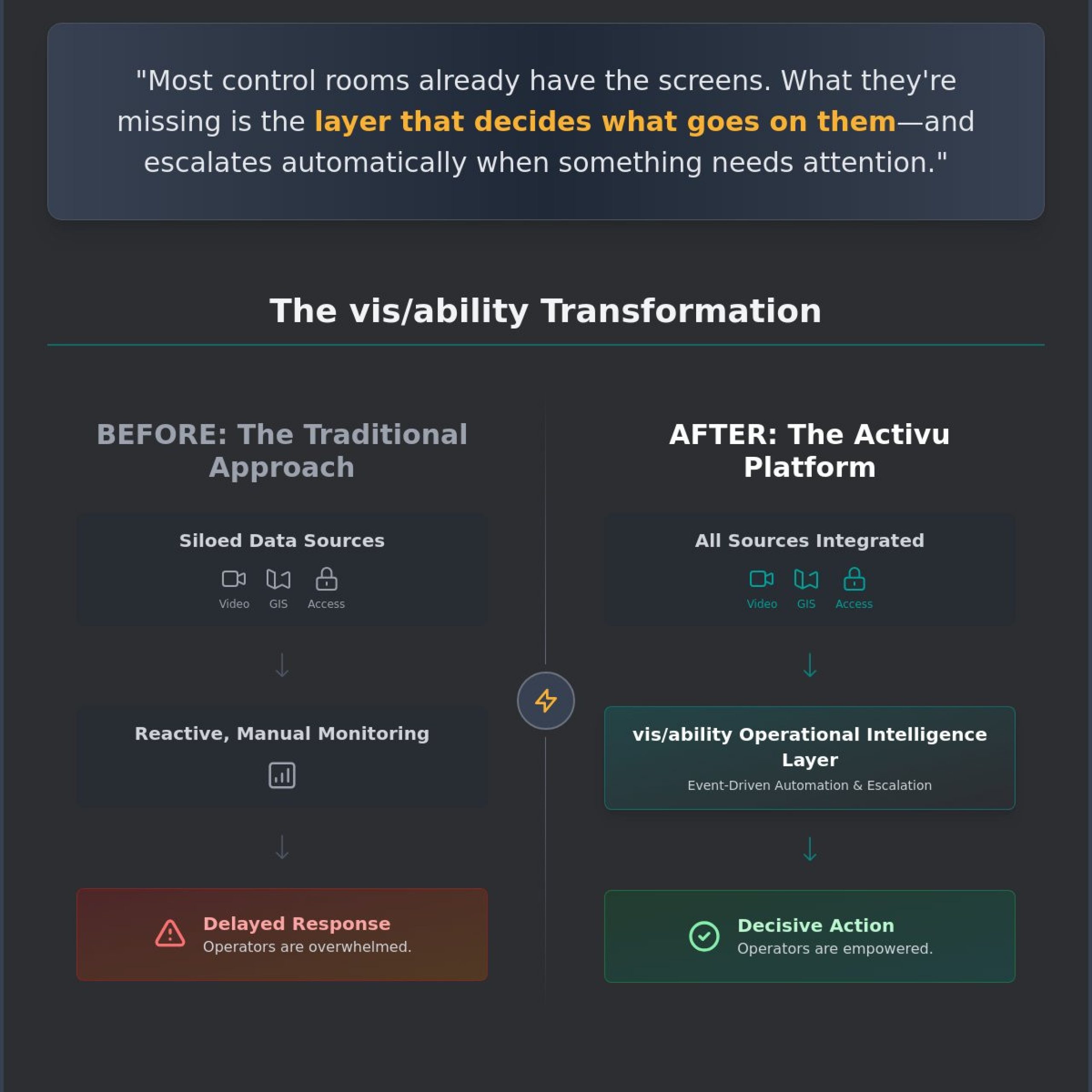
Why do multi-million dollar facility upgrades often fail to reduce response times or prevent operator burnout? The disconnect usually begins at the planning stage, where hardware specifications overshadow the need for a cohesive operational strategy. Organizations frequently struggle with fragmented systems that refuse to communicate, leaving teams to manage a chaotic flood of data across static displays. Developing a successful control room project proposal template requires looking past the physical infrastructure to the intelligence that powers it. Most control rooms already have the screens. What they’re missing is the layer that decides what goes on them, and escalates automatically when something needs attention.
You understand that justifying the cost of high-end situational awareness tools is difficult when the operational benefits remain abstract. This article provides a technical roadmap to build a high-stakes proposal that delivers a unified operating picture and automated incident escalation. While many existing video tools provide specific data, they often function as siloes; this guide details how to unify these streams into a single hub. We’ll explore the transition toward a future-proofed facility that meets ISO 11064 ergonomic standards and rigorous cybersecurity requirements. You’ll learn to position vis/ability as the essential operational intelligence layer that transforms raw data into decisive action.
Key Takeaways
- Identify the operational gaps that cause fragmented systems and siloed data feeds before finalizing your technical specifications.
- Utilize a control room project proposal template that centers on a common operating picture to secure executive buy-in and operational readiness.
- Replace static monitor layouts with event-driven situational awareness to prevent operator fatigue and ensure critical incidents trigger automatic escalations.
- Incorporate cybersecurity common operating pictures and regulatory standards like NERC CIP to protect your facility against evolving digital threats.
- Transition your operations into a unified intelligence hub where the vis/ability platform integrates disparate tools into one cohesive decision-making environment.
Identifying Operational Gaps in the Modern Command Center
A modern control room serves as the nerve center for complex, high-stakes operations. However, a significant disconnect often exists between the sheer volume of data collected and the intelligence actually utilized by decision-makers. This “Control Room Gap” represents the failure to transform raw sensor feeds and software alerts into actionable insight. When constructing a control room project proposal template, you must first address why operators frequently miss critical incidents despite being surrounded by high-definition displays. It’s not enough to buy more pixels; you have to solve the problem of visibility.
Reactive operations carry a high price. Relying on manual monitoring means your team is always behind the curve, responding to disasters after they’ve already escalated. Proactive situational awareness requires a system that moves beyond simple visualization. Most control rooms already have the screens. What they’re missing is the layer that decides what goes on them, and escalates automatically when something needs attention. Without this intelligence, the facility is merely a collection of expensive hardware rather than a strategic asset that ensures mission success.
The Problem of Cognitive Overload
Digital environments often overwhelm the human element. In a high-pressure SOC or NOC, operators face dozens of data feeds simultaneously. This leads to “wall-watching,” a state where monitors become static background noise. Human operators can’t maintain peak vigilance while scanning dozens of flickering screens for hours. To maintain operational readiness, you need intelligent filtering that surfaces only essential information. A robust control room project proposal template identifies this need for automated prioritization, ensuring the team sees the right data at the moment it becomes critical.
Siloed Tools and Fragmented Response
Many organizations rely on standalone applications that provide only a partial view of the field. Specialized video management or evidence platforms offer valuable data, but they often operate as silos. They don’t naturally communicate with building management systems, cybersecurity feeds, or geospatial data. This fragmentation forces operators to manually aggregate data during a crisis, which inevitably delays response times. You need a unifying operational intelligence layer that pulls these disparate tools into a single pane of glass. By positioning the vis/ability platform as the central hub, you turn fragmented data into a cohesive common operating picture that empowers the entire organization to act with certainty.
Essential Components of a Control Room Project Proposal
Securing executive buy-in for a facility upgrade requires a shift in perspective. A successful control room project proposal template must prioritize mission success and operational readiness over simple hardware procurement. Start with an executive summary that clearly defines how the proposed solution reduces response times and mitigates high-stakes risks. Decision-makers need to see a direct link between the investment and the organization’s ability to maintain continuity during a crisis. Most control rooms already have the screens. What they’re missing is the layer that decides what goes on them, and escalates automatically when something needs attention.
Defining the Common Operating Picture (COP)
A unified view is the bedrock of effective command and control. Your proposal should specify requirements for a Common Operating Picture that extends beyond the physical walls of the center. This includes mobile vis/ability requirements to ensure field teams and distributed stakeholders see the same real-time data as dispatchers. Incorporating Human Factors in Design is essential to ensure the interface remains intuitive under extreme stress. For sectors like power and water, linking these COP requirements to NERC CIP compliance demonstrates a commitment to regulatory standards and operational integrity.
Technical Specifications Beyond the Video Wall
Modern operations demand more than just pixels on a wall. Your technical architecture should define an operational intelligence layer that integrates SIEM, SOAR, and geospatial data streams into a cohesive environment. This software-defined visualization (SDV) approach allows for cybersecurity visualization and proactive network health monitoring. While some organizations utilize standalone video management software for specific needs, these often lack the integration required for a full operating picture. The vis/ability platform serves as the central hub where these disparate applications flow together, creating a unified stream of actionable intelligence.
Finalize the proposal with a clear implementation roadmap designed for zero-downtime environments. High-stakes operations cannot pause for an upgrade. A phased deployment strategy ensures that legacy systems remain functional until the new intelligence layer is fully operational. Justifying the budget becomes straightforward when you frame the ROI through risk reduction and the prevention of catastrophic failures. If you’re ready to refine your technical requirements, you can connect with our design team to discuss your specific operational needs.
Shifting from Static Layouts to Dynamic Situational Awareness
Traditional planning often focuses on hardware specifications, but a robust control room project proposal template must address the software logic that drives the display. Static video walls contribute significantly to operator fatigue. They show the same grid of cameras and dashboards regardless of the operational state. This passive approach forces operators to scan for anomalies manually, which increases the risk that a critical event goes unnoticed among hundreds of data points. Most control rooms already have the screens. What they’re missing is the layer that decides what goes on them, and escalates automatically when something needs attention.
Transitioning to a “manage by exception” model changes the entire operational dynamic. Instead of monitoring every feed at all times, the system surfaces data only when it deviates from established parameters. This proactive stance ensures that high-stakes environments remain focused on active threats rather than background noise. It transforms the facility from a reactive monitoring center into a proactive intelligence hub that prioritizes mission-critical information.
This transition toward informed, proactive leadership is equally critical in the education sector, where Visión Activa Consultoria para Sostenedores Educacionales supports administrators in achieving greater clarity when making school-wide decisions.
The Role of the Operational Intelligence Layer
The vis/ability platform acts as the central hub for all operational tools. It doesn’t replace your existing applications; it unifies them. While tools like Axon provide essential video data, they often remain siloed on individual workstations, limiting their utility during a widespread crisis. vis/ability pulls these streams into a cohesive environment, making them accessible in command centers, huddle rooms, or on mobile devices via Activu Link. This integration ensures that the entire team, regardless of their physical location, shares the same operational reality.
Automating the Escalation Workflow
True operational readiness requires logic-based triggers. When a SIEM alert or a geospatial sensor detects a threat, the intelligence layer should automatically update the video wall with the relevant data. This level of Dynamic Situational Awareness reduces the critical seconds between detection and response. By defining these automated workflows in your control room project proposal template, you ensure the right data reaches the right person at the right time. Automated escalation removes the burden of manual content management, allowing operators to focus entirely on decisive action and incident resolution.
Risk Mitigation and Regulatory Compliance in Your Proposal
Proposing a new command center involves more than operational efficiency; it requires a rigorous approach to risk mitigation. Your control room project proposal template must account for industry-specific standards to ensure long-term viability and executive approval. For organizations in the energy sector, this means addressing NERC CIP requirements for utilities. Visualizing compliance status in real-time on the main display allows leadership to verify security postures at a glance. Most control rooms already have the screens. What they’re missing is the layer that decides what goes on them, and escalates automatically when something needs attention. This automated layer ensures that when a compliance threshold is breached, the relevant data is immediately surfaced for intervention.
Cybersecurity and Network Health Visualization
Modern threats move at machine speed. Integrating SIEM and SOAR data into a unified security view is no longer optional. You must propose a platform that visualizes the organization’s security posture across the entire network, turning abstract logs into geospatial intelligence. This cybersecurity common operating picture ensures that technical teams and strategic decision-makers see the same threat landscape simultaneously. The technology itself must meet stringent federal security standards to prevent the command center from becoming a vulnerability. For instance, the latest software version for military command centers, vis/ability 6.7G, was announced on October 23, 2024, to provide the necessary security bedrock for government sites. Proposing a solution with this level of verified pedigree reduces the risk of technical obsolescence and unauthorized access.
Meeting Mission-Critical Uptime Requirements
Operational continuity is the baseline for success in any high-stakes environment. When designing for public safety and defense, the proposal must prioritize 24/7 reliability and redundant architecture. High-stakes environments can’t afford a single point of failure in their visualization stream. Situational awareness tools should be positioned as the primary engine for faster recovery and reduced downtime. By linking automated escalation to incident logging, you create an immutable audit trail that simplifies post-incident analysis. This documentation is vital for proving regulatory compliance during external audits and refining response protocols. It empowers your team to act with certainty, knowing every decision and data point is recorded for future accountability. Secure your facility against emerging threats by exploring our cybersecurity common operating picture solutions.
Implementation: Designing for the Future with Activu
Integrating Existing and New Technologies
The vis/ability platform functions as the central operational intelligence layer. It unifies tools like Axon or SIEM platforms into a single, cohesive view. While standalone video tools provide a partial solution, they often lack the integration needed for a full common operating picture. vis/ability fills this gap by ensuring seamless collaboration between the command center, huddle rooms, and distributed teams using mobile devices through Activu Link. This approach future-proofs the facility, allowing it to ingest new data streams and applications as operational needs evolve. By creating a hub where all tools flow together, you eliminate the siloes that typically hinder rapid response in high-stakes environments.
The Path to Improved Decision-Making
The ultimate goal of any facility upgrade is the transition from raw data to actionable intelligence. By finalizing your proposal with a focus on human judgment empowered by technology, you ensure that operators act with greater certainty when stakes are at their highest. The vis/ability platform serves as the bedrock of the operation, providing a steady stream of prioritized information during critical incidents. This shift allows teams to move away from manual monitoring toward a model of automated escalation and clear visibility. The narrative centers on the moment of a pivotal decision, framing the technology as the essential bridge that empowers individuals to act with speed and precision.
To ensure your technical requirements align with mission success and operational readiness, Contact Activu to refine your control room project proposal.
Securing Operational Readiness for High-Stakes Missions
Achieving mission success in high-pressure environments requires a shift from passive monitoring to proactive intelligence. As you finalize your control room project proposal template, remember that hardware alone cannot solve the problem of cognitive overload or fragmented data. Most control rooms already have the screens. What they’re missing is the layer that decides what goes on them, and escalates automatically when something needs attention. By prioritizing this intelligence layer, you ensure that critical information reaches the right person at the right time, transforming your facility into a proactive hub for decision-making.
Trusted by Federal Government and Defense agencies, the vis/ability platform provides a unified operating picture for utilities, transportation, and public safety. It effectively reduces incident response times through automated escalation, allowing operators to focus on resolution rather than manual data aggregation. This approach future-proofs your facility against evolving threats while maintaining rigorous compliance and security standards. You have the tools to build a bedrock of absolute technical reliability. Request a Demo of the vis/ability Operational Intelligence Layer to refine your strategy and lead your team with newfound clarity and confidence.
Frequently Asked Questions
What should be the primary goal of a control room project proposal?
The primary goal is to ensure mission success by enhancing the organization’s operational readiness. A successful control room project proposal template must prioritize the transition from raw data to actionable intelligence. It focuses on providing the team with the clarity needed to make certain decisions when stakes are at their highest, rather than simply listing hardware specifications or furniture layouts.
How do I justify the cost of a situational awareness platform to executives?
Justify the investment by framing it as a critical tool for risk reduction and regulatory compliance. High-end situational awareness tools prevent catastrophic failures and expensive downtime in sectors like energy and transportation. For utilities, meeting NERC CIP standards is a direct financial driver. Demonstrating how automated escalation reduces response times provides a clear ROI through improved safety and continuity.
What are the most common situational awareness problems in control rooms?
Fragmented systems and siloed data feeds represent the most prevalent control room situational awareness problems. When essential tools like Axon or various SIEM platforms operate in isolation, operators are forced to manually aggregate data during a crisis. This manual process creates a dangerous lag between the detection of a threat and the coordination of a unified response.
Why do operators often miss critical incidents on high-resolution video walls?
Operators miss incidents because high-resolution screens often display static, irrelevant information that eventually becomes background noise. Human vigilance naturally declines when scanning dozens of flickering monitors for hours without intelligent filtering. Most control rooms already have the screens. What they’re missing is the layer that decides what goes on them, and escalates automatically when something needs attention.
How does an event-driven situational awareness platform differ from a standard video wall?
A standard video wall typically displays a fixed grid of feeds regardless of the operational state, while an event-driven platform changes dynamically based on real-time data triggers. Event-driven systems surface only the information essential to the current incident. This shift to a “manage by exception” model ensures that the team remains focused on active threats instead of routine background monitoring.
What technical integrations are essential for a modern NOC or SOC?
Modern centers require the integration of SIEM for security logs, SOAR for response orchestration, and geospatial data for physical oversight. While standalone tools provide valuable data, they require a unifying operational intelligence layer to be effective for the entire team. The vis/ability platform acts as this central hub, allowing all disparate feeds to flow into a single, cohesive operating picture.
How can a control room proposal address operator fatigue and cognitive overload?
Proposals should recommend systems that prioritize essential information and automate the escalation of critical incidents. By reducing the volume of non-essential data, you lower the cognitive load on your operators. This approach prevents fatigue by ensuring that the team only interacts with high-priority alerts, maintaining peak operational readiness throughout the duration of a high-stress shift.