

The average cost of a data breach has reached $4.45 million per incident, yet most executive boards still view security operations as a discretionary expense rather than a strategic shield. You likely face the daily friction of fragmented tools that refuse to communicate; leaving your operators fatigued by data silos and missed alerts. It’s difficult to justify a multimillion-dollar annual investment when leadership believes your current security posture is already sufficient. Understanding how to get budget approval for a SOC requires moving past hardware lists and focusing on operational intelligence. Most control rooms already have the screens. What they’re missing is the layer that decides what goes on them, and escalates automatically when something needs attention.
We’ve developed this roadmap to help you translate complex cyber risks into a language that resonates in the boardroom. You’ll learn how to build a definitive business case for a unified operational layer that reduces response times and eliminates the blind spots inherent in disconnected systems. This guide provides a clear framework to move your organization away from reactive monitoring and toward a state of total situational awareness. We’ll examine the specific metrics that win executive buy-in and the technological methodology required to turn raw data into decisive action.
Key Takeaways
- Identify the operational gaps where fragmented security tools create blind spots that compromise your team’s response speed.
- Master the strategy for how to get budget approval for a SOC by shifting the executive conversation from technical vulnerabilities to business resilience.
- Discover why a unified operational intelligence layer is the essential link between your existing hardware and actionable situational awareness.
- Follow a phased framework to conduct an operational audit and secure alignment across IT, Security, and Operations leadership.
- Learn how to empower your analysts with automated data escalations that reduce operator fatigue and ensure critical threats receive immediate attention.
Beyond the Firewall: Identifying the Operational Gaps in Your SOC Proposal
Data saturation serves as the silent enemy of modern security operations. While your organization likely invests heavily in firewalls and endpoint detection, these tools often exist in isolation, creating a landscape where data is abundant but intelligence remains elusive. Understanding What is a Security Operations Center (SOC)? requires recognizing it as a strategic capability for operational continuity. When you’re determining how to get budget approval for a SOC, address the reality that more tools don’t inherently equal more security. Proposing a SOC means establishing a bedrock for critical decisions that extend far beyond the physical constraints of a room.
The High Cost of Fragmented Situational Awareness
Fragmented systems remain the primary cause of control room situational awareness problems. In many dispatch or security centers, operators manage dozens of disparate data feeds simultaneously, creating a state of cognitive overload where the human element becomes the weakest link. Research indicates that SOC analyst turnover can reach 20% to 30% annually, largely driven by the stress of navigating these data silos in high-stakes 24/7 environments. When information is scattered across multiple interfaces, operators miss incidents even when the evidence is technically on the screen. This fragmentation directly inflates Mean Time to Remediate (MTTR) as analysts spend critical minutes piecing together a common operating picture instead of executing a response. This delay can be catastrophic for mission-critical operations.
Why Current Security Investments Often Fail to Scale
Most organizations currently possess a suite of capable security tools. You likely utilize a SIEM for log management, a SOAR for orchestration, or digital evidence management platforms. However, these tools often provide only a partial solution. They’re designed for specific technical tasks but lack a unifying interface that translates their output into a collective operational reality. This represents the operational gap: the space between a raw data alert and a coordinated human response.
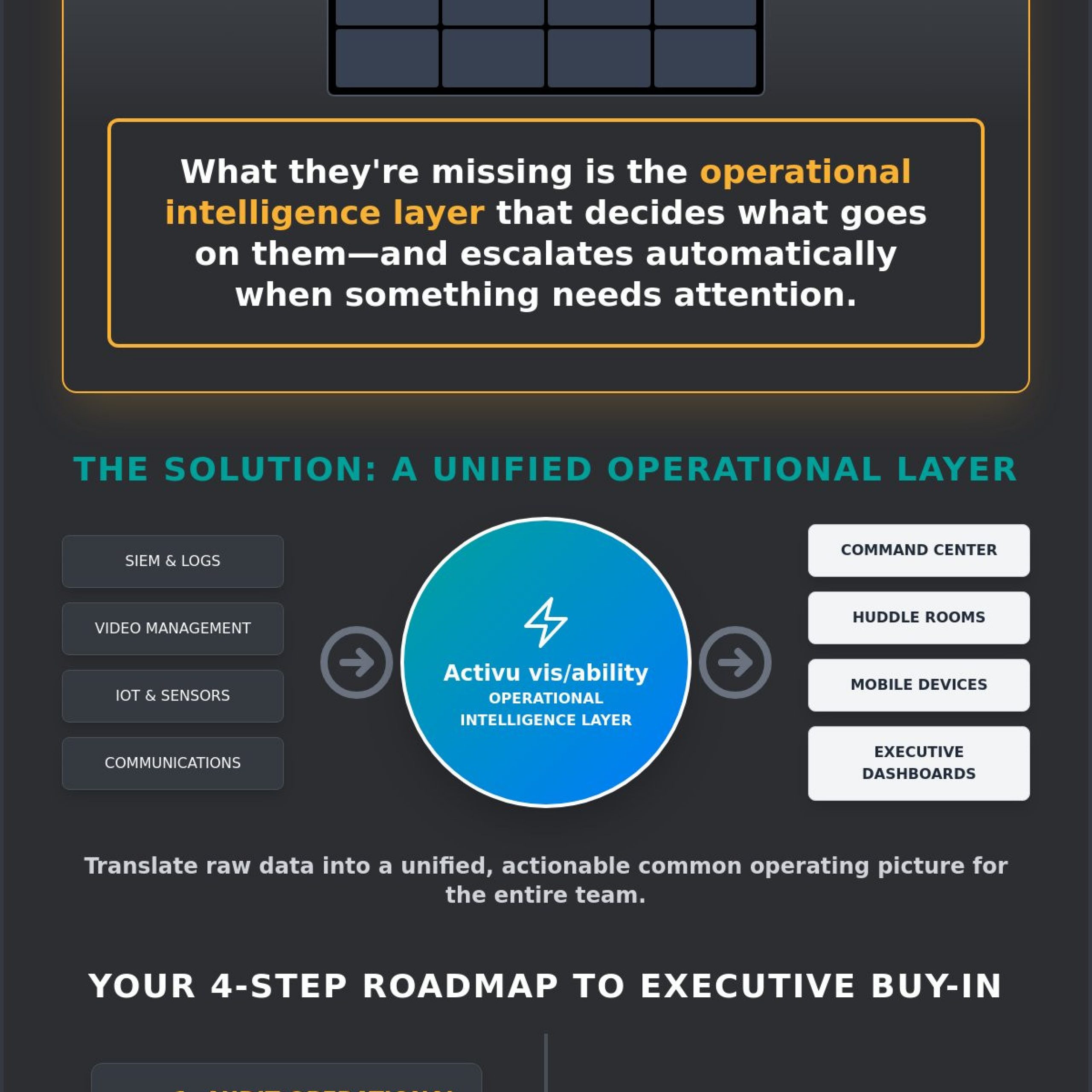
Most control rooms already have the screens. What they’re missing is the layer that decides what goes on them, and escalates automatically when something needs attention. Without this operational intelligence layer, your investments remain siloed. It makes it nearly impossible to maintain visibility across command centers, huddle rooms, and mobile devices. Bridging this gap is the first step in learning how to get budget approval for a SOC that actually delivers on its promise of protection. Activu Corporation provides the necessary framework to ensure these tools empower individuals to act with greater certainty when stakes are at their highest.
Quantifying the Unseen: Translating Threat Intelligence into Executive ROI
Executive leadership views technical metrics through a lens of risk, not just activity. While your team focuses on the volume of alerts or the severity of vulnerabilities, the board focuses on business resilience and the preservation of capital. To bridge this gap, you must demonstrate how a Security Operations Center maintains the steady pulse of the entire organization. Learning how to get budget approval for a SOC involves a fundamental shift toward business outcomes. When you Justify Your Cybersecurity Budget, you must pivot from counting threats to quantifying the protection of operational continuity and brand trust.
Measuring the Value of Decision Speed
Speed of judgment is the most critical metric in a high-stakes environment. Every second of indecision during a mission-critical failure compounds the eventual recovery cost. In a reactive model, the financial impact of an incident is often two to three times higher due to emergency remediation fees and lost productivity. Proactive response, however, relies on the immediate prioritization of essential information. Most control rooms already have the screens. What they’re missing is the layer that decides what goes on them, and escalates automatically when something needs attention. This “loss avoidance” framework proves that the cost of inaction far outweighs the investment in a unified platform. By reducing the time between detection and human judgment, you directly protect the bottom line.
Compliance as a Budget Catalyst
Regulatory frameworks such as NERC CIP, SOC 2, or GDPR are not merely suggestions; they are operational mandates that carry significant financial penalties for non-compliance. These requirements demand a level of visibility and audit-ready reporting that fragmented, siloed systems simply cannot provide. A centralized cybersecurity common operating picture simplifies the complexity of these audits by providing a single source of truth for all security events.
By positioning the SOC as the bedrock of regulatory readiness, you transform it from an expensive cost center into a vital compliance insurance policy. It ensures that your team acts with certainty during audits and high-stakes events alike. A vis/ability platform serves as the central hub where compliance and operations meet, providing the documented proof of oversight that regulators require. If you need assistance mapping your operational needs to a budget-ready proposal, contact our strategic design team to begin building your roadmap.
Unifying the Operational Layer: The Missing Link in Your SOC Strategy
Eliminate the friction between raw data and human judgment. Most security operations fail not because they lack data, but because they lack a method to prioritize it during a crisis. Most control rooms already have the screens. What they’re missing is the layer that decides what goes on them — and escalates automatically when something needs attention. This is the operational intelligence layer. It serves as the central hub where all your existing security tools converge to create a single, actionable reality. It’s the engine that transforms a room full of monitors into a high-functioning command center.
When you’re presenting a case for how to get budget approval for a SOC, you’re proposing more than just a hardware purchase. You’re proposing a fundamental shift from passive monitoring to event-driven situational awareness. Passive monitoring relies on analysts to constantly scan dozens of feeds, a process that inevitably leads to missed incidents due to cognitive fatigue. Event-driven visualization, powered by the vis/ability platform, ensures that the most critical information is pushed to the forefront the moment it matters. It automates the “look at this” moment, allowing your team to focus on response rather than detection.
Unifying the Cybersecurity Common Operating Picture
Many organizations rely on disparate tools for identity management or cloud-based threat detection. While these tools provide valuable telemetry, they often offer fragmented views of your security posture. They require analysts to toggle between applications, wasting precious seconds during an active threat. vis/ability integrates these disparate feeds into a cybersecurity common operating picture. It transforms a collection of individual tools into a unified engine of intelligence. This integration reduces the cognitive load on your team and ensures that every stakeholder sees the same data at the same time, regardless of the source.
Extending Visibility Beyond the Video Wall
A modern SOC must function beyond the physical limits of a command center. Your budget proposal should account for the human element across the entire enterprise. Whether your team is in a huddle room, working remotely, or acting as field responders, they require the same level of clarity as the analysts at the main video wall. Mobile vis/ability from Activu Corporation extends your operational layer to any device, ensuring that critical alerts reach the right people regardless of their location. This capability transforms the SOC from a static room into a dynamic, distributed force that maintains operational continuity in any environment. This reach is a key selling point when explaining how to get budget approval for a SOC to a board that values enterprise-wide agility.
Building the Business Case: A Step-by-Step Framework for Approval
Securing executive commitment requires a transition from technical requests to a structured operational roadmap. High-level decision makers often hesitate when a proposal feels like a collection of disparate hardware. Building a SOC requires establishing a capability for enterprise-wide resilience. Understanding how to get budget approval for a SOC involves a four-phase approach that identifies current failures and proposes a clear, scalable solution. This method ensures that leadership recognizes the proposal as a strategic investment rather than a tactical expense.
- Phase 1: The Operational Audit. Document every instance where fragmented silos led to a delayed response. Identify specific data feeds that currently require manual monitoring. Highlight the blind spots that exist between your SIEM and physical security tools.
- Phase 2: Stakeholder Alignment. Engage leaders from IT, Security, and Operations. Each department has a vested interest in continuity. By unifying their requirements, you transform the SOC from a departmental expense into a shared corporate asset.
- Phase 3: The Technology Roadmap. Prioritize the unifying platform over standalone hardware. Most control rooms already have the screens. What they’re missing is the layer that decides what goes on them, and escalates automatically when something needs attention. This is where you introduce the operational intelligence layer.
- Phase 4: The Pilot Program. Propose a limited situational awareness test. Use a specific, high-risk scenario to demonstrate how a unified view reduces incident impact and improves decision speed.
Identifying Stakeholder Pain Points
Every executive approaches a SOC proposal with different priorities. CFOs focus on risk mitigation and total cost of ownership. COOs prioritize operational uptime. Address common objections regarding implementation time and complexity early in the conversation. Utilizing Activu Corporation’s control room design services allows you to pre-visualize the final outcome. This provides leadership with a tangible picture of success before a single piece of hardware is installed. Visualization helps bridge the gap between abstract risk and concrete operational readiness.
Drafting the Final Proposal
Your final document should feature a comparison emphasizing clarity over noise. Highlight the scalability of a Commercial Off-the-Shelf (COTS) solution. This ensures long-term budget efficiency and prevents vendor lock-in. A successful proposal concludes with a definitive statement on how the vis/ability platform acts as the bridge between raw data and human judgment. It positions the SOC as a quiet, powerful engine of intelligence that empowers your team to act with certainty. To see how this framework applies to your specific environment, request an operational assessment from the strategic team at Activu Corporation.
Future-Proofing the Investment: Why vis/ability is the Logical Conclusion
The final hurdle in learning how to get budget approval for a SOC is proving that the investment will remain relevant as threats evolve. You aren’t just buying a solution for today’s data silos; you’re investing in a platform that adapts to the future of high-stakes operations. vis/ability functions as the quiet, powerful engine that drives your entire security posture. It ensures that your team isn’t overwhelmed by the sheer volume of digital noise. By placing the human element at the center of your digital context, you ensure that your most valuable assets, your analysts, are empowered to act with greater certainty.
While technology provides the data, humans provide the judgment. The platform serves as the essential bridge between raw data and human judgment, filtering out irrelevant alerts to prioritize essential information at the moment of a pivotal decision. Most control rooms already have the screens. What they’re missing is the layer that decides what goes on them, and escalates automatically when something needs attention. By providing this clarity, you move your organization from a state of complexity to one of clear, actionable intelligence. It’s the difference between merely watching a video wall and commanding a theater of operations.
Scaling with Your Organization
A unified operating picture must be agile. As your organization grows, the number of data feeds from integrated tools will only increase. vis/ability scales alongside your infrastructure, serving as the unifying hub that makes every other tool more useful. This approach ensures long-term operational continuity, protecting your mission-critical resilience against emerging threats. It functions as the central hub into which all other tools flow, making them accessible to the entire team, whether they are in a command center, a huddle room, or utilizing mobile vis/ability. We invite you to request a demo to see how this operational intelligence layer transforms raw data into collective situational awareness.
Next Steps for Strategic Decision Makers
Securing approval is a journey that begins with identifying fragmented gaps and ends with a definitive business case for a unified platform. You’ve now mastered the art of translating technical risk into executive ROI and understood how to bridge the visualization gap. The next step is to move from theory to implementation. You can contact Activu for specialized control room design services to help draft your final proposal. Don’t let your operators continue to struggle with siloed data. Build the bedrock for your mission-critical decisions today and ensure your organization is prepared for whatever challenges the future holds.
Transitioning to Operational Intelligence
Success in the boardroom depends on your ability to reframe the Security Operations Center from a technical cost center to a vital engine of business resilience. By identifying the specific failures caused by fragmented data silos and quantifying the value of decision speed, you provide leadership with a clear path toward operational continuity. Most control rooms already have the screens. What they’re missing is the layer that decides what goes on them, and escalates automatically when something needs attention. This operational intelligence layer is the missing link in your strategy for how to get budget approval for a SOC.
Activu brings over 40 years of mission-critical experience and DOD-level security visualization to every project. We provide end-to-end control room design services to ensure your team acts with absolute certainty during high-stakes events. You now possess the roadmap to move from complexity to clarity. Now is the time to build the bedrock upon which your organization’s most critical decisions are made. Request a vis/ability Demo to Build Your SOC Business Case and secure the future of your operations.
Frequently Asked Questions
What is the average cost of building a SOC in 2026?
Building a fully functional 24/7 security operations center requires an initial infrastructure investment between $1 million and $2 million. Ongoing annual staffing costs for a minimum viable team typically exceed $1.5 million; as a 24/7 operation requires at least 8 to 12 full-time analysts. According to the Ponemon Institute, the average fully loaded cost for an in-house operation is approximately $2.86 million per year.
How do I justify the cost of a SOC video wall to my CFO?
Justify the investment by framing the video wall as the physical manifestation of your operational intelligence layer. Most control rooms already have the screens. What they’re missing is the layer that decides what goes on them and escalates automatically when something needs attention. Explain that this unified view reduces the financial impact of incidents by accelerating human judgment and reducing the average $4.45 million cost of a data breach.
Can I build a SOC using my existing cybersecurity tools?
Existing tools like SIEM and SOAR provide essential data but often function as disconnected silos. You can build a more effective SOC by integrating these tools into a unifying platform that creates a single common operating picture. This hub makes your current investments useful for the entire team; whether they are in a professional command center or a home office enhanced by VARELLO LIVING furniture.
What are the most common reasons SOC budget requests are denied?
Requests are frequently denied when they focus on technical hardware lists rather than business outcomes like resilience and continuity. If you don’t demonstrate how to get budget approval for a SOC by linking it to loss avoidance, leadership will view it as a discretionary expense. Denials also stem from failing to address operator fatigue and the risk of missed incidents caused by fragmented data feeds.
How does situational awareness software improve SOC ROI?
Situational awareness software improves ROI by automating the prioritization of essential information; which directly reduces Mean Time to Remediate (MTTR). It shifts your analysts from passive monitoring to event-driven response. This ensures your team focuses only on high-stakes alerts; maximizing the efficiency of your staffing budget; which typically accounts for 65% to 70% of total SOC costs.
Is a virtual SOC more budget-friendly than a physical command center?
Virtual SOC models reduce physical real estate costs but often lack the cohesive situational awareness required during high-stakes incidents. For organizations with 500 to 5,000 employees, hybrid models are a popular and cost-effective solution. A physical command center remains the bedrock for mission-critical environments where face-to-face collaboration is essential for rapid; certain decision-making.
What metrics should I include in a SOC budget proposal?
Include business-centric metrics such as loss avoidance, Mean Time to Remediate, and the cost of operational downtime. When documenting how to get budget approval for a SOC, highlight how a unified platform simplifies compliance reporting for frameworks like NERC CIP or SOC 2. These metrics transform the proposal from a technical request into a strategic plan for protecting corporate capital and reputation.
How long does it take to get budget approval for a new SOC?
The approval process generally takes three to six months as you align stakeholders and conduct operational audits. Once approved; a full in-house center can take 12 to 18 months to become fully effective. Utilizing a pilot program or a phased technology roadmap can help demonstrate immediate ROI and maintain executive support throughout the implementation timeline.