
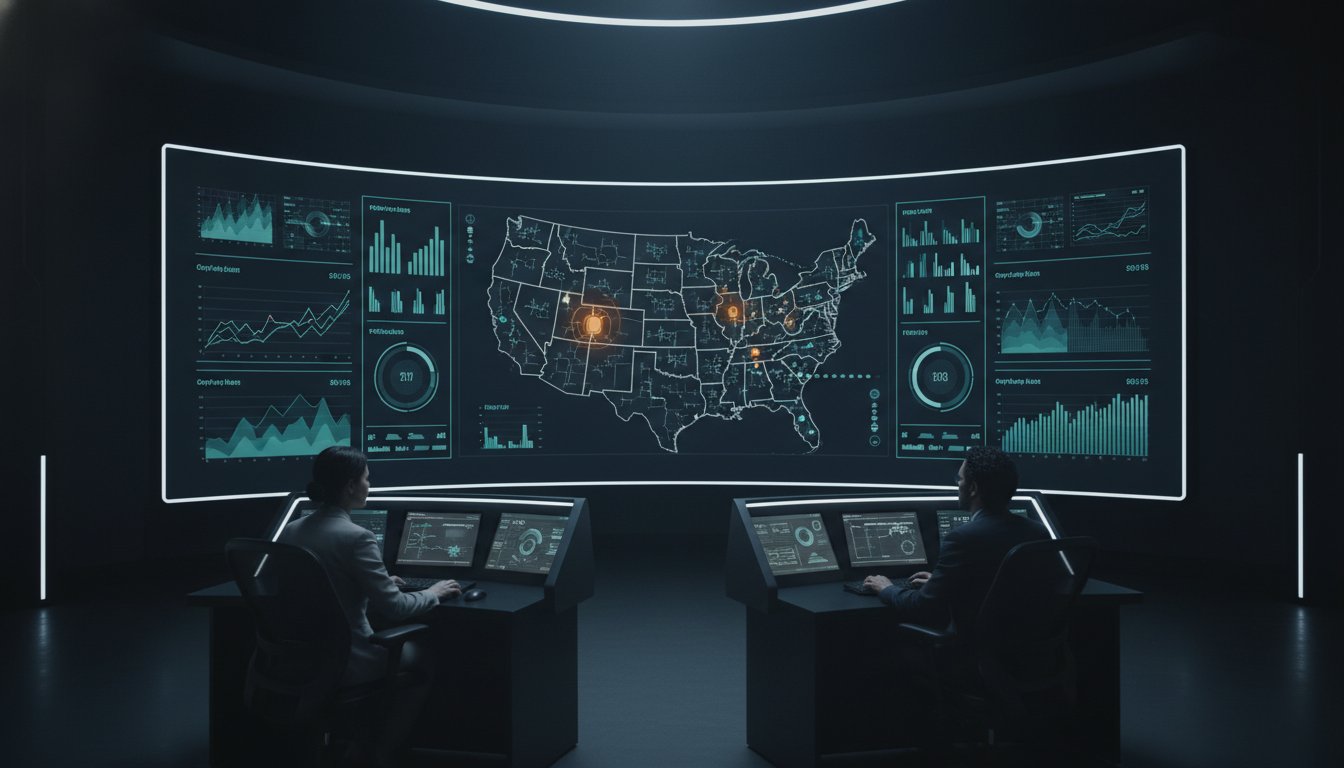
The most expensive video wall in the world is a liability if it forces your team to hunt for the data they need during a crisis. You likely already face the pressure of information overload, where siloed feeds and cognitive fatigue threaten to slow response times when seconds are the only currency that matters. True future-proof control room design requires more than just high-resolution hardware; it demands a shift toward a software-defined architecture that prioritizes human judgment. Most control rooms already have the screens. What they’re missing is the layer that decides what goes on them, and escalates automatically when something needs attention.
This article outlines how to architect a mission-critical environment that evolves with your data and empowers decisive action. We’ll explore how to move beyond the limitations of proprietary hardware and fragmented tools that provide only a partial solution without a unifying hub. By implementing vis/ability as your operational intelligence layer, you can create a unified operating picture that aligns with ISO 11064 ergonomic standards. This approach ensures your team remains focused and analytical when stakes are at their highest, turning raw data into clear, actionable intelligence.
Key Takeaways
- Transition from passive monitoring to event-driven situational awareness to eliminate the cognitive overload caused by traditional “monitor-everything” strategies.
- Achieve a future-proof control room design by adopting a software-defined architecture that remains resilient against technology shifts and proprietary hardware lock-in.
- Deploy an operational intelligence layer to manage the flow of information; ensuring that critical alerts escalate automatically to the right personnel at the right time.
- Optimize mission-critical environments for the human element by delivering intuitive interfaces that reduce fatigue and empower decisive action during high-stakes operations.
- Centralize fragmented systems into a unified operating picture using Activu vis/ability to provide total visibility for both onsite and remote team members.
The Critical Gaps in Traditional Control Room Architecture
Traditional command centers were built on a philosophy of constant, manual monitoring. In that era, success was measured by the number of cameras an operator could watch simultaneously. That model has collapsed under the weight of modern data velocity. Today, a mission-critical environment must process thousands of data points from IoT sensors, cybersecurity logs, and geospatial feeds. When a system relies on human eyes to catch every anomaly across a hundred static windows, failure isn’t just a possibility; it’s a mathematical certainty. Operators face massive cognitive overload, where the sheer volume of information makes the most critical alerts invisible. A future-proof control room design must move beyond this “monitor-everything” trap and transition toward event-driven situational awareness.
The Cost of Fragmented Situational Awareness
Operational silos are the primary enemy of decisive action. In many organizations, cybersecurity teams, logistics coordinators, and safety officers use disparate tools that don’t communicate. You might use specialized platforms for digital evidence or video management, but if those feeds aren’t integrated with your network health monitors or emergency dispatch systems, you’re operating with a partial view. This fragmentation creates “incident lag,” the period where an anomaly exists in one system but hasn’t been recognized or communicated to the rest of the team. Manually switching between applications to correlate data consumes precious minutes during a crisis. True situational awareness requires a hub that ingests these siloed feeds and presents them as a single, coherent narrative.
Why More Screens Are Not the Solution
There is a persistent misconception that increasing screen real estate leads to better visibility. In reality, human attention is a finite resource. Flooding a room with more pixels often exacerbates fatigue rather than solving it. Standard principles of Control room design emphasize ergonomics and the human element, yet many designs remain hardware-centric. These environments become obsolete the moment a new software requirement or data stream emerges that the existing processors can’t handle. Hardware-heavy designs lock you into proprietary ecosystems that are expensive to maintain and difficult to scale.
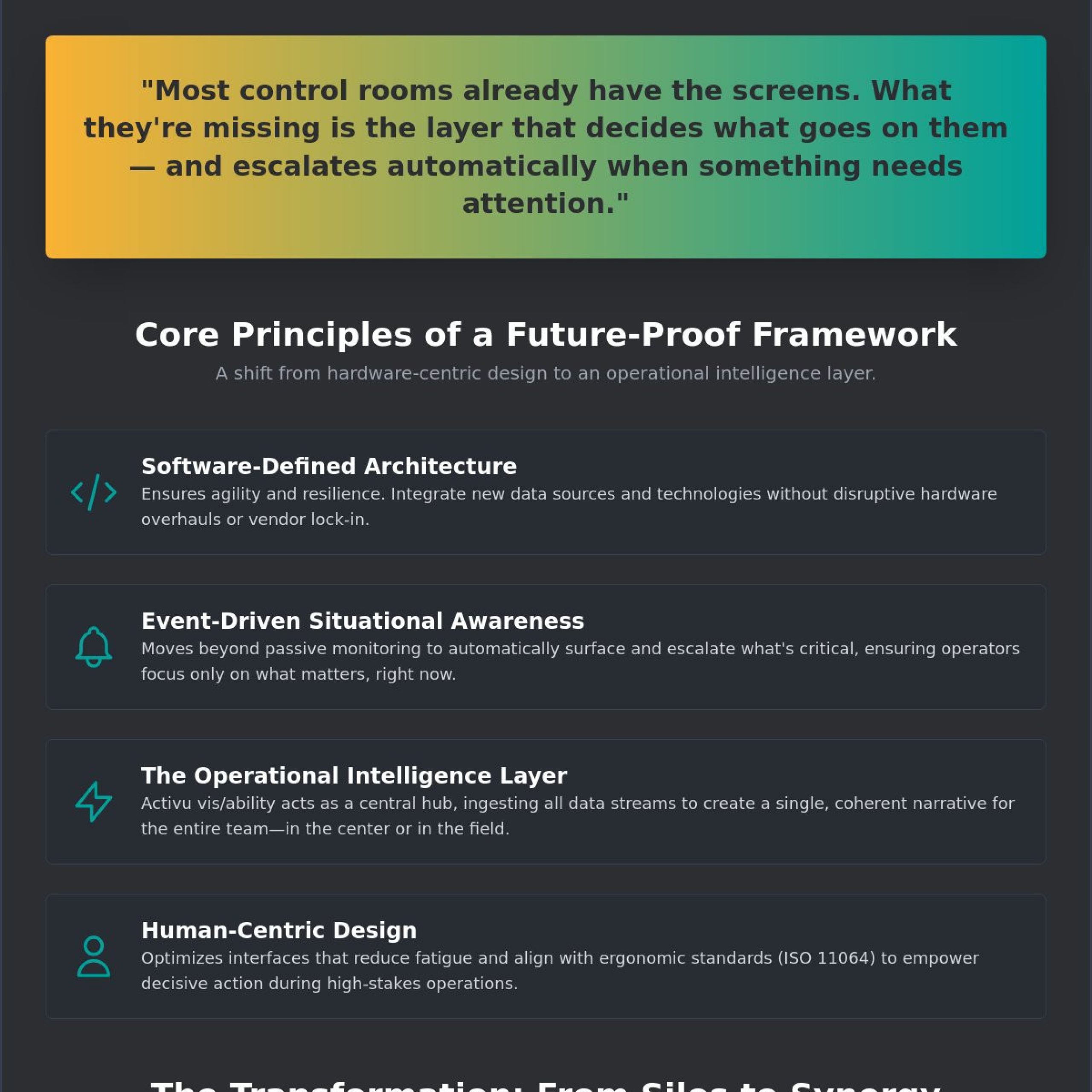
A future-proof control room design prioritizes the ability to integrate new data streams without requiring a complete hardware overhaul. It acknowledges that the mission will change, and the technology must be agile enough to follow. Most control rooms already have the screens. What they’re missing is the layer that decides what goes on them, and escalates automatically when something needs attention. By shifting focus from the glass on the wall to the intelligence behind it, organizations can ensure their public safety or corporate operations remain resilient regardless of how their data landscape evolves.
Core Principles of a Future-Proof Design Framework
Establishing a future-proof control room design requires a fundamental rejection of proprietary hardware dependencies. Relying on a single vendor’s black-box ecosystem creates a bottleneck for innovation and a massive financial risk. A software-defined architecture ensures the command center remains agile, allowing for rapid integration of new data sources as operational needs shift. This flexibility is the only way to accommodate the exponential growth of data feeds without constant, disruptive downtime. Scalability must be baked into the initial design phase, ensuring that adding a new regional office or a fleet of mobile units doesn’t break the existing visualization pipeline.
Leveraging COTS for Resilience and Flexibility
Implementing COTS solutions allows organizations to build their infrastructure on standard, high-performance hardware that is easily sourced and supported. This approach eliminates the danger of being stranded by a manufacturer’s end-of-life cycle or arbitrary price hikes. It simplifies maintenance and ensures that replacement components are readily available, which is vital for maintaining 24/7 uptime in mission-critical environments. Much of the human factors and ergonomics literature supports this modularity, as it allows the physical environment to adapt to the evolving needs of the operator without requiring a total teardown. Most control rooms already have the screens. What they’re missing is the layer that decides what goes on them, and escalates automatically when something needs attention.
Integrating Cybersecurity into the Common Operating Picture
Network health is no longer a separate IT concern; it’s a core component of operational readiness. A comprehensive cybersecurity common operating picture provides real-time visibility into threat intelligence alongside physical security feeds. Many organizations rely on standalone threat platforms like those offered by specialized security vendors. While these tools are powerful, they often provide only a partial solution because they exist in a silo. They can’t show how a server failure in a remote data center directly impacts a transit line or a power grid. By using incident management software as part of a unified visualization layer, teams can see exactly how a network anomaly might impact physical assets. This integration improves response speed and ensures that security personnel aren’t working in a vacuum. If you are ready to modernize your infrastructure, you can explore our operational intelligence platform to see how it unifies these disparate data streams into a single, decisive tool.
The Operational Intelligence Layer: Beyond the Video Wall
Actionable intelligence requires more than just high-resolution pixels. Most control rooms already have the screens. What they’re missing is the layer that decides what goes on them, and escalates automatically when something needs attention. Traditional video wall controllers function as glorified switchers, merely routing inputs to specific coordinates on a display. This static approach fails during high-stakes incidents because it places the burden of information filtering entirely on the operator. A future-proof control room design must prioritize a software-defined layer that understands the context of incoming data and delivers it with surgical precision.
Many organizations attempt to bridge this gap by using specialized niche tools for specific feeds, such as standalone evidence management systems or isolated GIS platforms. While these tools excel in their specific functions, they provide only a partial solution. They lack the ability to correlate evidence data with real-time facility alerts, network health monitors, or external sensor feeds. Without a unifying operational intelligence layer, these tools remain siloed, forcing operators to manually piece together a common operating picture while a crisis unfolds. True situational awareness is only achieved when these disparate feeds flow into a central hub that filters noise and highlights only what is mission-relevant.
Hardware-Centric vs. Software-Defined Intelligence
The primary difference between a standard video wall processor and the vis/ability platform is the transition from rigid hardware to dynamic software logic. Traditional processors are limited by physical port counts and fixed layouts that are difficult to change during an active event. In contrast, a software-defined architecture allows for instantaneous content adjustments based on real-time triggers. This “single pane of glass” concept ensures that whether your team is in the primary command center, a huddle room, or using mobile devices, they are looking at the same validated data set. This flexibility is the cornerstone of a future-proof control room design, as it allows the system to scale alongside your data footprint without requiring new proprietary hardware.
Automating Information Prioritization
Proactive operations depend on event-driven visualization. Instead of asking an operator to watch a thousand camera feeds, the system should remain dark until a specific threshold is met. When an anomaly is detected, the intelligence layer automatically pulls the relevant data, maps, and live feeds onto the video wall and mobile devices. This automated escalation significantly reduces the time between “threat detected” and “action taken.” By integrating complex application data directly into a unified operating picture, you eliminate the need for manual cross-referencing. This shift ensures that decision-makers are never buried under a mountain of irrelevant data, but are instead empowered by a clear, prioritized narrative of the operational environment. Similar to how VISIOLAB transforms complex organizational messages into high-impact visual content, this approach ensures clarity and impact in mission-critical settings.
Optimizing for the Human Element in High-Stakes Environments
The human element is the most critical component of any command operation. In high-stakes environments, technology must act as a force multiplier for human judgment rather than a source of distraction. When operators are forced to navigate complex, non-intuitive interfaces during an emergency, the risk of error increases. A future-proof control room design prioritizes cognitive clarity by ensuring that the most vital information is always at the center of the visual field. Most control rooms already have the screens. What they’re missing is the layer that decides what goes on them, and escalates automatically when something needs attention.
Operators in mission-critical hubs often face psychological pressure that hardware alone cannot alleviate. True reliability comes from a system that provides a sense of calm and clarity amidst potential complexity. By automating the delivery of essential data, you allow your team to remain focused and analytical when stakes are at their highest. This approach moves beyond traditional ergonomics, which often focuses only on furniture, and addresses the cognitive optimization required for modern data environments.
Reducing Cognitive Overload with Smart Visualization
Effective visualization relies on a strict hierarchy of information. In many traditional setups, every data feed is treated with equal visual weight, forcing the operator to scan dozens of monitors to find a single anomaly. Modern mission-critical operations benefit from a reduction in “data noise,” where the system only highlights actionable intelligence. Designing dashboards that emphasize triggers and alerts over raw data streams allows operators to process information faster. This strategy ensures that human attention, which is a finite resource, is never wasted on monitoring static or irrelevant feeds.
Collaboration Across Distributed Teams
The common operating picture must extend beyond the physical walls of the command center. Field units, remote stakeholders, and huddle rooms all require the same level of visibility to ensure coordinated action. A future-proof control room design facilitates this by pushing the intelligence layer to any device, regardless of location. Integrating mobile situational awareness allows field teams to see exactly what the command center sees, eliminating the communication gaps that often occur during verbal handoffs. This seamless flow of information keeps all personnel aligned with the primary mission objectives, ensuring that decisions made in the field are as informed as those made at the main console. If you are ready to build an environment that empowers your team, contact our design services team to begin architecting your solution.
Implementing Your Design Strategy with Activu vis/ability
The final phase of a future-proof control room design is the transition from conceptual planning to technical execution. Activu provides the bedrock for this transformation, positioning the vis/ability platform as the operational intelligence layer that unifies your entire mission-critical environment. Our design services don’t just focus on the physical arrangement of consoles; they bridge the gap between architectural layout and the software intelligence required to manage complex data. Most control rooms already have the screens. What they’re missing is the layer that decides what goes on them, and escalates automatically when something needs attention.
By prioritizing a software-defined approach, organizations can ensure their infrastructure remains resilient against the inevitable shifts in data formats and communication protocols. This strategy transforms the command center from a reactive monitoring hub into a proactive intelligence center. It moves the focus away from simply managing displays and toward the actual outcome of the mission. When your technology serves as a reliable partner, your team can act with absolute certainty, regardless of the complexity of the incident.
The vis/ability Platform as a Unifying Hub
The vis/ability platform serves as the central hub where disparate data streams converge into a single, validated narrative. For sectors like public safety and utilities, this aggregation is essential for maintaining a common operating picture across vast geographic areas. Whether you are managing emergency response or monitoring a power grid, the platform integrates seamlessly with your existing legacy applications. This ensures that you don’t have to abandon current investments to achieve modern visibility. The architecture is built to meet the most stringent security requirements, including NERC CIP standards, ensuring that your visualization layer is as secure as the infrastructure it monitors. It provides a scalable path for future growth, allowing you to add new integrations as your operational requirements evolve.
Next Steps: From Planning to Operational Readiness
Moving from a reactive monitoring hub to a proactive intelligence center requires a holistic review of your current operational gaps. Before investing in additional hardware, it’s vital to identify the specific bottlenecks that slow down your team’s response times. A proactive design strategy focuses on how information moves through your organization, from the initial alert to the final decisive action. We invite you to see the operational intelligence layer in action and discover how it can transform your high-stakes environment. By prioritizing software intelligence over proprietary hardware lock-in, you ensure your command center remains a trusted partner in your success. Contact Activu for expert control room design services to begin building your future-proof environment today.
Securing the Future of Mission-Critical Operations
Modern operational readiness depends on the transition from passive monitoring to proactive intelligence. By adopting a future-proof control room design, organizations move beyond the limitations of siloed data and proprietary hardware lock-in. This architecture ensures that decision-makers remain focused on the mission rather than struggling with information overload. Most control rooms already have the screens. What they’re missing is the layer that decides what goes on them, and escalates automatically when something needs attention.
Activu provides the bedrock for these high-stakes environments, backed by over 40 years of mission-critical experience. Dozens of Fortune 500 companies and the world’s most critical organizations rely on our technology to maintain operational continuity when seconds matter most. Transitioning to a software-defined intelligence layer is the only way to ensure your command center evolves as fast as the threats it monitors. We invite you to Request a Demo of the vis/ability Operational Intelligence Layer to see how we turn raw data into decisive action. Build an environment that empowers your team to act with absolute certainty.
Frequently Asked Questions
What makes a control room design future-proof?
A future-proof control room design relies on a software-defined architecture that separates the intelligence layer from the physical hardware. This approach allows organizations to integrate new data streams and applications without requiring a complete equipment overhaul. By using Commercial Off-the-Shelf (COTS) components, you avoid proprietary lock-in and ensure the system can scale as your operational requirements evolve over time. This flexibility is essential for maintaining readiness in an increasingly complex data landscape.
How do I manage multiple data feeds in a busy dispatch center?
Managing multiple data feeds requires a central hub that aggregates disparate sources into a single, unified interface. Instead of forcing operators to switch between siloed applications, an operational intelligence layer filters and organizes incoming information based on its relevance to the current mission. This reduces cognitive load and ensures that dispatchers can maintain focus on high-priority tasks during periods of high activity. Centralizing these feeds ensures that no critical alert is lost in the background noise.
Why do operators often miss critical incidents on standard video walls?
Operators miss incidents because human attention is a finite resource that is easily overwhelmed by data noise. Standard video walls often display too much static information, making it difficult to distinguish a genuine anomaly from routine activity. Most control rooms already have the screens. What they’re missing is the layer that decides what goes on them, and escalates automatically when something needs attention. Without this automated prioritization, the risk of operator fatigue and missed alerts remains high.
What is the role of a Common Operating Picture (COP) in an EOC?
A Common Operating Picture provides a single, validated version of reality that all stakeholders can access simultaneously. In an Emergency Operations Center (EOC), this ensures that decision-makers, field units, and remote teams are aligned on the same data. By unifying geospatial feeds, live video, and incident logs, a COP eliminates the confusion caused by fragmented reports and disparate communication channels. This alignment is vital for coordinating a rapid and effective response during a crisis.
How can I extend my control room visibility to mobile users in the field?
What are the common situational awareness problems in mission-critical environments?
Common situational awareness problems include fragmented data silos and the inability to correlate information across different systems in real time. When critical data exists but remains invisible to the wider team, response times suffer. These gaps are often exacerbated by operator fatigue, which occurs when personnel are forced to manually monitor hundreds of feeds for long periods. A future-proof control room design addresses these issues by automating information delivery and breaking down the barriers between disparate tools.
How does event-driven visualization improve incident response times?
Event-driven visualization improves response times by automating the delivery of relevant data the moment a specific trigger is met. Instead of operators hunting for information, the system proactively pushes maps, camera feeds, and checklists to the foreground when an anomaly is detected. This immediate escalation bypasses manual search processes, allowing the team to move directly from detection to decisive action. Reducing the time between threat detection and response is the primary goal of any proactive intelligence center.
Is it better to use a proprietary video wall controller or a software-defined platform?
A software-defined platform is superior because it offers the flexibility to adapt to changing technology without being tied to a specific hardware manufacturer. Proprietary controllers often lead to expensive lock-in and become obsolete when software requirements evolve. A software-defined approach ensures your design remains agile, cost-effective, and capable of integrating with any tool your mission requires. This strategy protects your long-term investment while providing the intelligence layer needed for high-stakes decision-making.