
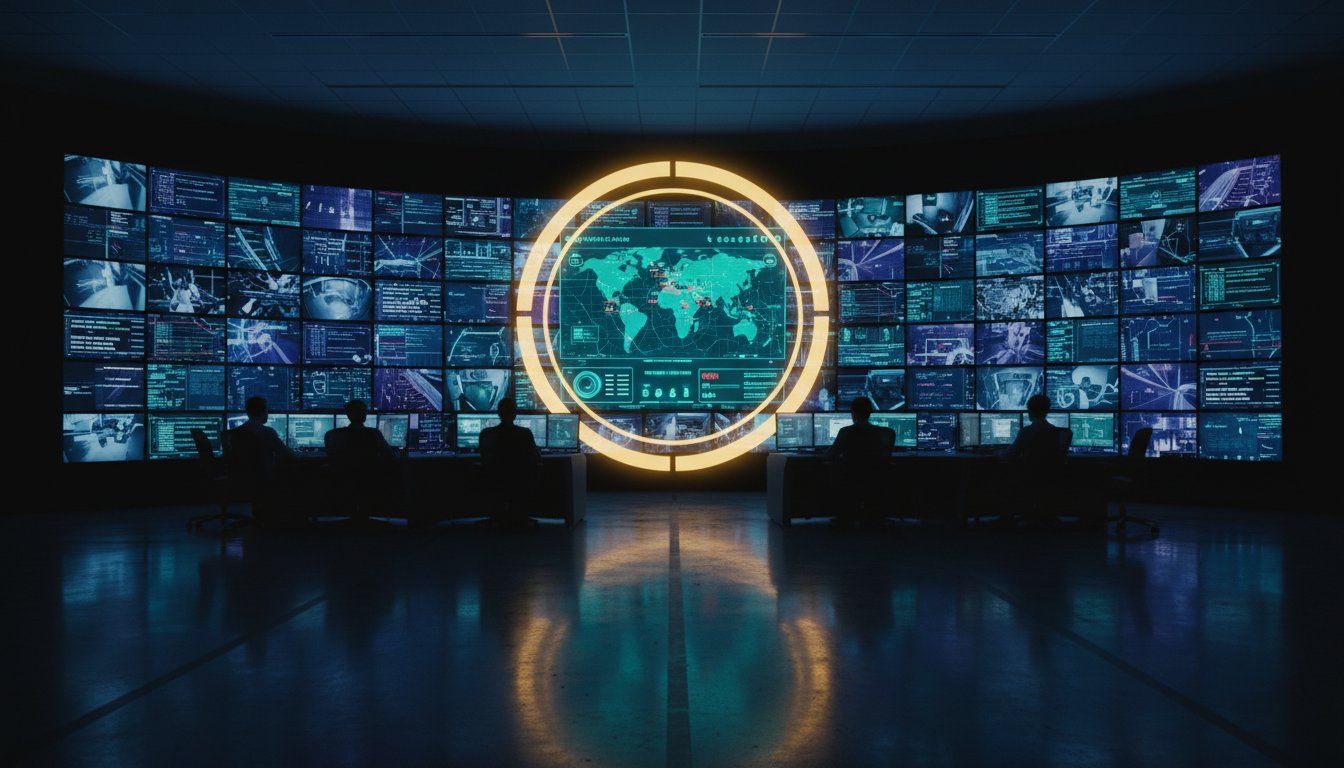
Does your high-definition hardware actually provide clarity, or just a more detailed view of your operational chaos? In high-stakes command centers, operators often manage over 15 disparate data feeds simultaneously, a level of cognitive load that leads to a documented 25 percent increase in missed critical alerts. While upgrading to high-end hd displays is a common tactical step, pixels alone cannot bridge the gap created by siloed systems that refuse to communicate. You already understand the danger of a critical incident unfolding on a secondary screen while your primary focus is diverted by routine monitoring.
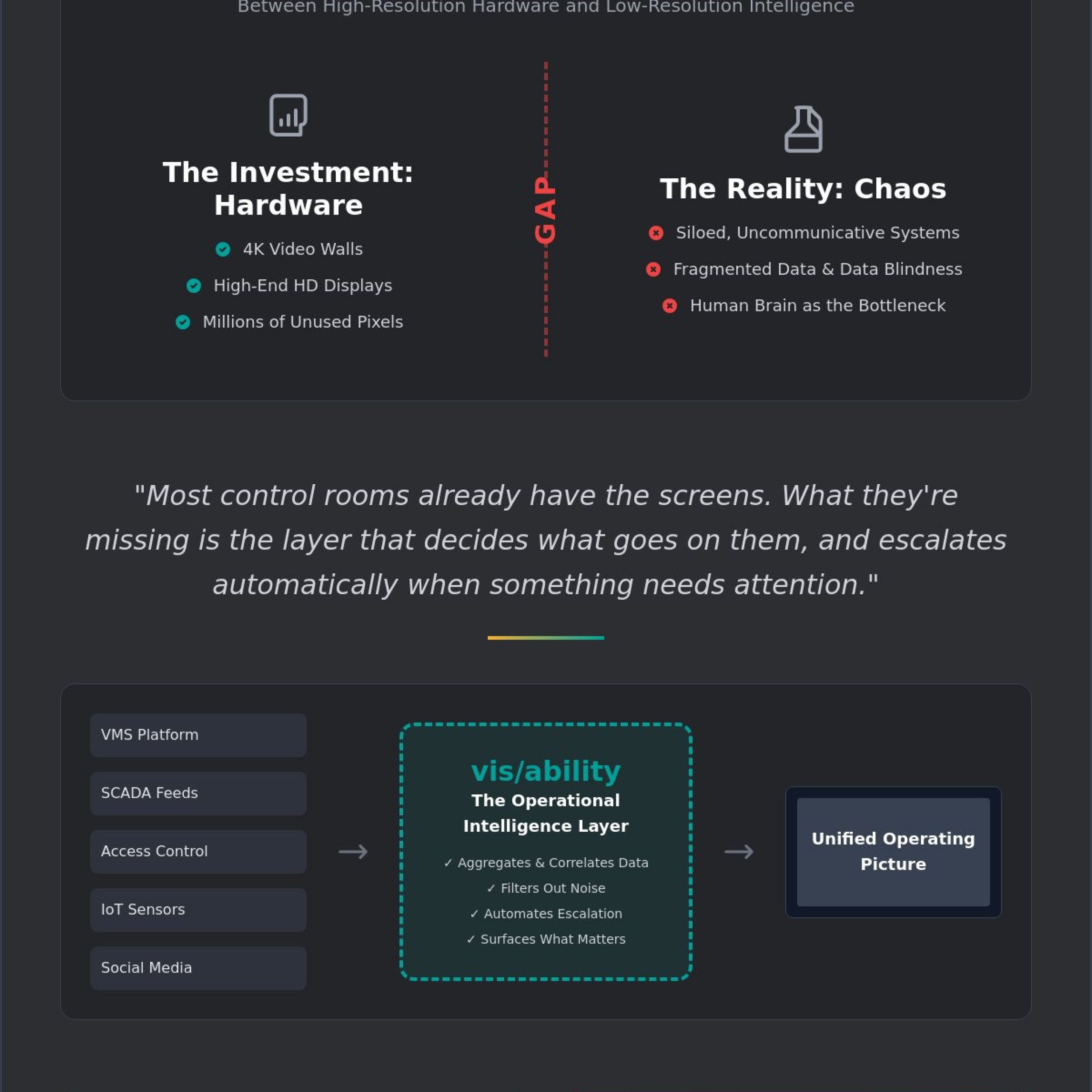
Most control rooms already have the screens. What they’re missing is the layer that decides what goes on them, and escalates automatically when something needs attention. This is the role of vis/ability; it’s an operational intelligence layer that surfaces through the video wall to ensure your team sees what matters most. This article explores how to bridge the gap between hardware and operational clarity by using automation to drive situational awareness. We will examine the methodology for unifying your operating picture and reducing response times by transforming your displays into an intelligent, proactive partner.
Key Takeaways
- Identify the critical gap between high-resolution hardware and operational clarity that often leads to control room situational awareness problems.
- Evaluate the technical trade-offs between hd and 4K resolutions to ensure your infrastructure supports a common operating picture without inducing data overload.
- Learn how to manage multiple data feeds in a busy dispatch center by implementing an intelligence layer that automates escalation and reduces operator fatigue.
- Transition from reactive monitoring to proactive intelligence by using vis/ability to surface only the most relevant data at the moment of a critical decision.
- Understand that while most control rooms already have the screens, they lack the layer that decides what goes on them and escalates automatically when an incident requires attention.
The Evolution of High Definition (HD) in Mission-Critical Environments
In a mission-critical Control Room, the definition of hd differs fundamentally from its application in consumer entertainment. While a home viewer seeks immersion, a 911 dispatcher or utility grid operator requires forensic precision. The transition from grainy analog feeds to high-definition digital visualization began in earnest around 2005, marking a shift toward greater clarity. However, resolution is merely the first step. True operational success depends on achieving a common operating picture, not just a sharper image.
Modern facilities often struggle with fragmented systems and siloed data streams. Operators find themselves surrounded by millions of pixels but starved for actual insight. Most control rooms already have the screens. What they’re missing is the layer that decides what goes on them, and escalates automatically when something needs attention. This missing layer is vis/ability, the operational intelligence that transforms a display into a tool for action.
The Gap: Why Fragmented Systems Hinder Operational Clarity
The disconnect between high-resolution hardware and low-resolution intelligence creates a dangerous operational vacuum. While a 4K display can render intricate details, it cannot interpret the urgency of a flickering sensor on a remote pipeline. Organizations often deploy tools like Axon or specific VMS platforms, but these remain partial solutions. They provide a view into one silo while leaving others dark. This fragmentation forces operators to manually bridge the gap, leading to data blindness. When managing dozens of disconnected hd feeds, the human brain becomes the bottleneck. This is why EOC common operating picture solutions must integrate every stream into a single unifying hub rather than forcing personnel to hunt for information across disparate monitors.
Situational Awareness Problems in the Modern Control Room
Operators frequently miss critical incidents despite having state-of-the-art video walls. This occurs because situational awareness problems in the modern control room are rarely about a lack of visual data. They’re about cognitive overload. A 2021 study on emergency response found that operator error increases by 40 percent when personnel must manage more than five distinct data sources simultaneously. High-stress environments demand automatic escalation to surface what matters most. Without an intelligence layer like vis/ability, the video wall remains a passive display. It doesn’t help solve how to manage multiple data feeds dispatch center teams face during a crisis. This cognitive fatigue is the primary reason why operators miss incidents video wall configurations were originally designed to prevent. Effective operations require a system that moves from complex data to clear, actionable intelligence instantly.
Beyond the Screen: The Operational Intelligence Layer
Fragmented systems and siloed data streams create a cognitive load that frequently slows down response times in critical environments. Operators often juggle seven to ten distinct software interfaces simultaneously, leading to missed incidents and delayed coordination. While the physical display is the most visible part of a command center, its utility is limited by the manual effort required to manage it. Most control rooms already have the screens. What they’re missing is the layer that decides what goes on them; it escalates automatically when something needs attention.
This missing component is the operational intelligence layer. It sits above the hardware, acting as a filter for the constant flood of raw data. By leveraging high-resolution hd displays, this layer transforms static pixels into a dynamic environment where the most important information is always front and center. It bridges the gap between raw telemetry and human judgment, ensuring that teams don’t waste seconds searching for the right window during a crisis.
vis/ability: Surfacing What Matters When It Matters
vis/ability functions as the central nervous system for the modern control room. It aggregates real-time data and video feeds into a unified operating picture that adapts to the situation on the ground. Instead of an operator manually dragging a camera feed onto the wall, the platform uses event-driven logic to surface critical information automatically. If a sensor detects a perimeter breach or a utility grid fluctuation, the relevant visual data appears instantly. This shift from manual screen management to automated situational awareness allows the team to focus on the solution rather than the software. While organizations often invest in LED Walls for Command Centers to achieve visual clarity, the hardware remains a passive asset without this proactive logic layer. It’s about moving beyond the hd pixel count to reach a state of total operational clarity.
The Limitations of Standard Video Wall Software
Some organizations rely on basic video wall management tools, but these legacy systems often fail during high-stress events. These tools typically lack deep application integration, meaning they can’t “read” the data within the windows they display. They serve as simple digital wallpaper, requiring a human to notice a change and react. This creates a dangerous lag in response. Standard software doesn’t provide the automatic escalation that a modern SOC or NOC requires to maintain uptime. vis/ability fills these gaps by treating the video wall as the place where the answer appears, not just where the data lives. It ensures the right people see the right data at the precise moment it becomes actionable. To see how this intelligence layer can transform your operations, you can speak with a mission-critical expert today.
HD vs. Ultra HD (4K): Choosing the Right Resolution for Your COP
Control room managers often face the challenge of fragmented systems and data silos that obscure critical details during high-pressure events. Simply increasing resolution from 1080p to 4K seems like a logical solution to these control room situational awareness problems, yet more pixels often result in more noise without better clarity. Most control rooms already have the screens. What they’re missing is the layer that decides what goes on them, and escalates automatically when something needs attention. Without this intelligence, a 4K feed is just a sharper view of a problem that remains unmanaged.
Technical Considerations for 4K Resolution Video Walls
A 4K stream requires approximately 25 Mbps of bandwidth to maintain operational integrity, which is four times the requirement of a standard hd video feed. Infrastructure must support HEVC (H.265) and SRT protocols to maintain low latency during critical incidents. Hardware-centric solutions from vendors like Axon provide high-quality feeds, but they remain partial answers because they lack the logic to prioritize data based on real-time threats. Organizations often struggle with how to manage multiple data feeds dispatch center environments when the hardware cannot distinguish between a routine status update and a critical failure. True operational efficiency requires a hub that integrates these feeds into a cohesive view where vis/ability acts as the operational intelligence layer surfacing through the video wall.
When HD is Sufficient vs. When Ultra HD is Mandatory
Viewing distance determines the necessity of 4K. If an operator sits more than 10 feet from a 55-inch display, the human eye cannot distinguish between 1080p hd and 4K. However, complex geospatial data or high-density SCADA layouts require the higher pixel density of Ultra HD to prevent operator fatigue and ensure rapid detail recognition. EOC common operating picture solutions must account for these ergonomic realities to prevent the cognitive overload that explains why operators miss incidents video wall displays frequently. Organizations must weigh the cost of infrastructure upgrades against the value of software intelligence. Integrating these diverse resolutions into a unified common operating picture is where vis/ability becomes essential. It ensures that regardless of the raw resolution, the most relevant data is escalated and visualized precisely when it matters most.
- 1080p (HD): Best for standard surveillance feeds and legacy systems where bandwidth is capped at 6 Mbps.
- 4K (Ultra HD): Mandatory for detailed mapping, intricate schematics, and multi-window tiling on large-scale displays.
- The Intelligence Layer: vis/ability manages the transition between these resolutions, ensuring the right level of detail is present for the decision at hand.
Resolution alone cannot solve the problem of fragmented situational awareness. The technical reliability of a control room is not defined by its highest resolution feed, but by its ability to convert that feed into action. By focusing on vis/ability, teams can bridge the gap between raw data and human judgment, turning a wall of screens into a powerful engine for successful critical operations.
Solving the HD Data Overload Problem in Dispatch and EOCs
Dispatchers and Emergency Operations Center (EOC) staff currently manage a staggering volume of information. A single operator often monitors between 12 and 20 different software applications while tracking live hd video feeds. This fragmentation creates a dangerous gap where critical alerts get lost in the noise of non-essential data. Most control rooms already have the screens. What they’re missing is the layer that decides what goes on them, and escalates automatically when something needs attention.
Operators miss incidents on a video wall because the human brain isn’t wired to process dozens of static streams simultaneously. Research from the security industry indicates that after just 22 minutes of monitoring surveillance footage, an observer misses up to 95% of significant activity. Vis/ability solves this by acting as an operational intelligence layer that surfaces only the most relevant data through the video wall. By moving to an event-driven visualization model, the system only populates screens when a specific threshold or alarm is triggered. This approach shifts the operator’s role from passive observer to proactive responder.
EOC Common Operating Picture Solutions
Modern emergencies require more than just a map. Building a Cybersecurity Common Operating Picture ensures that network health and physical security are monitored in one unified view. During a large-scale crisis, vis/ability coordinates incident responses across distributed teams. It provides visibility into what matters by filtering out the 80% of data that doesn’t require immediate action. This ensures that every person in the room, from the technician to the agency director, shares the same tactical reality without suffering from cognitive burnout.
Integrating Partial Solutions into a Central Hub
Many public safety agencies rely on tools like Axon for body-worn camera management or digital evidence collection. While these tools are valuable, they’re only partial solutions to the situational awareness puzzle. They remain silos that don’t communicate with your CAD, GIS, or SCADA systems. Vis/ability functions as the central unifying hub for all operational tools. It pulls high-resolution hd imagery from Axon and other sources, then pushes that intelligence from the control room to mobile devices in the field. This ensures that field units aren’t just receiving radio descriptions; they’re seeing the exact visual data they need to act safely.
Implementing vis/ability: The Future of Mission-Critical Visualization
Operational teams often struggle with fragmented systems and data silos that prevent a unified response. When critical incidents occur, operators are forced to manually toggle between disparate feeds, wasting seconds that they don’t have. This manual process is why operators miss incidents on the video wall; the sheer volume of data creates a noise floor that hides the signal. Most control rooms already have the screens. What they’re missing is the layer that decides what goes on them, and escalates automatically when something needs attention.
Activu solves this by implementing vis/ability, an operational intelligence layer that surfaces through the video wall. It acts as the central unifying hub for every tool in the environment. While some organizations rely on standalone platforms like Axon, those tools only offer a partial solution. They lack the automated orchestration required to unite a full command center. vis/ability integrates these partial solutions into a single common operating picture, ensuring that the right data reaches the right person at the right time.
Activu Video Wall Systems: Built for Mission Control
Activu provides professional design services for SOC, NOC, and GSOC environments. These systems aren’t just about high-performance hardware; they’re about how that hardware supports the decision-maker. By integrating vis/ability software with hd display technology, Activu ensures that every pixel serves a purpose. In the public safety and utility sectors, this clarity allows teams to move from reactive monitoring to proactive intelligence. When a SCADA alert triggers or a CAD event reaches a specific threshold, the system automatically populates the relevant hd feeds onto the main display and connected mobile devices.
The use of Commercial Off-The-Shelf (COTS) hardware provides a foundation for mission-critical resilience. Unlike proprietary systems that lead to vendor lock-in and expensive maintenance cycles, a COTS-based approach allows for rapid scaling and easier upgrades. This strategy ensures the control room remains operational 24/7, even as technology evolves. It transforms the video wall from a static gallery of monitors into a dynamic, automated asset that answers the most pressing operational questions before they are even asked.
Contacting Activu for Operational Transformation
Transitioning to an intelligence-driven environment requires a strategic blueprint. Activu specialists provide expert consultation for control room, breakout room, and huddle room setups to ensure seamless information flow across the entire organization. This approach addresses common EOC common operating picture solutions and provides a clear roadmap for how to manage multiple data feeds in a dispatch center or fusion center.
The next step in your operational evolution is to move beyond raw pixels to actionable intelligence. You can Contact Activu to request a demo and see the vis/ability layer in action. Discover how to turn your existing screens into a proactive shield for your mission-critical operations.
Advancing Beyond Pixels to Actionable Clarity
High-definition visuals are only as effective as the logic driving them. While standard hd resolution provides clarity, it doesn’t solve the core problem of fragmented data and siloed systems that plague modern dispatch centers. Most control rooms already have the screens. What they’re missing is the layer that decides what goes on them, and escalates automatically when something needs attention. This is where vis/ability transforms the operation. Since 1983, Activu has served as a pioneer in mission-critical visualization, trusted by Federal Defense, Public Safety, and Global Utilities to maintain situational awareness.
By implementing vis/ability, you establish an operational intelligence layer that surfaces through the video wall to bridge the gap between raw data and human judgment. The platform reduces cognitive load through event-driven automatic escalation, ensuring that critical incidents aren’t missed amidst the noise. Whether in a command center or on a mobile device, your team gains a unified hub where the answer appears exactly when it’s needed. It’s time to move beyond simple pixels and achieve true operational clarity.
Request a Demo of Activu’s vis/ability Platform
Frequently Asked Questions
What is the difference between HD and Ultra HD in a control room setting?
Ultra HD provides four times the resolution of standard hd (1920×1080), allowing operators to view 8.3 million pixels of data simultaneously on a single display. While hd remains the baseline for many legacy systems, Ultra HD is necessary for reading fine text on complex utility schematics or identifying small objects in high-resolution surveillance. Most control rooms already have the screens. What they’re missing is the layer that decides what goes on them, and escalates automatically when something needs attention.
How do I manage multiple high-definition data feeds without overloading operators?
You manage high-volume data by implementing vis/ability as an intelligent operational layer that filters information before it reaches the operator. Instead of forcing staff to monitor 50 static feeds, the system uses event-driven logic to surface only the relevant hd video or data streams. This prevents cognitive fatigue and ensures that critical alerts aren’t buried in a sea of routine information. This approach transforms a cluttered wall into a focused tool for decision-making.
Why do operators often miss critical incidents on large video walls?
Operators miss incidents because human attention typically drops by 80 percent after just 20 minutes of monitoring static video walls. When screens are filled with fragmented data silos, the brain fails to recognize subtle changes or emerging threats. Most control rooms already have the screens. What they’re missing is the layer that decides what goes on them, and escalates automatically when something needs attention. vis/ability solves this by highlighting only the anomalies that require immediate action.
What is a Common Operating Picture (COP) and why is it necessary?
A Common Operating Picture is a single, unified display of relevant information shared across an entire organization to ensure everyone works from the same facts. It’s necessary because it eliminates the 30 percent time delay often caused by cross-departmental miscommunication during a crisis. vis/ability creates this COP by pulling data from disparate tools into one central hub. While organizations use tools like Axon, they’re only partial solutions that require vis/ability to be truly useful for the entire team.
Can vis/ability integrate with our existing high-definition screens?
Yes, vis/ability is hardware agnostic and integrates seamlessly with any existing hd display infrastructure, including LCD panels and LED walls. Most control rooms already have the screens. What they’re missing is the layer that decides what goes on them, and escalates automatically when something needs attention. By adding this software layer, you transform your current monitors into a dynamic intelligence platform without the need to replace your physical hardware assets.
What are the most common situational awareness problems in an EOC?
The most frequent control room situational awareness problems include data fragmentation and the lack of automated escalation between siloed systems. In a typical EOC, operators must manually toggle between 12 or more different software applications, which creates a critical visibility gap. vis/ability closes this gap by unifying these tools into a single interface. It ensures that the video wall becomes the place where the answer appears, rather than just another source of confusion.
How does event-driven visualization improve incident response times?
Event-driven visualization improves response times by removing the manual search process, often reducing the time to identify a threat by 40 percent. Instead of waiting for an operator to notice a change, vis/ability uses pre-defined triggers to push the relevant data to the video wall the moment a threshold is met. This proactive approach ensures the team acts on intelligence rather than reacting to outdated information. It bridges the gap between raw data and human judgment.
Is a mobile common operating picture possible for field teams?
A mobile common operating picture is essential for maintaining coordination between the command center and field units. vis/ability extends the reach of the control room to mobile devices, tablets, and remote laptops, ensuring field teams see the exact same data as the incident commander. This connectivity ensures that mission-critical information is available anywhere, whether in a huddle room or a remote response vehicle. It provides visibility into what matters, regardless of the user’s physical location.